



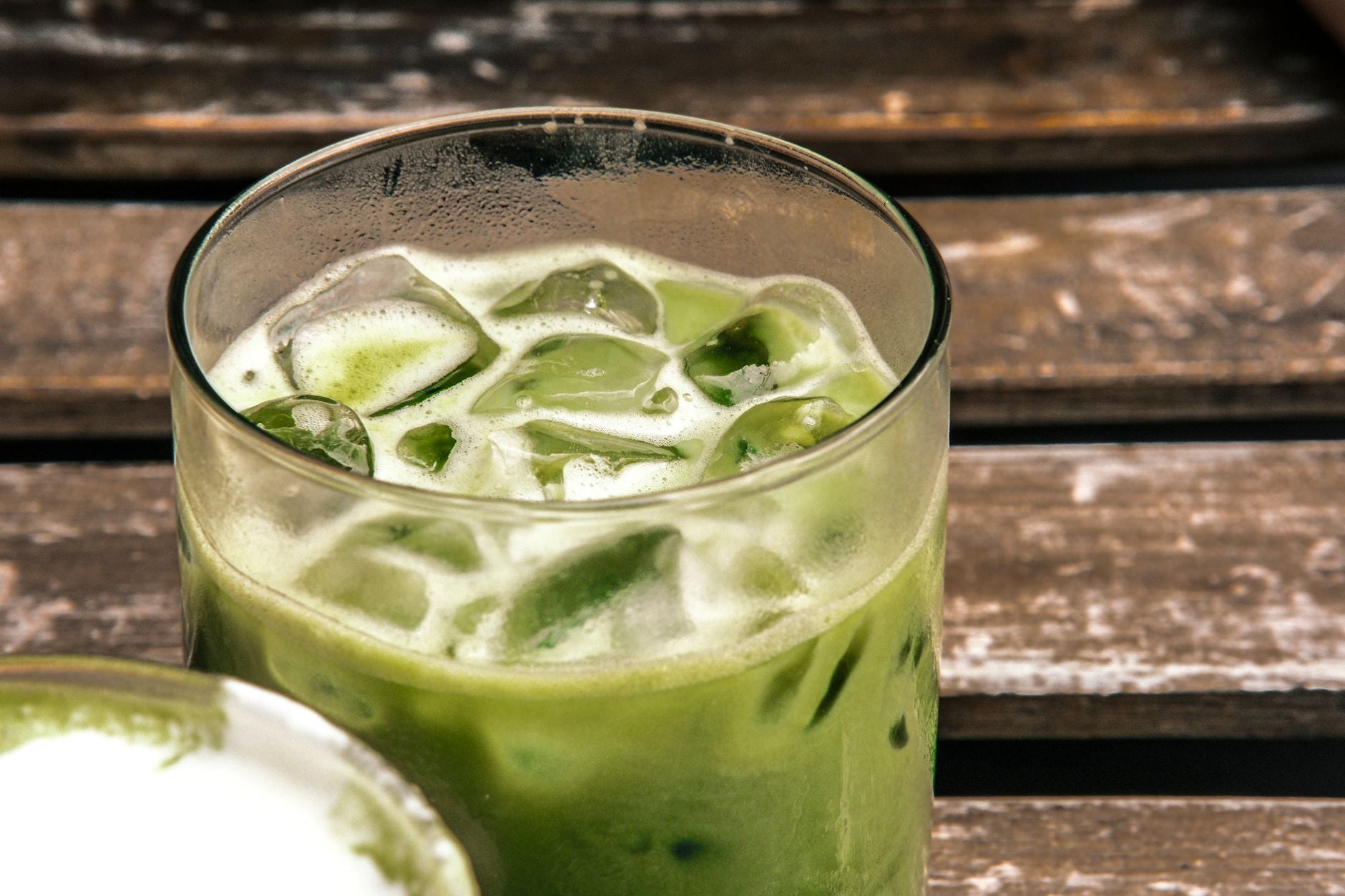
Matcha is made from tencha: the shade-grown, steamed, de-stemmed leaves of the tea plant Camellia sinensis, stone-ground into a fine green powder. There is no separate "matcha tree." It is the same evergreen plant that gives us sencha, oolong and black tea, grown under shade for the last weeks before harvest and finished in a very particular way. What you whisk into your bowl is the whole leaf, not an infusion left behind by one.
Updated September 2026 with the plant itself, what the powder is actually made of by weight, and fresh sources.
This page is the botany and process story: what the raw material is and how it becomes powder. Which regions and gardens grow it is a separate thread, and we keep the two apart on purpose.
The short answer, in one breath
- The plant: Camellia sinensis var. sinensis, the small-leaf tea plant, an evergreen shrub kept at about waist height.
- The leaf: tencha, meaning shade-grown leaves that are steamed, dried, and de-stemmed but never rolled.
- The transformation: tencha ground on a granite stone mill into a powder fine enough to suspend in water.
- The ingredient list: one item. Pure matcha is only ground tea leaf, nothing added.
- The difference from other tea: you drink the entire leaf, not a steeped-and-discarded infusion.
Is matcha a tree? What the tea plant really looks like
Not quite, and this is the question people ask most. Camellia sinensis is a woody evergreen that grows as a shrub or small tree, typically 1 to 5 meters tall, and left alone in the wild it can reach as high as 20 meters. On a tea farm it never gets the chance. Growers trim it to about 1 meter with a flat top, which is why a tea field looks like long, rounded green hedges rather than an orchard.
That pruning is practical: a low, flat table keeps the tender new shoots within reach and pushes the plant to put its energy into young leaves, the only part worth turning into matcha. So if you picture a "matcha tree," picture instead a clipped hedge of the ordinary tea plant, and a canopy of shade cloth stretched above it in spring.
Two main varieties exist. The small-leaf Chinese type, var. sinensis, is what Japan grows for green tea and matcha. The large-leaf Assam type, var. assamica, goes mostly into black tea. Within the small-leaf type, Japanese growers select named cultivars bred for shading and umami, such as Samidori, Okumidori and Asahi. Our guide to Japanese tea cultivars explains how much the cultivar actually changes the bowl.
It starts with one plant: Camellia sinensis
Every true tea comes from this single species. Matcha shares its botanical roots with sencha and gyokuro. There is no unique matcha species. What sets matcha apart is not the plant but everything that happens to the leaf before and after it is picked.
So when people ask what matcha comes from, the honest answer is: the tea plant you already know, grown and finished with unusual care. The craft lives in the method, not in some rare botanical secret.
Shading: the step that changes everything
A few weeks before harvest, growers cover the plants to block most sunlight. Japan's food labeling standard requires tea bound for matcha to be shaded for two to three weeks before picking, and many tencha gardens go longer, often about four weeks, using reed screens, straw mats, or cloth stretched over frames.
Starved of full sun, the plant slows down and shifts its chemistry. It holds onto more chlorophyll, which deepens the leaf to a vivid green, and it keeps more of the amino acid theanine instead of converting it into bitter-tasting catechins. That is why good matcha tastes savory and smooth rather than sharp. For how farmers build the shade and how long other teas sit under it, see our piece on kabusecha, the lightly shaded cousin.
Steaming and drying: locking the green in
Once picked, the leaves have to be stabilized fast, before they oxidize and turn brown. Japanese green tea does this with steam rather than the pan-firing used for many Chinese teas. The leaves are steamed at around 100 degrees Celsius for roughly 10 to 15 seconds, just long enough to halt oxidation and set the color.
Then they are dried. In a tencha dryer, the air runs hot, roughly 170 to 200 degrees Celsius, while the leaf itself stays near 70 degrees. Crucially, the leaves are dried flat and never rolled. Sencha and gyokuro get rolled into needles; matcha leaves are left open and brittle so they can later shatter cleanly into powder. That single choice, no rolling, is what makes the final grind possible.
De-stemming and de-veining: this is where tencha is born
The dried, flat leaf is not yet finished tencha. Stems and larger veins are separated out, keeping only the soft leaf flesh. What remains, thin flat flakes of shaded green leaf, is tencha, the only raw material matcha is made from. The Japan Matcha Association puts it simply: matcha is powdered tencha.
Removing stems and veins matters for taste and texture. Veins carry bitterness and a coarser fiber that would grind unevenly. Take them out and you are left with the tender part of the leaf, which mills into a smoother, sweeter powder. Our deep dive on what tencha is covers how much of it Japan makes and why it, not matcha, is the real bottleneck.
Stone grinding: from leaf to powder
The final step turns tencha into matcha. The flakes are fed into a granite stone mill, two grooved stones turning slowly against each other. The pace is deliberately gentle. A traditional stone mill produces only about 40 grams of matcha in an hour, roughly one small tin.
The slowness is the whole point. Grind too fast and friction heats the powder, scorching the fresh aroma and dulling the color. Turn slowly and the granite shaves the leaf into particles commonly cited at around 5 to 10 microns. That fineness is why matcha stays suspended in water and feels like silk instead of settling like sand. We compare the stone, ball and jet mills side by side in stone-ground vs machine-ground matcha.
What is matcha powder made of, by weight?
Because you eat the whole leaf, the powder carries the leaf's full makeup, not just what dissolves in hot water. Two independent measurements give a clear picture of what is in the tin.
Japan's official Standard Tables of Food Composition list 100 grams of matcha as containing 38.5 grams of dietary fiber, 28.1 milligrams of vitamin E and 29,000 micrograms of beta-carotene equivalent, as summarized by the Japan External Trade Organization. A 2024 laboratory analysis in the journal Foods, testing organic matcha from Uji in Kyoto, measured about 17 grams of protein, 7 grams of fat and 56 grams of total dietary fiber per 100 grams, nearly all of it insoluble.
| Component (per 100 g powder) | Measured value | Source |
|---|---|---|
| Dietary fiber | 38.5 g | Standard Tables of Food Composition in Japan (via JETRO) |
| Vitamin E (alpha-tocopherol) | 28.1 mg | Standard Tables of Food Composition in Japan (via JETRO) |
| Beta-carotene equivalent | 29,000 µg | Standard Tables of Food Composition in Japan (via JETRO) |
| Protein | 17.3 g | Kika et al., Foods 2024 |
| Fat | 7.3 g | Kika et al., Foods 2024 |
| Total dietary fiber (insoluble / soluble) | 56.1 g (52.8 / 3.3) | Kika et al., Foods 2024 |
Two honest caveats. The fiber figures differ because the samples and methods differ: one is a national reference value, the other a test of three packages of second and third harvest matcha. And no one eats 100 grams: a typical bowl uses about 2 grams, so these are proportions, not a daily dose. Caffeine is left out of the table on purpose, because published values vary widely by grade and harvest. Our note on how much caffeine matcha has goes deeper.
What matcha is not made of
Matcha is not grass, not a separate herb, and not a blend of green tea with something else. Pure matcha has a one-line ingredient list: ground green tea leaf. If the label on a matcha latte mix lists sugar, milk powder or flavorings, you are buying a drink mix that contains some matcha, which is a different product. Flavored matcha, like our strawberry ceremonial matcha, names its added ingredient openly for the same reason.
From bush to bowl, stage by stage
| Stage | What happens | Why it matters |
|---|---|---|
| Shading | Plants covered 2 to 4 weeks before harvest | Keeps theanine and chlorophyll high, deepens color and sweetness |
| Harvest | Tender young leaves picked from the shaded bush | Only the softest leaf becomes quality matcha |
| Steaming | Steamed ~10 to 15 seconds near 100 degrees C | Stops oxidation, locks in the green |
| Drying | Dried flat, never rolled | Leaves stay open and brittle for grinding |
| De-stemming | Stems and veins removed, leaving tencha | Cuts bitterness and coarse fiber |
| Stone grinding | Milled on granite, ~40 g per hour | Produces ultra-fine, aromatic powder |
How matcha is made, step by step
- Shade the plants. Cover the tea bushes for two to four weeks before harvest to block sunlight and keep theanine high.
- Harvest the leaves. Pick the tender young leaves from the shaded plants.
- Steam. Steam the leaves for about 10 to 15 seconds near 100 degrees Celsius to stop oxidation.
- Dry flat. Dry the leaves without rolling so they stay open and brittle.
- De-stem and de-vein. Remove stems and large veins, leaving clean leaf flesh known as tencha.
- Stone grind. Mill the tencha slowly on a granite stone mill into a fine green powder, about 40 grams per hour.
How matcha differs from the tea you steep
With sencha or a teabag, you pour hot water over leaves, drink the infusion, and throw the leaves away. Matcha skips the throwing-away. Because the leaf is ground into powder and whisked into water, you take in the whole leaf, including the fiber and fat-soluble compounds like beta-carotene and vitamin E that stay behind in spent tea leaves. That is also why matcha carries a fuller body and a more concentrated character than steeped green tea from the same plant.
It explains why sourcing and purity matter so much. When you consume the entire leaf, you also consume whatever the leaf absorbed while it grew. That is why we publish third-party lab results for lead and cadmium on our matcha, and why we filmed the gardens and people behind it in Japan rather than asking you to take our word for it. If you want to taste the difference, start with our organic ceremonial matcha, or read our guide to the best organic matcha powder for what to look for.
Frequently asked questions
What is matcha made from?
Matcha is made from tencha, the shade-grown leaves of the Camellia sinensis tea plant. The leaves are steamed, dried flat, stripped of stems and veins, then stone-ground into fine powder.
Is matcha a tree?
No. There is no separate matcha tree. Matcha comes from Camellia sinensis, an evergreen shrub that can grow into a small tree in the wild but is trimmed to about 1 meter on tea farms. It is the same plant used for green, black, and oolong tea; the difference is the shading and processing.
What plant is matcha made from?
Matcha is made from the small-leaf tea plant, Camellia sinensis var. sinensis, usually from Japanese cultivars bred for shade growing, such as Samidori, Okumidori and Asahi.
What is tencha?
Tencha is the raw material for matcha: shade-grown tea leaves that are steamed, dried without rolling, and cleared of stems and veins. Grinding tencha on a stone mill is what produces matcha.
What is in matcha powder?
Pure matcha is only ground tea leaf. By weight it is mostly dietary fiber, with a meaningful share of protein, some fat, chlorophyll, catechins, theanine and caffeine. Japan's food composition tables list 38.5 g of fiber and 29,000 µg of beta-carotene equivalent per 100 g.
Is matcha made of grass?
No. Matcha is made only from the leaves of the tea plant. Its bright green color comes from the extra chlorophyll that builds up while the plants are shaded, not from grass or added coloring.
Why is matcha ground on a stone mill?
Granite stone mills grind slowly enough to keep the powder cool, which protects color and aroma, and fine enough to reach just a few microns. A traditional mill makes only about 40 grams per hour, which is part of why quality matcha is costly.
Is matcha a whole-leaf tea?
Yes. Unlike steeped tea, where you discard the leaves, matcha is the whole leaf ground into powder and whisked into water, so you consume the entire leaf.
Where does matcha come from?
Matcha originates from shaded tea gardens, with Japan as its traditional home. Region and terroir shape flavor, which we cover separately. You can also explore our organic matcha collection to taste the difference.
Sources
- Japan External Trade Organization (JETRO), "Matcha," Highlighted Japanese Ingredients, citing the Standard Tables of Food Composition in Japan, 2015 (Seventh Revised Edition): 38.5 g dietary fiber, 28.1 mg vitamin E, 29,000 µg beta-carotene equivalent per 100 g. jetro.go.jp
- Kika J. et al., "Matcha Green Tea: Chemical Composition, Phenolic Acids, Caffeine and Fatty Acid Profile," Foods 13(8):1167, 2024: protein, fat and fiber of organic Uji matcha. pmc.ncbi.nlm.nih.gov
- Wikipedia, "Camellia sinensis": typical height 1 to 5 m, up to 20 m in the wild, trimmed to about 1 m in plantations; var. sinensis and var. assamica. en.wikipedia.org
- Wikipedia, "Matcha": 2 to 3 week shading under the Japanese labeling standard, steaming at ~100 degrees C for 10 to 15 seconds, drying temperatures, theanine and chlorophyll under shade. en.wikipedia.org
- Global Japanese Tea Association, "Tencha, the Hidden Treasure": tencha shaded often about 4 weeks, not rolled, stems and veins separated. gjtea.org
- Japan Matcha Association, "What is Matcha": matcha is powdered tencha, steamed, dried without rubbing and ground with a millstone. matcha.or.jp
- Nakamura Tokichi Honten, "Stone-Milled vs. Machine-Milled: Two Ways to Make Matcha": a stone mill produces about 40 grams of matcha per hour. global.tokichi.jp
Share:
What Does Matcha Taste Like? Umami, Sweetness, and Why Quality Matters
Types of Japanese Tea: The Main Green Teas Explained