




From our tea room
Superior Sencha Green Tea - USDA Organic Japanese First Flush
First-flush loose leaf, USDA Organic, direct from Japanese family farms.
View Superior SenchaKabusecha is green tea grown under a cover for roughly the last week before it is picked, then made exactly like sencha. That is not a marketing description. It is close to the literal wording of Japan's industry labelling standard, which defines kabusecha as leaf "plucked from a tea garden covered for approximately 7 days before plucking with covering materials such as straw or kanreisha, and manufactured in the same manner as sencha" (Japan Tea Central Public Interest Incorporated Association, Green Tea Labelling Standard, retrieved August 23, 2026).
Gyokuro, by the same standard, is covered for around 20 days in a garden where sunlight is "almost completely blocked." Sencha is not covered at all. Kabusecha sits in the gap, and that gap is the whole product.
Here is the part that surprised me when I went to the primary sources for this piece. Almost every English-language explanation of kabusecha, including ones I had repeated myself, gets two of its central facts wrong.
Key Takeaways
- The official definition is "approximately 7 days," with no legal minimum. Japan's green tea labelling standard uses the word teido (程度), approximately. There is no floor, no ceiling and no required shading percentage a farmer must hit to print "kabusecha" on a bag.
- Direct-cover kabusecha is shaded at about 85 percent, not 50 to 70 percent. The MAFF-funded production manual specifies black kanreisha "with a shading rate of around 85%" for direct cover, and gives no figure for the shelf cover used on higher grades. The 50 to 70 percent figure repeated across English tea writing is not supported by any Japanese authority source we could find.
- EGCG does not fall under shade. Total catechins fall and EGC falls. EGCG is listed as unchanged. The widespread claim that shading lowers EGCG is simply wrong.
- Mie grows most of it. 1,138 tonnes in the 2024 crop, about 59 percent of the 1,928 tonne surveyed main-prefecture total, centred on Suzuka, Yokkaichi and Kameyama.
- We could not find kabusecha brewing numbers from any Japanese authority. Treat any precise figure you see, ours included, as a starting point between sencha and gyokuro rather than a standard.

What Is Kabusecha? The Short Answer
Kabusecha (かぶせ茶) means "covered tea." A farmer lays shade cloth over the rows for the final stretch of the growing season, pulls it off, picks the leaf, and then steams, rolls and dries it the same way sencha is made. The processing is identical to sencha. Only the light changed.
What that does to the cup is consistent and well documented. Japan's covered tea production manual puts the mechanism plainly: shading "suppresses the decrease in amino acids and the increase in catechins that accompany growth," so the finished tea has "more umami and less astringency than open-field cultivation" (Covered Tea Stable Production Manual, MAFF-funded research consortium via NARO, 2018, retrieved August 23, 2026).
The other tell is colour. Brew it beside a sencha and the difference is immediate: the manual notes that the liquor "becomes a vivid green, as against the yellow of sencha." If you already know our guide to sencha and our guide to gyokuro, kabusecha is the tea that answers what happens between them.
How Long Is Kabusecha Shaded, and Is There a Legal Minimum?
Approximately seven days by the labelling standard, seven to fourteen days as recommended to growers, and no minimum written into the standard at all.
That last point deserves more attention than it gets. The document that defines kabusecha is the Green Tea Labelling Standard, a voluntary unified industry standard published by the Japan Tea Central Public Interest Incorporated Association. It is not a JAS standard and it sets no minimum shading period of its own. The name itself is a mandatory label item under the Food Labelling Act, and enforcement runs through a labelling committee that refers suspected misuse to the Consumer Affairs Agency and MAFF (Green Tea Labelling Standard, Article 6). The definition itself says 7日程度, "approximately 7 days." No minimum. No shading percentage.
So "kabusecha" is an industry definition rather than a JAS designation, and the length of the cover is left to the grower. A seven-day cover and a fourteen-day cover can carry the same word on the bag and taste noticeably different. That is worth knowing before you pay a premium for one.
Field practice is more specific than the label. The production manual specifies "approximately 7 to 14 days before harvest," and breaks it down by flush: "for the first flush, covering is carried out for about 10 to 15 days from the 2.5 to 3 leaf-opening stage; for the second flush, about 7 to 10 days."
| Tea | Days covered | Source of the figure |
|---|---|---|
| Sencha | 0 | Defined by processing only, no covering in the definition |
| Kabusecha | ~7 (standard), 7 to 14 (practice), 10 to 15 first flush | Labelling Standard; Covered Tea Production Manual |
| Tencha (matcha leaf) | ~14 to 21 | Labelling Standard, note to the matcha entry, "about 2 to 3 weeks" |
| Gyokuro | ~20, up to 30 | Labelling Standard; manual gives 20 to 30 for gyokuro and tencha |
Notice that tencha and gyokuro overlap heavily, and that kabusecha's upper end brushes tencha's lower end. These are not sealed categories. They are points on one continuous dial, and the dial is time under cover.
How Japanese Farmers Actually Build the Shade

There are two ways to put a tea field in the dark, and the choice is mostly about money.
Direct cover (直がけ, jikagake) means laying the cloth straight onto the hedge rows. Shelf cover (棚がけ, tanagake) means building a frame about two metres high over the bushes and covering that, which leaves the shoots growing in open air underneath. For kabusecha the manual is direct: "direct-cover shading is mainly used, but for higher grades, shelf-cover and tunnel-cover are used."
Gyokuro and high-grade tencha are the shelf teas. Traditionally that meant honzu covering, built from yoshizu reed screens and rice straw, or komo straw matting, over naturally trained bushes. Black synthetic fibre is now common, but as the manual notes, "this shelf-type covering carries high shelf installation costs." Direct cover exists because shelves are expensive.
We publish the underlying cost data: what Japanese green tea actually costs at origin.
The material itself is usually kanreisha (寒冷紗), a woven shade cloth. The official standard names straw alongside kanreisha, phrased as "covering materials such as" rather than as a closed list.
One statistic reframed this whole subject for me. On MAFF's interview-based figures, covering accounts for 18 percent of field-management labour hours in Japanese tea, and MAFF names it as a job that resists mechanisation because of "technical problems such as fixing the materials," to the point that it is "a bottleneck to increasing cultivated area per household" (MAFF, Current Status and Issues in the Tea Industry and Tea Culture, November 2024, retrieved August 23, 2026). Shade is not a passive step. It is close to a fifth of the work in the field, done by hand, on a deadline set by the weather.
What Shading Actually Does to the Leaf

It starves the plant of light, carbohydrate production falls, and the plant accumulates amino acids.
The research manual describes the mechanism as carbon limitation. Under cover, "carbohydrate production decreases and shoot and plant growth are suppressed," and because "the supply of carbon source is insufficient," the plant's amino acid pathways shift so that "amino acids containing nitrogen atoms in their molecules, particularly arginine, asparagine and glutamine, accumulate." That accumulation is named as "one factor in the increase of umami components."
Here is the manual's own summary of what moves. It reports direction of change rather than measured values:
| Component | Under shade | What you taste or see |
|---|---|---|
| Free amino acids | Increase | Umami, savoury depth |
| Theanine | Increases | Sweetness, roundness |
| Total catechins | Decrease | Less astringent grip |
| EGCG | Does not change | Commonly misreported as falling |
| EGC | Decreases | This is the catechin doing the work |
| Caffeine | Increases | Bitterness alongside the sweetness |
| Chlorophyll | Increases | The deep green colour |
| Dimethyl sulfide | Increases | Ooika, the "cover aroma" |
Two corrections worth stating plainly, because we have seen both errors in print and one of them in our own older notes.
First, the shading percentage. English tea writing very consistently says kabusecha is shaded at 50 to 70 percent and gyokuro at 90 percent or more. The Japanese production manual says kabusecha uses "black kanreisha with a shading rate of around 85%." Direct-cover tencha also uses 85 percent. In modern direct-cover practice the shading rate is not what separates kabusecha from tencha at all. Duration is. Meanwhile the official standard gives gyokuro no percentage whatsoever, only the phrase "almost completely blocked."
Second, EGCG. The claim that shading reduces EGCG is widely repeated, and the primary source lists EGCG as 変化しない, "does not change." What falls is EGC, a different catechin that is naturally low in young shoots and rises as they mature. Shading suppresses that rise. Total catechins fall as a result. That is not proof the opposite is true, but it does mean the claim is far less settled than the confidence around it suggests.
The aroma has a name, too. Ooika (覆い香) literally means "cover aroma," and the manual identifies its chemical carrier as dimethyl sulfide and its character as resembling aonori, green laver seaweed. The distinction the manual draws is precise: lightly covered sencha is aiming only at better leaf colour, while for kabusecha "clear deep-green colouring together with ooika is sought." Colour alone does not make it kabusecha. The aroma has to arrive.
The leaf even changes shape. Under cover it becomes thinner, broader, rounder and deeper green. There is a limit, though: push shading to nearly 100 percent, as producers of shirobacha white-leaf tea do by triple-layering cloth, and chlorophyll falls again and the leaf turns pale.
Where Does Kabusecha Actually Come From?

Mie Prefecture, overwhelmingly. Mie's own agriculture department states that the prefecture "ranks first nationally in kabusecha production volume, occupying a high weight of approximately 59% of the national share," The figure is 1,138 tonnes in the 2024 crop. Read the denominator carefully, because the prefecture is quoting its share of the surveyed main-producing-prefecture total of 1,928 tonnes, not of every leaf of kabusecha grown in Japan (Mie Prefectural Government, Department of Agriculture, Forestry and Fisheries, retrieved August 23, 2026).
Within Mie, the heartland is the northern Hokusei region, "centred on Suzuka City, Yokkaichi City and Kameyama City." Mie is also Japan's third-largest tea prefecture overall at 5,020 tonnes, behind Kagoshima and Shizuoka, which we mapped alongside every other producing region in our Japan tea production map.
A caveat on all kabusecha statistics, and this is why the numbers are hard to find. MAFF's headline tea-type statistics do not break out kabusecha. The ministry's production breakdown charts sencha and tencha and files gyokuro and bancha under "other," with no kabusecha line. The ministry does discuss kabusecha elsewhere, just not in those numbers. Every national share figure for kabusecha therefore comes from prefectural government or producer federations, not from the ministry's headline statistics. If you see a confident nationwide kabusecha number with no prefecture attached to it, be suspicious. You will also see 63 percent quoted for Mie. Mie itself publishes 59 for the 2024 crop, and figures from different crop years against a shifting survey list will not agree.
Cultivar is a similar story. Yabukita is the reference cultivar the manual uses for its kabusecha quality target, a SPAD leaf-colour reading of about 50. For tencha, "production is possible with any cultivar, but Samidori, Okumidori and Yabukita are frequently used." Note Samidori (さみどり), which is a different cultivar from Saemidori (さえみどり), a pair that English sources conflate constantly. We wrote up the full family in our guide to Japanese tea cultivars.
How Do You Brew Kabusecha?

Cooler and shorter than sencha, hotter and shorter than gyokuro. And we are going to be honest about how firm that guidance actually is.
We went looking for kabusecha brewing parameters published by a Japanese producer body, prefectural government or tea association, and did not find any. The brewing guides we checked step straight from sencha to gyokuro with no kabusecha entry in between. That may simply reflect where we looked, and we would genuinely like to be corrected, but we are not going to dress up a number we cannot source.
So the table below is explicitly our own house practice, not a cited standard. The sencha and gyokuro rows are the conventional reference points every Japanese brewing guide converges on. The kabusecha row is where we land between them:
| Tea | Water | Leaf | Volume | Time |
|---|---|---|---|---|
| Upper-grade sencha (conventional) | 80°C / 176°F | 4 g | 200 ml | 30 sec |
| Kabusecha (our practice) | 60 to 70°C / 140 to 158°F | 4 to 5 g | 150 ml | 60 to 90 sec |
| Gyokuro (conventional) | 50°C / 122°F | 6 g | 100 ml | 120 sec |
Treat every row as a starting point rather than a rule, and the middle one as ours rather than Japan's.
The logic behind cooler water is the same logic that produced the tea. Amino acids dissolve readily at low temperatures, catechins need heat. A tea grown specifically to carry more amino acids and fewer catechins deserves water cool enough to take the first and leave the second. Boiling water on a kabusecha wastes the entire growing season. Start at 65°C, taste, and adjust from there.
Kabusecha vs Sencha vs Gyokuro: Which Should You Drink?

| Sencha | Kabusecha | Gyokuro | |
|---|---|---|---|
| Days covered | None | About 7 to 14 | About 20 to 30 |
| Liquor colour | Yellow | Vivid green | Deep green |
| Character | Brisk, grassy, refreshing | Sweet and round, gentle grip | Dense, savoury, low astringency |
| Ooika aroma | No | Yes, required | Yes, pronounced |
| Forgiving to brew | Yes | Fairly | No |
- Drink sencha when you want brightness and a tea that survives slightly careless water. It is the everyday standard for good reason.
- Drink kabusecha when sencha feels a little sharp but gyokuro feels like a ceremony you do not have time for. It is the weekday version of a special tea.
- Drink gyokuro when the brewing itself is the point and you have twenty unhurried minutes.
If you are still deciding between the two ends rather than the middle, we compared them directly in sencha vs gyokuro, and the shorter definitions for every term on this page live in our matcha lexicon.
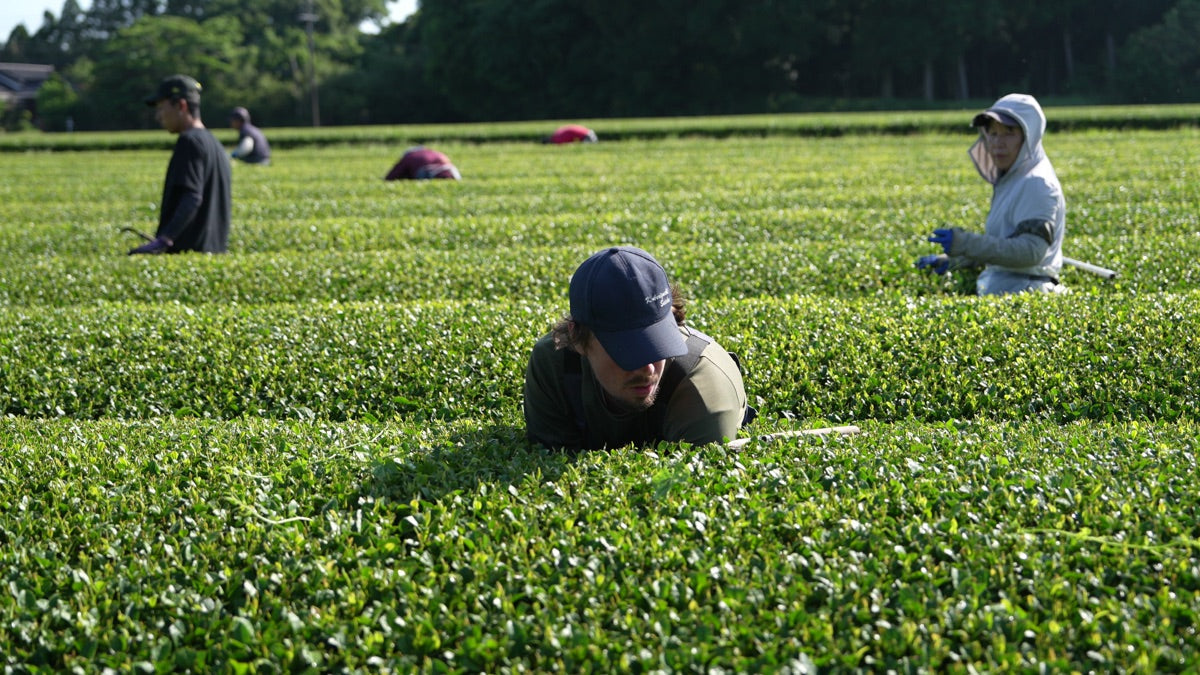
I have stood in fields in Yame in Fukuoka where the shading frames run up the terraces like scaffolding, standing empty most of the year and waiting for the two or three weeks when they matter. Seeing them changed how I read the word "shaded" on a label. It is not an adjective. It is a structure somebody built, cloth somebody hauled out and pinned down by hand, and a decision about exactly which day to pull it off. The 18 percent labour figure is abstract until you have watched it.
An honest note on what we sell. We do not currently stock a kabusecha. Our loose leaf line is first-flush organic sencha, genmaicha and kukicha, and our shaded work goes into matcha rather than steeped leaf. If you are coming to this page looking to buy kabusecha specifically, buy it from a Mie producer. If you want the shaded character in a bowl instead of a cup, that is what our matcha is, and the same agronomy on this page is what makes it taste the way it does. Buying for a cafe or studio? Our wholesale program documents the sourcing.
Frequently asked questions
Is kabusecha the same as gyokuro?
No. Both are shaded and both are processed like sencha, but the cover comes off much sooner for kabusecha. Japan's labelling standard says approximately 7 days for kabusecha and approximately 20 days for gyokuro, and gyokuro is grown in a garden where sunlight is almost completely blocked. Kabusecha is lighter, greener and considerably easier to brew.
How many days is kabusecha shaded?
Approximately 7 days according to Japan's Green Tea Labelling Standard, and 7 to 14 days as recommended in Japan's covered tea production manual, extending to 10 to 15 days for the first flush. There is no legal minimum, so the number varies by producer.
Is there an official standard for kabusecha?
There is a definition but not a law. The Japan Tea Central Public Interest Incorporated Association publishes the Green Tea Labelling Standard, a voluntary industry standard defining kabusecha as leaf covered for approximately 7 days before plucking. It is not a JAS standard and it specifies no minimum shading days or shading percentage. The name is a mandatory label item under the Food Labelling Act, but the standard itself leaves the length of the cover to the grower.
What percentage of light does kabusecha shading block?
Around 85 percent for direct-cover kabusecha, which is the mainstream method. Japan's covered tea production manual specifies black kanreisha cloth "with a shading rate of around 85%" and gives no figure for the shelf cover used on higher grades. The 50 to 70 percent figure often cited in English sources does not appear in any Japanese authority source we could locate.
Does shading reduce EGCG in green tea?
Not according to Japan's own covered-tea production manual, which lists EGCG as unchanged under shading and reports direction of change only. Total catechins decrease and EGC specifically decreases, because EGC normally rises as a shoot matures and shading suppresses that rise.
Where is kabusecha grown in Japan?
Mainly Mie Prefecture, which produced 1,138 tonnes in the 2024 crop, about 59 percent of the 1,928 tonne main-producing-prefecture total that Japan surveys. The main districts are Suzuka, Yokkaichi and Kameyama in the northern Hokusei region. Nara is second at 230 tonnes, then Shizuoka at 182 and Fukuoka at 145.
What temperature should I brew kabusecha at?
We brew it between 60 and 70°C, 140 to 158°F. We could not find an official figure for kabusecha from any Japanese producer body or tea association, so treat that as our house practice sitting between the conventional 80°C for upper-grade sencha and 50°C for gyokuro. Cooler water favours the amino acids the shading was grown to produce.
Sources
- Japan Tea Central Public Interest Incorporated Association, Green Tea Labelling Standard, Appendix Table 1: Names and Definitions. Official definitions of kabusecha, gyokuro and sencha in Table 1, tencha via the note to the matcha entry, covering periods and named covering materials. Retrieved August 23, 2026.
- Japan Tea Central Public Interest Incorporated Association, Green Tea Labelling Standard. Purpose of the standard and the enforcement mechanism via the Labelling Appropriateness Promotion Committee. Retrieved August 23, 2026.
- Covered Tea Stable Production Manual, MAFF-funded research consortium 27015C, March 2018, via NARO. Shading durations by flush, 85% shading rate, direct-cover versus shelf-cover, component changes including EGCG unchanged, carbon-limitation mechanism, ooika and dimethyl sulfide, leaf morphology, cultivar notes, history of covered cultivation. Retrieved August 23, 2026.
- MAFF, Current Status and Issues Relating to the Tea Industry and Tea Culture, November 2024. Covering as 18% of field-management labour and a mechanisation bottleneck; absence of kabusecha from national tea-type statistics; tencha production and export figures. Retrieved August 23, 2026.
- Mie Prefectural Government, Department of Agriculture, Forestry and Fisheries, "Promotion of Ise-cha". Mie kabusecha 1,138 t against a surveyed main-prefecture total of 1,928 t (approximately 59%), 2024 crop; Nara 230 t, Shizuoka 182 t, Fukuoka 145 t, Kyoto 102 t; Hokusei production districts. Retrieved August 23, 2026.
- One with Tea, Japan Tea Production Map. Prefecture-level production data. First-party compilation.
Share:
Single-Origin vs Blended Matcha: What Gogumi Actually Is
What Is Tencha? The Leaf Japan Grows to Be Ground