



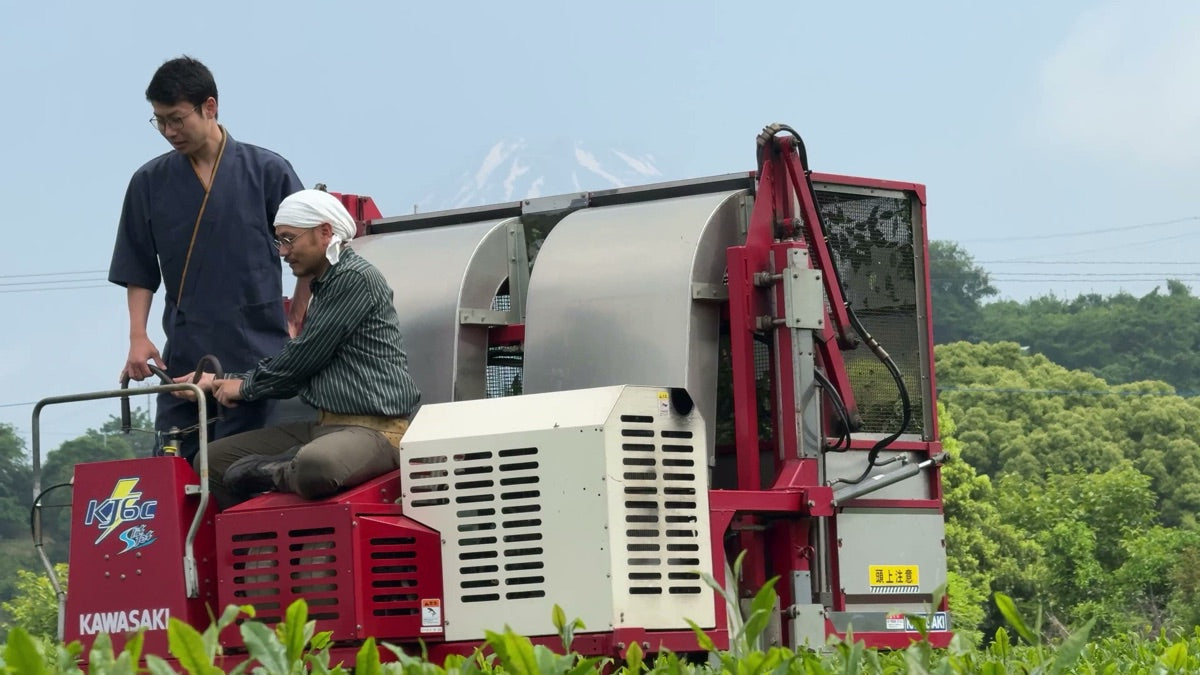
Neither one is better. They are two different products of two different crafts. A single-origin matcha is a snapshot: one farm, one season, whatever that spring actually gave. A blend is a recipe: several lots composed by a tea master so the bowl tastes the same in March and in November. Japanese tea has a name for that composing work, gogumi (合組), and it has been a respected profession in Uji for centuries. The marketing story that blending is where quality goes to hide is simply not how the Japanese tea trade works.
The question worth asking is not which side wins. It is whether the label in your hand tells you enough to know which one you are holding. When I pulled the data on the 84 best-selling matcha powders on Amazon US, 15 of them did not name a country at all.
Key Takeaways
- Gogumi (合組) is a named craft, not a cost-cutting trick. It is the second stage of Japanese tea manufacture, performed mostly by the wholesaler after the farmer's primary processing.
- Blending is graded like a martial art. Tea master Fumio Maeda holds judan, tenth dan, a rank created for him after the 1997 National Tea Technology Competition.
- An Uji house says a blend can beat any single lot. Kyo Hayashiya builds a four-part matcha because "it is rare to find a single-origin matcha that possesses all three qualities" of aroma, taste and color.
- Single-origin buys traceability and costs you consistency. One field in a difficult spring gives you a difficult spring.
- The real red flag is a missing origin. In our July 2026 index of 84 top-selling Amazon matcha powders, 18% state no country of origin anywhere in the listing.

Single-Origin vs Blended Matcha: The Short Answer
Single-origin matcha is tea traceable to one farm or one region, tied to named growers and lab data, as we define it in our matcha lexicon. Blended matcha is several lots of tencha combined on purpose by a blender who is chasing a specific flavor target.
Here is the cleanest way to tell them apart in practice. Single-origin is defined by what it refuses to do. As the Japanese tea educators at LILIKU put it, single-origin is simply green tea "that doesn't go through the gogumi process" (LILIKU Tea, retrieved August 22, 2026). Everything else about it, the cultivar, the shading, the mill, follows from the field it came from.
A blend is defined by what it adds: a decision. Somebody tasted a table of lots and chose the proportions.
Both are honest products. They answer different questions. Do you want to taste this specific place in this specific year, or do you want the same bowl every time you order it?
What is gogumi, the Japanese art of blending tea?

Gogumi (合組) is the blending stage of Japanese tea manufacture. It sits after the farmer's work, not instead of it. Farmers handle primary processing, turning fresh leaf into aracha. Gogumi is the secondary process, and it is mostly performed by a tea wholesaler rather than by the grower (LILIKU Tea).
The reason it exists is agricultural, not commercial. Tea is a crop. Weather, temperature and harvest timing move every single year, so the same field does not deliver the same leaf twice. Blending high and low grades, young and aged lots, was how Japanese houses produced "a perfectly balanced, constant taste and aroma" across seasons that were never constant.
What the blender is balancing is specific. Combining leaves of different character lets the aroma, sweetness, bitterness and astringency settle against each other, "bringing out a deeper flavor," in the words of the trade (NIHONMONO, retrieved August 22, 2026).
And this is a certified skill. Fumio Maeda, a Shizuoka tea master, blends by his ability to differentiate aroma. He holds judan, tenth dan, a rank that did not exist until it was created for him after his performance at the 1997 National Tea Technology Competition (NIHONMONO). Japanese tea grades its blenders the way judo grades its fighters. That is not the infrastructure you build around a way of hiding bad tea.
Uji's entire reputation rests on this, and the region says so itself. The official Uji-cha cultural landscape project puts it plainly: "Uji-chashi who produce and sell Uji-cha tea created a blend called Gogumi." Those blenders made "many creations like blending tea for tea ceremony masters in Kyoto." And the purpose was never disguise. Their techniques "were developed in order to keep its various flavor and quality consistent" (Uji-cha Cultural Landscape, retrieved August 22, 2026).
We track the production side: which Japanese prefectures actually grow the tea.
The trade was tightly controlled, too. Under the Tokugawa Shogunate, only licensed tea businesses known as cha-nakama could produce, and they became purveyors to the Shogun and the feudal lord families (Kyoto Prefectural Tea Chamber of Commerce and Industry, retrieved August 22, 2026).
Matcha itself became possible in Uji because of shaded cultivation, ōishita saibai, which "led to the birth of modern-day matcha" after developing there in the fifteenth or sixteenth century (Uji tea, Wikipedia, retrieved August 22, 2026). So the finest matcha region in Japan built its name on shading and on blending, in that order. The instinct that purity must beat blending has the history backwards.
Why would a tea master blend a great matcha at all?

Because the qualities you want in a bowl rarely arrive together in one lot.
Kyo Hayashiya, an Uji producer, publishes how their tea master Hideki Kuwabara builds a matcha, and it is a four-part blend. Aroma comes from Kohata leaves. Umami and taste come from Tanabe. Color comes from Hama tea. A fourth component is chosen to hold the price where it needs to be. Their stated reason is blunt: "The quality of matcha is determined by its aroma, taste, and color. It is rare to find a single-origin matcha that possesses all three qualities" (Kyo Hayashiya, retrieved August 22, 2026).
Read that carefully, because it inverts the usual sales pitch. The Uji house is not saying single-origin is bad. It is saying single-origin matcha that hits all three marks at once exists and is expensive, and that a skilled blend is how you reach that standard at a price a person will actually pay. The blend is the value engineering. The single-origin is the luxury of not compromising.
None of this changes what happens upstream. The leaf still has to be shade-grown, steamed, destemmed into tencha, and stone-milled at roughly 40 grams per hour on a 30 cm granite wheel (Global Japanese Tea Association, retrieved August 22, 2026). Blending cannot rescue leaf that was never any good. It composes leaf that already is.
What single-origin matcha actually gives you, and what it costs you

Single-origin gives you three real things: traceability to one farm or region, a named grower you can look up, and lab data that belongs to that specific lot rather than to an average.
It also gives you the year. This is the part people love and the part that surprises them. Terroir is not a decoration on a label. Soil, altitude, weather and the shading regime of one particular hillside show up in the cup. A Yame lot and a Kirishima lot from the same spring taste like two different teas, and they should.
Here is the cost, stated plainly. A single field in a difficult spring gives you a difficult spring. There is no second lot to lean on. If a late frost or a hot, fast May pushes the leaf, the tea moves with it, and the bowl you loved last year is not the bowl you get this year. I have watched that happen on farms we buy from, and there is nothing anyone can do about it except tell you honestly.
A blend absorbs that. That is the entire point of it. If you run a cafe, a studio or a latte program, a matcha that shifts character mid-year is an operational problem, not a charming one. If you are buying for your own morning bowl and you want the season to speak, the shift is the reason you bought it.
Grade is a separate axis from all of this, and worth understanding on its own. We cover it in our honest guide to ceremonial grade matcha. Cultivar is a third axis again, covered in our guide to Japanese tea cultivars. Single-origin and blended is only one of the three questions on the label.
What 84 best-selling matcha listings reveal about origin claims

Before you can choose between single-origin and a blend, the label has to tell you where the tea is from. Often it does not.
For our Matcha Market Index I recorded every matcha powder in Amazon US's top 95 organic results for "matcha," 84 products in all, and logged what each listing claims. As of July 14, 2026:
Sixty-seven listings (80%) say Japan somewhere. Fifteen (18%) name no country at all. Two name a Chinese growing region without ever writing the word China. Not stating an origin breaks no rule and proves nothing on its own. It is a gap, and it means that for nearly one in five best-sellers, the single-origin question cannot even be reached.
Two more numbers from the same set. 52 of the 84 powders (62%) call themselves "ceremonial grade," a phrase with no legal, JAS, ISO or industry-body definition behind it. And the price runs from $0.01 to $3.18 per gram, a 315x spread, with a median of $0.39. When 62% of a shelf claims the same premium tier, the phrase has stopped sorting anything. If you want the longer version of why that price spread exists, we wrote about what actually drives matcha pricing.
For the market context behind this, see the customs record behind matcha pricing.
Which should you buy: single-origin or a blend?

Choose by what you need the tea to do.
| Single-origin | Blended (gogumi) | |
|---|---|---|
| What it is | One farm or region, one harvest | Several tencha lots composed by a blender |
| Who decides the flavor | The field and the season | The chashi, the tea master |
| Year to year | Varies, sometimes a lot | Held deliberately consistent |
| Traceability | Named grower, prefecture, often cultivar and harvest window | Usually the house, not the field |
| Best for | Home bowls, tasting the season, provenance-led buying | Cafes, studios, wholesale, latte programs |
| Main trade-off | No consistency safety net | The specific field is not yours to taste |
- Buy a blend when consistency is the requirement. Cafes, studios, wholesale accounts, latte programs, anyone serving the same drink to the same people for a year. You are paying a blender to hold a profile steady, and that is a real service worth paying for.
- Buy single-origin when you want the field and the year to show, and you accept that it will move. You are buying a specific place and a specific spring, with the grower's name attached.
- Walk away from neither of them. Walk away from the listing that will not name a country.
What has genuinely shifted is what buyers ask for. Provenance, cultivar names and harvest windows are now normal questions rather than specialist ones, which we tracked in our read on where the 2026 matcha market is actually heading.
For what it is worth, we buy both, and we say which is which. We source directly from named family farms across several prefectures: Mohei Honda in Fuji and Ichikawa-en on the Makinohara plateau in Shizuoka, Horiguchi Seicha in Shibushi, Kagoshima, and Kurihara Seicha in Yame, Fukuoka. I have stood at Ichikawa-en's blending bench and watched a row of cupping bowls get tasted down to a decision. It is careful, unglamorous, deeply skilled work, and it changed how I think about the word "blend."
Ready to taste the difference? Explore our single-origin Japanese matcha, sourced from named growers with the farm and prefecture on the tin. Buying for a cafe, studio or brand? Our wholesale program is built for buyers who already know which tier they need and want the sourcing documented.
Frequently asked questions
Is single-origin matcha better than blended matcha?
No. They are different products with different jobs. Single-origin gives you traceability and the character of one field in one year. A blend gives you a composed, repeatable flavor profile built by a trained blender. An Uji producer states outright that it is rare for a single-origin matcha to excel at aroma, taste and color all at once, which is exactly why blending exists.
What does gogumi mean?
Gogumi (合組) is the Japanese term for tea blending. It is the secondary stage of tea manufacture, performed mostly by wholesalers after farmers complete primary processing, and it combines lots of different character to balance aroma, sweetness, bitterness and astringency.
Does blending mean the matcha is lower quality?
No. Blending is a graded professional skill in Japan, to the point that tea master Fumio Maeda holds a tenth-dan rank created after the 1997 National Tea Technology Competition. Blending cannot improve poor leaf, it composes good leaf. Uji built its reputation on its blenders.
How can I tell if my matcha is single-origin?
A genuine single-origin will name the farm or the region, and usually the prefecture, cultivar and harvest window. If the packaging names no country at all, you cannot answer the question. In our July 2026 index of the 84 best-selling matcha powders on Amazon US, 18% named no country of origin anywhere in the listing.
Why does my single-origin matcha taste different this year?
Because it is one field in one season, and seasons vary. Weather, temperature and harvest timing all shift the leaf. That variation is the thing you bought. A blend is specifically engineered to smooth it out.
Sources
- NIHONMONO, "Making tea more delicious: Tea master, Fumio Maeda". Gogumi definition, blending purpose, judan rank, 1997 National Tea Technology Competition. Retrieved August 22, 2026.
- LILIKU Tea, "What is Single Origin Green Tea?". Gogumi as wholesaler-performed secondary processing; single-origin as tea that skips it. Retrieved August 22, 2026.
- Kyo Hayashiya, "The secret behind matcha blending". Four-part blend, Kohata / Tanabe / Hama components, the aroma-taste-color quote. Retrieved August 22, 2026.
- Uji-cha Cultural Landscape project, "Chronological Table of History and Development of Uji-cha tea". Uji-chashi originating the Gogumi blend; blending developed for consistency. Retrieved August 22, 2026.
- Kyoto Prefectural Tea Chamber of Commerce and Industry, "History and Culture of Uji Tea". Cha-nakama as licensed Tokugawa-era purveyors. Retrieved August 22, 2026.
- Uji tea, Wikipedia. Ōishita saibai shaded cultivation, 15th to 16th century. Retrieved August 22, 2026.
- Global Japanese Tea Association, "Matcha". Tencha to matcha definition and stone-mill grinding rate. Retrieved August 22, 2026.
- Ichikawa-en. Shizuoka producer, Makinohara plateau facility. Retrieved August 22, 2026.
- One with Tea Matcha Market Index, July 14, 2026 (n=84). Origin claims, grade claims, price per gram. First-party data.
Share:
Koicha vs Usucha: Thick and Thin Matcha, and When Each Is Used
What Is Kabusecha? The Shade Tea Between Sencha and Gyokuro