



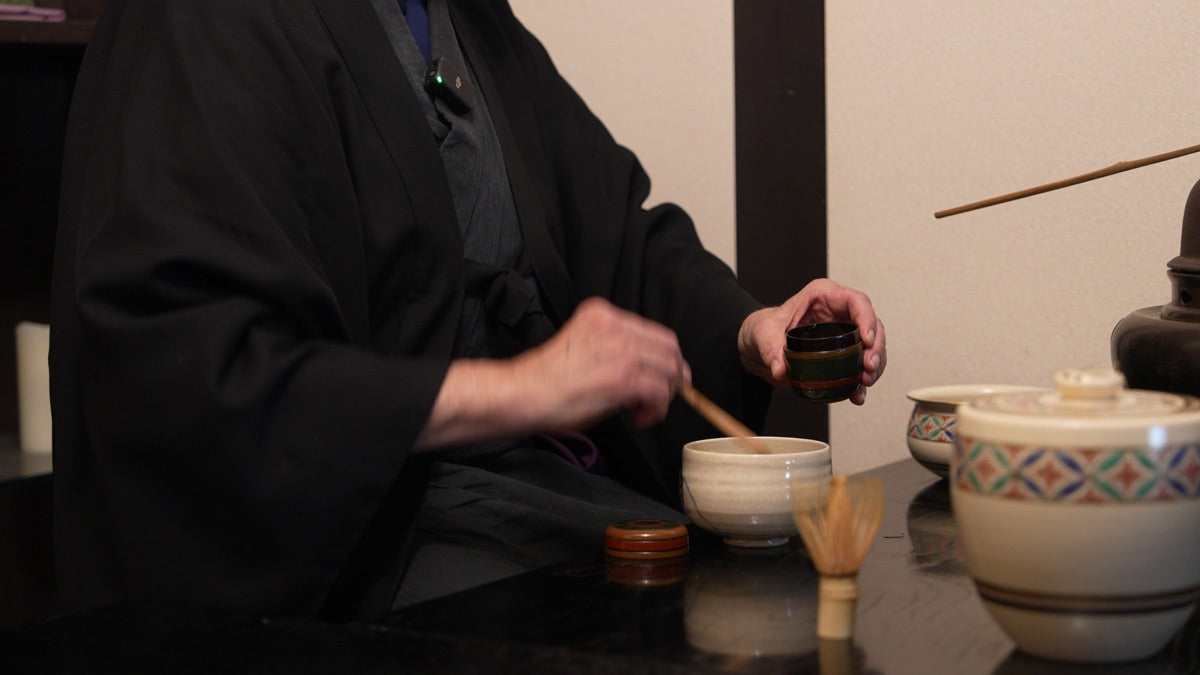
Koicha and usucha are the same powder in different amounts of water. Usucha, thin tea, is roughly 2 grams of matcha in 70 to 80 millilitres. Koicha, thick tea, is somewhere between 2 and 4 grams in as little as 15 to 40 millilitres. That single change in ratio is what decides everything else: the grade of matcha you need, the way it is mixed, how it tastes, and whether it arrives in your own bowl or one you pass to the person beside you.
Most explanations stop at "one is thick and one is thin," which is true and not very useful. In a tea room in Kyoto I watched a teacher make both from the same tin, and the interesting part was not the consistency. It was how much less forgiving the thick one is.
The regional picture is here: which Japanese prefectures actually grow the tea.
Key Takeaways
- Usucha is about 2g of matcha to 70-80ml of water. Koicha is about 2-4g to as little as 15-40ml, which works out between roughly two and nine times more concentrated.
- Sources genuinely disagree on the koicha measure. The Global Japanese Tea Association gives about 2g into 30-40ml, Nakamura Tokichi about 4g into 40ml, and Sugimoto 4g into just 15ml. Schools differ, so treat it as a range.
- Koicha is kneaded, not whisked, and produces no foam at all.
- Koicha needs a genuinely high grade of matcha. At 40ml of water there is nothing for bitterness to hide behind.
- In a formal chaji, koicha is served first as the centrepiece, and usucha follows as the lighter close. Usucha is the one to make at home.

Koicha vs Usucha: What's the Actual Difference?
The difference is concentration, and every other difference follows from it.
Usucha (薄茶) means thin tea. It is the everyday preparation, the one served at informal gatherings and the one nearly every matcha drinker outside Japan has actually had. It is whisked briskly, it carries a layer of fine foam, and it drinks like tea.
Koicha (濃茶) means thick tea. The Global Japanese Tea Association describes the result as a "shiny dark green tea of a syrupy consistency" with a taste that is "very intense" (Global Japanese Tea Association, retrieved 2026-08-21). It is closer to a thin paint than to a drink. It is not whisked into foam, it is mixed slowly until the powder and water become one smooth body.
We map it out: which countries produce matcha, and how much.
You can look both terms up any time in our matcha lexicon entry for koicha and the companion entry for usucha.
How Much Matcha and Water Does Each One Use?

Usucha lands around 2 grams of matcha to 70-80ml of water. Koicha lands around 2-4 grams into anywhere from 15 to 40ml. Here is where it gets honest: the sources do not agree on the koicha measure, and the spread is wide.
| Usucha (thin) | Koicha (thick) | |
|---|---|---|
| Matcha | about 2 g | about 2 g to 4 g |
| Water | 70-80 ml | 15-40 ml, sources vary |
| Motion | whisked briskly | kneaded slowly |
| Foam | yes, fine and even | none |
| Served | one bowl per person | one bowl shared |
| Occasion | everyday, informal chakai | the formal heart of a chaji |
The Global Japanese Tea Association specifies "3 scoop of matcha are used for each guest (that is about 2 grams of tea), while only 30 to 40 ml of water are enough" (Global Japanese Tea Association, retrieved 2026-08-21). The Uji tea house Nakamura Tokichi puts it higher, at "about twice the amount of matcha powder (4 grams)" against about 40ml (Nakamura Tokichi Honten, retrieved 2026-08-21). Sugimoto Tea Company goes further still, giving 4 grams into just 15ml (Sugimoto Tea Company, retrieved 2026-08-21).
All three are correct, because there is no single governing number. Different schools of tea, and different teachers inside them, hand down different measures, and a chashaku scoop is not a calibrated instrument. Anyone who tells you koicha is exactly 4 grams is quoting one lineage and calling it the rule.
Run the arithmetic and the spread is striking. Against a standard usucha of 2g in 70ml, the Global Japanese Tea Association measure is about twice as concentrated, Nakamura Tokichi about three and a half times, and Sugimoto more than nine times. That is not a rounding difference, it is three different drinks wearing one name.
What matters is the direction, not the decimal. Start at the gentle end, around 2 to 3 grams in 40ml, and add powder next time if it feels thin. It is much easier to thicken than to rescue a bowl you have overloaded.
Why Koicha Needs a Higher Grade of Matcha

This is the part that gets left out, and it is the practical reason not to attempt koicha with whatever is in the cupboard.
Dilution hides flaws. In a latte, milk and sweetness cover astringency almost completely. In usucha, 80ml of water and a layer of foam still soften a rough edge. In koicha you have taken the water away. Every note in that powder, including the bitter ones, arrives undiluted and stays on the palate.
The growing standards behind koicha reflect this. The Global Japanese Tea Association notes that high grades come from plants "shaded for around 4 weeks" and "always from spring harvest," and that for koicha "the quality standards get even higher. The shading might be even longer and very heavy that barely any sunshine goes through; and the harvest may even be done by hand" (Global Japanese Tea Association, retrieved 2026-08-21).
Longer and heavier shading is what pushes a leaf toward sweetness and body rather than briskness. First-flush spring leaf is softer than later harvests. Hand-harvesting takes only the youngest growth instead of everything the machine sweeps in. None of that is romance, it is the only way to build a powder that can survive that kind of concentration.
So the honest guidance is this: if a matcha is merely acceptable as usucha, it will be unpleasant as koicha. If you want to try thick tea, use a spring-harvested ceremonial grade. We wrote about what that grade designation does and does not guarantee in our guide to ceremonial grade matcha.
Kneaded, Not Whisked: How the Motion Changes
Usucha is whisked. Koicha is kneaded. The Japanese term for the koicha motion is closer to kneading than to whisking, and the Global Japanese Tea Association describes it as "a gentle mixing of the paste," made "by drawing two horizontal and two vertical lines inside the bowl until all the powder is well mixed with the water" (Global Japanese Tea Association, retrieved 2026-08-21).
Slow, deliberate, and silent. There is no rapid W motion, and there is no foam, because foam is not the goal. A properly made koicha has a glossy surface, not a frothy one.
The mechanics of the whisk itself, how to season a new chasen, which motion builds foam in usucha and what to do when it will not, all live in our complete guide to using a matcha whisk. If your thin tea is coming out flat, start with the frothing troubleshooting guide instead of buying a new tin.
When Is Each One Served?

Koicha is the formal centre of the gathering. Usucha is the lighter close, and the everyday cup.
In a full chaji, the long formal gathering that can run up to four hours and includes a full-course meal and confections, koicha comes first and is the most important act of the day. Usucha follows it. An informal chakai, by contrast, typically serves confections and thin tea only (Japanese tea ceremony, Wikipedia, retrieved 2026-08-21).
The sharing is the part that surprises people. Koicha is communal. One bowl is made for the group, and as the Global Japanese Tea Association describes it, "each guest drinks 3 sips, gently wipes the rim with a special napkin and passes the bowl to the next person" (Global Japanese Tea Association, retrieved 2026-08-21). Usucha is individual, one bowl per guest.
That single difference tells you what koicha is for. It is not a stronger drink, it is a shared one, and the intensity is what makes a small amount worth passing around a room. For the wider context of the ritual, the four principles and where these moments sit inside it, see our insider's guide to the Japanese tea ceremony.
Which One Should You Make at Home?

Usucha, almost certainly.
It is forgiving, it takes ninety seconds, it works with a good everyday ceremonial matcha, and it is the preparation the rest of the world means when it says "matcha." Make it daily, get the water temperature and the sifting right, and your tea improves more than it would from chasing a more advanced style.
Try koicha when two things are true. You have a spring-harvested, high-grade matcha you already enjoy as usucha, and you want to taste what that leaf actually is without water in the way. Use around 2 to 3 grams in 40ml of water at roughly 70 to 80°C, sift the powder first, and mix slowly rather than whisking. Expect something closer to a tasting than a drink.
One honest warning. Koicha made from a mediocre powder is genuinely unpleasant, and people often conclude they dislike koicha when what they disliked was the matcha. The style is not the variable, the leaf is.
If you are choosing a tin for either, our organic Japanese matcha is spring-harvested and shade-grown, and we are glad to point you to the right grade for the way you actually drink. For cafés, studios and retailers, our wholesale programme covers both everyday usucha service and ceremonial-grade tins.
Frequently Asked Questions
Is koicha stronger than usucha?
Yes, in concentration. Koicha uses the same or roughly double the matcha in a fraction of the water. Depending on whose measure you follow that is somewhere between two and nine times more concentrated than usucha. It also carries proportionally more of everything in the leaf, which is why the quality of the powder matters so much more.
Can I make koicha with culinary grade matcha?
You can, but it will taste harsh. Culinary grades are blended to hold up against milk and sugar, and koicha removes both. Use a spring-harvested ceremonial grade instead.
Why does koicha have no foam?
Because it is not whisked to make any. Koicha is mixed slowly, in straight lines rather than a rapid motion, until the paste is smooth and glossy. Foam is a feature of usucha, not a sign of a well-made bowl of thick tea.
How much matcha is in koicha exactly?
There is no single agreed figure. The Global Japanese Tea Association gives about 2 grams per guest into 30 to 40ml, Nakamura Tokichi gives about 4 grams into 40ml, and Sugimoto Tea Company gives 4 grams into just 15ml. Different schools hand down different measures, so treat 2 to 4 grams of matcha into 15 to 40ml as the working range.
Do koicha and usucha use the same bowl and whisk?
The same types, yes, though tea rooms often keep a sturdier whisk for koicha because kneading a thick paste asks more of the tines. For everyday purposes at home, one good chasen and one chawan will make both.
Which is the more formal, koicha or usucha?
Koicha. It plays the central role in a formal tea gathering and remains the centrepiece of a full chaji, while usucha is the lighter, less ceremonial style and is by far the more common of the two today.
Sources
- Koicha (濃茶), Global Japanese Tea Association, retrieved 2026-08-21.
- Matcha, Global Japanese Tea Association, retrieved 2026-08-21.
- Exploring Matcha: The Art of Usucha and Koicha, Nakamura Tokichi Honten, retrieved 2026-08-21.
- Koicha vs. Usucha, Sugimoto Tea Company, retrieved 2026-08-21.
- Japanese tea ceremony, Wikipedia, retrieved 2026-08-21.
- Urasenke Konnichian, retrieved 2026-08-21.
Questions about which grade suits the way you drink? Reply to any of our emails, a human reads them.
Share:
Samidori vs Saemidori: Two Matcha Cultivars, One Letter
Single-Origin vs Blended Matcha: What Gogumi Actually Is