



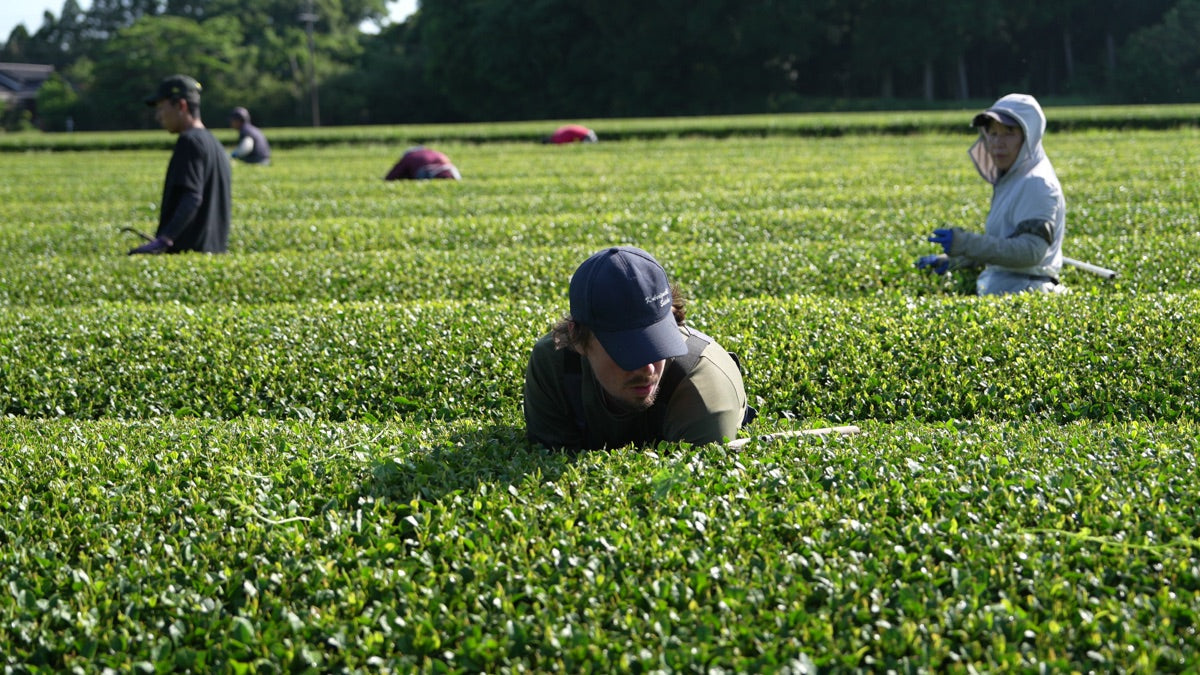
By Christian Mauerer, founder of One with Tea. Written after two weeks in Japanese tea fields in Shizuoka, Fukuoka and Kagoshima.
Samidori and Saemidori are two different tea plants. They are not spellings of the same word. Samidori is an Uji selection from native Kyoto seed stock, chosen by one man and on the Kyoto record from 1954, and it carries no national registration number at all. Saemidori is Chanorin No. 40, a deliberate cross of Yabukita and Asatsuyu made at the government breeding station in Makurazaki, Kagoshima, and registered in 1990. Different origin, different prefecture, different century of thinking. One letter, in the middle of the name, is all that separates them on a label.
Key Takeaways
- Samidori (さみどり) was selected by Koyama Masajiro from Uji native seed, and 1954 is the year on the Kyoto record. It has no Chanorin registration number, and it is grown for tencha and gyokuro (Kyoto Prefectural Tea Research Institute).
- Saemidori (さえみどり) is Chanorin No. 40, crossed in 1969 from Yabukita and Asatsuyu, registered in 1990, bred at Makurazaki in Kagoshima, and officially registered for sencha (茶農林登録品種一覧, annex table 1).
- The pronunciation gap is a single mora: sa-midori against sa-e-midori.
- The twist nobody mentions: Saemidori's father plant, Asatsuyu, was itself grown from an Uji native seedling at Kanaya in 1953. The Kagoshima outsider is half Uji by descent.
If you have landed here because a tin said one of these names and a search result showed you the other, you are in the right place. I sell matcha for a living and I still had to check the government registry to settle this properly. For the wider family these two belong to, start with our guide to Japanese tea cultivars.

What is the difference between Samidori and Saemidori?
The fastest way to tell them apart is to ask who made them and why.
Samidori came out of Uji, in Kyoto, the way most old Japanese cultivars did. Someone walked a field of seed-grown plants, found one bush that was better than its neighbours, and propagated it by cutting. The Kyoto Prefectural Tea Research Institute records the plant under its old line name, Koyama No. 69, credits the selection to Koyama Masajiro, and describes its origin plainly as a selection from Uji native stock. The year on the record is 1954.
Saemidori came out of a laboratory programme with a stated objective. Breeders at the national tea research station at Makurazaki, in Kagoshima, crossed Yabukita with Asatsuyu in 1969. Twenty-one years of selection later, the result was registered as Chanorin No. 40 in June 1990, under the working line name Makurazaki No. 9. It picked up a separate Seeds and Seedlings Law registration, number 2881, in November 1991.
So one is a lucky plant that a Kyoto grower noticed and kept. The other is a twenty-one year engineering project with a paper trail. That difference explains almost everything else about them.
Samidori: the Uji cultivar with no number

Here is the fact that surprised me most, and it is worth sitting with.
Samidori is not in the national cultivar registry. The Chanorin registered cultivar list contains a whole crowd of confusable green-named plants: Tamamidori (No. 4), Sayamamidori (No. 5), Yamatomidori (No. 10), Natsumidori (No. 16), Kyomidori (No. 19), Himemidori (No. 23), Okumidori (No. 32) and Saemidori (No. 40). Samidori appears in none of them.
That is not an oversight in my reading of the table. Kyomidori sits in that same list at No. 19, registered in 1954, also described as a seedling of Uji native stock, also from Kyoto, also intended for gyokuro and tencha. Same year, same origin type, same use, and it got a number. Samidori did not. Both My Japanese Green Tea and Florent Weugue of Japanese Tea Sommelier list Samidori explicitly among the unregistered cultivars.
What it did get was the work. Kyoto Prefecture's own assessment calls Samidori excellent as tencha, praising the clarity of its colour and the quality of its aroma and taste. On picking time it says something more useful than a date: mid-season, but with an unusually wide window of good picking. For a farm making tencha, a wide window is worth more than an early one. It means the shading, the picking and the steaming do not all have to happen in the same panicked four days.
Florent, who sells single-cultivar Uji matcha and has tasted more of it than almost anyone writing in a European language, described his Samidori as "very creamy, probably the most soft of the four. This gives me an impression of fruity, with an umami elegant but very present. This umami, this mellowness is deep and very long in the mouth" (Japanese Tea Sommelier, 13 October 2017).
Saemidori: Chanorin No. 40, and why Kagoshima wanted it

Saemidori's registry row is unusually informative, so it is worth reading straight: Chanorin No. 40, name Saemidori, old line name Makurazaki No. 9, parentage Yabukita times Asatsuyu, bred 1990, breeding location Makurazaki, intended use sencha.

From our tea room
Superior Sencha Green Tea - USDA Organic Japanese First Flush
First-flush loose leaf, USDA Organic, direct from Japanese family farms.
View Superior SenchaNote that last field. Saemidori was registered as a sencha cultivar, not a matcha cultivar. Its move into gyokuro and tencha came later and came from growers, not from the breeding brief.
The name means bright green, from 冴え緑, and Minamikyushu City's tea pages tie it to the exceptional brightness of the first flush leaves. The official flavour description reads: vivid green colour, fresh aroma, strong umami, little astringency. Its amino acid content runs higher than Yabukita's, which is the technical version of the same sentence.
The reason Kagoshima planted it is timing. Japan's agriculture ministry is actively encouraging growers to convert away from Yabukita toward early-budding, high-quality cultivars, and it names Saemidori among the targets: 「やぶきた」から早生で高品質な「さえみどり」等への品種転換が図られている (MAFF, November 2024). More on that in our Yabukita profile. Saemidori is an early-budding plant, which Japanese sources state as a category rather than a day count. My Japanese Green Tea puts a number on it, four to seven days ahead of Yabukita, and that number is worth having as long as you know it comes from one English-language blog rather than from the breeding record.
Early budding is the whole point, and the cost is real. Florent is blunt about the constraint: its low resistance to cold "prohibits the zones of production very exposed to the frost, like the mountainous areas of Shizuoka or the more northeastern regions like Sayama or Sashima." My Japanese Green Tea puts it the same way, that it is susceptible to frost damage and does not recover easily once hit. The Japanese registry data is more measured, rating its cold-injury resistance as medium and better than Yutakamidori, so read this as a siting constraint rather than a fragile plant. Either way it belongs to the warm south. Kagoshima and Miyazaki are its heartland, with Shizuoka planting more of it recently.
Its footprint has been expanding. A Japanese agriculture ministry survey put it at 3% of national tea garden area in 2014, as summarised in the NARO cultivar handbook. Florent's 2022 cultivar survey puts it at 4%. Back in October 2017 he called it the cultivar whose cultivated area had increased the most over the previous ten years, and the 3% to 4% trajectory is consistent with that. For where it fits against its late-budding cousins, see our piece on Okumidori and Gokou.
Samidori vs Saemidori: the differences that matter
| Attribute | Samidori (さみどり) | Saemidori (さえみどり) |
|---|---|---|
| Origin | Selection from Uji native seed | Deliberate cross, Yabukita x Asatsuyu |
| Where | Uji, Kyoto | Makurazaki, Kagoshima |
| Year | 1954 (year on the Kyoto record) | Crossed 1969, registered 1990 |
| Registry | None. Unregistered | Chanorin No. 40 |
| Registered use | Tencha and gyokuro | Sencha |
| Budding | Mid-season, wide picking window | Early |
| Cold tolerance | Not flagged as a constraint | Rated medium. Late frost limits where it is sited |
| Where you meet it | Uji tencha and matcha | Kagoshima sencha, increasingly matcha |
If you want one sentence to carry away: Samidori is a shade plant from Kyoto that was never registered, and Saemidori is a registered sencha plant from Kagoshima that grew into shade.
The twist: Saemidori is half Uji by descent
This is the part I did not expect, and it is the reason I stopped treating the two as opposites.
Saemidori gets described, reasonably, as the southern outsider that arrived in Kyoto from elsewhere. Florent frames the Uji tradition precisely: his Uji matcha cultivars are "all three tea plant varieties originating from Kyoto, resulting from the selection of Zairai local teas or crossing 100% of varieties originating from this prefecture," and he notes that "this non inheritance of cultivars from other regions is a peculiarity of Uji tea." Of Saemidori he writes that it "came to Kyoto as an outsider, but succeeded in imposing itself on high-end teas."
The regional picture is here: our map of Japanese tea production by prefecture.
Then you pull its parentage apart. Saemidori's mother is Yabukita, a Shizuoka selection. Its father is Asatsuyu. And Asatsuyu is Chanorin No. 2, bred at Kanaya in 1953, from an Uji native seedling.
So the two plants are not rivals from opposite ends of Japan. They are two different routes out of the same Uji seed stock. One route took a single generation and a good eye. The other took two breeding stations, thirty-seven years and a cross. Both of them end up in a bowl of shaded, stone-milled tea. If you want the region that started it, we wrote about the Uji matcha region separately.
Will you ever see these names on a tin?

Mostly, no, and that is not a scandal.
In the tins I have sourced and seen on shelves, blending is the norm and single-cultivar matcha is the exception. A blend is how a producer keeps a flavour steady from one year's weather to the next. When a producer does name the cultivar, they are telling you they made a choice worth naming, and they are giving up the safety of blending to do it.
When you do see them, the pattern is fairly consistent. Samidori on a tin points to Uji tencha. Saemidori points south, most often to Kagoshima, though it has started appearing in Uji too. If a tin says Saemidori and Uji at the same time, that is a real and interesting thing, not an error. Florent reviewed exactly such a matcha in April 2017 and was thoughtful about it, wondering aloud whether it lacked the particular perfume of the traditional Uji cultivars.
What I would not do is treat the name as a grade. A cultivar tells you about the plant, not about the shading, the picking, the leaf selection or the mill. Those decide far more of what ends up in your bowl. If grade is what you were actually asking about, we untangled that in our guide to ceremonial grade matcha. And if Yabukita keeps showing up in your reading, it is the parent of half this story, which we covered in our Yabukita profile.
Frequently asked questions
Are Samidori and Saemidori the same cultivar?
No. They are two distinct plants with nearly identical romaji. Samidori is an Uji selection from native Kyoto seed, recorded in Kyoto in 1954 and never given a national registration number. Saemidori is Chanorin No. 40, a Yabukita and Asatsuyu cross bred at Makurazaki in Kagoshima and registered in 1990.
How do you pronounce the difference between Samidori and Saemidori?
The gap is one mora. Samidori is sa-mi-do-ri. Saemidori is sa-e-mi-do-ri, with a distinct e sound after the opening sa. In kana the difference is visible immediately: さみどり against さえみどり.
Which cultivar makes better matcha, Samidori or Saemidori?
Neither is better by default. Samidori was assessed by Kyoto Prefecture as excellent for tencha, the leaf that becomes matcha, so it has the longer track record in that specific job. Saemidori was bred for sencha and moved into shaded tea afterwards, and it brings strong umami and low astringency when it does. Shading, picking standard and milling matter more to the finished bowl than the cultivar name.
Why does Samidori have no registration number?
The Chanorin registry lists cultivars that went through the national registration process, and Samidori never did, despite being widely planted in Uji. Kyomidori, a comparable Uji selection from the same year, is on the list as No. 19. Registration reflects an administrative route taken, not plant quality.
Is Saemidori grown in Uji?
Yes, but recently and on a small scale. Its heartland is Kagoshima and Miyazaki, where the warmth suits an early-budding plant whose late-frost risk limits where it can be sited. Uji plantings exist and the area is not yet extensive.
A note from me

I spent two weeks walking tea fields in Shizuoka, Fukuoka and Kagoshima, and the thing I kept relearning is that these names carry actual farm decisions inside them. An early-budding plant is a grower buying a second harvest window. An unregistered plant is a region that trusted its own eye over a national process. When you learn which cultivar is in your bowl, you are learning the shape of somebody's year.
If you want to taste what shaded Uji leaf does at its best, our organic Japanese matcha is where to start. And if you run a cafe or shop and want to talk sourcing, One with Tea wholesale matcha sourcing is open.
With love and tea,
Christian
Sources
- Kyoto Prefectural Tea Research Institute, on Uji cultivars (Samidori: line name Koyama No. 69, Uji native selection, 1954, breeder Koyama Masajiro; mid-season with wide picking window; excellent as tencha)
- Chanorin registered cultivar list, annex table 1 (Saemidori row: No. 40, Makurazaki No. 9, Yabukita x Asatsuyu, 1990, Makurazaki, sencha. Asatsuyu row: No. 2, Kanaya, 1953, Uji native seedling. Samidori absent from the list)
- Minamikyushu City, on the Saemidori cultivar (cross made 1969; parentage; national station at Makurazaki; flavour description; name etymology)
- MAFF, Japan Ministry of Agriculture, Forestry and Fisheries, tea production materials, November 2024 (cultivar conversion away from Yabukita toward early, high-quality cultivars including Saemidori)
- CRAFT TEA, summarising the NARO tea cultivar handbook on Saemidori (Chanorin naming June 1990; Seeds and Seedlings Law registration No. 2881, November 1991; 3% of national tea garden area, 2014 survey; growing regions)
- Japanese Tea Sommelier, The Japanese tea cultivars, 22 August 2022 (Samidori listed as unregistered; Saemidori at 4% of cultivated area)
- Japanese Tea Sommelier, 2017 matchas, four great cultivars, 13 October 2017 (Samidori tasting note; Uji non-inheritance of outside cultivars; Saemidori as outsider; cold resistance constraint)
- Japanese Tea Sommelier, Saemidori cultivar Matcha from Uji, 13 April 2017
- My Japanese Green Tea, the Samidori cultivar (unregistered status; picking alongside Yabukita)
- My Japanese Green Tea, the Saemidori cultivar (four to seven days earlier than Yabukita, attributed to this source)
Share:
Okumidori Cultivar vs Gokou: The Late-Budding Matcha Plants
Koicha vs Usucha: Thick and Thin Matcha, and When Each Is Used