



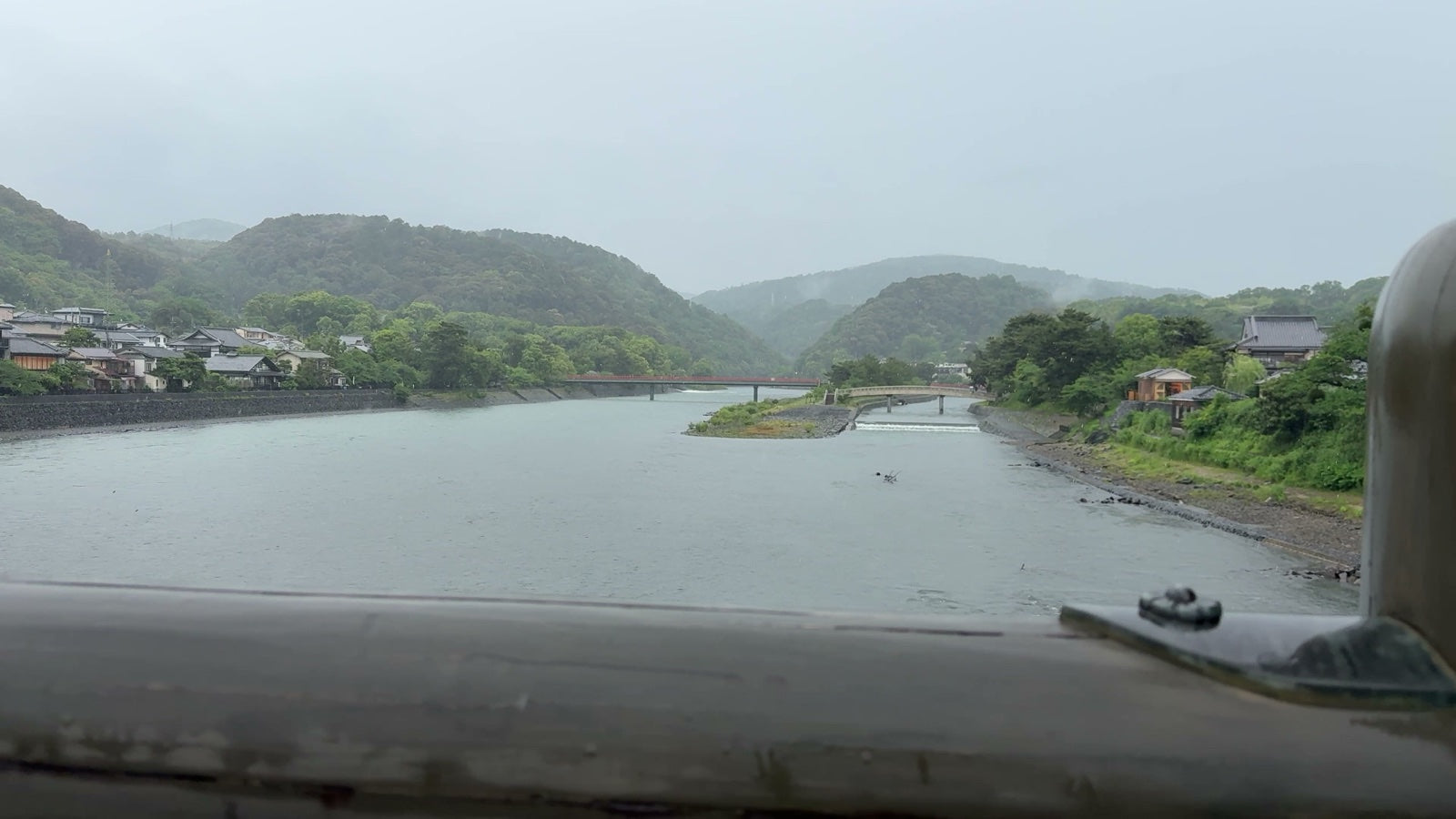
I came to Uji to understand a single question. Why did one small river valley, and not anywhere else in Japan, become the place that gave the world matcha as we know it. The answer is partly soil and mist, and partly eight centuries of patient hands.
Uji sits in Kyoto Prefecture, in the old province of Yamashiro, just south of Kyoto city (Wikipedia, Uji tea). The river runs cold through the middle of town. The hills hold morning fog. You feel, walking it, that the tea was almost inevitable here.
Key Takeaways
- Tea seeds reached Japan around 1191, brought by the Zen priest Myoan Eisai, who shared them with the monk Myoe (Wikipedia, Uji tea).
- Uji farmers invented covered shade cultivation, ooishita saibai, the method behind modern matcha and gyokuro.
- Shade cultivation cuts the sunlight reaching the plants by roughly 60 to 98 percent, commonly near 85 percent (NCBI / PMC, 2020).
- Tsuen, founded in 1160, is the oldest tea house in Japan and still runs in Uji today under the 24th generation (Wikipedia, Tsuen Tea).

Where does Uji sit, and why does the land matter?
Uji is a city in Kyoto Prefecture, in historic Yamashiro province, set along the Uji River south of Kyoto (Wikipedia, Uji tea). The valley's mist, mild winters, and well drained slopes give tea a slow, even growth that growers have prized for more than 800 years.
What strikes you first is the fog. It settles low over the hills in the early hours and lifts slowly through the morning. That soft, filtered light is the same gift that growers later learned to recreate by hand, with roofs of straw and reed over the bushes.
Standing in those fields at dawn, I understood why the old gardens were guarded so jealously. The terroir is not a marketing word here. It is the cold river air, the slope, and the patience the land demands.
How did tea first take root in Uji?

Tea seeds were introduced to Japan around 1191 by the Zen priest Myoan Eisai, who shared them with his friend, the monk Myoe (Wikipedia, Uji tea). Myoe began planting, and the seeds first spread at Toganoo, in the Kosanji area north of Kyoto, before Uji rose to take the crown.
For a time, Toganoo tea was regarded as the finest in the realm, around the year 1350 (Wikipedia, Uji tea). Uji's growers studied that early tea, then refined the craft until the title quietly moved down the valley to them.
This is the part that moves me most. Matcha did not arrive fully formed. It was carried from China as seed and idea, then shaped over generations by monks, farmers, and patrons into something the world had not tasted before.
What is the shade method that created matcha?

Uji farmers invented covered shade cultivation, known as the roof-over method or ooishita saibai, to keep direct sunlight off the bushes (Wikipedia, Uji tea). That single technique is what separates matcha and gyokuro from ordinary green tea, and it was born in this valley.
Shade cultivation reduces the sunlight reaching the plants by roughly 60 to 98 percent, commonly around 85 percent, by covering the field or the bushes directly (NCBI / PMC, 2020). Starved of full sun, the leaf holds back bitterness and leans into a deeper, savory sweetness.
The genius is restraint. By taking light away, Uji's growers coaxed more flavor in. The leaf turns a richer green and develops the umami that defines a good bowl of matcha. For the full picture of how that leaf becomes powder, our guide to what Uji matcha is walks through it in detail.
What were Uji's Seven Famous Gardens?

Under Muromachi-era shogunal patronage, Uji's best plots were elevated into the Uji Seven Famous Gardens, the Uji Shichimeien (First Agri, Uji Matcha). The seven were Mori, Iwai, Umoji, Okunoyama, Asahi, Biwa, and Kawashimo, and their names appeared in poetry of the age.
That patronage mattered. When power and prestige attached themselves to a handful of gardens, the standards rose, and the methods were protected and passed down. Uji became less a place that grew tea and more a place that defined it.
You can still trace that hierarchy in how Japan talks about its tea today. To see where Uji sits among the country's other great regions, our overview of Japan's matcha growing regions maps the wider landscape.
What can you see walking Uji today?
Tsuen is the oldest tea house in Japan, founded in 1160 in Uji, just east of the Uji Bridge near Uji Station (Wikipedia, Tsuen Tea). It was founded by Furukawa Unai, a samurai vassal of Minamoto no Yorimasa, and it still pours tea today under the 24th generation of the family.
The current building incorporates the remains of a merchant residence built in 1672, so the room you sit in has watched centuries of travelers cross the bridge (Wikipedia, Tsuen Tea). A short walk away stands Byodo-in, the UNESCO World Heritage temple whose image many of us know from the back of a coin.


I sat with a bowl of thick tea near the river and watched the light change on the water. There is no rush in Uji. The tea, the temple, and the bridge all keep the same unhurried time.
What cultivars give Uji matcha its character?

Uji is known for a small family of prized tencha cultivars, each grown for the bowl rather than for volume (Blossom Matcha, cultivar guide). Three names come up again and again, and tasting them side by side is the fastest way to understand the region.
Asahi is a noble cultivar, prized for intense umami and aroma and reserved for limited production. Samidori is the traditional Uji cultivar, balancing strong umami with sweetness and a vivid green color. Goko leans creamy and dark, low in bitterness, and is often chosen for koicha, the thick ceremonial preparation (Blossom Matcha, cultivar guide).
| Cultivar | Character | Best for |
|---|---|---|
| Asahi | Noble cultivar, intense umami and aroma, limited production | Top-grade ceremonial matcha |
| Samidori | Traditional Uji cultivar; strong umami balanced with sweetness, vivid green | Classic Uji matcha |
| Goko | Creamy and dark, low bitterness | Koicha, the thick ceremonial preparation |
Source: Blossom Matcha cultivar guide.
If you enjoy reading terroir the way others read wine, the cultivar is your map. For the data behind where each region's leaf actually comes from, see our 2026 breakdown of Japan's tea production by region.
Bringing Uji home
Uji taught me that great matcha is a kind of inheritance. Eight centuries of patience are folded into every bowl, from the first seeds at Toganoo to the shade roofs that still rise each spring.
If you want to taste that lineage, explore our single-origin Japanese matcha, sourced with care from growers who keep these methods alive. And if you run a cafe or shop and want authentic Japanese matcha at wholesale, reach out about our wholesale program, we would love to pour with you.
May you become one with tea, one with yourself.
Frequently Asked Questions
Where is Uji and why is it famous for matcha?
Uji is a city in Kyoto Prefecture, in historic Yamashiro province, along the Uji River (Wikipedia, Uji tea). Its growers invented covered shade cultivation over 800 years ago, the technique that created matcha and gyokuro as we know them.
Who brought tea to Uji?
Tea seeds reached Japan around 1191 with the Zen priest Myoan Eisai, who shared them with the monk Myoe (Wikipedia, Uji tea). Myoe began planting, and the seeds first spread at Toganoo before Uji rose to prominence as Japan's premier tea region.
What is ooishita shade cultivation?
Ooishita saibai is the roof-over method invented in Uji that covers the bushes to block sunlight. It reduces incident sunlight by roughly 60 to 98 percent, commonly near 85 percent (NCBI / PMC, 2020), raising umami and deepening the leaf's green color.
What is the oldest tea house in Uji?
Tsuen, founded in 1160 just east of the Uji Bridge, is the oldest tea house in Japan and still operates under the 24th generation of the founding family (Wikipedia, Tsuen Tea). Its current building incorporates remains of a merchant residence built in 1672.
Sources
- Wikipedia, Uji tea, retrieved 2026-06-15, https://en.wikipedia.org/wiki/Uji_tea
- Wikipedia, Tsuen Tea, retrieved 2026-06-15, https://en.wikipedia.org/wiki/Tsuen_Tea
- First Agri B2B, Uji Matcha: Why Kyoto's Tea Region Produces the World's Finest Matcha, retrieved 2026-06-15, https://first-agri.jp/matcha/columns/uji-matcha-kyoto-finest
- Blossom Matcha, Matcha Cultivar: The Secret of Taste, retrieved 2026-06-15, https://blossom-matcha.com/en/blogs/matcha-101/matcha-cultivar-secret-of-taste
- NCBI / PMC, Phenotypic Markers Reflecting the Status of Overstressed Tea Plants Subjected to Repeated Shade Cultivation, 2020, retrieved 2026-06-15, https://www.ncbi.nlm.nih.gov/pmc/articles/PMC7677308/
Share:
Premium Matcha for Cafes and Lattes: A 2026 Sourcing Guide
Inside Wazuka: Kyoto's Hidden Village of Tea