



By Christian Mauerer, Founder of One with Tea · Published May 7, 2026
In 2025, Kagoshima Prefecture overtook Shizuoka in first-flush ichibancha production for the first time since statistical surveys began in 1991, 8,440 tons of first-flush leaf against Shizuoka's 8,120. Shizuoka reclaimed that first-flush lead in 2026 (about 10,700 tons to Kagoshima's 9,610, per News On Japan), so the top spot now trades year to year, capping a multi-year shift in where Japan's tea actually comes from (Ooika, August 2025). The crude tea numbers tell the same story at a larger scale: Kagoshima 30,000 tons against Shizuoka's 24,100 tons in 2025, a record gap (Global Japanese Tea Times, February 2026). The map of Japanese tea looks different in 2026 than it did even three years ago.
We map it out: which countries produce matcha, and how much.
I run a small US matcha brand and source directly from named Japanese farms. I've spent the last several years tracking which prefecture grows what, why the rankings keep shifting, and how those shifts show up in cup quality and shelf prices. What follows is the 2026 geographic anchor I wish I'd had when I started, with a map, the prefecture-level data behind it, and a founder's read on what each region actually delivers right now.
Key Takeaways
- Kagoshima overtook Shizuoka in 2025 first-flush production for the first time since 1991, 8,440 tons against 8,120 tons, before Shizuoka reclaimed the first-flush lead in 2026 (10,700 t vs 9,610 t) (Ooika, Aug 2025).
- Kagoshima 2025 crude tea was 30,000 tons (+11% YoY) against Shizuoka's 24,100 tons (-7% YoY), a widening gap (GJTA, Feb 2026).
- Tencha, the leaf that becomes matcha, is concentrated in Kyoto (Uji) and Aichi (Nishio). Nishio reports 334 tons of tencha across 180 hectares, roughly 95% of the city's tea output (Tea & Coffee Trade Journal).
- 2026 Uji auction set a record gyokuro price of ¥500,000 per kilo, +30% year over year, while tencha was expected to make up roughly 90% of the auction's traded volume (GJTA, April 2026).
- Japan's commercial tea plantations are down roughly 29% over the past decade, even as remaining farms scale up (GJTA, Feb 2026).
Why Japan's Tea Map Looks Different in 2026
The headline shift is the Kagoshima rise and the Shizuoka decline, and both are now multi-year trends rather than single-season noise. Kagoshima's 2024 crude output was already 27,000 tons against Shizuoka's 25,800, and the 2025 numbers widened that gap meaningfully (GJTA, February 2026). The 1991 statistical baseline finally cracked in first-flush in 2025.

From our tea room
Superior Sencha Green Tea - USDA Organic Japanese First Flush
First-flush loose leaf, USDA Organic, direct from Japanese family farms.
View Superior SenchaThree forces explain it. Kagoshima's flatter, more mechanizable terrain rewards modern equipment and per-farm scale. Shizuoka's older terraced fields, while culturally iconic, are harder to mechanize and have been losing growers to retirement. And policy follows: Japan's Ministry of Agriculture is "supporting producer transitions to tencha cultivation," and Kagoshima has been the largest beneficiary of that subsidy push (GJTA, September 2025). The map you see in 2026 is the map a decade of policy and demographics built.
The Map: 10 Prefectures by Production and Tea Type
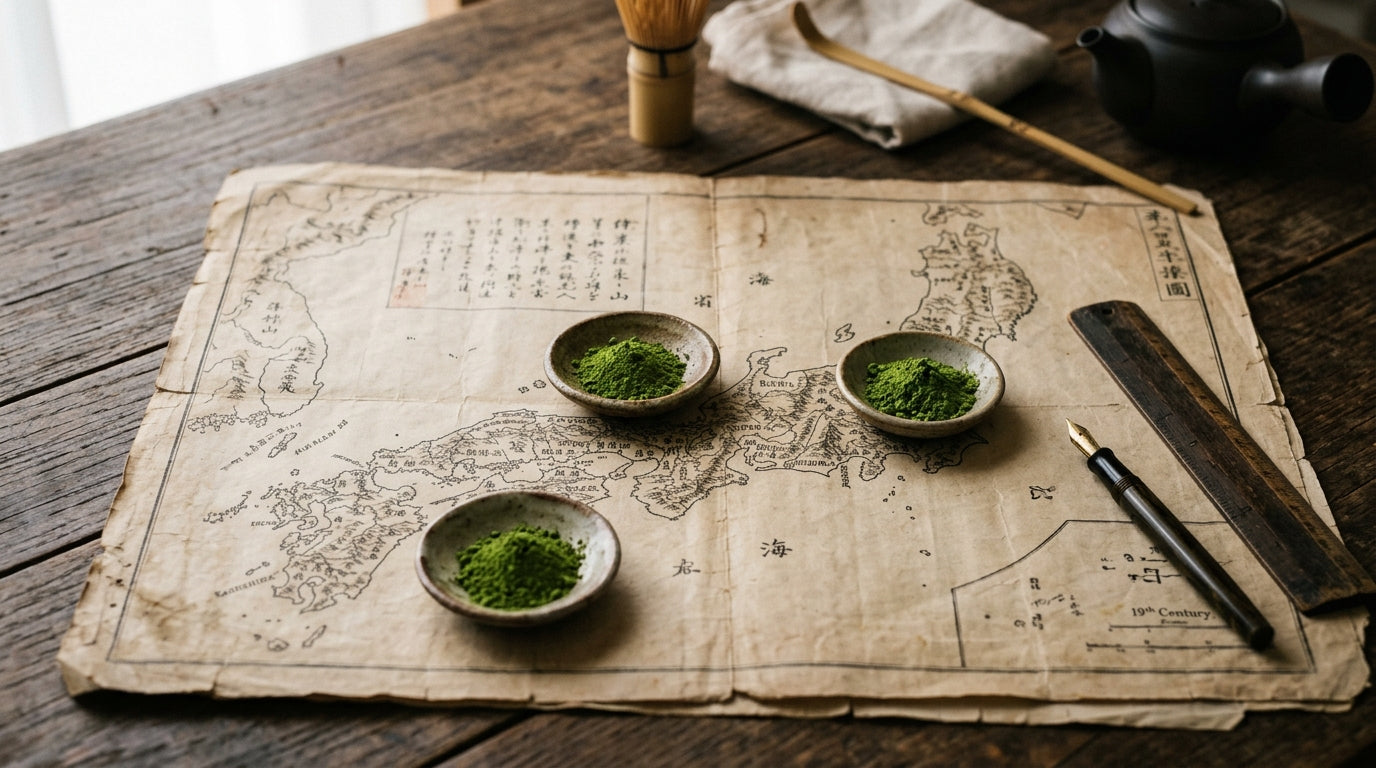
The map above plots ten prefectures that account for nearly all of Japan's commercial tea production, color-coded by what they specialize in. The rule of thumb most beginner guides skip is that Japan does not grow "matcha" everywhere. It grows tea everywhere, then specific regions process specific leaf types, and only certain regions process tencha, the shaded leaf that becomes matcha when stone-milled.
The 2025 first-flush ichibancha numbers, the most-watched single quality metric in Japanese tea, ranked: Kagoshima 8,440 tons, Shizuoka 8,120 tons, Mie 1,940 tons, Kyoto 1,070 tons, and Saitama 460 tons (Ooika, August 2025). Kyoto and Mie both saw roughly 19% and 8% year-over-year declines in first-flush, while Saitama (Sayama) eked out a 2% gain. Volume is not the same as cup quality, and Kyoto's smaller tonnage hides Japan's most valuable leaf.
Tea-type specialization, by 2025 National Tea Competition
Japan's 2025 National Tea Competition rankings, the cleanest single signal of regional specialization, broke as follows (GJTA, September 2025):
- Kyoto, top-ranked in tencha and kabusecha. The matcha and shaded-tea anchor.
- Shizuoka, top-ranked in regular sencha and fukamushicha. Still Japan's sencha heartland by quality.
- Saga, top-ranked in tamaryokucha and kamairicha, the curled-leaf and pan-fired styles.
- Nara, recognized for Takayama chasen (the bamboo whisks themselves), a Cool Japan Award winner.
Kagoshima's lead in tonnage doesn't make it the cup-quality leader for every category. The 2025 competition ranked it nowhere near the top for tencha or kabusecha. The map needs both axes: what each region produces in volume, and what each region is recognized for in cup quality.
Kagoshima Overtakes Shizuoka, Then Shizuoka Overtakes Back
The single biggest 2025 story in Japanese tea was that Kagoshima crossed Shizuoka in first-flush ichibancha for the first time since the statistical survey began in 1991, then Shizuoka crossed back in 2026 (about 10,700 t to 9,610 t) (Ooika, August 2025). Kagoshima's 8,440 tons against Shizuoka's 8,120 tons is a narrow margin in absolute terms, but it caps a trend that has been running for a decade.
The crude tea numbers, which include later flushes, are even more decisive. Kagoshima 2025 crude tea hit 30,000 tons (+11% year over year) while Shizuoka came in at 24,100 tons (-7%) (GJTA, February 2026). That is the largest gap on record between the two prefectures.
Auction prices echo the same shift. Kagoshima's first auction prices on April 6, 2026 rose 60% year over year, while Shizuoka's first auction average came in at ¥9,019 per kilo, a second consecutive year of decline (GJTA, April 2026). Demand is following supply south. From the buyer's seat, this is not abstract: when I source first-flush leaf for our tins, the Kagoshima farms I work with are quoting confidently and shipping on schedule, while several Shizuoka farms have asked for longer lead times two seasons running.
We publish the underlying cost data: what Japanese green tea actually costs at origin.
Where Matcha Actually Comes From (Tencha Geography)
When buyers ask "where does real matcha come from," the honest 2026 answer is more layered than the marketing claim of "Uji." Tencha, the shaded green leaf that becomes matcha when stone-milled, is grown in a handful of prefectures, with two carrying most of the volume: Kyoto (Uji) and Aichi (Nishio). Kyoto is the heritage anchor and the cup-quality leader, with the 2025 National Tea Competition ranking Kyoto first in tencha and kabusecha (GJTA, September 2025).
Nishio, in Aichi, is the most concentrated tencha city in Japan. Its 2024 production reached 334 tons of tencha across 180 hectares with 87 growers, and "approximately 95 percent of green tea manufactured in the city" is tencha (Tea & Coffee Trade Journal). Nishio's cultivar mix runs roughly Yabukita 50%, Samidori 30%, and Okumidori 20%, with a yield ratio where "100kg of green leaves become 20kg of tencha" after the stem-and-vein removal that defines tencha processing.
Why Uji's auction prices are diverging from tonnage
Kyoto's first-flush 2025 came in at only 1,070 tons, a roughly 19% year-over-year decline (Ooika, August 2025). The April 2026 Uji auction set a record: gyokuro at ¥500,000 per kilo, +30% year over year, sencha at ¥333,339 per kilo, with tencha "expected to account for roughly 90% of trade" at the auction (GJTA, April 2026). Smaller Uji volume is meeting larger global tencha demand, which is why the Ministry of Agriculture is funding tencha conversion in other prefectures.
That conversion push is the part most consumer guides miss. Kagoshima farms are receiving subsidies to switch fields to tencha cultivation, and the next decade of "where matcha comes from" will look broader than the Uji-only story most Western tins still tell. We covered the supply mechanics in our 2026 matcha shortage explainer and the price flow-through in why matcha prices are rising in 2026.
Specialty Regions: Yame, Sayama, Nara, Saga, Miyazaki
Beyond the volume leaders, several smaller prefectures define Japan's specialty cup quality. Saitama (Sayama) brought in 460 tons of first-flush in 2025, a roughly 2% year-over-year gain, the only volume increase outside Kagoshima (Ooika, August 2025). Sayama's heat-roasted finish and its colder northern climate produce a distinct sweet, deep flavor that has loyal followers domestically.
Yame in Fukuoka prefecture is one of Japan's top gyokuro producers and is now pursuing ESG assessment to support export promotion (GJTA, September 2025). Saga's 2025 National Tea Competition top rankings in tamaryokucha and kamairicha mark it as the curled-leaf and pan-fired specialist. Nara's Takayama district is recognized less for leaf and more for the bamboo chasen whisks themselves, awarded in 2025 by Cool Japan (GJTA, September 2025).
Mie prefecture, often overlooked, was Japan's third-largest first-flush producer in 2025 at 1,940 tons, despite a roughly 8% year-over-year decline (Ooika, August 2025). Mie's Iseh and Kabuse styles are widely used in blends but rarely named on Western tins.
What 2026 Auction Prices Tell Us About Each Region
Auction prices are the cleanest near-real-time signal of regional health. The April 2026 numbers paint three different pictures. Uji set its record gyokuro price at ¥500,000 per kilo, with tencha expected to dominate roughly 90% of traded volume, a sign that Kyoto's smaller volume is meeting concentrated global demand (GJTA, April 2026). Kagoshima's first auction prices on April 6, 2026 rose 60% year over year, the strongest demand signal of any prefecture this season.
Shizuoka's first auction average came in at ¥9,019 per kilo, a second consecutive year of decline (GJTA, April 2026). For Shizuoka producers, this is the second straight year that opening-day pricing has not held the line, and several are accelerating retirements rather than replanting. The auction floor is doing what auction floors do: clearing the market, and that clearing is moving the geographic center of Japanese tea south.
Why Plantations Have Shrunk 29% in a Decade
Japan's commercial tea plantations are down roughly 29% over the past decade, even as Kagoshima expands (GJTA, February 2026). Two structural forces drive it. First, demographic: the average Japanese farmer is well past retirement age and tea farming is famously labor-intensive, especially on the older terraced fields of Shizuoka, Kyoto, and Mie. Second, consolidation: the per-farm average area in Kagoshima has more than doubled, from 1.5 hectares in 2000 to 3.3 hectares in 2015, with the trend continuing through 2025 (Tealife).
The aggregate effect is that Japan produces less tea total than it did 25 years ago, but the remaining production is more concentrated, more mechanized, and more focused on shaded teas (tencha and kabusecha) where global demand and prices are strongest. Roughly 60% of commercial tea farms have closed across most prefectures since 2000, with Kagoshima the partial exception (Tealife).
For sourcing in 2026, this means three things. Named-region tins are getting harder to honor as smaller cooperatives consolidate. Cultivar specificity is becoming a real differentiator because larger farms can dedicate fields to single cultivars. And the matcha-vs-sencha split inside each prefecture is shifting toward matcha as MAFF subsidies fund tencha conversion. Our 2026 organic matcha guide covers what that means at the tin level.
How One with Tea Sources Across the Map
For full transparency: we source from named Japanese organic-certified farms across multiple prefectures rather than committing to a single region. Our flagship ceremonial tencha comes from named farms in Uji and Nishio, where the cup-quality and processing tradition for tencha is deepest. Our culinary-grade and blended tins draw from broader sourcing, with prefecture and harvest year listed on the label.
I made that choice deliberately. A single-region tin is a beautiful story, but in 2026 it concentrates supply risk in a narrow band of farms whose volumes are declining year over year. Sourcing across the map, with named-farm transparency, is how I keep cup quality stable while the geography of Japanese tea reshapes underneath us. When buyers ask which region "real matcha" comes from, my honest answer is that it comes from a small set of named farms doing serious work, and those farms are now spread across more of Japan than the Uji-only marketing story suggests. Our cafe and restaurant guide walks through how we match volume needs to region, and our first-flush vs second-flush guide covers harvest timing inside each region.
If you are picking a tin in 2026, look at the label and ask: is the prefecture named? Is the cultivar listed? Is the harvest year and flush stated? Those three details alone, regardless of which region, tell you whether the producer knows what they're shipping. The map is the geography. The label is where the geography becomes verifiable.
Want a tin with the prefecture, cultivar, and harvest year on the label?
USDA Organic and JAS certified, third-party lab tested, sourced from named Japanese regions across the 2026 map.
Shop Matcha Collection Inquire About WholesaleHave a question or want to talk wholesale? Email info@onewithtea.com. I read everything.
Share:
Matcha for Meditation Practice: Tea as Ritual
Benefits of Matcha: What the Research Actually Shows (Founder's Guide)