



Why Matcha Prices Are Rising in 2026 (And What You're Actually Paying For)
By Christian Mauerer, Founder of One with Tea · Published May 6, 2026
If your favorite ceremonial tin jumped from $25 to $38 in the last twelve months, you didn't get gouged. You got priced honestly into the new reality of Japanese tea. Tencha (the leaf used for matcha) saw record wholesale price increases through 2025, with multiple regional reports describing the largest single-year jumps in industry memory. Japan's matcha-producing prefectures faced a difficult harvest year while global demand kept climbing. Industry coverage from Perfect Daily Grind documented the supply-side stress, and Japan's overall tea market data confirmed the squeeze. The demand curve, meanwhile, has not blinked.
I source matcha for a small US brand. I've spent most of 2025 and 2026 watching this play out from the buyer's side, and I've made every pricing decision a small operator can make. What follows is what's actually inside a $30+ tin in 2026, why the numbers moved this hard this fast, and how to read whether your brand of choice is pricing honestly or hiding the math.
Key Takeaways
- Japan's fiscal 2025 green tea exports rose 42% in volume to 13,125 metric tons while value doubled to ¥84.7 billion, a textbook signature of buyers competing on price for a constrained product (Japan Times).
- Foreign green tea imports into Japan rose 82% to 5,801 tons, backfilling the domestic shelves emptied by exports (Japan Times).
- Japan lost 53,000 tea farmers to retirement between 2000 and 2020, and new fields take 4 to 5 years before they reach maturity, with low yields even then (Nio Teas).
- Japan's matcha export value approximately tripled in dollar terms over the recent surge, from ¥292 billion ($2 billion) in 2023 toward ¥400 billion ($2.7 billion) projected for 2025 (Real Gaijin newsletter).
- From our buyer's desk, premium tencha that landed at roughly $11 per 30g in 2023 lands at $19-22 in early 2026, before any tariff, freight, certification, or retail margin.
- The cost will not snap back in 2026. Best case, the spring 2026 harvest stabilizes prices. A reset to 2023 levels is at least 24 months out.
The Tencha Cost Move, in Plain Terms
Tencha is the specific Japanese leaf that gets stone-ground into matcha. Real matcha is tencha. Anything else is not matcha. So when tencha wholesale moves, every honest tin downstream moves with it.
From the buyer's side of the table, the 2025 wholesale move was the steepest year-over-year jump I have personally seen since I started sourcing. To translate it into a tin: a 30g ceremonial tin needs about 30g of stone-ground tencha. (Stone-grinding does not destroy mass, it just costs about an hour of mill time per 30g.) On our supplier invoices, the leaf-cost component of a 30g tin moved from roughly $11 in 2023 to $19-22 in early 2026. The rest of the supply chain either eats that or passes it through.
Most brands cannot eat it. Margins on a $25 ceremonial tin in 2023 were already structured around a leaf cost in the $3-5 range. Triple that input and the math doesn't close at the old shelf price. The brands that held shelf prices through 2025 either found cheaper substitutes (no longer real ceremonial tencha) or burned reserves (running on 2024 inventory, eventually exhausted).
What Goes Into a Tin's Real Landed Cost in 2026
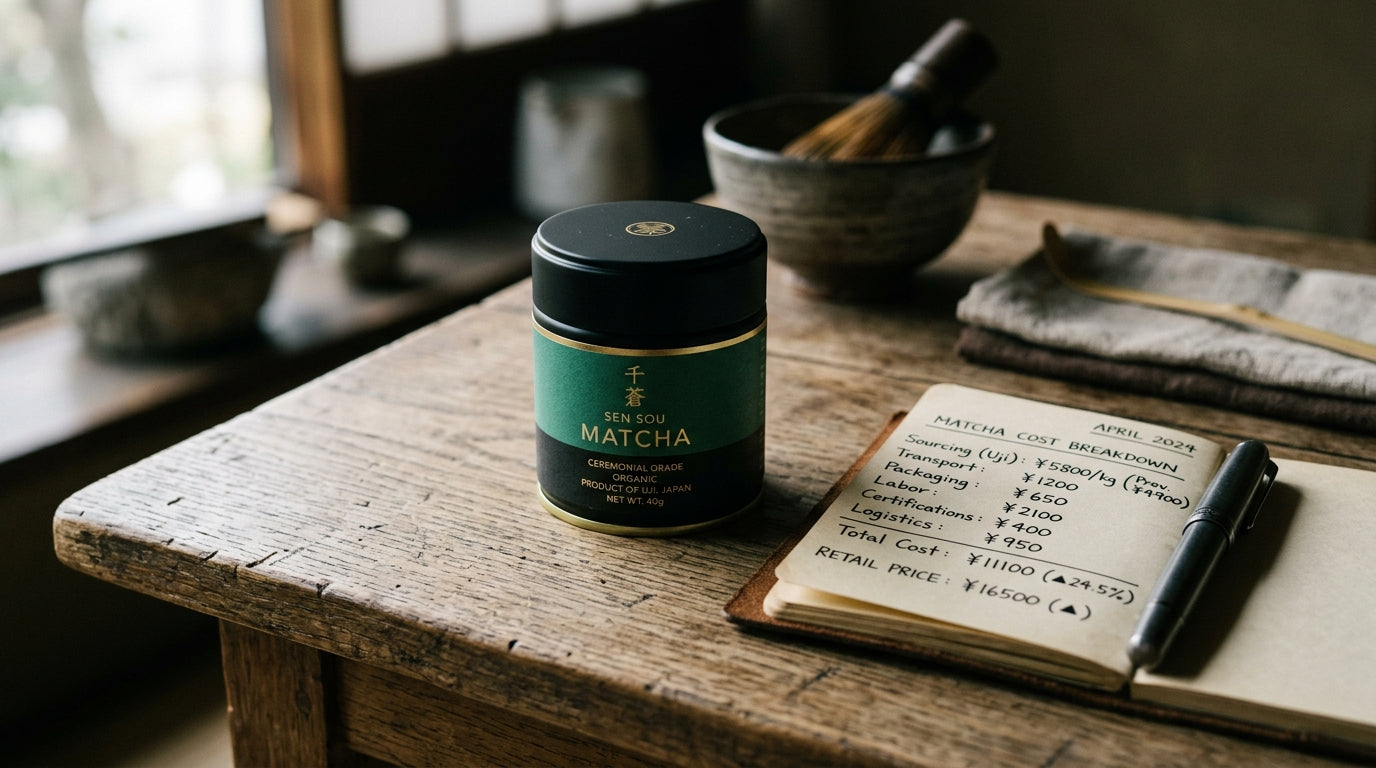
Here is a rough but honest breakdown of what shows up on a US small operator's invoice for a USDA Organic, JAS-certified, single-origin ceremonial 30g tin in early 2026. These are our numbers; other operators will have variants, but the structure is similar.
Tencha leaf, stone-ground: $19-22. This is the line that moved hardest from our supplier conversations. In 2023 the same line was about $11.
Tin and packaging: $1.50-2.50. Premium tins, oxygen-blocking liners, custom print runs. This component is roughly flat year-over-year.
Inbound freight from Japan: $1-2 per tin at small-importer volume. Has crept up with fuel and trans-Pacific cost.
USDA Organic + JAS certification fees, allocated: $0.50-1.00 per tin. Annual audits, soil testing, processing audits.
Third-party heavy-metal and pesticide lab work, per lot: $0.30-0.60 per tin allocated. We publish ours by lot on our Lab Results page; this is a real expense, not a marketing line item.
US fulfillment, storage, packing: $1.50-2.50 per tin (warehouse + pick + ship materials at small DTC volume).
Total honest landed cost in 2026: roughly $24-30 per 30g tin before any margin, marketing, customer support, or returns. In 2023 the same calculation was roughly $16-20.
That is why a USDA Organic ceremonial 30g tin priced under $25 in 2026 is economically very difficult to produce honestly. Some retailers run loss-leader promotions. Some brands subsidize with culinary-grade volume. But as a steady-state shelf price, the math does not close at the bottom of the range. Treat the price as data.
Why the Cost Will Not Snap Back in 6 Months
Short-term commodity spikes recover when the next harvest lands. The matcha situation is not a short-term commodity spike. It is a structural supply ceiling colliding with a structural demand floor, and there is no substitute that buyers will accept.
The labor base is aging out. Between 2000 and 2020, Japan lost 53,000 tea farmers to retirement, and the next generation has not stepped in at the same rate (Nio Teas). New tea plants take 4 to 5 years to reach maturity and yields stay low even then. So even an aggressive planting response now does not reach the shelf in meaningful volume until roughly 2030.
Production is geographically concentrated. Real ceremonial-grade tencha comes from a handful of regions: Uji (Kyoto), Nishio (Aichi), Kagoshima, and Shizuoka. When weather or disease hits one of them, the system has no slack to absorb it. Industry coverage of the 2024-2025 harvest stress documented yield reductions across multiple regions, with the supply tightening that translated directly into the wholesale price moves we saw on our invoices (Perfect Daily Grind).
Demand has not flinched. The global matcha market roughly tripled in production from 2010 to 2023, and the 2024-2025 demand wave (latte boom, social, daily ritual category acceptance) broke past what the existing fields could deliver. Japan's matcha export value reached approximately ¥400 billion ($2.7 billion) by 2025, up from ¥292 billion in 2023 (Real Gaijin newsletter, 2026).
Domestic Japan is also feeling it. Foreign green tea imports into Japan rose 82% to 5,801 metric tons in fiscal 2025 to backfill the domestic market emptied by export pull (Japan Times). When even Japanese consumers can't get enough Japanese green tea, the supply pressure is real.
Best-case path: the spring 2026 harvest is solid, demand growth softens, and prices stabilize at roughly current levels rather than rising further. A return to 2023 leaf prices is at least 24 months out and depends on the planting response landing, which it can't before 2030 in any meaningful volume.
Why You Are Paying More Even From Honest Brands
The trickiest part of the 2026 price reality is that integrity is more expensive than the alternative.
An honest ceremonial brand in 2026 has three options when leaf cost triples. One: keep the same tin, raise the price, explain why. Two: keep the price, swap the leaf for a non-Japanese cultivar or later-flush blend, do not change the front-of-tin language. Three: shrink the tin (28g instead of 30g, or 25g instead of 30g) and hold the apparent price.
Option one is the only one that maintains the tin's identity. We took option one in early 2026: same product spec, transparent price adjustment, founder-direct explanation. Some brands took option two. A few took option three.
The result for buyers is that price floors became reliability signals. A brand that quietly held 2023 prices through 2026 either has a margin source the rest of the industry doesn't have, or is making one of the silent quality trades that we covered in the counterfeit matcha guide. Brands that raised honestly are the ones whose lab reports and origin documentation tend to also hold up.
Founder-direct pricing communication is the cleanest signal. If a brand quietly raised prices without any acknowledgment, that's a question. If a brand explained the price move with reference to specific harvest data, certification cost, or supplier conversations, that's an answer.
Scarcity also fuels fakes: the same pressure pushing prices up raises the incentive to mislabel cheaper powder as premium Japanese matcha. Before any order, see how to spot counterfeit matcha, and the full 2026 shortage picture.
What a Fair Price Looks Like in 2026
If you have 30 seconds in front of a tin and want a heuristic, here is the one we use ourselves when checking competitive pricing:
Floor for honest USDA Organic + JAS-certified ceremonial 30g: roughly $28-32 in early 2026 retail. Below that, the math is hard to close honestly without quietly trading something away.
Reasonable mid-range for the same spec: roughly $32-42, depending on cultivar specificity, region named, and brand marketing layer.
Above $50 per 30g: usually a single-cultivar, named-farm, hand-picked first-flush from a flagship producer like Uji-Hikari or competition-grade Samidori. These exist and they are wonderful, but you are paying for harvest specificity, not for "premium" as a marketing word.
For more on the quality framework we use to evaluate tencha lots ourselves, see our buyer's guide for organic matcha. For more on the supply situation that drove the 2025-2026 price moves, see our 2026 matcha shortage explainer.
How One with Tea Adjusted
For full transparency: we adjusted our tin pricing in early 2026 to reflect what landed cost actually became. The move was meaningful, in the order of 25-35% on our flagship ceremonial line. We did not chase the headline. We did not blend. We did not swap to a non-Japanese cultivar. We did not shrink the tin.
What we did was hold the product spec and let the price move with the market. Same prefecture, same cultivar pool, same JAS plus USDA Organic certification stack, same per-lot heavy-metal and pesticide panels published on our Lab Results page. The only change is what it costs us to produce, and what we therefore charge.
If you're a cafe, restaurant, or brand exploring wholesale during this period, our wholesale program is taking on a small number of new accounts for the 2026 season, with allocation locked. If you've had a previous supplier raise prices 60% and offer an alternative blend at the old price, the conversation about real ceremonial supply is welcome.
Looking for matcha priced honestly through the 2026 supply reset?
USDA Organic and JAS certified, third-party lab tested, sourced from named Japanese regions.
Shop Matcha Collection Inquire About WholesaleHave a question about pricing or sourcing, or want to talk wholesale? Email info@onewithtea.com. I read every message that comes in.
For the latest on tencha pricing right now, see our breakdown of the 2026 Kyoto tencha opening auction and what it means for the rest of 2026.
Share:
How the 2026 Iran War Is Pushing Matcha Prices Higher
How the 2026 Iran War Is Pushing Matcha Prices Higher