



By Christian Mauerer, Founder of One with Tea · Published May 18, 2026
The 2026 opening tencha auction in the Kyoto Uji area landed with a jolt. Asahi Shimbun reported that the season's first auction prices climbed meaningfully above last year's opening, with industry observers describing it as one of the steepest year-over-year opening jumps in recent memory. For anyone buying ceremonial matcha this year, the opening auction is the single best read on what's coming to the shelf. So I want to walk you through what happened, why it matters, and what I'm doing about it from the sourcing side.
I source matcha for a small US brand. I've been tracking the Uji opening auction every spring since I started, because it's the closest thing the matcha world has to a futures market. When the opening prints high, the entire year's ceremonial inventory prints high with it.
Key Takeaways
- Kyoto Uji area tencha opening auction prices jumped at the 2026 first sale, per Asahi Shimbun reporting, continuing the supply-tight pricing pattern that began in 2024.
- The opening auction sets the ceiling for the rest of the season. Blenders who win the top lots use them to anchor every grade below.
- Japan's fiscal 2025 green tea exports hit a record 13,125 tonnes, up 42% YoY, with powdered tea at about 70% of volume, roughly 9,188 tonnes matcha-led (Nation Thailand / Kyodo, citing Japan Ministry of Finance).
- For US ceremonial tin buyers, expect another round of honest price adjustments through summer and fall 2026 as new-crop leaf flows into bags and tins.
- Stockpiling at retail rarely beats buying in steady cadence from a brand you trust. Real ceremonial matcha doesn't reward hoarding.
What happened at the 2026 Kyoto tencha opening auction?
The 2026 opening auction for Kyoto-area tencha printed significantly above the 2025 opening, according to Asahi Shimbun reporting on the first sale of the season. The opening event is hosted in the Uji-area tea trade and brings together the first-flush tencha lots from local producers and the master blenders who bid on them. The jump caught the trade press because openings rarely move this fast in two consecutive years.
This is the second year in a row that the opening printed steeply higher than the prior season. The 2025 opening already moved up sharply on the back of a weak harvest year and surging global demand. A second consecutive jump tells the trade that buyers don't believe supply pressure is easing yet.
The exact yen-per-kilogram figures published by Asahi Shimbun are most useful as a directional signal, not a single number to memorize. The signal is unambiguous: the top of the tencha market is more expensive in 2026 than it was in 2025, and 2025 was already a record.
The 2026 Kyoto Uji tencha opening auction printed prices materially above the 2025 opening per Asahi Shimbun reporting, the second straight year of double-digit-percent opening jumps. Industry context: Japan's FY2025 green tea exports hit a record 13,125 tonnes with ~70% powdered share (Nation Thailand / Kyodo, citing MOF).
Why this auction sets the tone for the whole 2026 matcha year
The Kyoto Uji opening auction is the bellwether event for matcha pricing globally. The lots sold at the opening are the most prestigious first-flush tencha of the year, won by the master blenders who anchor every downstream price for ceremonial-grade matcha. When the opening prints high, every grade below it prints high too.
Here's the cascade. The top Uji blenders win the flagship lots at the opening, often paying record prices for fame as much as for leaf. Those same blenders then bid on second-tier opening lots, regional auctions later in the season, and lower-grade tencha that flows through the rest of spring and into early summer. Each subsequent auction prices itself relative to the opening.
From the sourcing side, the practical effect is that my supplier conversations in late May and June feel different than they did six weeks earlier. The opening auction prints, and within ten days my supplier's quote sheet has been re-priced from the top down. Even mid-grade ceremonial tencha that didn't touch the opening event is suddenly quoted higher, because the blender's whole inventory is re-marked against the new top print.
For US buyers, this means the matcha that lands on shelves in late summer and fall 2026 will reflect this opening's pricing, not what was paid for the 2025 harvest. The inventory in tins right now is mostly 2025-crop or older. The next inventory cycle prices off of what just happened in Kyoto.
How tencha auctions actually work
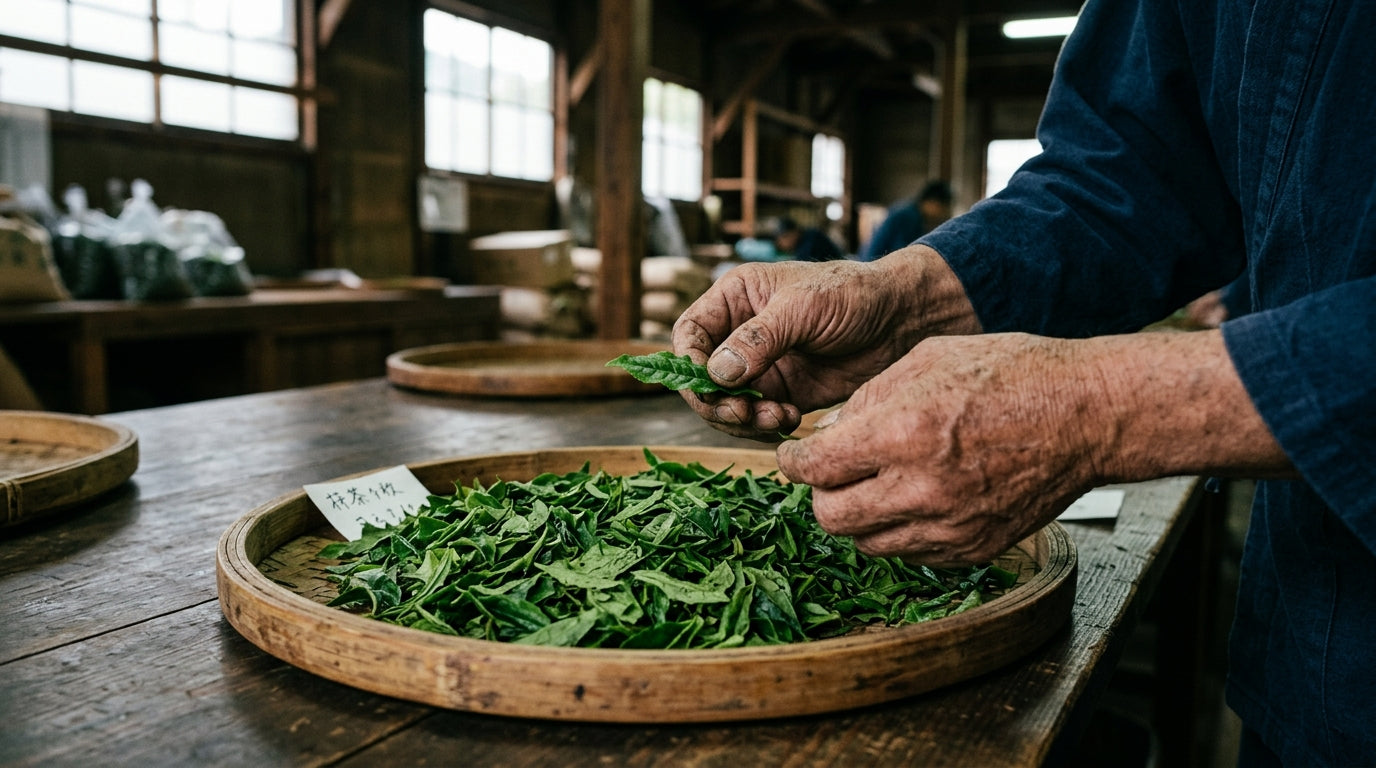
Tencha auctions are sealed-bid events run inside Japan's regional tea trade associations, with the Kyoto and Uji-area sales the most influential for ceremonial matcha. Producers bring first-flush leaf processed into tencha, master blenders inspect each lot for color, aroma, leaf integrity, and shading quality, then submit bids. The highest bid wins the lot, and the winning price becomes public reference data.
What gets auctioned
The top lots are typically hand-picked first-flush tencha from named producers in Uji, Wazuka, Minamiyamashiro, and surrounding tea villages in the Yamashiro region. The cultivars represented at the opening tend to be the prestige varieties for matcha: Samidori, Asahi, Gokou, Uji-Hikari, and Yabukita-derived selections grown under traditional honzu (reed shade) cultivation. Matcha Direct Kyoto has a useful primer on the seven main tencha cultivars for the Uji area.
Who bids
The bidders are master blenders, mostly long-established Kyoto blending houses that grind tencha into named matcha brands. They bid against each other because winning a top lot, even at a loss-leader price, builds the prestige of their seasonal release. The high prints at the opening are not always the most economically rational moves in isolation, but they make sense as part of the blending house's annual brand cycle.
Why the prints matter beyond the room
The auction prices are reported publicly through Asahi Shimbun, Kyodo, and the local Japanese tea trade press. Once the numbers are out, they become the anchor that wholesale tencha negotiations all over Japan price against. Even tencha auctions in Aichi (Nishio), Shizuoka, and Kagoshima for non-Uji ceremonial-grade leaf calibrate against the Uji opening as the reference point.
For background on Uji's role in Japan's tea industry, the Global Japanese Tea Association has a clean explainer on what tencha is and why it sits upstream of every legitimate matcha tin in the world.
What's driving the price jump in 2026?
Four pressures stacked on each other again this season, and the auction print reflects all four in one number. The same supply-demand stress that drove 2025's record-setting year is still in the system, and in some respects it's intensified.
The 2025 harvest stress carried over. Industry reporting through 2025 documented yield reductions across multiple matcha-producing prefectures, including weather pressure on Kyoto's spring shading window. Reserves built in earlier seasons have largely been drawn down, so the 2026 first-flush is doing more work than usual to cover the year's commitments.
Global demand kept climbing. Japan's fiscal 2025 green tea exports hit a record 13,125 tonnes, up 42% year-over-year, with powdered tea (mostly matcha) at about 70% of volume, roughly 9,188 tonnes matcha-led. Total export value rose 2.2x to ¥84.7 billion (Nation Thailand / Kyodo, citing Japan Ministry of Finance customs data). When export value grows roughly twice as fast as volume, that's buyers competing on price for a constrained product. Master blenders walking into the opening auction know this.
The labor base keeps shrinking. Japan lost roughly 53,000 tea farmers to retirement between 2000 and 2020 per Nio Teas industry coverage, and the next generation hasn't stepped in at the same pace. Tencha-specific cultivation, with reed-shaded honzu fields and the labor-intensive plucking and steaming, is the hardest to recruit into. The opening auction reflects that reality even when the spring weather cooperates.
Currency and trade conditions amplified the move. A weaker yen through 2025 made Japanese matcha cheaper for foreign buyers in dollar and euro terms, pulling more demand into the auction room than the supply could absorb at the old prices. The same currency move that helped US and European cafe chains stock up at favorable rates also raised the yen-denominated price domestic Japanese blenders had to pay to win the lots they needed.
What this means for ceremonial matcha prices on shelves this year
The shelf impact lands on a delay. Tencha auctioned at the May 2026 opening doesn't reach consumer tins until late summer at the earliest, and more typically through fall 2026 and into early 2027. So most ceremonial matcha sold through summer 2026 is still priced off the 2025 supply cycle. That's the inventory window where prices look stable. The 2026 opening prints will show up in the next inventory rotation.
From our own wholesale conversations this season, cafe and yoga studio buyers are asking the same question in slightly different words: "Is now the right time to lock my pricing for the next quarter?" My honest answer is that prices on real ceremonial-grade tencha are unlikely to retrace meaningfully in 2026, and the inventory you can buy at today's quote is mostly the last of the 2025-cycle leaf. Locking a quarter is a defensible move if your menu pricing has any margin for the upcoming inventory step.
If your favorite ceremonial tin holds 2025 prices through the second half of 2026, one of three things is happening: the brand is burning down 2025 inventory, the brand has unusually deep margin to absorb the input move, or the brand has quietly changed the leaf spec. The third scenario is the one to watch for. We covered how to spot quiet substitution in our counterfeit matcha guide.
For more on how 2026's price moves connect to the broader supply situation, see our 2026 matcha shortage explainer and our breakdown of why matcha prices are rising this year.
Ceremonial matcha tins on US shelves through summer 2026 are still priced off the 2025 supply cycle. The 2026 Kyoto opening auction print, materially above 2025 per Asahi Shimbun, will show up in the next inventory rotation, likely fall 2026 through early 2027. Japan's FY2025 export value rose 2.2x to ¥84.7 billion (Nation Thailand / Kyodo).
Should buyers stockpile or wait?
Stockpiling rarely beats steady buying for real ceremonial matcha. The product is alive in a meaningful sense. Once a tencha lot is stone-ground into matcha and sealed, oxidation starts the moment the seal breaks. Even with nitrogen-flushed tins kept refrigerated, the bright color and the sweet umami profile fade noticeably after about three to four months from open. Hoarding six tins at today's price means drinking three or four of them past their peak window.
For home drinkers
Buy what you'll drink in the next 60 to 90 days. If you have a daily morning ritual at 1 to 2 grams per bowl, a single 30g tin lasts most people two to three weeks, so one or two tins per order is the practical sweet spot. If you genuinely drink more, buy on a steady cadence rather than a single panic order.
For cafes and studios
Lock pricing for the next quarter if your menu has any margin to absorb the upcoming inventory step. The 2026 opening print signals that the fall 2026 supplier quote will be higher than today's. A 90-day lock at today's quote is usually defensible against a 10 to 20% step in October. Our wholesale program is taking on a small number of new accounts for the 2026 season.
For new buyers wondering what to try first
Start with a single tin of an honestly priced ceremonial-grade matcha and learn what real tencha tastes like before any stockpile question matters. Our beginner's guide to matcha walks through what to look for on the tin and how to evaluate the powder before you commit to a larger buy.
The contrarian read on the 2026 opening jump is that it's actually a healthy signal for the long-term matcha buyer. Two consecutive years of significant opening prints have done what years of low prices couldn't: they've finally made tencha farming economically attractive enough that some Japanese producers are quietly considering replanting and expansion. The matcha market spent two decades undervaluing the leaf, which is part of why the farmer base aged out. Sustained higher prices, painful as they are right now, are the first market signal that might pull new tencha capacity into the system. That capacity won't reach the shelf until roughly 2030, but the planting decision happens this year, off this year's auction print.
Frequently asked questions
Where can I read the original Asahi Shimbun report on the 2026 Kyoto tencha auction?
The original is on asahi.com, partially paywalled and in Japanese. Asahi Shimbun covered the 2026 opening tencha auction in Kyoto as part of its regular tea-trade reporting. Most of the detailed coverage is in Japanese and behind a subscription, but the directional headline of a significant year-over-year jump at the opening was picked up across the Japanese tea trade press in mid-2026.
How much did Kyoto tencha auction prices actually rise in 2026?
Materially above the 2025 opening per Asahi Shimbun, though exact figures vary by cultivar and lot. The 2025 opening was itself a record at the time. Exact yen-per-kilogram figures vary significantly by cultivar, producer, and lot. The trade signal is unambiguous: two consecutive years of double-digit-percent opening-auction increases, with no clear easing in supply pressure.
Why does the Kyoto auction matter more than other Japanese tencha auctions?
It sets the reference price that all other Japanese tencha auctions calibrate against. Kyoto Uji is the historical and prestige center of Japan's tencha industry. The Uji opening auction sets the reference price that other regional tencha auctions in Aichi (Nishio), Shizuoka, and Kagoshima calibrate against. When Uji prints high, every downstream ceremonial-grade tencha lot in Japan, including non-Uji regions, prices off that anchor for the rest of the season.
Should I expect my favorite ceremonial matcha tin to get more expensive in 2026?
Probably yes, on a delay, typically fall 2026 through early 2027. Most ceremonial tins on US shelves through summer 2026 are priced off the 2025 supply cycle. The 2026 opening auction print will show up in the next inventory rotation, typically fall 2026 through early 2027. Honest brands will explain the move when it happens. Brands that quietly hold the old shelf price may be quietly trading something on the leaf side.
Is the matcha price jump going to keep getting worse?
Plan for today's prices as the new normal for the next 24 to 36 months. Best case, the rest of the 2026 spring harvest stabilizes and the 2027 opening auction prints flat to 2026. A meaningful retracement toward 2023 prices requires both demand growth to cool and meaningful new tencha capacity coming online, and neither happens quickly. New tea plants take 4 to 5 years to mature.
Looking for ceremonial matcha sourced honestly through the 2026 supply reset?
USDA Organic and JAS certified, third-party lab tested, sourced from named Japanese regions including Uji and Kagoshima.
Shop Matcha Collection Inquire About WholesaleHave a question about pricing, sourcing, or the auction itself? Email info@onewithtea.com. I read every message that comes in.
Related reading from One with Tea: FY2025 Japan green tea export data · Japan vs China matcha production · Where matcha is grown · Global matcha production map · Is the matcha boom slowing down in 2026?
Share:
Is the Matcha Boom Slowing Down? FY2025 Data Says No
Ichikawa-en: Deep-Steamed Sencha from Makinohara, Shizuoka