

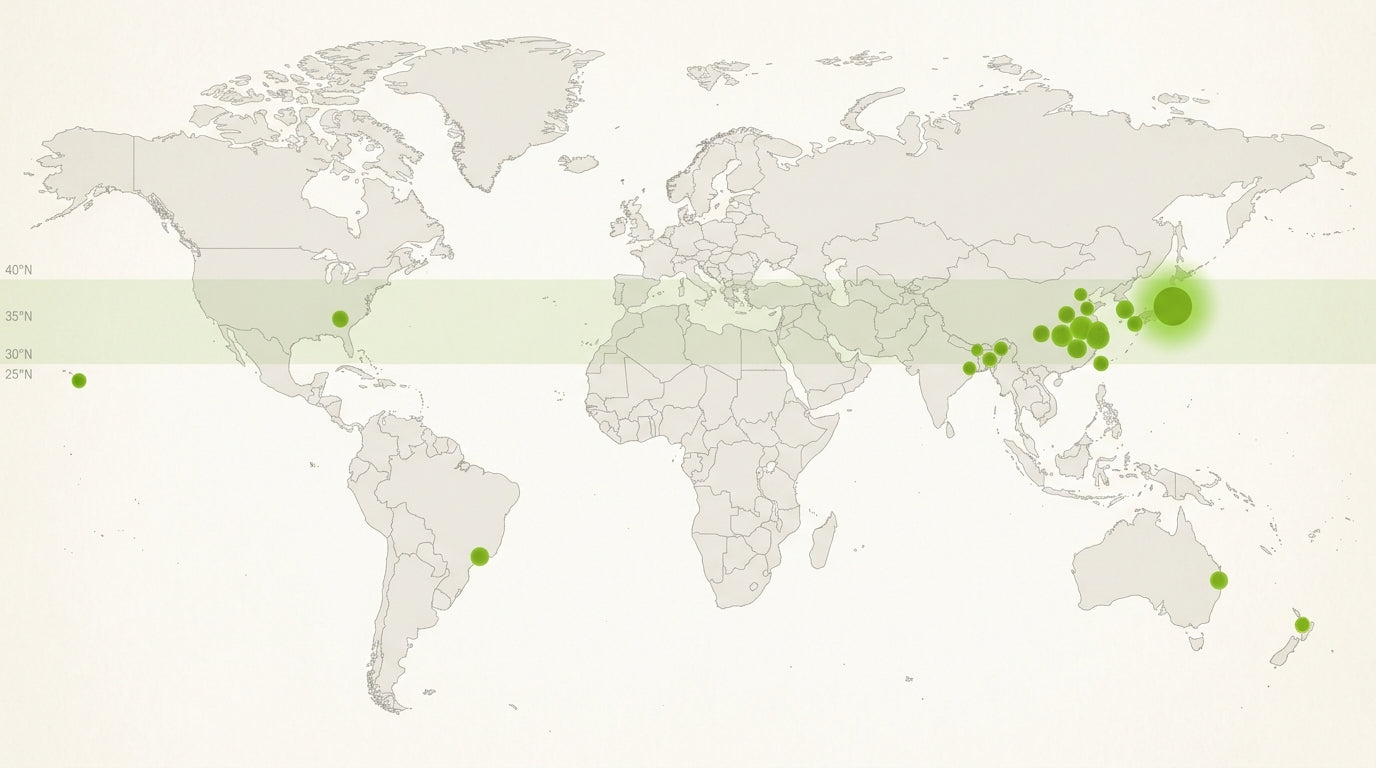
Matcha comes from Japan, and Japan still grows almost all ceremonial-grade matcha. Japan produced 6,278 tonnes of tencha, the shaded leaf that is stone-ground into matcha, in 2025, and the three biggest growing prefectures are Kagoshima, Kyoto and Shizuoka (Japan Ministry of Agriculture, Forestry and Fisheries, July 2026). China now makes more powder by sheer volume, but most of it goes into food and drink manufacturing. Korea, Taiwan, India, the US, Australia and New Zealand grow tea that has been turned into matcha only in small batches.
Christian here, founder of One With Tea. Most people assume every tin of matcha is Japanese. By volume, that stopped being true in 2025. For ceremonial grade, it is still nearly true. This is the map I use when I source, with the 2025 figures behind it.
Key Takeaways
- Country of origin: matcha as we drink it today is Japanese. The powdered-tea method came from Song-dynasty China and reached Japan with the monk Eisai in 1191, then faded in China while Japan kept and refined it.
- Japan: 6,278 tonnes of tencha in 2025, about 3.2 times the 2014 level. Kagoshima ranks first, Kyoto second, Shizuoka third (MAFF).
- China: more than 12,000 tonnes of matcha in 2025, put at 60 to 70% of world output depending on the report, led by Zhejiang (8,851 t) and Tongren in Guizhou (2,500 t) (People's Daily; Xinhua via Global Times).
- Exports: Japan shipped 13,125 tonnes of green tea in FY2025, up 42%, and powdered tea including matcha was about 70% of that volume (Nation Thailand / Jiji Press).
- Everywhere else: the tea plant grows outdoors in US hardiness zones 6 to 9, so you can grow it in much of the US. Making matcha takes shading, steaming, unrolled drying and milling on top of that, which is why output outside Japan and China stays tiny.
What country is matcha from?
Matcha is from Japan. That is the short answer to "matcha is from which country?" The longer answer has two countries in it, and both are part of the story.
The tea plant itself is not Japanese. The FAO places its origin somewhere across northeast India, northern Myanmar and southwest China, and notes that the exact spot is unknown (FAO). Powdered tea whisked with hot water was a Song-dynasty Chinese practice. The Zen monk Eisai brought tea seeds home from China in 1191 and planted them near Kyoto, and in 1214 he wrote the Kissa Yojoki, a treatise on drinking tea (Encyclopedia.com).
Over the following centuries, whisked tea faded in China as loose-leaf tea took over. In Japan it stayed, first in Zen temples and then in the tea ceremony, and growers around Uji developed the shading that turns ordinary leaf into tencha.
So the method was born in China, but the drink, the shaded leaf, the stone mill and the word "matcha" as the world uses it today all come from Japan. When a tin says "matcha" with no country on it, that history is exactly why you should check the label. More on what matcha actually is in our clear definition of matcha.

From our tea room
Organic Ceremonial Matcha Powder - USDA Certified (30g)
Stone-milled ceremonial grade, USDA Organic, third-party lab tested.
View Ceremonial MatchaWhere is matcha actually grown?
Matcha-style powdered green tea is now made in at least eight countries, but the tiers are not equal. Japan grows the leaf behind almost all ceremonial-grade matcha. China leads raw volume, mostly for lattes, bottled drinks, baking and ice cream. Everyone else is experimenting. No agency measures a "ceremonial-grade" share, because the term is unregulated, so treat any precise percentage you see for it with suspicion.
The short list of producing countries: Japan, China, South Korea, Taiwan, India, the United States, Australia and New Zealand. Two of them account for nearly all of the volume you will ever see on a shelf, and only one of those two reliably makes drinking-grade ceremonial matcha at scale.
The map is misleading if you do not split it by tier. A country can make "matcha" by the loosest definition, powdered green leaf, without making it by the strict Japanese one: leaf shaded for two to three weeks before picking, steamed, dried without rolling, then milled (MAFF). So when someone asks "is matcha only grown in Japan?", the honest answer is no for powdered green tea and very nearly yes for ceremonial matcha.
| Country | Main matcha regions | 2025 volume | Typical tier |
|---|---|---|---|
| Japan | Kagoshima, Kyoto (Uji), Shizuoka, plus Aichi (Nishio), Mie, Fukuoka (Yame) | 6,278 t tencha (raw leaf) | Ceremonial to culinary, full range |
| China | Zhejiang (Hangzhou, Shaoxing, Jinhua, Ningbo), Guizhou (Tongren) | 12,000+ t matcha | Mostly food industry and tea drinks |
| South Korea | Jeju, Boseong, Hadong | small batches, no published figure | Experimental / niche |
| Taiwan | Northern Taiwan (Sanxia) | small batches, no published figure | Experimental / niche |
| India | Assam, Darjeeling, Nilgiris | small batches, no published figure | Experimental / niche |
| United States | Hawaii, Southeast (AL, MS, SC) | small batches, no published figure | Experimental / niche |
| Australia / New Zealand | NSW (Madura), Waikato (Zealong) | small batches, no published figure | Experimental / niche |
Where is matcha grown in Japan?
Tencha, the leaf that becomes matcha, was 6,278 of Japan's 75,100 tonnes of crude tea in 2025, about 8%. It sells for about 4.9 times the price of sencha (MAFF). Demand has pulled that share up fast: 2025 tencha output was about 3.2 times the 2014 level. Three prefectures lead the ranking, and the order surprises most people who only know the word "Uji."
| Tencha rank (2025) | Prefecture | All crude tea, 2025 | What it is known for |
|---|---|---|---|
| 1 | Kagoshima | 30,000 t (Japan's #1) | Largest tencha volume, early harvests, mechanized farms |
| 2 | Kyoto (Uji, Wazuka) | 2,280 t | The heritage center and premium benchmark |
| 3 | Shizuoka | 24,100 t | Largest tea acreage, mainly deep-steamed sencha |
Kagoshima: Japan's biggest tencha grower
Kagoshima in southern Kyushu has ranked first in Japanese tencha since 2020. In 2024 it produced around 2,150 tonnes, about 40% of the national total, and at its May 2026 tencha trading event the average price reached about 19,000 yen per kilogram, roughly 1.8 times the year before (Global Japanese Tea Association). A warmer southern climate brings an earlier first flush, and gentle slopes with consolidated fields let riding harvesters cover about 99% of its tea area (MAFF). Buying at volume? See our guide to choosing a Japanese matcha supplier by region.
Kyoto: Uji, Wazuka and Yamashiro
Kyoto is the historic heart of matcha and ranks second in tencha. Eisai's seeds were planted around Kyoto, and Uji has supplied tea for the ceremony for centuries. The mountain village of Wazuka and the Yamashiro area grow much of the leaf that gets finished and blended in Uji. Kyoto's crude tea volume is small, 2,280 tonnes in 2025, but a large share of it is shaded leaf, and its hand-picked lots set the premium benchmark. Its May 2026 opening tencha market averaged 13,972 yen per kilogram for machine-picked leaf, about 1.7 times the previous record (Global Japanese Tea Association). Why that matters for supply is in the 2026 matcha shortage explainer.
We keep the full record: our sourced chronology of tea, 486 dated entries.
Shizuoka: the most tea fields, third in tencha
Shizuoka has more tea acreage than any other prefecture, 11,600 hectares, and mostly makes sencha, especially deep-steamed fukamushi. It ranks third for tencha (MAFF). The older idea that Shizuoka is Japan's biggest tea producer is out of date: Kagoshima passed it on volume in 2024.
Aichi (Nishio), Mie and Fukuoka (Yame)
Aichi's Nishio area has grown tencha for generations and still turns out large amounts of culinary and mid-tier matcha. Mie produces shaded teas used heavily in blends, and Fukuoka's Yame is best known for gyokuro, with small, high-quality matcha lots. Our deeper guide to matcha growing regions in Japan walks through each one, and Japan's tea production by region has the full prefecture data.
Where is matcha made, not just grown?
Growing the leaf and making matcha are two steps, often in two places. Tencha is processed near the field: the shaded leaf is steamed, then dried without the rolling that sencha gets (MAFF). Stems and veins come out, and the flakes are stored cold. Milling into powder often happens later and somewhere else, at a finisher or blender, so the place on the tin is not always the place the leaf grew.
That is also why "product of Japan" says less than it seems. It tells you where the tea was finished, not which prefecture grew it. The full journey from leaf to powder is in what matcha is made of.
How big is Chinese matcha production really?
China is now the world's largest matcha producer by volume. Output passed 12,000 tonnes in 2025. Xinhua puts that at about 60% of global production and People's Daily at nearly 70%, both drawing on industry association data. The sector has compounded about 28.7% a year over the past nearly five years (Xinhua via Global Times; People's Daily). The share depends on how you count Japan, so read either number as "more than half."
Two regions carry most of it. Zhejiang, better known for Longjing green tea, has four matcha areas (Hangzhou, Shaoxing, Jinhua and Ningbo) and produced 8,851 tonnes in 2025. Tongren in Guizhou produced 2,500 tonnes, and its matcha goes mainly to the international food industry and new-style tea drink chains (People's Daily). Tongren only switched from leaf tea to matcha around 2018 (China Daily).
The honest framing has changed, and older articles (including an earlier version of this one) get it wrong. Some Chinese factories now run Japanese-style tencha lines, with steaming, drying and precision grinding (People's Daily), and Tongren has started shipping matcha to Japan by the tonne (People's Daily, 2025). What China has not built at scale is the drinking-grade tier: the shaded first-flush leaf, cultivars and slow stone milling that whisked ceremonial matcha depends on. It is competing for the latte, bakery and bottled-drink shelf, and winning it on price. The full comparison is in our Japan vs China matcha breakdown.
What about South Korea, Taiwan and the rest of Asia?
South Korea, Taiwan and India all grow green tea, and all three have small matcha or matcha-style operations. None publishes a matcha figure that would register on a global map. The shading setup and the tencha processing chain simply have not been built at scale outside Japan and China.
South Korea: Jeju, Boseong and Hadong
Korea's three main tea areas are volcanic Jeju Island, Boseong on the southern coast, and Hadong near Jirisan. Most Korean tea is steamed or pan-fired loose leaf. Powdered tea exists, mostly as a small specialty line.
Taiwan: oolong first, matcha small
Taiwan is famous for high-mountain oolong, not matcha. Its best-known green tea comes from Sanxia outside Taipei. Matcha-style production is small and mostly culinary.
India: experimental
India is one of the world's largest tea producers, overwhelmingly black tea from Assam, Darjeeling and the Nilgiris. A few specialty estates have tried shaded and powdered green tea, but India is not a meaningful matcha producer yet. Vietnam, Indonesia and Sri Lanka could plausibly follow if export demand pulls them in.
Where can matcha grow? The climate it needs
Matcha can grow anywhere the tea plant, Camellia sinensis, grows, which is wider than most people think. NC State Extension lists it as hardy in USDA zones 6a to 9b, with the small-leaf Chinese variety (var. sinensis) taking colder winters into zone 6 and the large-leaf Assam variety hardy from zone 7 south (NC State Extension). It wants acidic soil below pH 6.0, good drainage, and full sun to partial shade.
The plant is the easy part. What limits matcha is everything after it:
- Shading: two to three weeks under reed, straw or cloth before picking (MAFF). This is what gives matcha its deep green color.
- Fast steaming: fresh leaf has to be steamed the same day, which means a factory near the field.
- Tencha drying: a dedicated tencha dryer that dries the leaf without rolling, unlike sencha lines.
- Milling: traditional granite mills grind slowly to keep the powder cool and fine.
Each of those is equipment and know-how that took Japan centuries to build, and it is why the matcha map looks so much narrower than the tea map.
Are there matcha farms outside Asia?
Yes, but they are tiny. The United States, Australia and New Zealand all have small commercial tea farms, and a few have made matcha-style powder in micro batches. None of these countries publishes a matcha production figure.
United States: Hawaii and the Southeast
Hawaii has the most established US tea scene, with small farms on the Big Island and other islands making green tea, oolong and the odd batch of powdered green tea. On the mainland, small farms in the Southeast, including Alabama, Mississippi and South Carolina, grow tea and have experimented with matcha-style powder. The US League of Tea Growers connects these farms.
Australia and New Zealand
Australia's best-known estate is Madura in northern New South Wales, mostly black and green tea. New Zealand's Zealong estate in Waikato makes oolong, black and green tea from Taiwanese cultivars. Matcha in both countries is experimental.
Can you grow matcha in the United States, or at home?
You can grow the plant in much of the US, from zone 6 southward, in the ground or in a pot (NC State Extension). Making real matcha from it at home is a different matter. You would need to shade the bush for two to three weeks before picking, steam the leaves right away, dry them without rolling, strip the stems and veins, and grind the flakes very fine. A home project can give you a pleasant powdered green tea. It will not taste like shaded first-flush Japanese tencha, and that gap is why US matcha stays at micro-batch scale.
When we sample teas from non-Japanese producers at One With Tea, the pattern I see most is solid green tea basics without the shading-and-milling stack that defines matcha. The plant travels. The craft does not travel easily.
Why hasn't ceremonial matcha scaled outside Japan?
Four things keep ceremonial matcha concentrated in Japan: cultivars, shading infrastructure, the processing chain and climate. Japanese growers use cultivars selected for shaded leaf, such as Samidori, Asahi, Okumidori and Saemidori, and a new tea cultivar takes many years to breed, test and plant out.
Traditional reed-and-straw shading over trellises is labor-heavy, and even the simpler black-cloth method is an installed cost for a new grower. The steaming, tencha-drying and milling steps each need specialized machinery and people who know how to run it.
Climate is the last barrier, and the softest one. Japan's tencha prefectures sit between about 31°N and 35°N, with mist, river-valley humidity and cool nights. Parts of southern Korea, mountain Taiwan, the US Southeast and northern New Zealand fit that profile, but the cultivar and craft barriers still sit on top.
Price shows the moat. Japan's 2025-crop average tencha price across all harvests was 8,562 yen per kilogram, and first-flush tencha 10,030 yen, against 2,428 yen for first-flush green tea overall (MAFF). Growers get paid for shaded leaf because few places can make it. For what that means at the shelf, see why matcha prices are rising in 2026 and our 2026 matcha industry outlook.
What does the global production map mean for buyers in 2026?
Where matcha is grown now matters as much as the grade on the label. Japan's green tea exports reached 13,125 tonnes in FY2025, export value more than doubled to 84.7 billion yen, and powdered tea was about 70% of the volume (Nation Thailand / Jiji Press). In our own sourcing, tight Japanese supply means we see more non-Japanese matcha on US shelves, which makes origin clarity more important, not less. We break down Japan's export boom separately.
What "Japanese matcha" actually means on a label
"Japanese matcha" can mean tencha from any of several prefectures, or a blend of them. A lot of ceremonial-tier matcha sold abroad is finished in Kyoto from leaf grown in Kyoto, Kagoshima and elsewhere. Single-prefecture or single-estate matcha is rarer but easier to find each year. The strongest label is prefecture + cultivar + harvest year + named producer.
What to look for if you care about origin
Look for a named prefecture (Uji, Kagoshima, Nishio, Shizuoka, Yame), a cultivar (Samidori, Okumidori, Asahi, Saemidori), the harvest year rather than the packing date, and a named producer. JAS Organic is Japan's government organic seal, and it is recognized by USDA Organic under the US-Japan organic equivalence arrangement (USDA AMS). More in where to buy authentic Japanese matcha and how to tell real Japanese matcha from a counterfeit.
What this means for café operators
For cafés buying wholesale, start with the use case. Matcha whisked straight needs Japanese tencha, ideally with prefecture and cultivar on the spec sheet. Lattes can run on Japanese culinary grade, and most customers will not notice the difference under milk and sweetener. Baking, ice cream and bulk drinks sit firmly in the price tier where Chinese volume competes. See our wholesale matcha for cafés and studios.
Frequently asked questions
What country is matcha from?
Matcha is from Japan. The powdered-tea method came from Song-dynasty China and reached Japan when the monk Eisai returned in 1191, but it faded in China while Japan developed shaded tencha, stone milling and the tea ceremony. Today Japan grows the leaf behind almost all ceremonial matcha.
Is matcha only grown in Japan?
No. Matcha-style powdered green tea is also made in China, South Korea, Taiwan, India, the United States, Australia and New Zealand. China actually makes the most by volume, over 12,000 tonnes in 2025. Ceremonial-grade matcha, made from shaded, steamed, unrolled and finely milled tencha, still comes almost entirely from Japan.
Which country produces the most matcha?
By volume, China: more than 12,000 tonnes in 2025, mostly from Zhejiang and Guizhou and mostly for food and drink makers. Japan grew 6,278 tonnes of tencha, the raw leaf for matcha, in 2025 and dominates the drinking-grade tier.
Where is matcha grown in Japan?
The top three tencha prefectures in 2025 were Kagoshima, Kyoto and Shizuoka, in that order. Aichi (Nishio), Mie and Fukuoka (Yame) also grow it. Kyoto's Uji is the historic center, while Kagoshima now grows the most.
We track the production side: where Japan's tea is really grown.
Is Chinese matcha real matcha?
It is real powdered green tea, and some Chinese factories now use Japanese-style steaming and tencha drying lines. Most of it is made for lattes, baking and bottled drinks rather than for whisking straight, and "matcha" has no single international standard, so check the origin and grade on the label.
Can you grow matcha in the United States?
You can grow the tea plant in USDA zones 6 to 9 in acidic, well-drained soil. Turning it into matcha needs two to three weeks of shading before harvest, quick steaming, drying without rolling and fine milling, so US matcha remains a micro-batch, experimental product.
Will matcha production expand outside Japan?
Volume yes, the ceremonial tier slowly. Chinese output has compounded about 28.7% a year over the past nearly five years. Building Japan's full stack of shade cultivars, shading, tencha processing and milling takes decades, so drinking-grade matcha should stay concentrated in Japan for years to come.
The takeaway
The global matcha map is shaped like an iceberg. Japan sits at the top, growing the shaded leaf behind almost all ceremonial matcha, now led by Kagoshima with Kyoto and Shizuoka behind it. China sits underneath with the largest volume of powder, mostly for food and drinks. Korea, Taiwan, India, the US, Australia and New Zealand appear on the map, but at experimental scale.
For buyers, "where is matcha grown" is the wrong question asked alone. The useful question is which tier is grown where, and what the bag in your hand actually tells you. Prefecture, cultivar, harvest year and producer carry more information than a country name.
We are filming the longer version, including the family farms we work with in Uji and Kagoshima, for our One With Tea documentary.
Written by Christian Mauerer, founder of One With Tea. We source single-origin Japanese matcha directly from family farms in Uji and Kagoshima. Japanese figures come from MAFF and the Global Japanese Tea Association; Chinese figures come from the China Tea Marketing Association as reported by People's Daily and Xinhua. Updated October 6, 2026.
Looking for ceremonial matcha sourced honestly from named Japanese regions?
From JAS-certified family farms, third-party lab tested. USDA Organic on our ceremonial, latte and strawberry matcha.
Shop Matcha CollectionInquire About Wholesale
Share:
Japanese Tea Producers: 5 Voices Reshaping the Matcha World
Matcha and Cortisol: What the Research Actually Says About Stress (2026)