



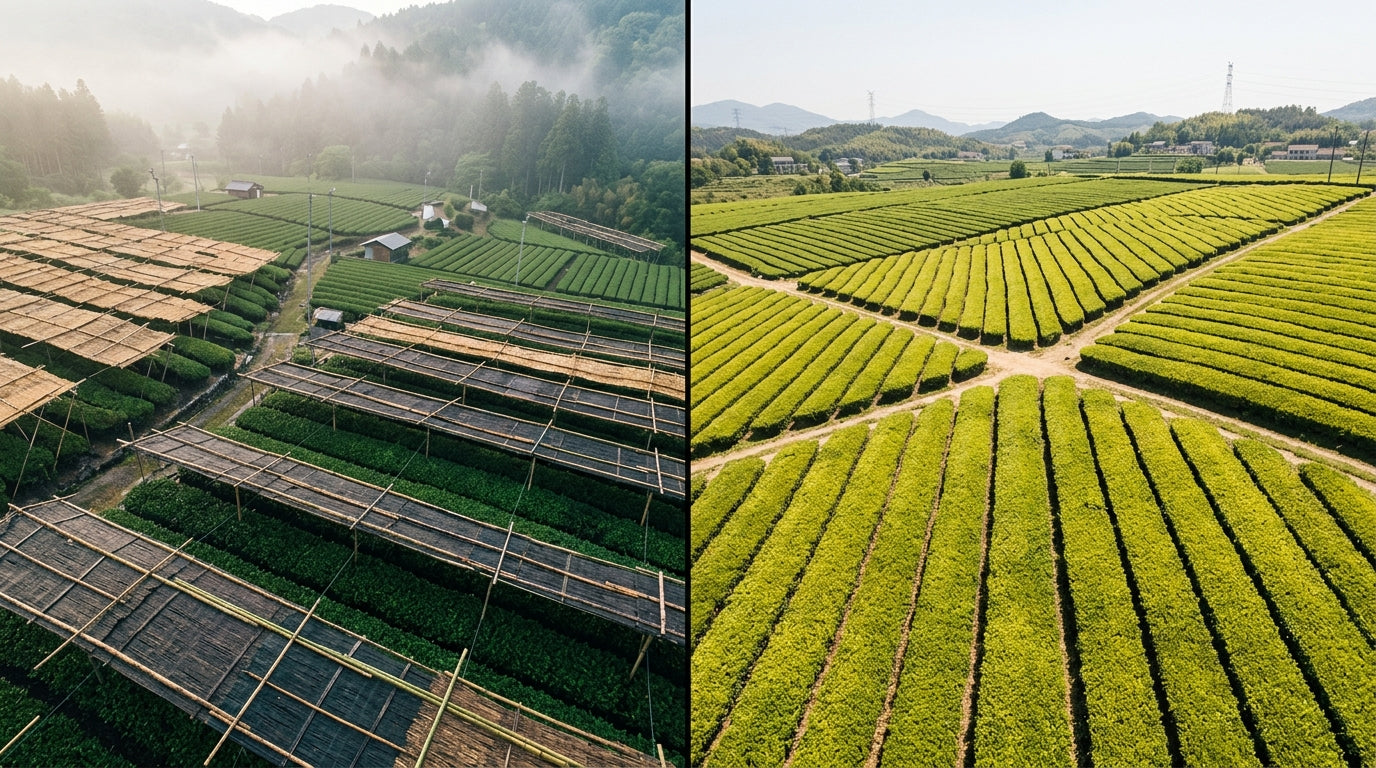
Japan vs China Matcha Production: How the Two Industries Really Compare in 2026
Updated October 16, 2026 with 2025 production figures from both countries and Guizhou's draft tencha standard.
Christian here, founder of One With Tea. I get asked this question every week. Someone is comparing a 30 dollar tin of Japanese ceremonial matcha against a 12 dollar bag of Chinese matcha on Amazon and wants to know if they are the same thing. The short answer is: sometimes they are closer than you think, and usually they are not. The longer answer is more interesting than a side by side price tag, and it changed a lot in the last two years.
Japan's green tea exports hit 13,125 tonnes in FY2025, up 42% year over year, with matcha-style powdered tea accounting for roughly 70% of that volume (Nation Thailand / Jiji Press, 2026). At the same time, Japan imported 5,801 tonnes of green tea from China and other countries, up 82%. Both numbers are real. The question is what they mean when you are buying matcha. Japan tea export surge breakdown
The short answer
China now makes more matcha than Japan: over 12,000 tonnes in 2025 (Xinhua via Global Times), against 5,336 tonnes of tencha in Japan in 2024 (Reuters via Malay Mail). Its top matcha-exporting region, Guizhou, has also copied the core of the Japanese method, with 15 to 20 days of shade and steam fixing in Guizhou's draft tencha standard (Guizhou tencha draft standard). What still separates them is the top tier: cultivars bred in Japan for tencha, slow stone milling, and a label you can trace to a prefecture and a producer. Cheap "matcha" made from unshaded green tea is a different product in both countries.
From our tea room
Organic Ceremonial Matcha Powder - USDA Certified (30g)
Stone-milled ceremonial grade, USDA Organic, third-party lab tested.
View Ceremonial Matcha

Key Takeaways
- Japan exported 13,125 tonnes of green tea in FY2025, up 42% year over year, with powdered tea (mostly matcha) at ~70% of volume (Nation Thailand / Jiji Press, 2026).
- China produced over 12,000 tonnes of matcha in 2025, about 60% of global output by one count and nearly 70% by another (Xinhua via Global Times; People's Daily). Japan produced 5,336 tonnes of tencha, the leaf matcha is milled from, in 2024 (Reuters via Malay Mail).
- Japan also imported 5,801 tonnes of green tea (up 82%) from China and other countries (Nation Thailand / Jiji Press), and Chinese matcha now ships to Japan by the tonne: Guizhou's Gui Tea Group sent 16 tonnes there between January and November 2025 (People's Daily).
- Japan defines tencha as leaf from fields shaded for about 2 to 3 weeks, steamed and dried without rolling (Kyoto Tea Chamber). Guizhou's draft standard asks for 15 to 20 days of shade and steam fixing (Guizhou tencha draft standard). On paper, the best Chinese tencha is now made the Japanese way.
- Japanese tencha cultivars (Asahi, Samidori, Okumidori, Yabukita, Saemidori, Gokō, Ujihikari) were bred in Japan and registered between 1953 and 1990 (Matcha Direct Kyoto, 2026).
- Based on our 2026 wholesale inquiries, Japanese ceremonial typically ranges from 145 to 475 USD per kilogram, while Chinese matcha typically wholesales from 20 to 80 USD per kilogram. The spread reflects structural cost, not brand markup.
Is Chinese matcha real matcha?
It depends which Chinese matcha you mean. If it is milled from shaded, steamed tencha, it is real matcha by Japan's own definition. If it is ground-up open-field green tea, Japan would not call it matcha at all. Both are sold under the same word in the US, and that is the whole problem.
Japan's green tea labeling standard, an industry standard quoted by the Kyoto Prefecture Tea Chamber of Commerce and Industry, defines matcha as tencha (leaf from shaded fields, dried without rolling) milled into a fine powder "with a stone mill or similar." The chamber's own note adds that tencha milled on modern machines such as ball mills also counts as matcha. Powder made from any other tea is funmatsucha (粉末茶, "powdered tea"), a separate label. China has its own national matcha standard too, GB/T 34778-2017, in force since May 2018. In Chinese the word is written with the same two characters, 抹茶 (mǒchá); our piece on what the word matcha means breaks them down.
None of that protects the English word. Outside Japan and China, "matcha" has no binding definition at all, so a bag of powdered sencha can sit next to stone-milled Uji tencha under the same name. The method matters more than the passport.
The cleanest mental model I can give you: think of Japanese ceremonial matcha the way you would think of Champagne. Sparkling wine made elsewhere can be excellent, but if it does not come from Champagne, France, using the specific grape varieties and method, it is not Champagne. Same logic applies here, except matcha has no protected designation of origin, and some of what China makes now really is matcha. So buyers have to read past the country to the method and the producer.
Citation capsule: Japan's industry tea labeling standard defines matcha as tencha, leaf shaded for about 2 to 3 weeks, steamed and dried unrolled, then milled by stone mill or an equivalent machine; powder from any other tea is labeled funmatsucha (Kyoto Tea Chamber). Guizhou, one of China's two core matcha regions, now writes the same shading and steaming steps into its own draft tencha standard (Guizhou tencha draft standard), so "Chinese matcha" covers both genuine tencha powder and ordinary powdered green tea.
Is matcha Chinese or Japanese?
Both, in sequence. Whisked powdered tea started in China, and the shaded tencha that defines modern matcha was developed in Japan. China Daily puts the Chinese view plainly: "The drinking of matcha originates from ancient China, and was later introduced to Japan" (China Daily via CTMA, 2025).
The Japanese side of the story starts with the Zen monk Eisai. According to the Kyoto Tea Chamber, history of Uji tea, he brought tea seeds and the way of drinking tea home from China at the start of the Kamakura period. His friend, the monk Myōe, planted some at Kōzan-ji in Kyoto, and cultivation spread from temple to temple, Uji among them. The step that turned that tea into matcha as we know it came later and in Japan: shaded cultivation began in Uji after the Ōnin War (1467-77), and the chamber credits it with a big jump in umami.
China's modern matcha industry, by contrast, is young. Gui Tea Group helped build a matcha industrial park in Jiangkou, Guizhou, in 2017 and landed its first North American export order in 2019 (China Daily via CTMA). Zhejiang Xiangyu Tea began matcha production in 2019 (People's Daily). So the honest answer to "is matcha Chinese or Japanese?" is: Chinese roots, Japanese method, and since the late 2010s a fast-growing Chinese industry that copies that method.
Japan vs China matcha production: the industry numbers
By volume, China passed Japan some time ago. The China Tea Marketing Association puts Chinese matcha output above 12,000 tonnes in 2025, about 60% of global production (Xinhua via Global Times). The 2026 China Matcha Industry Development Report, as reported by People's Daily, says nearly 70%, with output compounding at 28.67% a year over the past five years (People's Daily). Japan produced 5,336 tonnes of tencha in 2024, about 2.7 times its output ten years earlier, according to the Japanese Tea Production Association (Reuters via Malay Mail).
| Measure | Japan | China |
|---|---|---|
| National output | 5,336 t of tencha (2024) | 12,000+ t of matcha (2025) |
| Growth | ~2.7x in ten years | 28.67% a year for ~5 years |
| Key regions | Kyoto makes about a quarter of tencha | Zhejiang 8,851 t (2025); Gui Tea Group, Guizhou, 2,500+ t sold (2025) |
| Trade | 13,125 t green tea exported, FY2025 | Zhejiang exported 1,242 t of matcha in Q1 2026 alone, up 7.3x |
Here is how I read those numbers as someone who buys on the Japanese side. The two industries are mostly not competing for the same cup. Chinese growth is coming from lattes, bakeries and drink chains, the shelf where price per kilo wins. Japan's growth is tencha for whisked and premium matcha, where the price has gone the other way: our breakdown of the 2026 Kyoto tencha auction shows what the shortage did to it. The overlap is growing, though. Guizhou's Gui Tea Group shipped 16 tonnes of matcha to Japan between January and November 2025 (People's Daily), which means some Chinese matcha now ends up inside the Japanese supply chain. That is why the producer name on the label matters more every year.
Citation capsule: China produced more than 12,000 tonnes of matcha in 2025, roughly 60 to 70% of global output depending on the source (Xinhua via Global Times; People's Daily), while Japan produced 5,336 tonnes of tencha in 2024, 2.7 times its level a decade earlier (Reuters via Malay Mail). China leads on volume for food and drink use; Japan leads on the shaded, stone-milled drinking tier.
How is Japanese matcha grown differently from Chinese matcha?
Four production steps decide the cup: shading, cultivar, fixing and milling. Ten years ago China differed on all four. Today its best producers match Japan on the first and third, so the real gaps are the cultivar and the mill, plus everything a cheap "matcha" powder skips. Japan's tea labeling standard sets the baseline: tencha comes from fields covered for about 2 to 3 weeks before picking, steamed and dried without rolling (Kyoto Tea Chamber).
| Production step | Japanese ceremonial matcha | Chinese tencha matcha (Guizhou standard) | Budget "matcha" powder |
|---|---|---|---|
| Shading | About 2 to 3 weeks under cover | 15 to 20 days under shade | None (open-field leaf) |
| Cultivar | Asahi, Samidori, Okumidori, Yabukita, Saemidori, Gokō (bred 1953-1990) | "Suitable" cultivars, not specified | Whatever green tea is cheapest |
| Fixing method | Steamed | Steam, or steam plus hot air | Varies, including pan-fired |
| Leaf prep | Dried unrolled, stems separated into tencha | Dried, stems and leaf separated | Often ground whole leaf |
| Grinding | Stone mill for top grades (~40 g per hour); ball mills also allowed | Ball mills at Gui Tea Group | Industrial mills |
| Wholesale price (USD/kg) | $145 to $475 (ceremonial tier) | $20 to $80 (typical export "ceremonial") | Lowest tier |
Shading: weeks under cover, now in both countries
Shading was developed in Japan, not China. It began in Uji after the Ōnin War (1467-77), in the late Muromachi period (Kyoto Tea Chamber, history of Uji tea). When you cover a tea plant for weeks before picking, it shifts its chemistry: less catechin (the bitter compound), more L-theanine (the sweet, umami amino acid). That is what gives matcha its character.
This is the step that has changed most in China. Guizhou's draft tencha standard, drafted by two Gui Tea Group companies and five other Guizhou producers, says to harvest after 15 to 20 days under shade, once 70% of the terminal buds have disappeared and three to five leaves have opened (Guizhou tencha processing standard, public-comment draft). That is in the same range as Japan. The budget powders that undercut everyone online are another story: ground from unshaded green tea, they taste grassier and more astringent, and in Japan they would be labeled funmatsucha, not matcha.
Cultivar: bred for tencha vs general green tea cultivars
Japanese tencha comes from cultivars bred specifically for shaded growth. The Matcha Direct Kyoto cultivar guide lists the major ones, all with documented release years and breeders: Asahi (1954, Jinnojo Hirano), Samidori (1954, Masajiro Koyama), Ujihikari (1954, Kyoto Tea Industry Research Division), Yabukita (1953, Hikosaburo Sugiyama), Okumidori (1974, NARO), Saemidori (1990, NARO), Houshun (2006, Kyoto Tea Industry Research) (Matcha Direct Kyoto, 2026).
The regional picture is here: which Japanese prefectures actually grow the tea.
About 75% of all tea grown in Japan is Yabukita, the workhorse cultivar (Tezumi Insights). The higher-grade matcha cultivars (Asahi, Samidori, Gokō) are deliberately chosen for thin, flat leaves that devein and grind well into tencha. Chinese tencha comes from regional cultivars; Guizhou's draft standard only asks for ones "suited" to the job (Guizhou tencha draft standard), and the cheapest powders use whatever green tea is on hand. Different starting genetics, different ceiling on the final product.
Fixing: steam on both sides now, pan-fire at the bottom
This used to be the cleanest split between the two traditions, and for the matcha that matters it no longer is. Japanese tencha is steamed straight after picking (Kyoto Tea Chamber), which stops oxidation and keeps the vivid green color (Naoki Matcha). Chinese green tea is traditionally pan-fired, but China's leading matcha makers have switched: Guizhou's draft standard specifies steam, or steam plus hot air (Guizhou tencha draft standard), and Zhejiang Xiangyu Tea runs eight tencha lines that steam, dry and precision-grind the leaf (People's Daily).
Pan-fired leaf still turns up in the cheapest matcha-style powders. Pan firing tends to bring a roasted note and a duller green, which you can see in the bowl before you taste it.
Grinding: stone mill vs ball mill, a grade line more than a border
Traditional Japanese tencha is ground on granite stone mills at low speed. The standard pace is about 40 grams of matcha per hour per mill (My Japanese Green Tea; Naoki Matcha). The slow speed matters. Going faster generates friction heat, which damages the matcha. Ball mills grind much faster, with a different particle distribution, and ball-milled powder tends to feel heavier and less airy in the mouth. China Daily describes Gui Tea Group, a leading Guizhou producer, grinding its sterilized green tea "by a series of ball mills" (China Daily via CTMA). But the Kyoto chamber also counts ball-milled tencha as matcha (Kyoto Tea Chamber). So the mill tells you more about the grade than about the country: stone-milled is the drinking tier, wherever it is made.
Stone-ground matcha process explained
What does the taste difference actually feel like?
Side by side, the taste gap is not subtle. Japanese ceremonial matcha leads with umami and finishes with a long, sweet aftertaste. Chinese matcha typically leads with grass and finishes short, sometimes with a tannic bite. The difference comes from the shading (more L-theanine) and the cultivar (bred for shaded sweetness), not the price tag.
Last fall I ran a blind taste test on four samples for myself and two friends in the kitchen. Sample one was a single-origin Uji ceremonial from a small producer we work with. Sample two was a mid-grade Kagoshima ceremonial. Sample three was a popular Anhui-sourced "ceremonial grade" matcha we picked up from a national grocery chain. Sample four was a culinary-grade Japanese matcha (for baking, not drinking). We whisked all four the same way: 2 grams, 70 ml water at about 75°C, bamboo chasen, no sugar, no milk.
Here is what we logged:
- Sample 1 (Uji single-origin): Bright green color, dense foam, opening note of sweetcorn and seaweed, long finish, no astringency. Two of three tasters ranked it first.
- Sample 2 (Kagoshima ceremonial): Deep green, good foam, more straightforward umami, slightly shorter finish. Solid daily drinker.
- Sample 3 (Anhui "ceremonial"): Olive-green color, thinner foam, opening note of fresh-cut grass, finish ended in a faint metallic bite. All three of us said we would not drink it straight again.
- Sample 4 (Japanese culinary): Yellow-green, broke up into clumps, mild bitter finish. Designed for milk and sugar, not for whisking.
That last detail is worth dwelling on. The Japanese culinary-grade matcha, which costs less than the Anhui "ceremonial," still came from shaded tencha and ground tencha cultivars. It was just blended for baking. The Anhui product was marketed as the higher tier but tasted closer to a powdered sencha than to actual matcha. Marketing label vs production stack.
Citation capsule: Blind taste testing across Japanese ceremonial, Japanese culinary, and Chinese "ceremonial grade" matcha consistently shows the Japanese-origin samples leading with umami sweetness and the Chinese samples leading with grass-forward astringency. The cause is the four-step Japanese production stack: 20-plus days of shading, steam fixing, deveining of tencha leaves, and slow stone-mill grinding (Naoki Matcha; Tezumi Insights).
Where does Chinese matcha typically end up in the supply chain?
Chinese matcha has a real market, just not the one most US buyers assume. Its growth is in processed and blended tea drinks, food manufacturing, and private label for cafés and chains: People's Daily ties the boom to consumers seeking "processed and diversified tea drinks" (People's Daily), and China Daily describes Gui Tea's powder going into milk, ice cream and chocolate (China Daily via CTMA). Its strength is volume and price. Based on our wholesale inquiries, a 25 kg case of Chinese matcha can wholesale at 500 to 2,000 USD, far below the entry point for genuine Japanese ceremonial tencha.
That is not a knock. The Chinese tea industry is older than the Japanese one, and produces excellent traditional teas (Longjing, Tieguanyin, pu'erh, white teas, oolongs). What Chinese producers have built at scale, fast, is shaded and steamed tencha for the food and latte tier, with Gui Tea Group sending technicians to Japan for training (China Daily via CTMA). What they have not built is the top of the Japanese stack: decades-old cultivars bred for tencha, first-class stone milling, and producers whose names carry a record. That is the tier whisked drinking matcha lives in.
If you are a café operator or wholesale buyer, the practical question is which use case you are sourcing for. Drinking matcha (whisked, straight or with water) demands Japanese-origin tencha. Lattes can run on Japanese culinary grade or a high-end Chinese matcha and customers will rarely notice. Baking and ice cream are firmly in the Chinese-matcha price tier. Wholesale matcha sourcing for cafés and studios
Why is Japan importing so much Chinese tea then?
Japan imported 5,801 tonnes of green tea from China and other countries in FY2025, up 82% year over year (Nation Thailand / Jiji Press, 2026). For a country that produces world-leading green tea and is exporting matcha at this pace, that import surge looks paradoxical. It is not.
Japan's domestic tea industry is shifting capacity toward tencha production for export. Tencha is more profitable per kilogram than sencha, and farmers have been pivoting fields, shading structures, and processing lines accordingly. That pivot creates a gap at the lower end of the domestic market: bottled green tea for vending machines, RTD canned tea, blended supermarket sencha, food-service bulk tea. Japanese demand for those products has not gone away. The cheapest way to meet it is to import Chinese green tea.
Most of that imported leaf feeds bottled tea, ready-to-drink cans and food-service blends. But not all Chinese tea arriving in Japan is cheap leaf. Gui Tea Group shipped matcha to Japan three times between January and November 2025, 16 tonnes in total, and a company executive called one 4-tonne shipment Japan's first matcha purchase at that scale from the company (People's Daily). Some of it can end up in products sold by Japanese brands. That is why "packed in Japan" and "grown in Japan" are different promises, and why the prefecture and the producer on the label carry the weight.
This bifurcation is actually a structural defense of Japan's premium matcha category. By offloading the low-margin domestic demand to Chinese imports, Japanese producers can dedicate more domestic land and labor to high-margin tencha for export. The 82% import surge and the 42% export surge are two sides of the same strategic move, not contradictions. 2026 matcha shortage explained
Citation capsule: Japan's FY2025 trade data shows a deliberate two-lane structure: 13,125 tonnes of green tea exported (up 42%) at ¥84.7 billion, alongside 5,801 tonnes imported (up 82%), as cheaper imported tea pressures domestic growers (Nation Thailand / Jiji Press, 2026). Chinese matcha also reaches Japan directly, 16 tonnes from one Guizhou producer in 2025 (People's Daily).
How can buyers verify their matcha is actually Japanese origin?
Country-of-origin labeling alone is not enough, because the term "matcha" has no protected designation outside Japan. The strongest signal is specificity. If a label tells you the prefecture (Uji, Kagoshima, Nishio, Shizuoka, Yame, Fukuoka), the cultivar (Samidori, Okumidori, Asahi, Saemidori), and the harvest year, you are looking at a producer who knows their supply chain. If the label just says "ceremonial grade matcha, product of Japan," that is a weaker signal.
What to look for on the label
- Prefecture of origin (specific region, not just "Japan")
- Cultivar disclosure (single cultivar or named blend with cultivar list)
- Harvest year (the year the tencha was picked, not the year it was packed)
- Stone-milled designation (look for "ishi-usu" or "stone-milled" in the description)
- Producer name (a named farm or blender, not just an importer brand)
- Organic JAS certification (the Japanese organic seal, mutually recognized with USDA Organic since January 1, 2014, per Shizuoka Tea)
Red flags
A few patterns I have learned to spot. "Ceremonial grade" with no producer or prefecture named. Prices under about 30 USD per 30 grams retail for "ceremonial" tier, which is below the structural cost of genuine Japanese tencha. "Origin: Japan" on the front of the bag but a different country listed on the back-panel small print as the country of processing. And generic descriptions like "premium Japanese matcha powder" with no specific identifiers. Where to buy authentic Japanese matcha
For the market context behind this, see 36 months of Japanese green tea import prices.
If you want to go further, third-party laboratory testing for heavy metals and pesticides is available through US-based labs (Eurofins, ALS Global). The ICP-MS method commonly used can detect trace metal levels down to parts per billion. Reputable Japanese producers will share recent lab reports on request. If a brand will not share, that is its own answer.
Will China close the gap on Japanese matcha?
On volume and on the basic method, it already has. China out-produces Japan, and Guizhou's draft standard shades and steams like Uji. On the drinking tier, not soon. That gap is a cultivar and craft problem that took Japan centuries to build: tea seeds and the habit of drinking it came from China with Eisai, and shaded cultivation took shape in Uji after the Ōnin War (Kyoto Tea Chamber, history of Uji tea).
Could China build a stone-milled, drinking-grade tier too? Yes, technically, and it has started with the shading and steaming. But the cultivars matter. The major Japanese tencha cultivars (Asahi 1954, Samidori 1954, Yabukita 1953, Saemidori 1990) are the product of decades of breeding programs at Japanese prefectural research institutes (Matcha Direct Kyoto, 2026). Cultivar development is a 20-to-30-year process per variety. You cannot speed-run it.
The likelier outcome is that China keeps growing fast in matcha for food and drinks, and dominates the food-service, RTD, and culinary tiers. Japan continues to define the ceremonial and drinking-tier premium product. Both industries grow in their respective lanes, with more overlap at the latte tier every year. 2026 matcha industry outlook
Citation capsule: The gap between Japanese ceremonial matcha and Chinese matcha is structural, not branded. Japanese tencha cultivars (Asahi, Samidori, Okumidori, Saemidori, Yabukita) were bred between 1953 and 1990 at Japanese prefectural research institutes for shaded growth and stone-mill processing (Matcha Direct Kyoto, 2026). Replicating that genetic and craft stack would take another generation.
Frequently asked questions
Is Chinese matcha as good as Japanese matcha?
For lattes and baking, the better Chinese matcha can be close enough that most people will not notice, and it costs far less. For whisking straight, Japanese ceremonial matcha from a named prefecture and producer is still the safer choice, because its cultivars and stone milling are built for that cup. Judge the method and the producer, not only the country: China's best tencha is now shaded 15 to 20 days and steamed (Guizhou tencha draft standard).
Is China the largest matcha producer?
By volume, yes. China produced over 12,000 tonnes of matcha in 2025, about 60% of global output according to China Tea Marketing Association data (Xinhua via Global Times). Japan produced 5,336 tonnes of tencha in 2024 (Reuters via Malay Mail). Japan still leads on premium, whisked-grade matcha.
Did matcha come from China?
Powdered, whisked tea came from China (China Daily via CTMA), and the monk Eisai carried tea seeds and the way of drinking it to Japan in the Kamakura period. Shaded cultivation, the step that defines modern matcha, began in Uji after the Ōnin War (1467-77) (Kyoto Tea Chamber, history of Uji tea).
Is Chinese matcha bad for you?
No, Chinese matcha is not inherently bad. The better Chinese matcha is shaded, steamed tencha; the cheapest is powdered green tea with a matcha label. The quality varies widely by producer. Heavy-metal and pesticide testing matters for any tea, regardless of origin, and reputable producers in both countries should be able to share recent third-party lab reports on request.
Why is Japanese matcha so much more expensive than Chinese matcha?
Structural cost, not brand markup. Japanese ceremonial matcha requires two to three weeks of shading, hand or machine picking of first-flush tencha leaves, deveining, and stone-mill grinding at roughly 40 grams per hour (Naoki Matcha). Based on our 2026 wholesale inquiries across both supply chains, Japanese ceremonial typically wholesales from about 145 to 475 USD per kilogram, while Chinese matcha typically wholesales from 20 to 80 USD per kilogram. The 5-to-10x spread reflects cultivar, milling and first-tier leaf, not just the country.
Can I use Chinese matcha for a tea ceremony?
Traditional Japanese tea ceremony (chanoyu) uses matcha blended from Japanese tencha, typically named blends from established Kyoto producers (Tezumi Insights, 2025). Chinese matcha is not used in formal chanoyu. For casual whisked matcha at home, you can technically use any powdered green tea, but the taste profile of Chinese matcha (grassier, more astringent) is not what the ceremony tradition is built around.
How can I tell where my matcha was actually produced?
Look for prefecture-specific origin (Uji, Kagoshima, Nishio, Shizuoka), cultivar disclosure (Samidori, Okumidori, Asahi), harvest year, and a named producer. "Product of Japan" on its own is a weak signal because it may refer to the country of final packaging, not the country where the tencha was grown. Organic JAS certification is a stronger signal, since JAS is a Japanese government program (Shizuoka Tea).
Does "ceremonial grade" on a label mean Japanese matcha?
No. "Ceremonial grade" is an unregulated marketing term in both Japan and abroad. Anyone can use it on any product (Tezumi Insights, 2025). It carries no legal meaning. The term originated as a way to distinguish drinking-grade matcha from culinary-grade, but it is now applied freely to Chinese matcha, lower-tier Japanese matcha, and almost anything in between. Rely on origin, cultivar, and producer instead.
Is there a Japanese certification I can trust for matcha origin?
The Japanese Agricultural Standard (JAS) Organic seal is the strongest single certification, and certified organic Japanese tea has been mutually recognized with USDA Organic since January 1, 2014 (USDA AMS, US-Japan Organic Equivalence). The JAS organic standard is administered by Japan's Ministry of Agriculture, Forestry and Fisheries and requires that certified products meet Japan's organic production requirements (MAFF Japan). For non-organic matcha, the strongest signal stack is named producer + prefecture + cultivar + harvest year on the label.
The takeaway
For the global zoom-out across all producing countries, see our global matcha production map. Japan and China now make some of the same thing and a lot of different things. Japanese ceremonial matcha is shaded tencha, steamed, dried unrolled and stone-milled, from cultivars bred over decades for that process. China's best matcha copies the shading and steaming at far greater volume for the food and latte tier, and the bottom of the Chinese market is plain powdered green tea under the same name. Same word, three different products.
Japan's FY2025 export data (+42% volume, +120% value to ¥84.7 billion) shows the premium Japanese category accelerating, not stagnating. China's 12,000 tonnes show the volume tier moving there. Two lanes, both growing, and starting to touch.
If you are buying matcha for daily drinking, look for Japanese-origin tencha with named producer, prefecture, cultivar, and harvest year. If you are running a café and need volume for lattes and baked goods, the mid-tier Japanese culinary grade or higher-end Chinese matcha can both work for the right use case. The trap is paying ceremonial-tier prices for a Chinese product or paying for "ceremonial grade" with no specific identifiers. The label tells you very little. The supply chain tells you everything.
I wrote the longer version of how we source the Japanese side of this at One With Tea in our documentary project, including the farms we work with in Uji and Kagoshima. One With Tea documentary
If you are new to whisking matcha at home, the practical starting point is a single-origin Japanese ceremonial at the entry tier and a good chasen. Best matcha for beginners
For a visual zoom-out, see the interactive global matcha production map.
Wondering if you missed the wave? See is the matcha boom slowing down?
For the latest on tencha pricing right now, see our breakdown of the 2026 Kyoto tencha opening auction and what it means for the rest of 2026.
Written by Christian Mauerer, founder of One With Tea. We source single-origin Japanese matcha directly from family farms in Uji and Kagoshima. Nothing in this article is medical advice. Tasting impressions are my own and reflect a small informal sample, not laboratory analysis.
Looking for ceremonial matcha sourced honestly from named Japanese regions?
USDA Organic and JAS certified, third-party lab tested, direct from family farms.
Shop Matcha CollectionInquire About Wholesale
Share:
Mohei Honda: a fifth-generation tea master in Shizuoka
Is the Matcha Boom Slowing Down? FY2025 Data Says No