

Key Takeaways
- Eichi Honda, known professionally as Mohei, is a fifth-generation tea master based in Shizuoka, at the foot of Mount Fuji.
- He is the president of the Association of the 100 Best Teas of Shizuoka and produces sencha, gyokuro, kamairi-cha, and hojicha.
- We spent a day at his farm earlier this year watching the harvest, the steaming, and a sado tea ceremony hosted by Mohei himself.
- His story is documented in The Tea Master (52 min), co-directed by Kate Thompson-Gorry and Taro Yamashita, an ARTE France co-production.
The first thing you notice on the way to Mohei Honda's tea farm is the silhouette of Mount Fuji breaking through the haze. The fields sit in its shadow, rows of green leaves running toward foothills that disappear into morning cloud. We drove in early on a Monday this spring, cameras in the back. Our colleague Scott rode along with us, quiet, the way you go quiet before meeting someone who matters.
Mohei is the name he goes by. His given name is Eichi Honda. He is the fifth generation of his family to grow tea in Shizuoka, and the president of the Association of the 100 Best Teas of Shizuoka. He is also the subject of The Tea Master, a 52-minute documentary co-directed by Kate Thompson-Gorry and Taro Yamashita, broadcast by ARTE France. The director's note describes him as a man committed to preserving sado, the way of tea, while bridging tradition and modernity.
This is what that looked like up close.

Meeting Mohei
Mohei wears a white tenugui wrapped around his head and a worker's vest. He moves the way people move when they have been doing the same work since they were children. There is no wasted motion. At the edge of the field he gave us a slight bow and a smile, then pointed at the harvester sitting in the row. He pointed the way you'd point at an old friend.
His farm sits in the prefecture that anchored Japanese green tea for decades. Shizuoka led the country in first-flush (ichibancha) production every year on record. In 2025, Kagoshima edged ahead with 8,440 tonnes to Shizuoka's 8,120, the first such shift since the survey began in 1991, according to the Global Japanese Tea Association. Shizuoka reclaimed the first-flush lead the very next year: the 2026 harvest ran about 10,700 tonnes to Kagoshima's 9,610 (News On Japan), so the two now trade the top spot depending on the year and the metric. The reputation for sencha here was built in places like this one. Generations of cultivation, careful pruning, slow soil work.
The regional picture is here: where Japan's tea is really grown.

From our tea room
Superior Sencha Green Tea - USDA Organic Japanese First Flush
First-flush loose leaf, USDA Organic, direct from Japanese family farms.
View Superior SenchaMohei produces sencha, gyokuro, kamairi-cha, and hojicha. Each tea comes from the same leaf but different decisions: when to pick, whether to shade, how long to steam, whether to roast. Walk through his factory and you see the entire decision tree laid out in stainless steel. The farm is Fuji MARUMO Tea Garden (富士山まる茂茶園, founded 1927) at 1765 Fujioka, Fuji City, in the Gakunan Region south of Mount Fuji. Mohei (本多茂兵衛, born 1984) is the fifth generation to carry the family name and the tea-master title. His credentials: Grand Gold Medal at the 2013 World Green Tea Contest (roasted tea), Platinum at the 2015 Japanese Tea Award, Chairman of Shizuoka's 100-Tea Organization, and certified Fermentation Meister of Shizuoka Prefecture for oolong.

From our tea room
Organic Hojicha Powder - USDA Certified Roasted Green Tea
Roasted green tea, naturally low in caffeine. USDA Organic.
View Organic Hojicha
The harvest
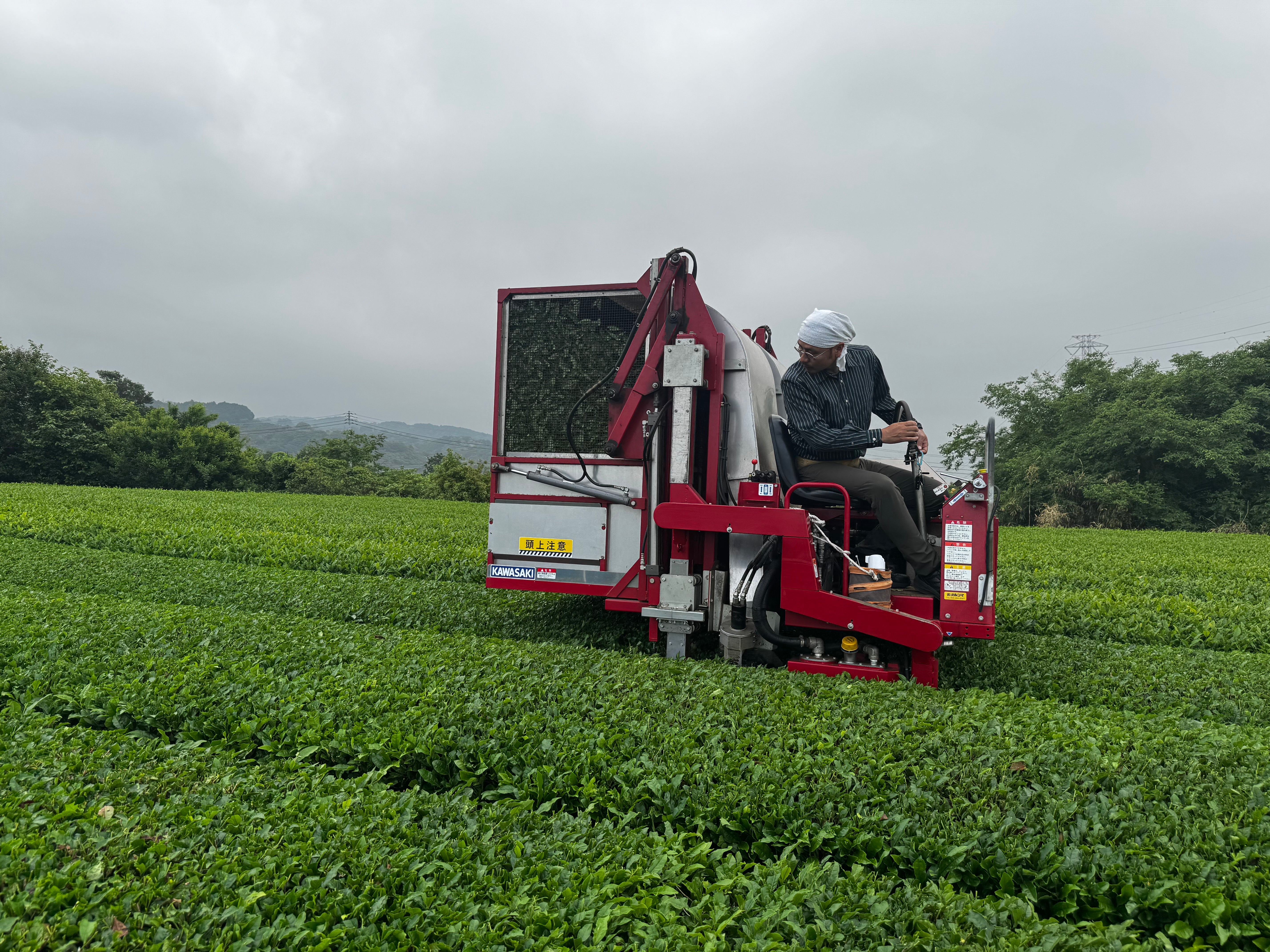
The machine looks like a small red tractor with a curved cutting blade and a bin on the back. Two people ride it, one driving and one watching the cut. It takes a row of waist-high tea bushes and shaves off the top inch of new growth in a single pass.
"Originally, tea leaves were rolled by hand," Mohei told us, with Taro translating. "If you have a look inside the machines, you have mechanical arms which recreate the hand motions. The rolling, then at the end the massaging."
That sentence stayed with us all day. The machine is not a replacement for the hand. It is a memory of the hand, scaled up to feed a country that drinks a lot of tea. Every step in the factory was built to copy a movement that someone, long ago, did with their fingers.
Mohei waved us onto the harvester. Christian climbed up. The transcript from that morning is mostly him laughing.
"Mohei-san just let me ride the harvesting machine. I'm a little starstruck. What an honor it is to contribute to tea, to harvest tea, to learn, respect the plant and everything that goes into it. That's all I can say. Wow. Thank you, thank you, thank you."

The factory: steam, roll, roast
The truck of fresh leaves left the field and rolled into the factory two minutes later. Speed matters. Once a tea leaf is cut, the enzymes inside it start to oxidize. Black tea makers welcome that. Japanese green tea makers race to stop it.
Step one is steaming. A long boiler pushes hot vapor through the leaves for a few seconds, just long enough to deactivate the enzymes. The leaf goes in bright green and comes out brighter, somehow, with a vegetal smell that fills the room. Mohei stood at the boiler the whole time, watching the steam plume.
Step two is rolling. The leaves drop into the first rolling chamber, where those mechanical arms Mohei described move in slow rotations, breaking down cell walls and shaping the leaf. They do this for hours. The next chamber massages. The next dries.
This particular morning, Mohei was making hojicha. Hojicha is what happens when you take a finished green tea and roast it. The grassy notes step back. A nutty, toasty character steps forward. You can drink it at night without thinking about caffeine the way you might with sencha. It tastes like a warm room.
"So you see this?" Christian narrated, holding a handful of fresh-roasted leaves. "It's real. It's a true great product."

The tea ceremony
By early afternoon, the work was done and a low wooden platform had been set under a tarp at the edge of the field. Tea bushes pressed in on three sides. A small kettle, a chasen whisk, a chawan bowl. Mohei sat across from us in seiza, and we did our best to mirror him.
Tea ceremony, in Japan, is called sado, the way of tea. It is not a performance. It is a series of small attentions arranged in a sequence: how you fold the cloth, how you scoop the matcha, how you turn the bowl before drinking. Each gesture is a way of saying, I see you, and I am here.
Mohei whisked. The matcha rose into a soft green foam. He turned the bowl twice with his right hand and offered it. We bowed, took it with both hands, turned it back, and drank.
The conversation that followed touched on what we had been turning over all year. Matcha had become a global trend, but Mohei pointed out that in Japan, it had never been an everyday drink. "Originally, matcha was meant for ceremony," he said. "People don't drink matcha every day. There's a tremendous trend overseas, but they don't drink it as it was originally meant to be drunk."
Mohei's tea truck

One of the things that drew us to Mohei in the first place was his refusal to wait for the world to come to him. During the pandemic, when small Japanese producers were watching their wholesale orders evaporate, he converted a truck into a mobile tea bar and started driving it to Tokyo. According to the documentary's production notes, the goal was to put quality Japanese tea in front of Japanese drinkers who had stopped meeting it.
He calls it bridging tradition and modernity. We call it the same instinct that built One with Tea: if the people who care about the craft don't carry it forward, no one will.
His own brand sells directly through moheitea.com and a YouTube channel where Taro Yamashita, who first introduced us, documents the farm.
What this day gave us
We don't carry Mohei's labeled tea in our store. He sells his own. What this visit gave One with Tea is something else: a clearer picture of what good tea costs, in time and attention, before it ever reaches a tin.
When we taste a Shizuoka sencha now, we think about the steam plume in Mohei's factory and the way he stood next to it without moving. When we whisk matcha at home, we think about how he turned the bowl. When we drink hojicha at night, we think about the moment the green tea passed through the roaster and turned into something quieter.
The brand we are building is one that names the people. We can't visit every farm we source from. But we can keep the rhythm Mohei modeled: slow down, watch the leaf, respect what came before, and pass it forward in a form that holds.

Frequently asked questions
Where is Mohei Honda's tea farm?
Mohei Honda's farm is Fuji MARUMO Tea Garden (富士山まる茂茶園), at 1765 Fujioka, Fuji City, in the Gakunan Region south of Mount Fuji, Shizuoka Prefecture, Japan. The farm has cultivated tea continuously since 1927.
Is Mohei Honda the same person as Eichi Honda?
Yes. Eichi Honda is his given name. Mohei (本多茂兵衛) is the professional name he uses for his tea work and his brand.
What kinds of tea does Mohei produce?
Sencha, gyokuro, kamairi-cha, and hojicha. He also produces oolong and matcha, and hosts sado ceremonies featuring matcha at his farm.
What awards has Mohei Honda won?
Grand Gold Medal at the 2013 World Green Tea Contest (roasted tea category) and Platinum at the 2015 Japanese Tea Award. He is Chairman of Shizuoka's 100-Tea Organization and a certified Fermentation Meister of Shizuoka Prefecture for oolong tea.
Can I watch the documentary about him?
The Tea Master, released in French as Japon, le combat d'un maître de thé, is a 52-minute documentary by Kate Thompson-Gorry and Taro Yamashita. It is an ARTE France co-production with Troisième Œil Productions and Shizuoka Broadcasting System. Availability varies by region; check arte.tv for current streaming windows.
Does One with Tea sell Mohei's tea?
No. Mohei sells his own teas directly through moheitea.com. We visited his farm to learn from him and to deepen our understanding of how the best Shizuoka teas are made. The lessons inform how we source.
What is the difference between hojicha and sencha?
Both come from the same plant, Camellia sinensis. Sencha is steamed and rolled and keeps its grassy, vegetal character. Hojicha takes finished green tea, often sencha or bancha, and roasts it, which produces a nutty, toasty flavor with lower caffeine. Mohei was producing hojicha the day we visited.
Why does it matter who grows the tea?
Because every decision in the leaf, the soil, the steam, and the roast shapes what ends up in your cup. Knowing the grower tells you whether those decisions were made with care or made with shortcuts. With Mohei, the answer is obvious within thirty seconds of meeting him.
More producer profiles from this Japan trip: Ichikawa-en (Makinohara, Shizuoka) · Houkouen (Shizuoka mountains) · Kurihara Seicha (Yame, Fukuoka).
Christian, founder of One with Tea
Looking for ceremonial matcha sourced honestly from named Japanese regions?
USDA Organic and JAS certified, third-party lab tested, direct from family farms.
Shop Matcha CollectionInquire About Wholesale
Share:
What Is Ceremonial Grade Matcha? An Honest Guide
Japan vs China Matcha: Why Japan Defines Ceremonial 2026