




From our tea room
Superior Sencha Green Tea - USDA Organic Japanese First Flush
First-flush loose leaf, USDA Organic, direct from Japanese family farms.
View Superior Sencha
by Christian, founder of One with Tea, May 15, 2026
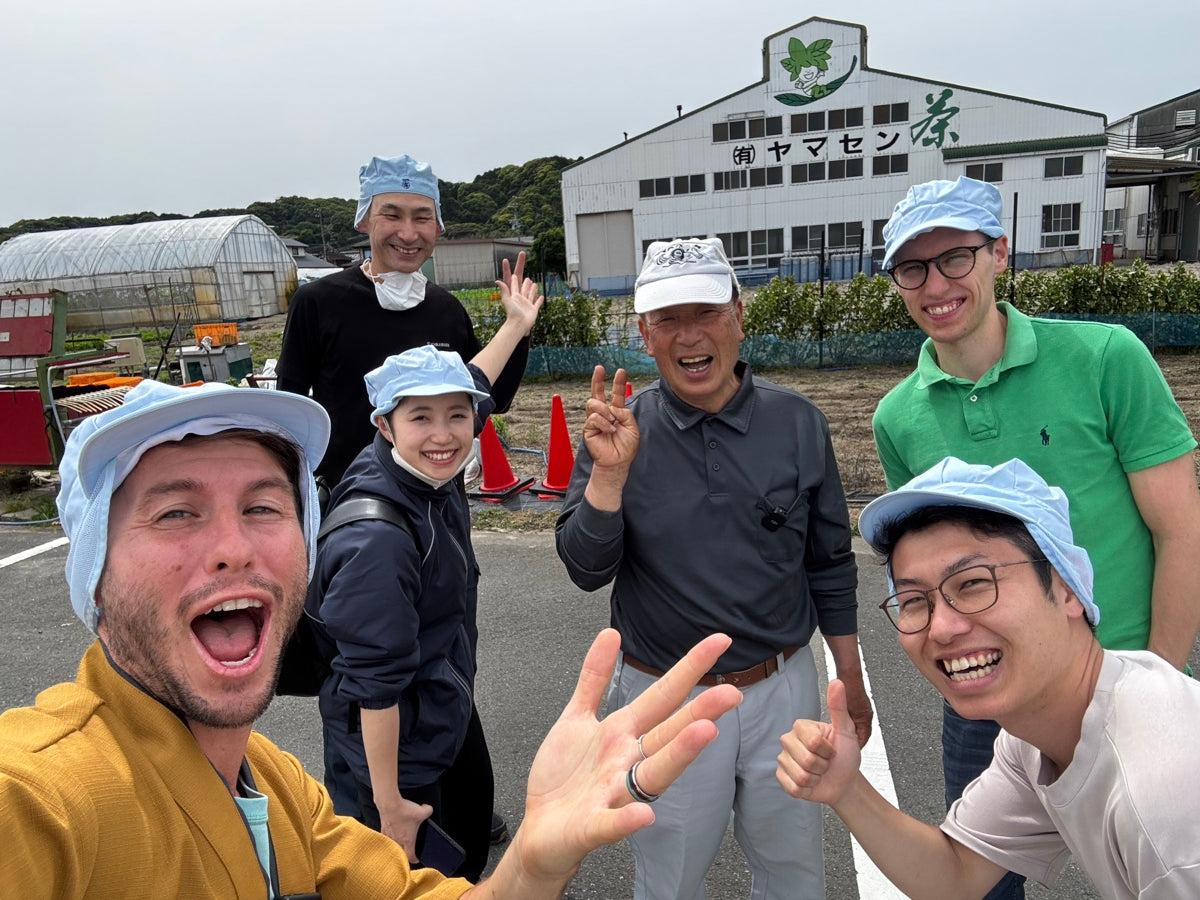
The road from Shizuoka City climbs into the Makinohara Plateau, and at some point the hills flatten out into fields you can't see the end of. We came up on a Monday in May during our trip to Japan to spend the day at Ichikawa-en, a family tea operation that has been blending and producing sencha on this plateau for generations. Cameras in the back. Hairnets in the bag. A long list of questions we had been carrying since we started sourcing Japanese tea.
Ichikawa-en's signature is fukamushi sencha, deep-steamed green tea, the style that Shizuoka built. The factory we walked into can produce up to five tons of aracha a day at peak harvest. Momoko runs the blending bench alongside her mother, tasting and adjusting, the way good kitchens do. She told us the line runs with three to four people during a working day: one watching steam timing, one on the initial rolling and yori-te twisting machines, one on final-stage drying. The fukamushi process itself runs through eight different machines in sequence over roughly four hours. The deep-steam technique came into Makinohara around Shōwa 40 (1965), when tea drinkers wanted a brew that wouldn't go bitter under hot kettle water. This is what that day looked like up close.
Key Takeaways
- Ichikawa-en Co., Ltd. is a Japanese tea company headquartered in Suruga Ward, Shizuoka City, with production operations on the Makinohara Plateau.
- Our host was Momoko Ichikawa, daughter of the owner, who runs the blending bench alongside her mother.
- The signature is fukamushi sencha, deep-steamed for 90 to 150 seconds for body and natural sweetness.
- The factory can produce up to five tons of aracha (crude tea) per day during peak first-flush harvest.
- Blending is collaborative across two generations, with mother and daughter tasting and adjusting iteratively.
- The Makinohara Plateau was first cleared and planted with tea in 1869 by former samurai led by Chuujou Kageaki, with the first harvest in 1873.

Meeting Momoko Ichikawa

Our host that day was Momoko Ichikawa, the daughter of the owner of Ichikawa-en. She walked us through the production facility, sat with us through the day, and answered the kind of questions you only get to ask when you are standing on the floor.
We sat down with her in a small office attached to the factory. A 2025 calendar on the wall, an ink-painted scroll, a low table with two flower-printed teacups already set out. She has the warm directness that runs in tea families, the same energy we'd seen at Mohei Honda's farm a day earlier. The kind of person who answers a question by reaching for the actual material.
The blending bench at Ichikawa-en, she told us, is not a one-person job. She buys in raw leaf from sourcing rounds across the season, looks at each lot, and starts mixing the blend in her head before she ever puts it on the scale. The actual mixing happens with her mother. They taste, compare against the previous run, and adjust. "If she says the sweetness is lower than last time," Momoko said, "we add something sweeter the next time. We take a little out, put a little in. We go back and forth."
What she's protecting is what she called the Ichikawa-en feel. The house style. Every blend they ship has to taste like itself, not like the trends. They use one base tea most years, and the question is what to add to round it out. "Tea covering tea," she said. "One filling in what the other is missing."
The Makinohara plateau: a tea region built by samurai

Ichikawa-en sits inside one of the most consequential tea landscapes in Japan. The Makinohara Plateau wasn't always tea. After the daimyo returned their lands to the Emperor in 1869 and the samurai class was effectively dissolved, a group of former retainers led by Chuujou Kageaki chose to lay down their swords and clear the plateau for tea farming. The first harvest came in 1873, four years after they began. Today the plateau covers roughly 5,000 hectares, one of the largest tea-growing areas in Japan.
You can stand at the top of certain fields here and see the Izu Peninsula on a clear day. Momoko pointed south toward Shimoda, where Commodore Perry's ships first reached Japan in 1854. The history is layered. Tea became one of Japan's most promising export crops in the same decade the samurai turned to it.
We keep the full record: our sourced chronology of tea, 486 dated entries.
The land itself is high and broad and reasonably flat for Japan, which is rare. Driving between rows of dark green bushes that run to the horizon, it's easy to forget that every one of them is a deliberate planting on what used to be wilderness.
Inside the factory: steam, roll, dry

The day we arrived, the factory was running. We pulled on white coats, hairnets, and stepped onto the production floor. The smell of fresh steaming leaves hit before anything else. Bright, sweet, deeply vegetal.
Three to four people work the sencha line on any given run. One watches the steaming. One watches the early kneading and rolling. One watches the final shaping. The tencha line, which produces the leaf used for matcha, is staffed by a single person. "Tencha is simpler," Momoko said. "Sencha is the difficult one."
Steaming is the first move. Hot vapor deactivates the oxidation enzymes, which is what keeps Japanese green tea green. Then comes the kneading sequence. Long machines press and roll the leaves through staged pressure that starts around 3 kilograms and rises to 7 or 8 kilograms over roughly four hours. "Each machine recreates a part of the human hand," Momoko explained. "The roll, the squeeze, the way you'd work moisture out of the leaf with your fingers."
One machine on the floor uses pressure without heat. She pointed at it carefully. "Steam is the enemy here," she said. "If the leaf gets steamy in this stage, the aroma escapes. The umami starts to taste cooked instead of fresh. So we don't use heat. Just force." The whole sequence runs about 35 minutes in the shaping machine, then another 30 minutes in the dryer. By the end you have aracha, crude tea, ready to be finished and blended at the parent facility.
Fukamushi: why the leaves drink deep

The Ichikawa-en signature is fukamushi sencha, which means deep-steamed tea. Most Japanese sencha is steamed for 50 to 70 seconds. Fukamushi is steamed for 90 to 150 seconds, almost twice as long. The leaves come out close to the edge of breaking down.
The point isn't to overcook them. The point is to remove the natural astringency. With regular sencha, you have to brew at a lower temperature, often around 50 degrees Celsius, to keep the cup from going bitter. That works beautifully, but it asks the drinker to be patient. To boil the kettle, cool the water, time the steep.
"The world got faster," Momoko said. "People want to pour from a pot and drink it. Fukamushi gives you that. You can pour hot water on it, and it stays sweet." The flavor reads thick on the tongue. Cloudier in the cup. A little softer than a high-grown sencha but with more body.
Her own favorite tea is the fukamushi sencha Ichikawa-en produces, especially with the cultivars Saemidori and Tsuyu-hikari mixed in. The house has been making matcha too. But when you ask her what she reaches for, it's the deep-steamed sencha, brewed strong. Body, sweetness, weight.
On price, value, and overseas markets
The harder conversation came later, sitting at the small table with the teacups. We asked him what he hoped people would take away from a documentary about Japanese tea. He thought for a while.
"In Japan, tea comes out of the tap. Out of vending machines. It's free at the rest stops, free at the supermarket. People stopped seeing the value." She wasn't bitter about it. She was diagnostic. "Then they go to events overseas and see people pay for tea like it's wine or sake. The work is the same. The skill is the same. The history is older. But the price tells a different story in each country."
This is part of why Ichikawa-en goes to international tea expos. Momoko sees buyers there who understand that the cup in front of them represents centuries of craft. "The answer is in those rooms," she said. "Where people look at the leaf the way you look at a vintage wine."
The brand we're building tries to do the same in reverse, to put Japanese tea in front of drinkers who are ready to taste it as a slow, considered thing. Letting the price say what the work is worth.
What this day gave us
Ichikawa-en doesn't appear on our shelves under their own label. Like most of the producers we've met, they sell into the channels that have always served Japanese tea. What this visit gave One with Tea is a clearer picture of the work. The number of hands. The number of machines that quietly imitate hands. The four-hour kneading curve from 3 kilograms to 8. The mother-and-daughter pair at the blending bench. The five-ton days during shincha season.
When we taste a Shizuoka fukamushi sencha now, we taste the patience in it. The strong steaming, the cool factory floor, the family conversation about whether this year's blend is sweeter than last year's. The producers we visit aren't only suppliers. They are the reason we can describe what's in your cup.
Where is Ichikawa-en located?
Ichikawa-en Co., Ltd. is headquartered at 2-3 Mizuho 4Chome, Suruga-ku, Shizuoka City, in Shizuoka Prefecture, Japan, with production operations on the Makinohara Plateau, the country's historic sencha heartland. The plateau itself was first cleared and planted with tea in 1869 by former samurai led by Chuujou Kageaki.
We track the production side: where Japan's tea is really grown.
Who is Momoko Ichikawa?
Momoko Ichikawa is the daughter of the owner of Ichikawa-en. She hosted our visit to the production facility and runs the blending bench alongside her mother, building the Ichikawa-en house style season by season.
What is fukamushi sencha?
Fukamushi sencha is deep-steamed Japanese green tea. The leaves are steamed for roughly 90 to 150 seconds, compared with 50 to 70 seconds for regular sencha. The longer steaming reduces astringency, so the tea brews sweet even when made with hot water. The cup runs thicker and slightly cloudier than standard sencha.
Does One with Tea sell Ichikawa-en's tea?
No. Ichikawa-en sells through their own channels. We visited their factory earlier this year to deepen our understanding of Shizuoka fukamushi production. The lessons inform how we source.
How is fukamushi sencha different from regular sencha?
Regular sencha is steamed briefly (50 to 70 seconds) and is best brewed at lower water temperatures to avoid bitterness. Fukamushi is steamed longer (90 to 150 seconds), which removes the astringency at the source. You can brew fukamushi with hot water straight from a kettle and still get a sweet, full-bodied cup. The trade-off is a softer, less aromatic profile than a classic high-grown sencha.
Why is Makinohara historically important for Japanese tea?
The Makinohara Plateau was developed for tea starting in 1869 by former samurai of the dissolved retainer class, led by Chuujou Kageaki. The first harvest came in 1873. Today the plateau covers roughly 5,000 hectares and remains one of the largest tea-growing areas in Japan.
What's the role of cultivar in a Shizuoka sencha?
Each cultivar (the specific tea-plant variety) brings a different flavor. Yabukita is the workhorse used across most Japanese tea fields. Saemidori is known for a sweeter, brighter cup. Tsuyu-hikari is appreciated for body and umami. Most production blends combine cultivars to balance brightness, sweetness, and body, the way wine regions blend grapes.
More producer profiles from this Japan trip: Mohei Honda (Shizuoka) · Houkouen (Shizuoka mountains) · Kurihara Seicha (Yame, Fukuoka).
Christian, founder of One with Tea
Looking for ceremonial matcha sourced honestly from named Japanese regions?
USDA Organic and JAS certified, third-party lab tested, direct from family farms.
Shop Matcha CollectionInquire About Wholesale
Share:
Kyoto Tencha Auction 2026: Prices Jumped at Opening
The 2026 Matcha Shortage Explained: A Founder's View From the Sourcing Floor