



by Christian, founder of One with Tea, May 15, 2026
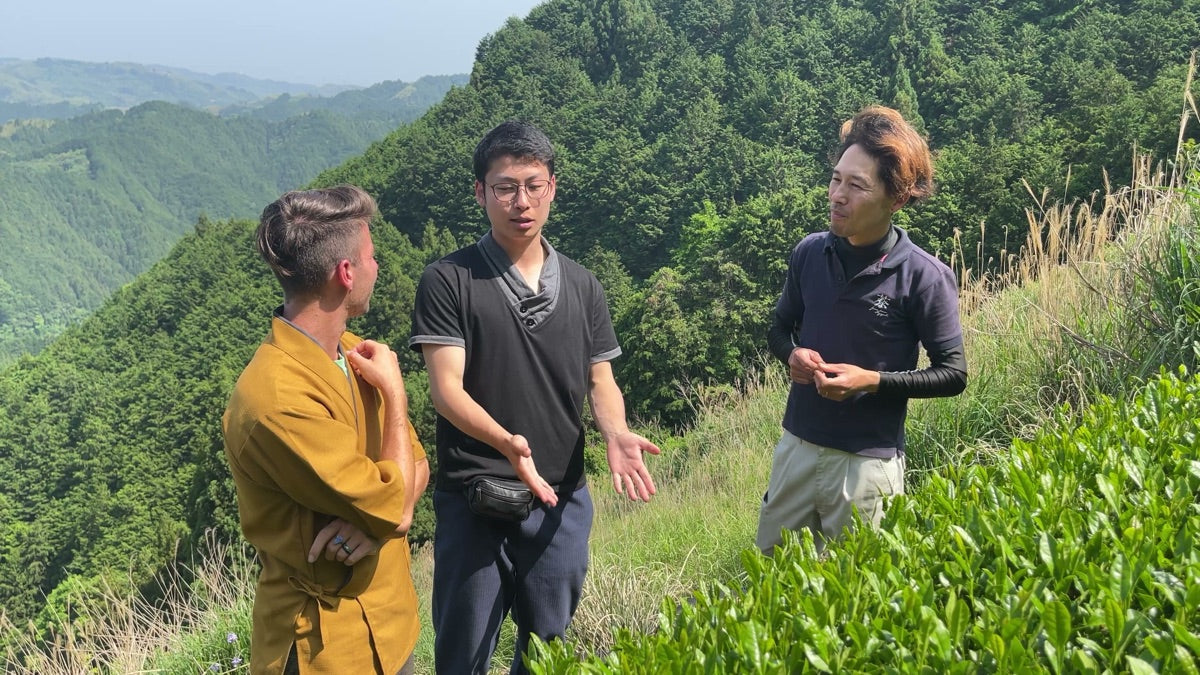
The road kept climbing. We had spent the morning at Mohei Honda's farm on the lower hills, and by mid-afternoon we were following a smaller road that wound up into the Shizuoka mountains. Cameras in the back. The light getting longer. We were on our way to meet Jiro-san at Houkouen, and the journal entry I wrote that night reads, simply: "mountain farmer, he's an artist with tea."
Jiro-san is one of those producers who does not show up much on social media. He is not chasing a brand. He is on the slope, working the rows, blending and tasting and starting again. We sat with him for the better part of an evening, drinking what he had made and asking the kind of questions you only get to ask when you are physically there. This is what that day taught us about mountain tea, about craft, and about why the maker matters more than the postcode.
Key Takeaways
- Houkouen is a third-generation mountain tea farm in Ryogochi, Shimizu Ward, Shizuoka City, run by Jiro Katahira at 350 meters elevation across 3.8 hectares (Houkouen).
- Mountain-grown Japanese tea typically grows slower at elevation, producing denser leaves and a more concentrated cup compared with flat-land tea.
- Jiro-san's view: the difference between great tea and ordinary tea sits in the maker, not the region. Famous postcodes are not a guarantee.
- His framing of tea as a "luxury" came from observing that tea gives energy without delivering calories. It asks the soil to work and gives nothing back nutritionally.
- Houkouen's tea was selected to supply the Japanese Imperial Household in 2015, and Jiro-san exhibits at the Hinpyoukai Shuppin Cha National Tea Competition (Houkouen). He did not mention either to us.
- Houkouen does not appear on One with Tea's shelves. The visit informs how we evaluate craft, sourcing, and what to ask producers we work with.

Meeting Jiro-san, the mountain farmer

Houkouen sits high above the valley. To get to the fields you climb past clusters of houses, then past flatter farmland, then up into terrain where the planting starts to follow the contours of the hill instead of the road. The slopes rise and fall and rise again. Each row of tea has been trimmed by hand into the curve of the land, so the field reads like a topographic map of itself.
Jiro-san met us in working clothes. He was direct, calm, and a little dry, the way real practitioners often are when they have nothing to prove and a lot of work waiting. He has the kind of presence that makes you want to put your phone away and pay attention. Within minutes of arrival he was already correcting a few of our assumptions about tea, in a way that felt less like a lecture and more like watching someone clean their tools.
One thing that became obvious right away: this is one person's slope. There are no marketing teams, no greeters, no gift shop. The work happens between Jiro-san, the leaf, the weather, and the small machine he uses to bring the harvest in. When you stand at the top of his fields and look back at the valley, you understand that everything you can see has been shaped by his attention.
Jiro-san is Jiro Katahira. He took over Houkouen as the third generation, running about 3.8 hectares of slope at 350 meters elevation in Ryogochi (両河内), in the Shimizu Ward mountains above Shizuoka City. The farm produces roughly two tons of tea a year across more than twenty varieties, including gyokuro, sencha, kabusecha, houjicha, and a Japanese black tea (Houkouen).
Mountain tea or flat-land tea: what is the actual difference?

I asked him the obvious question first. What is mountain tea? Why do people talk about it as if it is special?
"Same in essence," he said. "Different in the details."
The headline answer is what most tea writers will tell you. Higher elevation means cooler nights, more morning mist, slower growth. Slower growth means a denser, more concentrated leaf, often with more aromatic complexity and a longer finish. Flat-land tea, especially on a place like the Makinohara plateau, can be incredible too, but the cultivation is different. Bigger fields. Faster growth. More volume. The cup tends to be brighter and more straightforward.
That much is geography. Where Jiro-san wanted to push us was past the geography.
"Of course there are differences in the land," he said. "But the differences between people are bigger than the differences between places."
That sentence reframed the rest of the visit. It is the through-line I came home with.
It is not the land, it is the maker

Jiro-san named names. In Shizuoka, the regions you will hear most often praised for high-mountain tea are Kawane, Tenryu, and a handful of other elevated valleys. Those areas have a real reputation. Buyers will pay more for a "Kawane sencha" simply because of the postcode.

From our tea room
Superior Sencha Green Tea - USDA Organic Japanese First Flush
First-flush loose leaf, USDA Organic, direct from Japanese family farms.
View Superior Sencha"But if you open the lid," he said, "in those regions there are people making incredible tea, and there are people making junk."
He used a stronger word in Japanese. The English meaning is the same. The point: a famous region is not a guarantee. And conversely, in a flat region like Makinohara, there are makers producing extraordinary cups alongside makers producing average ones.
"What matters most," he said, "is how much time the person spends on the tea. That is the real variable."
Then he laid out the part that stayed with me longest. Most producers, when they talk about why their tea is good, will start with cultivation. Fertilizer. Pruning. The variety of plant. The schedule of work.
"Everyone does that," he said. "Everyone is particular about fertilizer. Everyone has opinions on pruning. So those things do not actually distinguish anyone. They are the floor, not the ceiling."
His real question for any producer was different. With what intention are you making this tea? If a maker cannot answer that, if there is no thought behind the work beyond the technical, then to him, that is just an ordinary person making ordinary tea, no matter what the soil looks like.
This is why he was firm on one piece of advice for anyone serious about Japanese tea: meet the producer. Not to verify their technique, but to see how they live, how they think, how they speak about the cup. Everything else follows from that.
Tea as luxury: a farmer's view on calories, soil, and joy

Late in the visit the conversation drifted into something more philosophical. Jiro-san poured another round and started talking about what tea is, in his view, fundamentally.
"Tea has no calories," he said. "You drink it, your body gets nothing nutritional. But the plant has worked. The soil has given energy to grow that leaf. So in a way, drinking tea is a luxury. It is the soil's work, with no caloric payoff for us."
He was not making a guilt argument. He was making a metaphysical one. Tea sits outside the calorie economy. It does not feed you. It gives you something else: a state, a moment, a softening of the day. That is why, in his view, tea has always belonged to the side of life that is hobby, ritual, joy. It is not a meal. It is what you reach for when the meal is over and you want to be present.
He calls the work "tea with our whole heart." Hand-picked leaves, no big machinery, no trimming or pruning of the bushes (Houkouen). For him those three things are preconditions, not features. They are how a leaf is treated before any conversation about craft can even start.
"What does tea give you, really?" he asked us. "Joy. Conversation. Laughter. People sitting together. And from that, healing. The healing is not in the ingredients. It is in the joy of drinking it."
This is a very Japanese idea, and an old one. Chanoyu, the tea ceremony, was built on the same instinct centuries earlier. But hearing it phrased by a working farmer, in his own clothes, after a day in the field, made it feel less like cultural philosophy and more like operating instructions for life.
Why we visit producers like this
Houkouen does not appear on One with Tea's shelves. Jiro-san sells through his own channels, the way many smaller producers in Japan still do. We did not visit him to buy. We visited him to learn.
What this evening gave us was a working framework for evaluating producers. The cultivar matters. The elevation matters. The soil matters. But none of those, on their own, predict whether the tea in your cup will be remarkable or forgettable. What predicts that is the maker's intention. How much of themselves they are putting into the work. Whether they can answer the question "why are you making this tea?" with something more than a technical specification.
When we evaluate a new Japanese green tea source for One with Tea now, that is the question we are really listening for. Not "what is your method?" but "why is this your work?" The first question gets you a brochure. The second one gets you a relationship.
And when we sit with Houkouen tea now, even though we are not selling it, what we taste is a man who decided long ago that tea was worth doing properly. That is not a story you can fake. You can hear it in the cup.
Worth saying out loud: in 2015 Houkouen's tea was selected to supply the Japanese Imperial Household, and Jiro-san exhibits at the Hinpyoukai Shuppin Cha National Tea Competition (Houkouen). He did not mention either to us. The work speaks.
Where is Houkouen located?
Houkouen sits at 270 Nunosawa in Ryogochi (両河内), Shimizu Ward of Shizuoka City, Shizuoka Prefecture, Japan, at 350 meters above sea level. The farm covers 3.8 hectares of mountain slope with views of Mount Fuji in the distance, in the elevated terrain north-central to Shizuoka City (Houkouen).
For where this sits on the map, see our map of Japanese tea production by prefecture.
Who is Jiro-san?
Jiro-san is Jiro Katahira (born 1984), the third-generation farmer at Houkouen. He runs a 3.8-hectare farm in Ryogochi, Shimizu Ward, Shizuoka City, at 350 meters elevation, producing roughly two tons of tea a year across more than twenty varieties (Houkouen). He works the slope, blends, and sells primarily through his own channels rather than large distributors. Houkouen's tea was selected to supply the Japanese Imperial Household in 2015.
Does One with Tea sell Houkouen tea?
No. Houkouen is not part of the One with Tea catalog. Jiro-san sells through his own channels. We visited his farm earlier this year to deepen our understanding of mountain Japanese tea, and the lessons inform how we evaluate every producer we consider working with.
What is the difference between mountain tea and flat-land tea in Japan?
Mountain-grown Japanese tea generally grows more slowly because of cooler nights, more mist, and shorter sun exposure at elevation. The slower growth tends to produce denser leaves, more aromatic complexity, and a more concentrated cup. Flat-land tea, often grown on plateaus like Makinohara, tends to produce greater volume with a brighter, more direct flavor. Both styles can be excellent. Region alone does not predict quality.
Why does Jiro-san say the maker matters more than the region?
His view, after decades on the slope, is that famous tea regions contain producers making both excellent and ordinary tea. Likewise, less-famous regions can contain extraordinary makers. What separates a great cup from a forgettable one is how much time, attention, and intention the maker pours into the work. Region is a signal. The maker is the actual variable.
What did the visit to Houkouen teach One with Tea about sourcing?
It clarified the right question to ask producers. Most makers will explain their cultivation methods if asked. Few will explain why they make tea at all. Jiro-san's challenge, that intention is the thing that distinguishes one maker from another, is now central to how we evaluate any new Japanese tea source for the brand.
More producer profiles from this Japan trip: Mohei Honda (Shizuoka) · Ichikawa-en (Makinohara, Shizuoka) · Kurihara Seicha (Yame, Fukuoka).
Christian, founder of One with Tea
Share:
2026 Matcha Industry Outlook: Supply, Prices, Trends
Is a Chashaku a Sifting Tool? Tradition vs. the Café Trend