



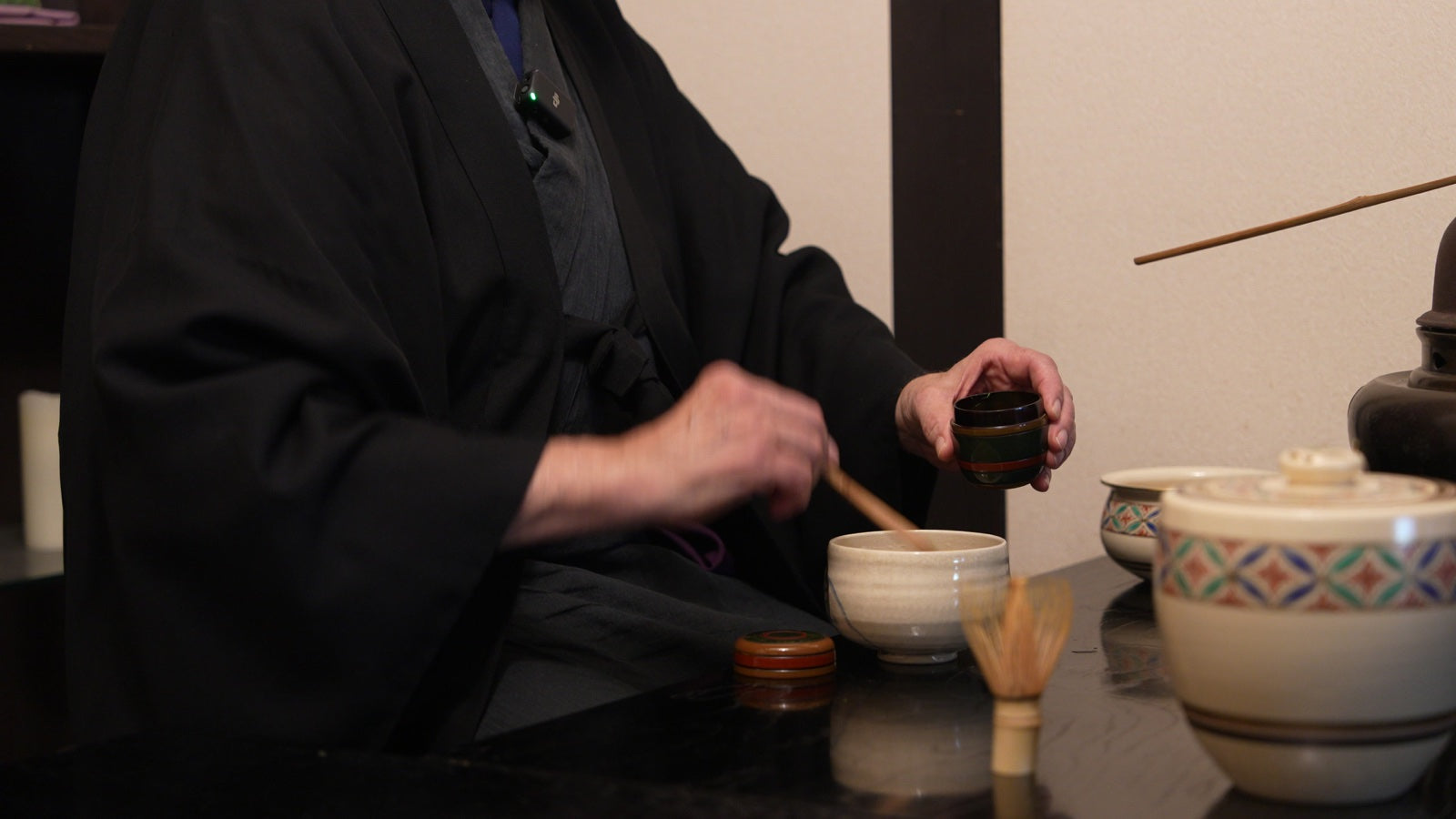
Is a Chashaku a Sifting Tool? What the Café Trend Gets Right, and Wrong
If you have watched matcha videos online or stood at a café counter outside Japan, you have probably seen it: a slim bamboo scoop pressed against a fine mesh sieve, powder raining into the bowl below. It looks deliberate. It looks traditional. The Global Japanese Tea Association raised the question this week in a piece by their writer Machi, and it is worth sitting with. A chashaku is not a sifting tool. Or, the way the world is going, is it now?
If you want the whole arc, see the full timeline of tea, entry by entry.
Key Takeaways
- No, a chashaku is not a sifting tool. It is a hand-carved bamboo scoop used in Japanese tea ceremony to measure matcha and transfer it from the caddy into the bowl.
- The proper tool for sifting is the furui, a fine-mesh matcha sifter, often paired with a small bamboo spatula called a take-bera.
- Pressing a chashaku against a metal mesh can damage its delicate tip, the most expressive part of the scoop.
- The café sieve-with-scoop habit spread fastest outside Japan and is now appearing inside Japan too, which is what prompted the conversation.
- The deeper driver is the matcha boom: a market near $4.6 billion in 2026, with most new drinkers learning preparation from short video, not from a teacher.
What a chashaku actually is, and what it is for
A chashaku is a slender bamboo tea scoop used in Japanese tea ceremony, called chanoyu or sado, to measure a portion of matcha and carry it from the caddy into the bowl. That is its whole job: measure and transfer. Historically scoops were carved from ivory or wood, until Sen no Rikyu popularized bamboo within the rustic wabi-cha aesthetic in the Momoyama period, roughly 1573 to 1615 (Japanese tea utensils, Wikipedia).
The caddy it draws from has a name too. For thin tea you use a lacquered natsume, for thick tea a ceramic chaire. The scoop lifts a measure of powder and tips it into the chawan, the bowl. One curve of bamboo, one small motion, repeated for centuries. Nothing about that motion involves pressing powder through a screen.
Why a curve of bamboo carries so much meaning
The chashaku is one of the humblest objects in the tea room, and one of the most personal. Tea masters often carve their own from a single length of bamboo, then give the finished scoop a poetic name, a mei, that evokes a season or a feeling. The name is frequently inscribed on the scoop's storage tube, the tsutsu, and the choice of which chashaku to use can set the entire tone of a gathering.
That meaning is not abstract. Scoops attributed to Rikyu himself are preserved as cultural treasures. The Metropolitan Museum of Art holds a tea scoop attributed to him, dated to the Momoyama period (The Met, Tea Scoop (Chashaku)). During haiken, the moment guests appreciate the utensils, a chashaku is lifted and studied with both hands, slowly, the way you would hold something you intend to remember. A tool treated like that is not a tool you grind against a sieve.
The café trend: pressing matcha through a sieve with the scoop
The habit in question is simple to picture. A barista holds a fine mesh strainer over a bowl, taps matcha into it, then uses the flat back of the chashaku to push the powder through. It makes a satisfying, photogenic motion, which is part of why it travels so well on video. According to the GJTA's piece by Machi, this is seen most frequently outside Japan, in matcha cafés across the United States, Europe, and Australia, and it has recently started appearing in some Japanese cafés too (GJTA, 2026).
There are two quiet problems. The first is physical. The tip of a chashaku is its thinnest, most expressive feature, shaved almost to translucency, and pressing it against metal mesh wears it down or splits it. The second is about meaning. Using an object for how it looks while setting aside what it is for creates a small contradiction, especially with an object whose whole point is intention.
The right tool for the job: the furui and the take-bera
The proper tool for sifting matcha is the furui, a small sifter built with mesh fine enough for matcha's particle size, usually paired with a little bamboo spatula called a take-bera to coax the powder through. Matcha is ground to roughly 5 to 10 microns and clumps readily from static and moisture, so a quick sift before whisking gives you a smoother bowl, fewer lumps, and a better foam when you reach for the chasen whisk.
The nuance worth naming: sifting matcha is genuinely good practice. The café instinct is not wrong about the goal, only about the instrument. Reach for a furui and a take-bera, or a clean fine-mesh sifter with a small spoon, and leave the chashaku to do the one thing it was carved to do. If you are setting up at home, our guide to the traditional Japanese tea set walks through each piece and its role.
Why this is happening now: the matcha boom
The reason an improvised technique can spread worldwide in a season is the sheer scale of the matcha boom. The global matcha market was worth about $4.17 billion in 2025 and is projected to reach roughly $4.61 billion in 2026, a compound annual growth rate near 10.6% (The Business Research Company, 2026). Demand has outrun what Japan's tea fields can supply, and the resulting shortage has buyers competing for limited stock and looking beyond Japan for production (Perfect Daily Grind, 2025).
We map it out: which countries produce matcha, and how much.
Most of those new drinkers learn how to make matcha from a fifteen second clip, not from a teacher in a tea room. A clip rewards motion and aesthetics, the press, the rain of powder, the foam. It rarely explains which tool is which, or why a scoop named after a season is held with two hands. That is how a misunderstanding becomes a norm.
A founder's take, from the sourcing floor
I have stood in tea rooms and on tea farms in Japan, and the thing that stays with me is the slowness. A maker handling a chashaku does not rush it. There is a pause built into every step, the pause where the ritual actually lives. When I watch the café version, the sieve and the scoop pressed into one quick motion, I do not feel offended. I feel the pause going missing. The boom brought tea to millions of new people, and I am grateful for that. It also flattened a few things on the way.
So I land somewhere honest about it. I would rather a café sift its matcha with the wrong tool than not sift at all, because that café is still pouring someone a better bowl. And I would rather we keep teaching what each piece is for, because the meaning is the part that does not show up in a fifteen second clip. If you run a café and you are sourcing seriously, our guide to the best matcha for cafés covers grade, freshness, and supply, the parts that matter more than the strainer.
Tradition or evolution: is there an answer?
There is no clean verdict here, and the GJTA does not pretend otherwise. Traditions do evolve. Bamboo chashaku were themselves an innovation Rikyu introduced over ivory and wood. The honest question is not whether tea practice can change, it is whether a given change comes from understanding or from imitation. A new technique born from knowing the tools is evolution. A habit copied because it filmed well is something thinner.
My answer is to keep the knowing alive. Use a furui to sift. Use a chashaku to measure. Use a chasen to whisk. Learn the names, because the names carry the care. And if you are choosing your daily powder, our notes on ceremonial-grade matcha and on matcha as a meditation practice are a good place to slow back down.
Frequently asked questions
Is a chashaku a sifting tool?
No. A chashaku is a bamboo scoop used in Japanese tea ceremony to measure matcha and transfer it from the caddy into the bowl. It is a measuring and serving tool, not a sifter. Using its tip to push powder through a sieve can damage the bamboo.
What do you use to sift matcha?
You use a furui, a fine-mesh matcha sifter sized for matcha's tiny 5 to 10 micron particles. It is traditionally paired with a small bamboo spatula called a take-bera. A clean fine-mesh kitchen sieve with a small spoon also works at home.
Will using a chashaku to sift matcha damage it?
It can. The tip of a chashaku is shaved very thin and is the most delicate part of the scoop. Repeatedly pressing it against metal mesh wears the tip down or splits it, which is why practitioners discourage the habit.
Do I really need to sift matcha at home?
Sifting is optional but genuinely helpful. Matcha clumps from static and moisture, so a quick sift before whisking gives a smoother bowl, fewer lumps, and a better foam. It takes about ten seconds and noticeably improves the cup.
What is a chashaku used for?
A chashaku measures a portion of matcha and transfers it from the caddy, a natsume or chaire, into the bowl, the chawan. In tea ceremony it is also a personal, named object that guests appreciate during haiken, the moment utensils are inspected with care.
What is the difference between a chashaku and a chasen?
A chashaku is the bamboo scoop that measures matcha. A chasen is the bamboo whisk that blends matcha with water into foam. Different tools, different steps: scoop first, sift with a furui, then whisk with the chasen.
Bring the ritual home, or to your café
At One with Tea we source organic Japanese matcha directly from growers, and we believe the small tools deserve the same care as the powder. Become one with tea, one with yourself.
Shop ceremonial matcha Inquire about wholesale
Sourcing matcha for a café or shop? Our wholesale program supplies authentic Japanese matcha at volume. And if you want the scoop done right, we carry a hand-finished bamboo chashaku built to measure, not to sift.
Share:
Houkouen: Jiro-san's Mountain Artisan Tea in Shizuoka
Japan Green Tea Exports +42% in FY2025: Matcha Boom