



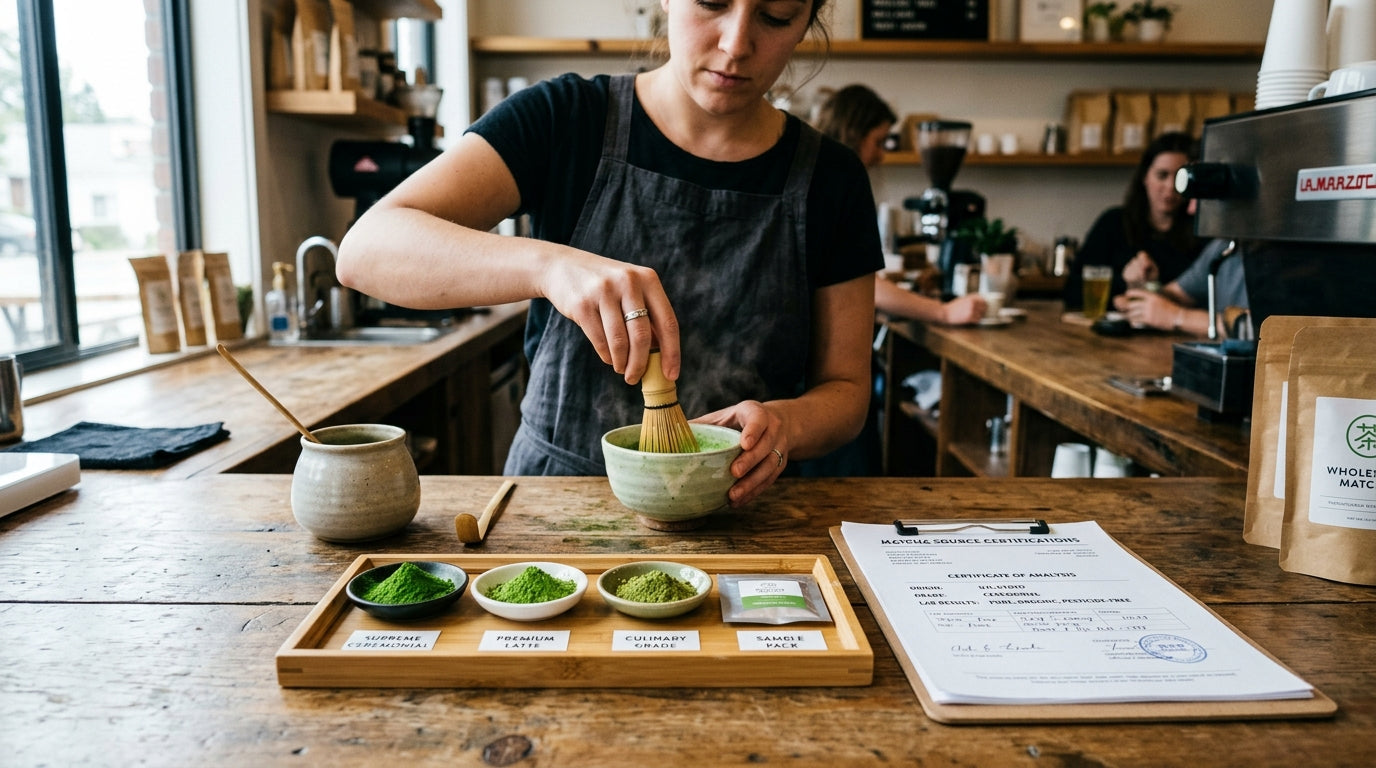
Best Matcha for Cafes and Restaurants: 2026 Wholesale Guide
By Christian Mauerer, Founder of One with Tea · Published May 7, 2026
Buying matcha for a cafe is fundamentally different from buying for yourself. The economics shift, the compliance asks change, and the supply-security question gets sharper every quarter. In 2026, with Japanese tencha wholesale running well above 2023 levels and allocations tightening, the cafe owner or restaurant beverage director who picks a supplier on price alone is the one who has to renegotiate again in six months. The cafe owner who picks on a framework, the kind I'll lay out below, is the one whose menu stays on the board.
I source matcha for a small US brand and we take wholesale accounts. I have been on the cafe side of this conversation as a buyer myself, and I now get it from the supplier side every week. Here is the framework I'd give a beverage director planning a 2026 program, with verifiable wholesale pricing and the specific compliance asks foodservice operators need to handle.
Key Takeaways
- 2026 wholesale pricing tiers (1kg quantities): Heritage / competition grade $450-650+ per kg, ceremonial $180-320, premium latte $85-140, culinary $55-80. 25kg+ contract pricing runs lower across each tier (First Agri B2B).
- Counterfeit-risk thresholds: ceremonial under $120 per kg, latte under $65 per kg, culinary under $35 per kg are red-flag pricing in 2026 (First Agri B2B).
- For milk-based lattes, latte-grade matcha (not ceremonial) is the right input. Ceremonial flavors largely disappear in milk and the cost premium is wasted (First Agri cafe guide).
- Typical drink cost at 3 grams of latte-grade matcha per drink is roughly $0.24, supporting strong gross profit margins on a $5-7 retail latte (First Agri cafe guide).
- JAS-certified Japanese matcha can be sold as USDA Organic in the US under the equivalency agreement effective January 1, 2014, simplifying foodservice compliance documentation (Shizuoka Tea).
- Inductively Coupled Plasma Mass Spectrometry (ICP-MS) is the standard heavy-metal testing method, accurate to parts per billion. A wholesale supplier should be able to produce a lot-specific Certificate of Analysis on request (Best Matcha glossary).
The Three Concerns That Separate B2B from Consumer Buying
Consumer matcha buyers can pick a tin and live with the consequences. A cafe cannot. A foodservice matcha buying decision touches three concerns that consumer buying does not: drink-cost economics, regulatory compliance, and supply security across the menu lifecycle.
Economics is the first because every gram has a per-drink cost and a margin attached. A 30-cent input cost on a $6 latte is sustainable. A 90-cent input cost on the same latte is the kind of margin compression that quietly kills a tea program. Choosing the right grade for the right drink is the single largest cost-management lever a beverage director controls.
Compliance is the second. Most US health departments will accept proper food-grade documentation, but commercial buyers should expect to produce certificates of analysis on heavy metals and pesticides if asked, especially for menu programs that emphasize organic claims. Foodservice operators selling to schools, hospitals, or contract clients face stricter documentation asks than retail cafes.
Supply security is the third, and it is more urgent in 2026 than in any year of the last decade. The matcha market is in a structural supply shock that's documented in our 2026 matcha shortage explainer and the cost-side analysis in our 2026 cost breakdown. The 2026 oil and freight overlay layered on top of that is in the Iran-war supply chain analysis. A cafe selecting a supplier this year should be selecting on allocation reliability, not just spot price.
Wholesale Grade Tiers and What Each Buys You
Wholesale pricing in 2026 falls into clear tiers. Per First Agri B2B data, the roughly current per-kilogram ranges are:
Heritage or competition grade: $450-650 per kg and up. Single-cultivar, named-farm, hand-picked first-flush. Reserved for thin tea (usucha) preparation in formal ceremonial settings or flagship single-origin menu items.
Ceremonial grade: $180-320 per kg at 1kg quantities ($100-200 at 25kg+ contract pricing). Stone-ground first-flush tencha from named regions. Appropriate for thin tea preparation, simple matcha-and-water service, and high-end matcha-forward menu items where the grade name itself is part of the offering.
Premium latte grade: $85-140 per kg at 1kg quantities ($55-85 at 25kg+ contract pricing). The right input for milk-based lattes. Vibrant green, smooth flavor that holds up against dairy, designed for the drink format rather than ceremonial appreciation.
Culinary grade: $55-80 per kg at 1kg quantities ($35-50 at 25kg+ contract pricing). Used for baking, ice cream, and confectionery applications where the matcha is one ingredient among many.
The same source identifies counterfeit-risk thresholds: ceremonial grade priced under $120 per kg, latte grade under $65 per kg, or culinary grade under $35 per kg should be questioned. The economics of producing real Japanese-origin matcha at those price floors do not work in 2026 (First Agri B2B).
If you want the number behind the number, we track our running index of Japanese tea import prices.
The Drink-Cost Math
The most common mistake new cafe matcha programs make is buying ceremonial-grade for the latte program. The math says no. At a typical 3 grams of matcha per latte and roughly $80/kg latte-grade, the per-drink matcha ingredient cost is around $0.24 (First Agri cafe guide). The same drink built on $250/kg ceremonial-grade costs roughly $0.75 in matcha alone. On a $6 retail latte, that's the difference between a healthy gross margin and one that's compressed before you've added milk, syrup, labor, and packaging.
The more important argument is that the upgrade isn't tasted. Per the same source, "ceremonial grade is designed for drinking with water only, its subtle flavors disappear when mixed with milk." When ceremonial flavors are masked by dairy and sweetener, you pay 3-4x for an input the customer cannot perceive.
For a basic operating framework on cost analysis, Restaurant Ware's economics overview walks through the cost components (powder, milk, sweetener, labor, packaging) and makes the case that "understanding exact costs enables cafés to better assess profit margins on matcha lattes and adjust your pricing strategy accordingly." That's the level of cost-tracking discipline a successful matcha program operates on.
Why Latte-Grade Is Not a Downgrade
Latte-grade matcha is engineered for milk drinks. It is vibrant green, smooth, and built to hold flavor against dairy, sweeteners, and ice. Operators sometimes hesitate to put "premium latte-grade" on a menu, fearing the word "latte" implies lower quality than "ceremonial." It does not. It implies fit-for-purpose.
If your menu has a ceremonial-grade drink option (matcha and water, served in a bowl, customer pays $9-12), source ceremonial-grade for that line and call it out as a separate menu item. For the everyday matcha latte that the espresso machine is pulling 50-200 of per day, latte-grade is the correct input both economically and flavor-wise.
Compliance: What Health Authorities Want to See
Most US foodservice health permitting accepts standard food-grade documentation for tea, but commercial buyers who emphasize organic or premium claims should be ready to produce two specific documents per supplier:
Certification chain documentation. If your menu claims "USDA Organic matcha," you need to be able to show your supplier's USDA Organic certificate of conformity and ideally JAS organic certification of the source farms. JAS-certified Japanese matcha satisfies the USDA Organic claim under the equivalency agreement effective January 1, 2014, which significantly reduces the documentation burden on US foodservice operators (Shizuoka Tea).
Lot-specific Certificate of Analysis (CoA). A serious wholesale supplier should provide a CoA for heavy metals (lead, arsenic, cadmium, mercury) and pesticides, dated and tied to the lot you received. The lab method should be ICP-MS, which "detects multiple elements simultaneously at trace levels... accurate quantification down to parts per billion" (Best Matcha glossary). Schools, hospitals, and contract foodservice often require this proactively.
If a wholesale supplier cannot provide a recent CoA tied to the lot you actually received, they are either re-packing without testing or relying on supplier-provided documentation they cannot verify. Either case is a compliance risk worth pricing into the supplier-switching conversation.
Supply Security in 2026
The 2026 supply environment is structurally different from any year in the last decade. The combination of an aging Japanese tea-farmer base, climate stress on Uji and Aichi prefectures, exploding global demand, and now the 2026 oil and freight overlay (covered in our Iran-war supply chain analysis) means cafe operators face a real allocation question, not just a price question.
Practical implications for a cafe planning a 2026-2027 program:
Lock supply contracts early. First-flush 2026 tencha allocations are typically claimed weeks before the spring harvest. Operators waiting to commit until late summer often find their preferred suppliers fully allocated.
Diversify regions where possible. Kagoshima ceremonial product offers a different cost profile than Uji, with a flavor signature that works in milk-based drinks. A cafe willing to operate on a regional pool rather than a single Uji supplier has more options when allocations tighten. The Wako Koro regional overview describes Kagoshima's profile as "rich, deep flavor with pronounced natural sweetness... low in bitterness" (Wako Koro Tea).
The regional picture is here: prefecture by prefecture production figures.
Verify against counterfeit risk. The supply tightening in 2025-2026 has pushed mislabeled product into wholesale channels. Our guide to spotting counterfeit matcha covers the sensory and packaging tells. The pricing red-flags above are the wholesale-side equivalent.
Avoid unnecessarily long shipping. Sea freight from Japan can take 40-55 days and exposes matcha to temperatures that degrade flavor. Air freight or expedited routes preserve quality on the wholesale side (First Agri cafe guide).
Foodservice tea trends documented by Gavina Coffee Solutions identify premiumization, ethical sourcing, transparency, and seasonal rotation as the operative themes in the 2026 cafe and restaurant beverage scene. Matcha that can document its origin chain and lab work is positioned correctly for that direction.
Choosing the matcha is half the decision; choosing who supplies it is the other half. Our founder's guide to finding a Japanese matcha supplier for a small business covers how to vet traceability, minimums and consistency, and what cafes should actually be paying in 2026 covers the numbers.
If you want to put this framework to work, I pulled what a cafe needs into one place: our wholesale matcha page for cafes covers the two organic grades we keep in US stock, how ordering works, and how to ask for samples. To size your first order, the matcha order quantity calculator turns your drinks a day into the amount of matcha you'll need.
How One with Tea Approaches Wholesale Accounts
For full transparency on the supplier side: we hold both JAS organic and USDA Organic certifications and source from named Japanese organic-certified farms. We run third-party heavy-metal and pesticide testing on every lot using ICP-MS protocols and publish lot-specific lab reports on our Lab Results page. Wholesale accounts get a per-lot Certificate of Analysis on request, the certification documentation needed for foodservice claims, and a real human at info@onewithtea.com if your buyer or compliance officer has questions.
We adjusted our wholesale pricing in early 2026 to reflect what landed cost actually became, rather than chasing market peaks or quietly substituting cultivars. We take a small number of new accounts each quarter, prioritizing operators whose menu vision matches our supply approach. Allocation conversations for the 2026-2027 season are open now.
For consumer-facing buyer guidance see our beginner's buyer's guide and our premium organic comparison framework. Both are useful background for cafe operators preparing customer education or barista training material.
Planning a 2026 cafe matcha program?
USDA Organic and JAS dual-certified, third-party lab tested, sourced from named Japanese regions. Wholesale accounts open for 2026-2027.
Inquire About Wholesale Shop Matcha CollectionWant a wholesale CoA, allocation conversation, or pricing for your 2026 program? Email info@onewithtea.com. I read everything that comes in.
Related reading for cafe owners
- Best organic matcha powder buyer's guide covers grade-by-grade quality markers, pricing tiers, and red flags. Useful framing for staff training.
- Matcha caffeine breakdown with comparison to coffee and L-theanine science. Good reference for menu copy and customer questions.
- Brewing temperature guide covers the 160-175°F window for optimal extraction. Worth posting in the prep area.
- USDA Organic Ceremonial Matcha (60g) is what we serve in our own wholesale program.
Share:
The Best Matcha Powder for Weight Loss in 2026
First-Flush vs Second-Flush Matcha: What It Means