



Last updated: July 01, 2026
Best Organic Ceremonial Matcha 2026: A Founder's Brand-by-Brand Guide
The global matcha market reached $5.07 billion in 2025 and is projected to grow at a 10.6% CAGR through 2026 (Grand View Research, 2026). With that surge, store shelves filled with powders that share a name and almost nothing else. Some are stone-ground tencha from shaded fields in Uji. Others are bitter, dull-green leaf dust dyed and bagged overseas. This guide gives you the seven markers that actually separate premium organic matcha from the rest, so you can drink with confidence and stop overpaying for the wrong tin. Sourcing for a cafe or shop? Compare options in our Japanese matcha supplier and wholesale guide.

From our tea room
Organic Ceremonial Matcha Powder - USDA Certified (30g)
Stone-milled ceremonial grade, USDA Organic, third-party lab tested.
View Ceremonial MatchaKey Takeaways
- Real organic matcha carries either USDA Organic or JAS certification, and the two have been mutually recognized since January 1, 2014 (MAFF Japan).
- Tencha (the leaf used for matcha) is shaded for at least 20 days before harvest, which raises L-theanine content roughly five-fold versus unshaded green tea (Mizuba Tea Co.).
- A 2-gram serving of ceremonial matcha delivers roughly 50 mg of L-theanine and 40 to 70 mg of caffeine, paired in a ratio that produced measurable focus gains in a Biological Psychology study.
- Independent third-party testing in 2024 to 2025 found heavy metal contamination in many "organic" matcha brands, so a current lab report matters as much as the certification seal (Lead Safe Mama, 2025).
- Color, aroma, foam, and taste tests at home will tell you in 90 seconds whether the powder in your tin is the real thing.
What Does "Organic Matcha" Actually Mean?
"Organic" on a matcha tin is a regulated claim, not a marketing flourish. In the US, it means the product meets 7 CFR Part 205, the National Organic Program rule that prohibits synthetic pesticides, GMOs, and dozens of other inputs across the entire supply chain (USDA AMS). Japan's parallel system, JAS, was established under MAFF in 2000 and requires a product to be at least 95% organically produced to wear the green seal.
Since January 1, 2014, the US and Japan have held an equivalence arrangement. A tea grown and processed under JAS rules can ship to the US and be sold as USDA Organic without re-certification, provided the operator is registered correctly. This is why most authentic Japanese organic matcha you'll find in the US carries both seals, or a JAS seal with a US importer's organic compliance documentation behind it.
One important update: as of 2025, the USDA's National Organic Program Import Certificate (NOPID) became mandatory. No certified organic shipment can leave Japan for the US without it, and importers who can't show verified supply chain documentation are now blocked at the border. In practice, this means a Japanese matcha brand selling in the US in 2026 has been audited at both ends, by JAS and by an accredited US-side certifier. That's the floor. Quality lives above it.

The Seven Quality Markers Worth Paying For
According to research published by Mizuba Tea Co. and confirmed across multiple Japanese tea producers, the difference between a $15 tin and a $40 tin comes down to seven measurable factors. Most of them happen on the farm and at the stone mill, before the powder ever sees a label.
1. Origin Region
Uji (Kyoto), Nishio (Aichi), Kagoshima, and Shizuoka produce the overwhelming majority of Japan's authentic matcha. Uji is the historical birthplace and still sets the price ceiling for ceremonial grades. Nishio is famous for its concentrated production scale and consistent stone-grinding tradition. Kagoshima leads on certified organic acreage. Vague labels that say "Japanese matcha" without naming a region or a farm are a yellow flag. Real producers name their fields.
2. Grade: Ceremonial vs. Latte
Ceremonial grade is the youngest, most-shaded leaves from the first spring harvest, ground for drinking straight with water. Latte grade (sometimes called culinary or premium culinary) uses slightly later leaves and stands up better to milk, syrup, and heat. There's no legal definition of either term, which is why a "ceremonial" tin under $20 is almost certainly mislabeled. If you're whisking matcha with water, buy ceremonial. If you're building a latte or baking, latte grade is the honest choice.
3. Processing: Stone-Ground Tencha
True matcha is tencha, a shaded leaf that's been steamed, dried, de-stemmed, and de-veined before grinding. The traditional stone mill produces about 30 to 40 grams of powder per hour. That's slow enough to keep the leaf from oxidizing under heat, which protects color, aroma, and chlorophyll. Powders ground in industrial mills run hotter and faster, and you can usually taste the difference.
4. Harvest Timing
First-flush (ichibancha) leaves are picked in late April through May. They contain the highest concentration of amino acids the plant built up over winter dormancy. Later harvests have more catechins, which means more astringency and bitterness. A premium organic matcha worth keeping on your shelf comes from the first flush.
5. Shading Period
Industry standard tencha must be shaded for at least 20 days before harvest, often using the traditional tana method, where curtains rest on bamboo or steel poles raised over the field. Shading reduces photosynthesis by up to 90%, which slows growth and forces the plant to retain L-theanine instead of converting it to catechins. The longer and more carefully a field is shaded, the sweeter and more umami-rich the resulting matcha.
6. Color
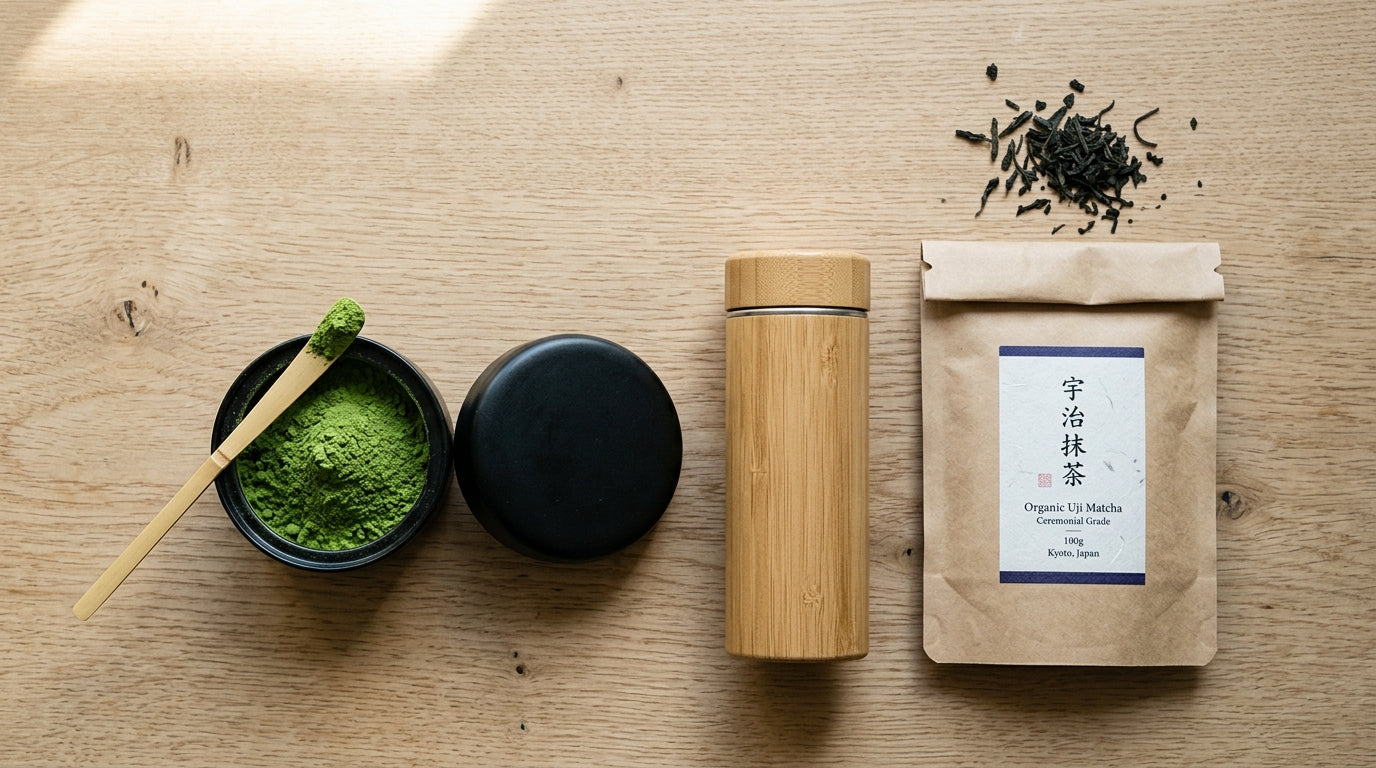
Vibrant jade green, bordering on electric, is the visual signature of premium matcha. Dull olive, yellow-green, or brown tones suggest older leaves, oxidation, sun damage, or a powder that's been sitting too long. This is the easiest single test you can do at home.
7. Third-Party Heavy Metal Testing
Tea plants pull heavy metals from soil, and matcha consumers eat the whole leaf rather than steeping and discarding it. Independent testing by Tamara Rubin's lab in 2024 to 2025 found measurable lead, cadmium, mercury, and arsenic in many widely sold organic brands (Lead Safe Mama, 2025). The takeaway isn't to avoid matcha. It's to drink brands that publish current lab reports, not just certification seals. Soil chemistry varies by region and harvest, so a 2022 test isn't enough for a 2026 tin.
How to Evaluate Matcha at Home in 90 Seconds
Even without a chemistry lab, you can verify quality with four sensory checks that take less than two minutes. According to research summarized by peer-reviewed sources on Japanese tea processing, premium matcha shows specific physical traits that lower-grade powder cannot fake.
Color test. Tap a small mound onto a white plate. Premium powder is bright, uniform jade. Anything yellow, brown, or grey-green has either oxidized, aged past its prime, or used later-flush leaves.
Aroma test. Open the tin and inhale. You're looking for a sweet, vegetal, slightly grassy aroma that some tasters describe as fresh-cut hay or sea breeze. Stale or musty smells suggest poor storage, often from broken vacuum seals or warm shelves.
Foam test. Whisk one teaspoon of matcha with two ounces of 175°F water using a chasen (bamboo whisk) for about 20 seconds in a quick W-pattern. Premium ceremonial powder builds a thick, persistent crema with fine micro-bubbles. Lower grades produce thin, large-bubble foam that collapses within seconds.
Taste test. The first sip should be umami-forward, slightly sweet, and grassy, with a clean finish. Sharp bitterness, chalky texture, or a metallic aftertaste are all flags. Real matcha can be intense, but it's never harsh.

What Should You Pay? Price Tiers Explained
Pricing in the matcha world spans an enormous range, and most of it correlates with the seven markers above. Here's roughly what you're getting at each tier in the US market in 2026.
Entry ($8 to $15 per 30g). Usually culinary or industrial grade, often blended with later-harvest leaves. Fine for baking and recipes where matcha competes with sugar, butter, or strong flavors. Skip it for straight whisking.
Mid / Latte grade ($16 to $25 per 30g). The honest sweet spot for daily lattes. Look for first or early-second flush, USDA Organic seal, and a recent heavy metal test posted on the brand's site. Most reputable brands sit here for their workhorse latte tin.
Premium ceremonial ($26 to $40 per 30g). First-flush, fully shaded tencha from a named region. Bright color, sweet umami, persistent foam. This is what you want for water-whisked matcha, koicha-style preparations, or any moment where you want the leaf to speak for itself.
Ultra-premium ($45 to $90+ per 30g). Single-farm, often single-cultivar lots from named producers in Uji or Nishio. Lovely if it's your practice. For most drinkers, premium ceremonial delivers 90% of the experience at half the price.
Red Flags That Should Stop a Purchase
Most disappointing matcha purchases share a small set of warning signs. According to consumer guidance compiled by Consumer Reports on heavy metals in food and across multiple Japanese tea trade publications, here's what to walk away from.
- No origin information. "Product of Japan" alone isn't enough. Real producers name the prefecture, often the town, sometimes the farm.
- "Ceremonial grade" under $20 per 30g. The math doesn't work. Real ceremonial powder costs more to produce than that.
- Dull or yellow-green color. Visible through the seal on transparent packaging or in the first scoop.
- Vague organic claims. Look for the actual USDA Organic or JAS seal plus the certifying body's name. "Naturally grown" and "pesticide-free" are not regulated terms.
- No heavy metal lab report. Or a report dated more than 18 months old. Soil and harvest conditions change.
- Bitterness that lingers. A small bitter note is normal. A harsh, drying, or chemical aftertaste is not.
- Bulk packaging without nitrogen flush or vacuum seal. Matcha oxidizes quickly. Quality producers ship in airtight tins or pouches with clear best-by dates.
- "Organic" without third-party pesticide testing. Independent lab tests in 2025 found 15% of organic-labeled matcha samples contained trace neonicotinoid pesticides per Fortune's testing report on matcha powders. Brands publishing third-party Certificates of Analysis for both pesticides and heavy metals reduce exposure risk by up to 90%.
How One with Tea Approaches Sourcing
We started One with Tea because the matcha most Americans were drinking didn't reflect the tea we'd had on Japanese farms. Our ceremonial matcha comes from organic-certified producers in Japan's traditional tea regions, ground on stone mills, sealed for freshness, and tested independently for heavy metals before each release. Lab results are published on our Lab Results page, dated and named.
Our founder, Christian, comes from a journalism background and built the brand around clear sourcing rather than wellness language. The whole catalog is USDA Organic. Our flagship 30g ceremonial tin sits in the premium range above. The 60g pouch is our refill option, and the latte grade is what we drink in milk-based drinks at the office.
If you're new to whisking, the matcha preparation guide walks through water temperature, dosage, and chasen technique, all of which matter as much as the powder itself.
Why Premium Matcha Is Worth the Practice
Beyond the sourcing story, the chemistry is genuinely interesting. A 2-gram serving of premium ceremonial matcha contains roughly 50 mg of L-theanine and 40 to 70 mg of caffeine, paired in a ratio that's been studied for cognitive effects. A study published in Biological Psychology found that 100 mg of L-theanine combined with 50 mg of caffeine produced faster reaction times and improved sentence verification accuracy compared to either compound alone. Two cups of good ceremonial matcha sit close to that ratio, naturally.
Drinking matcha in this way isn't a productivity hack. It's a small, repeatable ritual: the boil, the cool, the sift, the whisk, the pause. The powder you choose shapes that ritual. Bright color, sweet umami, and a clean lab report change the experience entirely.
New to the ritual? Start with our best matcha for beginners guide, then come back here when you're ready to compare organic ceremonial options.
Frequently Asked Questions
Is USDA Organic the same as JAS Organic for Japanese matcha?
Functionally yes since January 1, 2014, when the US and Japan signed an equivalence agreement (MAFF Japan). A JAS-certified Japanese matcha can be sold as USDA Organic in the US, provided the importer is registered. As of 2025, an additional NOPID import certificate is required for entry, so the supply chain is now audited at both ends.
What's the real difference between ceremonial and culinary matcha?
Ceremonial uses the youngest, most-shaded first-flush leaves and is meant for whisking with water. Culinary (or latte) grade uses later-harvested leaves and stands up better to milk, sweetener, and heat. There's no legal definition of either term in the US, so any "ceremonial" tin priced under $20 per 30g should be questioned.
How much L-theanine and caffeine does matcha actually contain?
A 2-gram serving of ceremonial matcha provides roughly 50 mg of L-theanine and 40 to 70 mg of caffeine, depending on harvest and grade. That's about five times the L-theanine of unshaded green tea, mainly because tencha is shaded for at least 20 days before picking, which prevents the amino acid from breaking down.
Should I worry about heavy metals in matcha?
It's worth verifying, not panicking. Independent testing by Lead Safe Mama in 2024 to 2025 found measurable lead, cadmium, mercury, and arsenic in many "organic" brands (Lead Safe Mama, 2025). Choose brands that publish current third-party lab results dated within the last 18 months. The certification seal is the floor, the lab report is the ceiling.
How long does organic matcha stay fresh once opened?
Roughly four to six weeks at peak quality, then a slow fade. Matcha oxidizes when exposed to air, light, and heat, which dulls the color and flattens the aroma. Store in an airtight container in the refrigerator after opening, and finish a 30g tin within six weeks of breaking the seal for the best experience.
Is more expensive matcha always better?
No. The honest premium tier ($26 to $40 per 30g) covers 90% of what most drinkers need. Ultra-premium single-farm lots above $50 are wonderful if matcha is a daily practice, but the marginal gain shrinks fast. Spend the money on third-party-tested first-flush ceremonial from a named region, and you've already cleared the bar that 80% of the market doesn't.
Can I drink matcha every day?
Most healthy adults can. A typical daily serving (1 to 2 grams) sits well within standard caffeine guidelines and delivers L-theanine that takes some of the edge off compared to coffee. As with any caffeinated drink, your body's response is the best meter. If you're pregnant, breastfeeding, or managing a medical condition, check with your healthcare provider on appropriate intake.
Where to Start
If you're choosing your first premium organic matcha or upgrading from a supermarket tin, start with a verified first-flush ceremonial powder from a named Japanese region, with a current heavy-metal lab report and an honest USDA Organic or JAS seal. That single decision puts you ahead of most matcha drinkers in the US, and it makes every cup that follows easier to enjoy.

From our tea room
Organic Ceremonial Matcha Green Tea Powder - USDA Certified (60g)
Ceremonial grade for whisking with water. Stone-milled, USDA Organic, third-party lab tested. From Shizuoka.
View Ceremonial Matcha 60gOur 30g ceremonial tin is where most new customers begin. If you're already settled into a daily practice, the 60g refill is the better value. Either way, give the powder a quiet morning, a quiet bowl, and a real chance. Good matcha rewards attention.
Looking for ceremonial matcha sourced honestly from named Japanese regions?
USDA Organic and JAS certified, third-party lab tested, direct from family farms.
Shop Matcha CollectionInquire About Wholesale
Share:
What Is Shincha? Japan's First-Flush New Tea
Matcha vs Coffee: Caffeine, Energy, and Which Is Better