

Matcha for Meditation Practice: A Founder's Take on Tea as Ritual
By Christian Mauerer, Founder of One with Tea · Published May 7, 2026
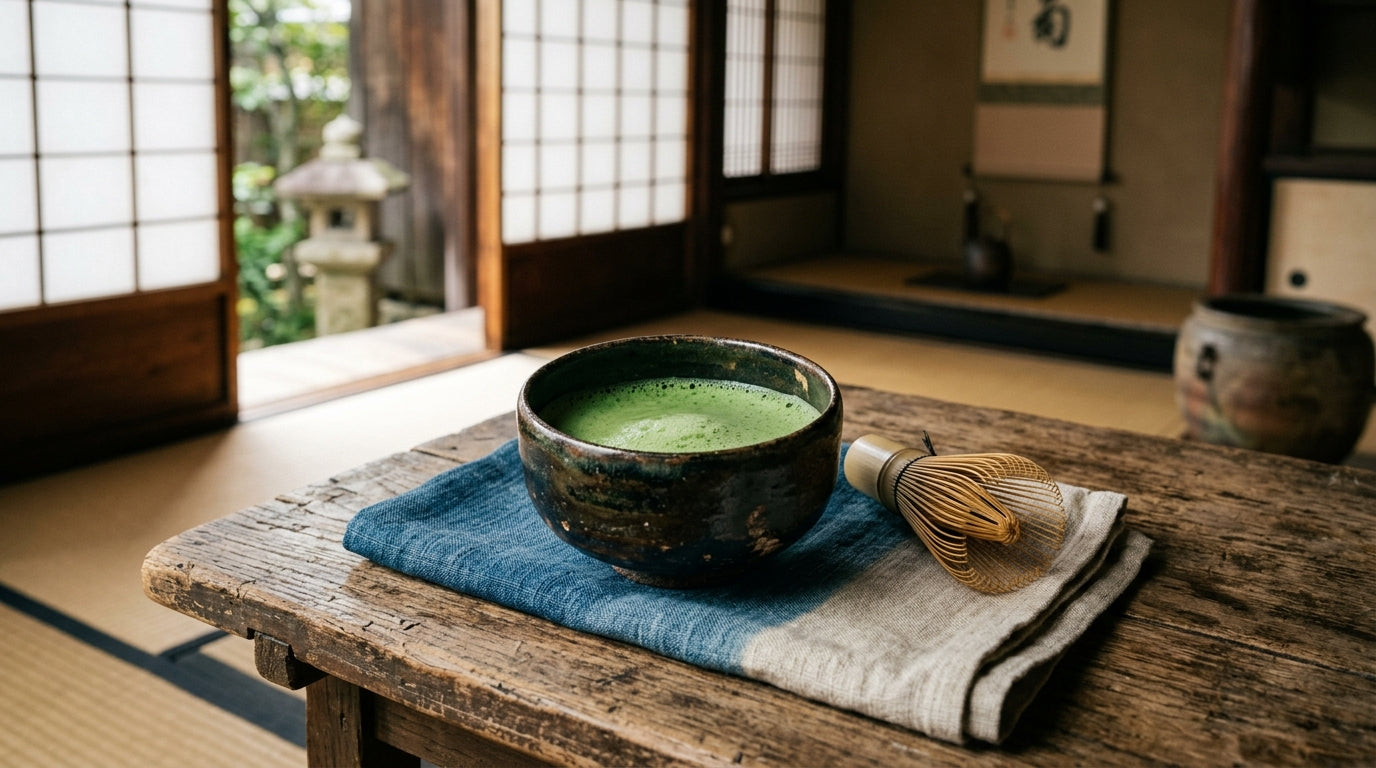
The meditative quality of matcha is not in the cup. It is in the ritual that produces the cup. Five hundred years before the modern wellness industry discovered the word "mindfulness," Japanese tea masters had already codified a complete preparation form around four principles: harmony, respect, purity, and tranquility (Wikipedia, Japanese tea ceremony). The bowl, the whisk, the order of the gestures, the temperature of the water. None of it is decoration. All of it is a structure for attention.
I run a small US matcha brand and have spent years preparing a daily bowl, sometimes well, sometimes badly, always as a marker. What follows is how I think about matcha as a meditation anchor in 2026, what chanoyu got right that modern practice still depends on, and where sourcing fits into all of it. The bowl is not a productivity tool. The bowl is a pause.
Key Takeaways
- Japanese tea ceremony (chanoyu) is built on four principles: harmony (wa), respect (kei), purity (sei), and tranquility (jaku) (Wikipedia, Japanese tea ceremony).
- The host "ritually purifies each utensil, including the tea bowl, whisk, and tea scoop, in the presence of the guests in a precise order and using prescribed motions" (Wikipedia, Japanese tea ceremony).
- Modern mindfulness, as defined by Jon Kabat-Zinn at UMass Medical Center in 1979, is "moment-to-moment, non-judgmental awareness" (Wikipedia, MBSR).
- Standard preparation: roughly 1 teaspoon of matcha to 4 ounces of 175 °F water, whisked with the chasen kept "as vertical as possible" until the water froths (Harney & Sons).
- First-flush ceremonial matcha (May harvest) is the form most aligned with ritual use. The amino acids that create the umami "are at their best" in the first crop (Harney & Sons).
The Bowl as a Marker of the Pause
The reason matcha holds up as a daily practice anchor is that it asks for a defined window of time. There is no fast version of whisking a bowl properly. The water has to come off the boil and rest. The powder has to be sifted. The whisk has to move. Done well, the whole sequence runs about three to five minutes, which is, not coincidentally, the length of a short seated practice.
The bowl is not productivity fuel. I want to be careful about that, because the way matcha is marketed in the US in 2026 often collapses into "drink this and perform better." That is not what tea ceremony is, and it is not how I drink it. I drink it because the act of preparation is the only window in my morning where the next task is the current task. Sift, pour, whisk, sit. The bowl is a marker that says the day has not started yet. The day starts when the bowl is empty.
What Did Chanoyu Get Right About Ritual?
Chanoyu is the Japanese tea ceremony, and it has been refined for roughly five centuries. Its four guiding principles are harmony (和, wa), respect (敬, kei), purity (清, sei), and tranquility (寂, jaku) (Wikipedia, Japanese tea ceremony). The form is also deeply tied to Zen Buddhism: "Zen Buddhism and Shinto has greatly influenced the culture of Japanese tea" (Wikipedia, Japanese tea ceremony). What chanoyu got right, in a way modern practice keeps rediscovering, is that the structure itself is the teaching.
Read the description of the host's role and notice what is happening. The host "ritually purifies each utensil, including the tea bowl, whisk, and tea scoop, in the presence of the guests in a precise order and using prescribed motions" (Wikipedia, Japanese tea ceremony). The order matters. The motions are prescribed. The cleansing happens in front of the guests. There is no wasted gesture and no hidden one. The form removes the question of what to do next, which is the question that keeps the mind busy. When the next motion is given, the mind has somewhere to rest.
Is the Whisk a Mindfulness Practice?
Jon Kabat-Zinn founded Mindfulness-Based Stress Reduction at the University of Massachusetts Medical Center in 1979 and defined mindfulness as "moment-to-moment, non-judgmental awareness" and as "the non-judgmental acceptance and investigation of present experience" (Wikipedia, MBSR). That definition, written for a hospital context in the late 1970s, describes almost exactly what whisking a bowl of matcha asks of you, if you let it.
The technique itself is small and specific. Harney & Sons describes it cleanly: "whisk the water until it froths" and "keep your whisk as vertical as possible" (Harney & Sons). Try the vertical-whisk instruction once with attention. The wrist has to stay loose. The arm has to do the work. The angle of the chasen against the bowl is the whole game. If your mind drifts, the foam goes flat. The feedback is immediate and physical, which is what makes the act a useful practice object. You are not being asked to think about your breath. You are being asked to keep the whisk vertical, which is a doorway to the same place.
The Compounds in Your Bowl
A short factual paragraph, because the biology gets oversold elsewhere. Matcha contains caffeine and the amino acid L-theanine, the same compound responsible for matcha's umami. The first crop, harvested in May, is when "the amino acids that create the mouth-filling umami are at their best" (Harney & Sons). That is the extent of what is useful to say. The taste of a well-made first-flush bowl is the direct sensory expression of those amino acids. Everything beyond that, in the context of meditation practice, is a distraction from the bowl in front of you.
Why Does Sourcing Matter for Ritual Use?
If the practice is about intention, then knowing what is in the bowl is part of the practice. This is where I land hardest as a founder, and it is the part of the conversation that gets lost when matcha is sold purely as a beverage. First-flush ceremonial tencha, picked in spring (typically May), from a named Japanese region (Uji, Nishio, Kagoshima, or Shizuoka), is the form most aligned with ritual use. Not because the label says "ceremonial," but because the harvest timing, the cultivar, and the processing are all calibrated for whisked preparation rather than for blending into baked goods or lattes.
Sourcing knowledge IS a form of intention. JAS organic certification, USDA Organic, third-party heavy-metal and pesticide panels per lot. We publish ours on our Lab Results page. None of that is a wellness claim. It is a question of whether the object you are using to anchor your morning is what the label says it is. For a daily practice tin, the answer to that question matters more than for a tin you'll bake into cookies. If you want the deeper read on harvest timing, our first-flush vs second-flush guide walks through it. For organic certification specifically, see our organic matcha breakdown.
How Do You Build a Daily Matcha Practice?
Start small and let the form do the work. Three commitments hold most beginning practices together.
Same bowl, same time, same place. Pick a chawan you actually like, a corner of the kitchen, a window in the morning before the phone is open. The mind learns the location. Within a week, walking to that corner is itself the start of the pause.
Use the standard preparation. Roughly 1 teaspoon of matcha to 4 ounces of water at 175 °F (about 80 °C), whisked with a bamboo chasen kept "as vertical as possible" until the water froths (Harney & Sons). Boil the kettle, then let it rest 60-90 seconds before pouring. This is the same standard we cover in our beginner's guide if you are new to whisking.
Sit with the bowl. Drink it slowly. Don't pair it with a podcast or an inbox. The whole point is that the three minutes of preparation and the three minutes of drinking are the practice. If you skip the second half, the first half is just chores.
How One with Tea Sources for Practice
For full transparency: our flagship ceremonial 30g and 60g tins are first-flush, sourced from named Japanese organic-certified farms, with the prefecture and harvest year listed on the label. We hold both JAS and USDA Organic certification. We run third-party heavy-metal and pesticide panels per lot and publish them on our Lab Results page. The same product spec ships today as shipped in 2024, with pricing adjusted to reflect actual landed cost in 2026.
I source this way because I drink the tin daily, and because if I am going to put a bowl at the center of my morning, I want to know exactly what is in it. The practice is the point. The sourcing is how I keep faith with the practice. If our tin is the right one for your daily bowl, wonderful. If it is a different brand whose harvest detail and lab results you can verify, that is also wonderful. The category wins when the bowl is honest.
Looking for a tin to anchor your daily practice?
First-flush ceremonial, USDA Organic and JAS certified, third-party lab tested, sourced from named Japanese regions.
Shop Matcha Collection Inquire About WholesaleHave a question or want to talk wholesale? Email info@onewithtea.com. I read everything.
Share:
First-Flush vs Second-Flush Matcha: What It Means
Japan's Tea Production by Region: 2026 Map + Data