


By Christian Mauerer, Founder of One with Tea · Published May 7, 2026
The actual quality dividing line in matcha is not "ceremonial vs culinary." It is first-flush vs second-flush. Leaves picked from the same Japanese tea plant in late April through early June carry roughly three times the theanine of leaves picked from that same plant six to eight weeks later, and that single biochemical fact drives everything you taste in the bowl (Shizuoka Tea, Nio Teas). Sweetness, umami depth, color, even how the powder whisks. The Western "ceremonial" label sits on top of that biology and often hides it.
I source for One with Tea, and when I am writing purchase orders to our Japanese partners I am asking about flush before I ask about anything else. I have spent the last several years tasting first, second, and third flush from the same farms in the same season, and the gap is not subtle. What follows is the framework I would give a friend trying to understand why two tins both labeled "ceremonial" can taste like completely different products.
Key Takeaways
- First-flush matcha (ichibancha) is harvested late April through early June. Second-flush follows roughly six to eight weeks later (Nio Teas).
- Ichibancha contains approximately 3 times more theanine than nibancha from the same plant (Shizuoka Tea).
- Second-flush leaves are "more astringent in flavour and less green in colour" because they sit lower on the plant and have converted L-theanine into catechins (Perfect Daily Grind, Nio Teas).
- Authentic ceremonial-grade matcha and gyokuro use first-flush leaves almost exclusively (Liliku Tea).
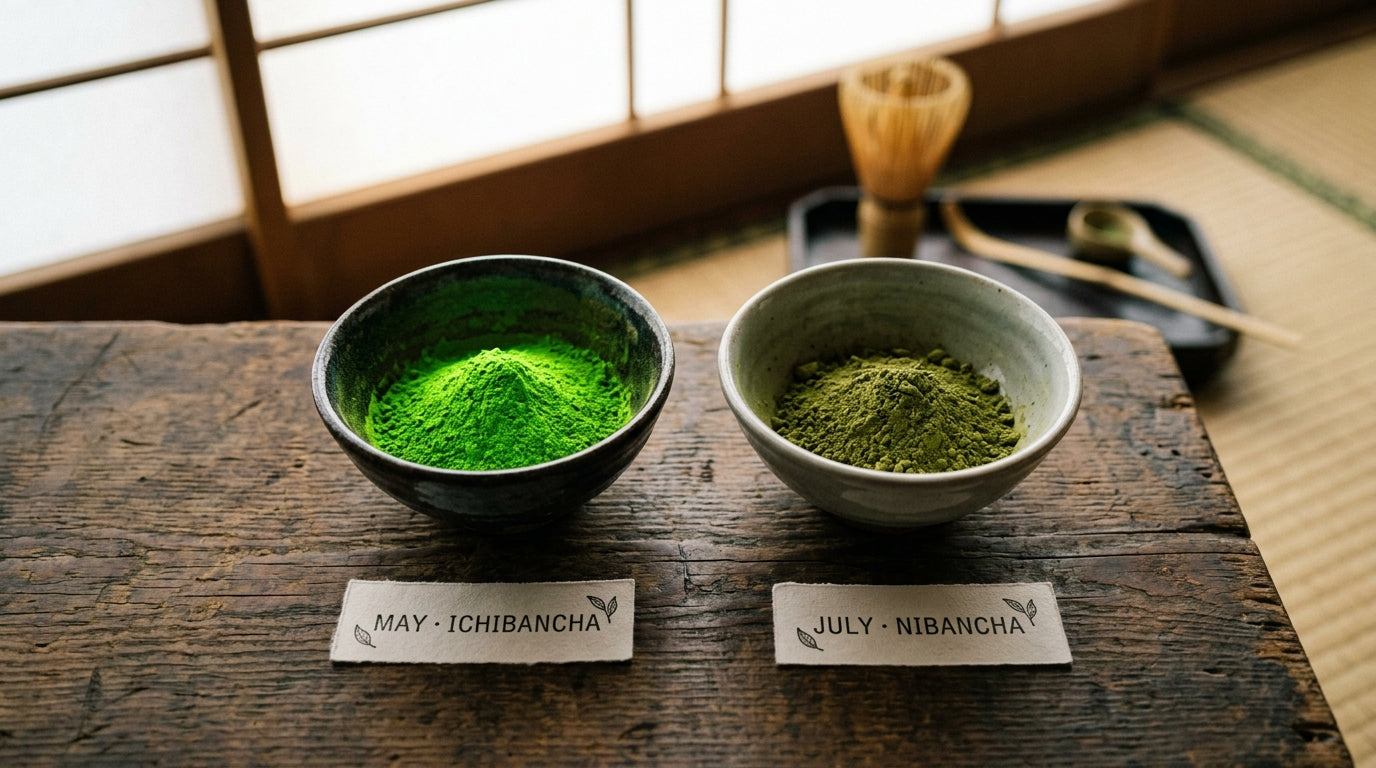
- Visual tell: first-flush matcha shows a vivid, almost neon jade green. Later flushes shift olive or dull yellow-green (Nio Teas).
- Second and third flushes still have legitimate uses in lattes, blends, and culinary work. They are not the same product as first-flush ceremonial.
The Japanese Tea Calendar: Three Flushes a Year
Japanese green tea is harvested in distinct flushes, not continuously. The first flush, called ichibancha, runs from late April through early June depending on region (Best Matcha). Second flush (nibancha) follows roughly six to eight weeks later, and a third flush (sanbancha) sometimes follows that in late summer or fall (Nio Teas).
The calendar tracks the plant's energy. After winter dormancy, the tea bush channels stored amino acids and chlorophyll into the first new shoots. Those first shoots become ichibancha. Once they are picked, the plant has to push out new growth in summer heat with less stored reserve, and the chemistry of the leaf changes as a result. Shizuoka Tea, a Japanese-side wholesaler, names it directly: "Ichibancha / First tea, late April to May," with nibancha and sanbancha following as the season progresses (Shizuoka Tea).
Different prefectures sit on slightly different timelines. Kagoshima in the south picks earliest, often in mid to late April. Uji in Kyoto and Nishio in Aichi tend to pick in early to mid May. Shizuoka and northern regions can run into early June. The plant biology is the same. The calendar just shifts.
We track the production side: which Japanese prefectures actually grow the tea.
Why Does First-Flush Matcha Taste So Different?
The flavor gap comes down to one number: theanine concentration. Shizuoka Tea reports plainly that "Ichibancha contains approximately 3 times more theanine than Nibancha" (Shizuoka Tea). Theanine is the amino acid that gives matcha its sweetness and its mouth-filling umami quality. Three times more of it is not a marketing flourish. It is the difference between a bowl that finishes sweet and a bowl that finishes flat.
We put them side by side: our caffeine comparison across teas.
The conversion mechanism matters too. Nio Teas, citing standard tea chemistry, explains that as the plant grows through summer it "converts stored L-theanine into catechins" (Nio Teas). Catechins are the astringent, slightly bitter compounds. So second-flush leaves don't just have less theanine, they have proportionally more astringency, which is exactly what you taste in the bowl. Perfect Daily Grind documents the practical result: second and third harvest leaves "are a bit lower on the tea plant and tend to be more astringent in flavour and less green in colour" (Perfect Daily Grind).
The amino acid math also drives the umami the rest of the industry uses to describe high grades. Harney & Sons, a long-running US tea importer, notes that "the first crop (harvested in May) is used to make this matcha. This is the time when the amino acids that create the mouth-filling umami are at their best" (Harney & Sons). When you read a label that names "first flush" or "May harvest," you are reading a claim about that amino acid concentration. When the label only says "ceremonial," you are reading marketing.
The Visual Tell: Why First-Flush Matcha Is Brighter Green
Color is the fastest visual signal of flush timing. First-flush matcha shows what Nio Teas describes as a "vivid, almost neon green colour," while later harvests carry an "olive or dull yellow-green tone" (Nio Teas). The chlorophyll concentration in first-flush tencha leaves is higher because shading and timing both peak in spring. Best Matcha goes further: "the vivid jade-green color of premium matcha comes exclusively from first-flush leaves" (Best Matcha).
This is also why color is one of the cleanest counterfeit tells. If a tin marketed as ceremonial pours out an olive or yellow-green powder, you are almost certainly looking at a later-flush or blended product, regardless of what the label claims. We covered this signal in our guide to spotting counterfeit ceremonial matcha, where olive-green color is a flush-timing tell that often outranks the label itself.
The color difference is not just aesthetic. It is a direct readout of where the leaf was on the plant and when it was picked. Two tins from the same farm in the same year, one first-flush and one second-flush, will sit side by side and look like different products. Because they are.
What Are Second and Third Flushes Actually Good For?
Second-flush and third-flush leaves still have a real place in the matcha economy. They are the workhorses of the latte, smoothie, and culinary tier. The astringency and lower amino acid concentration that make them less interesting in a straight whisked bowl are less of an issue when the matcha is buffered by milk, sweetener, ice, or baked into a recipe. A latte built on first-flush ceremonial is a luxury. A latte built on second-flush culinary is a sensible daily drink and a cafe's actual margin.
The pricing reflects the use case. Liliku Tea notes that "most of the ceremonial grade matcha use the first flush tea. Also, gyokuro, where sweetness and umami are as important as matcha, is harvested during the first flush timing only" (Liliku Tea). First-flush leaves get reserved for the products where umami carries the experience. Later flushes flow into the products where it does not have to.

From our tea room
Organic Ceremonial Matcha Powder - USDA Certified (30g)
Stone-milled ceremonial grade, USDA Organic, third-party lab tested.
View Ceremonial MatchaThe trouble is when second-flush product is sold under "ceremonial" labeling at first-flush prices. That gap is the entire counterfeit and mislabeling problem the category has been working through since the 2025 supply tightening. Shizuoka Tea is direct about the concentration drop too, noting that "on Nibancha, nutrients and health benefits dropped considerably from Ichibancha, and Sanbancha has even fewer nutrients than Nibancha" (Shizuoka Tea). Translated to buying terms, the concentration of beneficial compounds and the amino acid concentration both drop meaningfully with each subsequent flush.
How Do You Read a Tin for Flush Information?
Five label-level signals will tell you whether a tin is first-flush ceremonial or something further down the calendar. Most US retail tins fail at least one of these five.
Harvest timing or flush named. "First-flush," "ichibancha," "May 2026 harvest," or "spring first-flush" are real signals. Generic "ceremonial" without a harvest detail is not. The producer either knows the flush or they don't, and a tin that doesn't claim it is a tin where you should not assume it.
Region named. First-flush ceremonial typically comes from Uji, Nishio, Kagoshima, or Shizuoka. A "Product of Japan" label without a prefecture is leaving room for blending across flushes and origins.
Cultivar named. Yabukita is the most planted Japanese cultivar. Samidori, Asahi, Okumidori, and Uji-Hikari are common premium first-flush cultivars. A producer who knows their material lists it. A tin that does not name a cultivar is usually a blend, and blends often mix flushes.
Color matches the claim. Open the tin in good light. Vivid jade or neon green is consistent with a first-flush claim. Olive, dull yellow-green, or hay-toned is not, regardless of what the front of the tin says.
Lab and provenance documents. Heavy-metal panel, pesticide screen, and ideally a harvest date on the back. We publish ours by lot on our Lab Results page, and any honest first-flush producer can show you the equivalent.
How One with Tea Sources Across the Calendar
For full transparency on how I think about this when I am writing purchase orders. When I source for OWT, I am sourcing first-flush ceremonial because that is the only flush where the umami math actually works. Our flagship 30g and 60g ceremonial tins are first-flush ichibancha from named Japanese organic-certified farms, with the prefecture and harvest year on the label. We hold both JAS and USDA Organic certification, and we run third-party heavy-metal and pesticide panels per lot.
I have tasted second and third flush from the same farms. They are perfectly good products for the right use. They are not what I want sitting in a 30g tin with a ceremonial label on it, and they are not what I want my customers whisking on a Sunday morning. The price gap between flushes is real, and the supply pressure documented in our 2026 pricing analysis means first-flush tencha prices will keep climbing through this season.
If you are evaluating a tin and you cannot tell what flush it is, that itself is the signal. The producers who source first-flush say so on the label. The ones who don't, often have a reason they don't. For the framework on what good ceremonial actually looks like beyond flush, our beginner's guide walks through what makes ceremonial-grade matcha taste sweet and how to verify it. For the organic side specifically, our first-flush organic ceremonial guide covers certification stacks.
Want to taste what first-flush ichibancha actually tastes like?
USDA Organic and JAS certified, named-region first-flush ceremonial, third-party lab tested per lot.
Shop First-Flush Ceremonial Inquire About WholesaleHave a question or want to talk wholesale? Email info@onewithtea.com. I read everything.
Share:
Best Matcha for Cafes and Restaurants: 2026 Guide
Matcha for Meditation Practice: Tea as Ritual