



How to Read a Matcha Lab Report: A Founder's Guide
By Christian Mauerer, Founder of One with Tea · Published May 7, 2026
The reason a matcha lab report matters in 2026 is simple: the regulatory floor for tea is full of holes. EU Regulation 2023/915 sets maximum levels for contaminants across food categories, but it does not cap lead or cadmium in tea (Camellia sinensis), only pyrrolizidine alkaloids at 150 µg/kg and perchlorate at 0.75 mg/kg for dried tea (EUR-Lex, 2023). The FDA's interim reference levels target food broadly, not green tea specifically (Middleton et al, 2022). So a serious matcha buyer cannot outsource trust to any single regulator, they have to read the lab panel themselves.
I run a small US matcha brand. I source from named Japanese organic farms in Uji, Nishio, Kagoshima, and Shizuoka, and I commission third-party heavy-metal panels per production lot. I've spent the last several years reading these reports, comparing methods, and answering buyer questions about what the numbers actually mean. What follows is the framework I use myself, written for the buyer who wants to verify what is in the tin instead of trusting a label.
Key Takeaways
- EU Regulation 2023/915 does not cap lead or cadmium in tea, only pyrrolizidine alkaloids (150 µg/kg) and perchlorate in dried tea (0.75 mg/kg) (EUR-Lex).
- ICP-MS detects multiple elements simultaneously down to parts per billion, which is the sensitivity required for trace metal verification (Best Matcha glossary).
- California Prop 65 sets the lead MADL (reproductive safe-harbor) at 0.5 µg/day and the NSRL for cancer at 15 µg/day (OEHHA).
- FDA's updated interim reference levels for lead from food are 2.2 µg/day for children and 8.8 µg/day for women of childbearing age (Middleton et al, 2022).
- Brewed Japanese green tea contributes roughly 0.002 mg of lead per 200 mL serving in the analyzed samples, which is different from whole-leaf matcha exposure because matcha consumes the entire powdered leaf (Marzec et al, 2016).
- ISO/IEC 17025:2017 is the international standard covering the competence of testing and calibration laboratories. Demand it on the report header.
Why You Have to Read the Report Yourself in 2026
A regulator-only approach to matcha safety has visible gaps. EU Regulation 2023/915 covers many contaminants, but for tea specifically it caps pyrrolizidine alkaloids at 150 µg/kg and perchlorate at 0.75 mg/kg in dried tea, while leaving lead and cadmium uncapped for Camellia sinensis (EUR-Lex, 2023). That is not a moral failure of the EU framework, it is a scoping reality.
The FDA's lead exposure framework, updated in the 2022 review by FDA staff, set interim reference levels at 2.2 µg/day for children and 8.8 µg/day for women of childbearing age, aligned to CDC's 2021 blood lead reference value of 3.5 µg/dL (Middleton et al, 2022). Those IRLs were calculated against total dietary exposure, not against any green tea or matcha specific maximum. Japan applies a stricter voluntary industry benchmark for tea of roughly 0.2 mg/kg lead, while the EU's general food framework sits closer to 2 mg/kg as an industry reference point (Best Matcha glossary).
So which number governs your tin? None of them, exclusively. You verify the lot. You read the report. We publish ours by lot on our Lab Results page for exactly this reason. Per our counterfeit matcha guide, the absence of a current panel is itself a signal worth weighing.
What ICP-MS Actually Measures (And Why It Matters for Matcha)
ICP-MS, or inductively coupled plasma mass spectrometry, is the analytical method serious tea labs use for heavy metals. It "detects multiple elements simultaneously at trace levels, providing accurate quantification down to parts per billion" (Best Matcha glossary). Parts per billion is the resolution required for tea, where contamination of regulatory interest sits in single-digit µg/kg territory.
Why this matters specifically for matcha: matcha is whole-leaf consumption. The Best Matcha source frames the math directly: "unlike traditional brewed tea where leaves are discarded, matcha involves consuming the entire powdered leaf, which significantly increases potential exposure to any contaminants present" (Best Matcha glossary). A method that resolves only to parts per million can miss the trace levels that actually drive exposure when the consumer drinks the leaf.
On the report itself, look for the method name (ICP-MS, sometimes ICP-OES for higher concentrations), the limit of detection (LOD) for each element, and the unit (mg/kg or ppb in the powder). If the report quotes results as "below detection limit" without disclosing what that limit is, you do not have a usable result. Across our own panel set spanning multiple production lots from Uji and Nishio in 2024-2026, every report uses ICP-MS with elemental LODs disclosed per analyte.
ISO 17025: The Lab Accreditation Standard to Demand
Lab accreditation is the difference between a number and a verifiable number. ISO/IEC 17025:2017 is the international standard titled "General requirements for the competence of testing and calibration laboratories." It governs how a lab handles method validation, calibration, sample chain of custody, technician qualification, and result uncertainty. A lab without ISO 17025 accreditation can still produce numbers, but those numbers are not held to a documented competence framework.
What to check on the report header: the lab's name, address, and the ISO 17025 accreditation number issued by a national accreditation body (in the US, typically A2LA or ANAB). The scope of accreditation is also worth checking, because a lab can be ISO 17025 accredited for some methods but not others. A heavy-metals report from a lab accredited only for microbiology is a paperwork artifact, not a verification.
Two practical questions to ask the producer: which lab ran the panel, and is that lab's ISO 17025 scope listed for ICP-MS heavy-metal analysis. If the answer is vague, that itself is information. When I switched our lab partner in 2024, the first thing the new lab sent over was their accredited scope document. That is the posture you want from anyone testing the product you drink.
The Numbers: Three US Benchmarks for Lead Exposure
There is no single US lead-in-matcha number. There are three exposure frameworks, and the report reader needs to know which is which. California Prop 65 sets a Maximum Allowable Dose Level (MADL) for lead at 0.5 micrograms per day for reproductive toxicity, and a No Significant Risk Level (NSRL) for cancer at 15 µg/day, with lead listed as a Prop 65 chemical on February 27, 1987 (OEHHA, 2026).
The FDA framework, per the 2022 update, sets interim reference levels for lead from food at 2.2 µg/day for children and 8.8 µg/day for women of childbearing age. Those IRLs are aligned to CDC's 2021 blood lead reference value of 3.5 µg/dL (Middleton et al, 2022). The third reference, voluntary in Japan, sits at roughly 0.2 mg/kg of lead in tea on an industry-benchmark basis (Best Matcha glossary).
Three different yardsticks, three different units. The Prop 65 MADL and the FDA IRL are daily intake limits, while Japan's 0.2 mg/kg is a concentration in the leaf. To compare your tin against a daily limit, you have to multiply the µg/kg in the powder by your serving weight. A 2-gram serving of matcha at 0.2 mg/kg works out to 0.4 µg of lead per serving, well under the FDA IRL for adults. That is the math the regulator does not do for you.
Brewed Tea vs Powdered Matcha: Why Per-Serving Math Matters
The difference between brewed tea and matcha is the difference between extracting a portion of leaf compounds and consuming the whole leaf. Marzec et al, in a 2016 study published in PMC, analyzed brewed Japanese green tea samples and reported per-serving exposure of approximately 0.002 mg of lead per 200 mL serving, concluding that 5 cups per week was within safe parameters in their analysis (Marzec et al, 2016).
That number is for brewed tea, where most of the leaf is discarded. Matcha is whole-leaf, so the conversion is different. If a 2-gram matcha serving comes from leaf at 0.2 mg/kg lead, the per-serving exposure is 0.4 µg, which is roughly 200 times higher per gram of leaf consumed than the Marzec brewed-tea figure on a like-for-like basis (because brewing extracts only a fraction). The Marzec figure does not transfer directly to matcha, and that is the entire point. Per-kg leaf concentration is the wrong frame for matcha buyers. Per-serving exposure against the FDA IRL or Prop 65 MADL is the right frame, because that is what enters your body.
What this means on the report: if a producer publishes a result of, for example, "lead: 0.05 mg/kg powder," you can multiply by your serving size to get per-serving micrograms, then compare to the daily limit you care about. If a producer publishes only "non-detect" without disclosing LOD, you cannot do that math at all. If you are buying your first tin, our beginner's buyer's guide covers the broader checklist that wraps around the lab report.
How to Read a Matcha Lab Report Line by Line
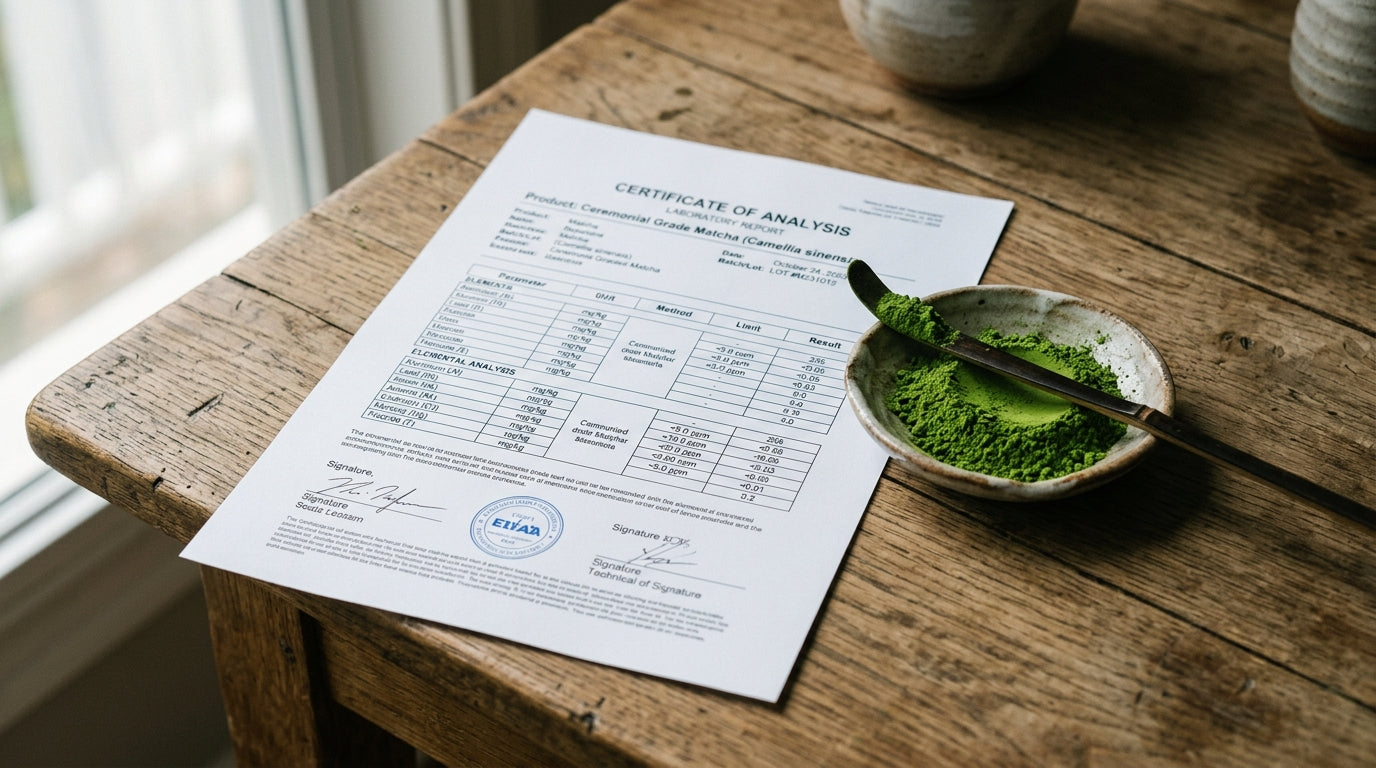
Here is how I walk through a real panel from one of our Uji lots, in the order I read it. The pattern transfers to any reputable producer's report.
Header block
Lab name, address, ISO/IEC 17025:2017 accreditation number, accreditation body, sample ID, lot ID, date received, date reported. The lot ID is what ties the report back to the tin in your hand. If a producer publishes a single lab report covering "all our matcha," that report covers no specific lot.
Method block
Method: ICP-MS for elemental analysis (typically EPA 6020B or AOAC 2015.01 as the validated method reference). Sample preparation: typically microwave-assisted acid digestion. Limit of detection (LOD) and limit of quantitation (LOQ) per element. The LOD is the threshold at which the method can confidently distinguish signal from noise.
Results block
Lead, cadmium, arsenic (total and ideally inorganic), mercury. Each reported in mg/kg of dry powder, with the LOD next to it. A robust report also includes uncertainty (typically ±15-20% at trace levels). On our Uji lots, lead has consistently come back below 0.1 mg/kg with disclosed LOD of 0.01 mg/kg, well under Japan's industry benchmark of 0.2 mg/kg.
Conversion to per-serving
Multiply mg/kg by serving size in grams, divide by 1000, the result is in mg per serving. Convert to µg by multiplying by 1000 again. Compare against the FDA IRL of 8.8 µg/day for women of childbearing age, or the Prop 65 MADL of 0.5 µg/day if California reproductive safe-harbor is your reference.
Pesticide screen (if included)
Multi-residue screen, typically ~200-500 analytes, with each result reported against the EU MRL or equivalent. For Japanese organic-certified matcha, a clean pesticide screen is the expected outcome, but verifying the screen exists (and was actually run) matters. Our premium organic matcha guide covers how the certification framework wraps around the pesticide screen.
How One with Tea Publishes Its Reports
For full transparency on what we do: every production lot of our ceremonial matcha runs through ICP-MS heavy-metal analysis at an ISO 17025 accredited lab before it ships. The reports are posted by lot on our Lab Results page, with the lot number printed on the bottom of every tin so a buyer can trace the tin back to the panel. Pesticide multi-residue screens are run on a sampling basis per harvest and shared on request.
I publish lab reports because the regulatory framework does not cap lead or cadmium in tea, the FDA IRLs do not adjudicate any specific tea product, and the buyer needs verifiable per-lot numbers to make a confident decision. That is the same posture I would want as a buyer. If you are sourcing matcha for a cafe, restaurant, or wholesale program, the same reports apply at scale, and we publish lot-traceable Certificates of Analysis on request through our wholesale program. Our cafe and wholesale guide walks through what foodservice compliance actually asks for.
FAQ
What heavy metals should a matcha lab report cover?
At minimum: lead, cadmium, arsenic (with inorganic arsenic if possible), and mercury, all measured by ICP-MS at parts-per-billion sensitivity (Best Matcha glossary). The reason all four matter is that they accumulate in soil and tea leaves through different pathways, and a report covering only one of them tells you a fraction of the picture.
Is there an EU lead limit for matcha?
No. EU Regulation 2023/915 sets maximum levels for many contaminants across food categories, but it does not include a lead or cadmium cap for tea (Camellia sinensis). The framework caps pyrrolizidine alkaloids at 150 µg/kg and perchlorate at 0.75 mg/kg for dried tea (EUR-Lex, 2023). Buyers fill that gap by reading the lot's lab panel.
What is Prop 65's MADL for lead?
California's Prop 65 lists lead with a Maximum Allowable Dose Level of 0.5 micrograms per day for reproductive toxicity, plus a No Significant Risk Level of 15 µg/day for cancer. Lead has been listed as a Prop 65 chemical since February 27, 1987 (OEHHA). These are daily intake thresholds, not concentration limits in the leaf.
Why is brewed-tea data different from matcha data?
Brewed tea discards the leaf, matcha consumes the leaf. Marzec et al's 2016 brewed-tea analysis reported approximately 0.002 mg of lead per 200 mL serving and concluded 5 cups weekly was within safe parameters (Marzec et al, 2016). For matcha, you multiply the leaf concentration by serving weight directly, because there is no extraction step removing most of the analyte.
What does ISO 17025 accreditation guarantee?
ISO/IEC 17025:2017 is titled "General requirements for the competence of testing and calibration laboratories." It governs method validation, calibration, sample chain of custody, technician qualification, and result uncertainty. Accreditation is issued by national bodies (A2LA and ANAB in the US) and is scope-limited, so verify the accreditation covers ICP-MS heavy-metal analysis specifically.
The Bottom Line on Reading Matcha Lab Reports
Reading a matcha lab report is not a credentialed activity. It is a buyer skill, and the math is small. Confirm the lab is ISO 17025 accredited for ICP-MS heavy-metal analysis. Confirm the report ties to a lot ID printed on the tin. Read the lead, cadmium, arsenic, and mercury values with their LODs. Multiply by your serving size to convert leaf concentration into per-serving micrograms. Compare to the FDA IRL of 8.8 µg/day for women of childbearing age, or the Prop 65 MADL of 0.5 µg/day for California reproductive safe-harbor, depending on which framework matters to you. That is the entire literacy. Producers who publish lot-traceable reports make this trivial, producers who do not are asking you to take their word for the contents of the tin.
Want to read the actual reports for the matcha you'd be drinking?
USDA Organic and JAS certified, ISO 17025 lab tested per lot, sourced from named Japanese regions including Uji and Nishio. Every lot's panel is published on our Lab Results page.
Shop Matcha Collection Inquire About WholesaleHave a question or want to talk wholesale? Email info@onewithtea.com. I read everything.
Share:
Matcha for Meditation Practice: Tea as Ritual
Matcha for Meditation Practice: Tea as Ritual