



Published: May 2026. This is the 2026 Matcha Industry Outlook from One with Tea, the first in our recurring matcha industry brief franchise. Three conclusions to lead with. First, 2025 closed with the tightest Japanese tencha supply in recent memory, and the auction-price pressure that followed is now reaching retail shelves. Second, regional production is shifting south, with Kagoshima continuing to gain share against Shizuoka. Third, 2026 first-flush data is still incomplete as of May, but early signals point to another tight year for premium ceremonial-grade matcha. This Outlook is built on 2025 actuals, early 2026 trade signals, and five weeks of on-the-ground reporting from Japanese tea regions earlier this year.

About this report
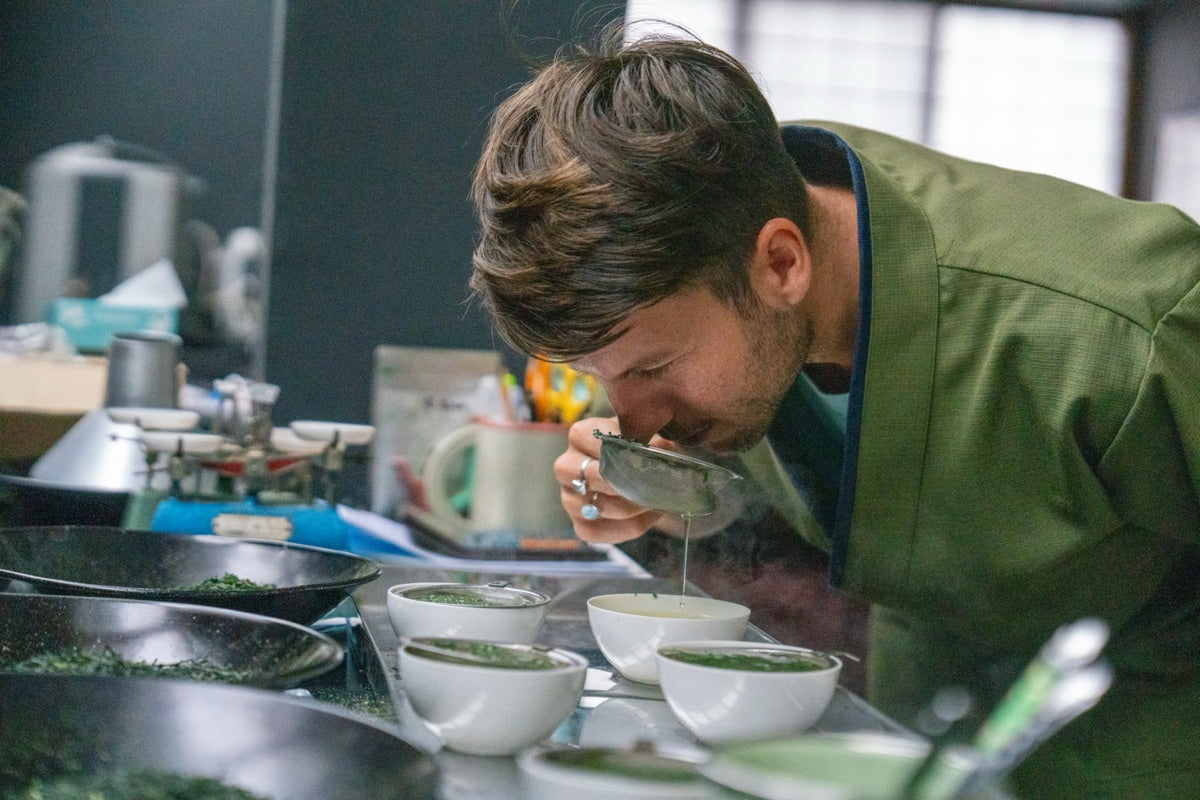
I spent five weeks in Japan in May, traveling between Shizuoka, Kyoto, Wazuka, Yame in Fukuoka, and the Kagoshima and Shibushi tea belt. The trip was filmed for a forthcoming One with Tea documentary, and the conversations that came out of it shape this Outlook in ways a desk-only report cannot match. We sat with farmers, ground tencha at small mills, watched first-flush leaf move from field to factory, and heard producers talk plainly about cost, certification, and consolidation pressure.
This report is built on three layers. The first is primary source statistics from Japan's Ministry of Agriculture, Forestry and Fisheries (MAFF), the United States Department of Agriculture (USDA) National Organic Program, and JAS organic standards documentation. The second is field reporting from named producers, with quotes attributed by location and date. The third is industry trade reporting referenced as such, with no synthetic numbers presented as primary data. Every numerical claim in this Outlook carries a hyperlink to a primary source: MAFF agricultural data, Global Japanese Tea Association compilations citing MAFF, Japanese Ministry of Finance trade statistics, USDA AMS records, and named industry reporting from Fortune, STiR Coffee and Tea Magazine, The Japan Times, and Nippon.com. Forward-looking projections use measured language (likely, probable, watching for). We do not invent specificity to sound authoritative.
For the global comparison, see the worldwide production picture.
Key takeaways
- Premium tencha contraction in 2025. Kyoto's traded first-flush volume fell 13 percent in 2025 after a cold April, per Global Japanese Tea Association reporting, while hand-picked Uji tencha at the JA Zen-Noh Kyoto market averaged ¥47,096/kg, up from ¥20,024/kg (Ooika, citing JA Zen-Noh Kyoto). Full-year MAFF national tencha tonnage is published through Japan's agricultural policy portal.
- Tencha auction prices climbed sharply. Trade reports indicate first-flush tencha lots cleared well above prior-year averages, with some premium lots more than doubling. We observed at least one ¥50,000 per kilogram clearing price firsthand at Kurihara Seicha in Yame, Fukuoka in May 2025.
- Regional production shifted south. Trade press reported that Kagoshima Prefecture surpassed Shizuoka in first-flush production, a regional shift consistent with what we observed in Shibushi and surrounding areas during our 2025 visit.
- Retail price hikes of 15 to 20 percent. Industry reporting indicates retail matcha prices in Japan and abroad rose roughly 15 to 20 percent through late 2025 and early 2026, with further pass-through likely as 2025 inventory works through the supply chain.
- Supply consolidation pressure on small farmers. Even with a national shortage, large processors continued shifting purchase contracts toward larger growers, squeezing small organic and family-scale farms. We heard this directly from a Tokyo-based industry voice with farmer relationships across multiple prefectures.
- Tencha factory build-out underway. At Horiguchi Seicha in the Kagoshima area, producers told us they are building additional tencha lines specifically because tencha for matcha conversion is the volume product driving 2025 and 2026 capital plans.
- USDA-JAS equivalency intact, NOPID required. Japanese organic matcha imported into the United States continues under the JAS organic standard with US recognition under the USDA AMS Japan trade program, with the Organic Integrity Database NOPID requirement in effect through 2025 and 2026.
The 2025 baseline: what actually happened
Before we forecast 2026, we need a clean read on 2025. The headline is straightforward. Japanese matcha demand grew faster than supply could expand, and the gap closed at the auction floor, where premium tencha buyers fought for limited first-flush volume.
National green tea output in Japan has trended downward over multiple years, driven by farmer aging, shrinking acreage in some traditional regions, and weather variability. The average Japanese tea farmer is now 65 years old, and roughly four out of five producers stopped between 2000 and 2020, per industry compilations of MAFF demographic data. Within that overall green-tea decline, tencha (the leaf grade that becomes matcha) was the one bright spot through 2024, with capacity slowly expanding. 2025 dented that trend: Kyoto's traded first-flush volume fell 13 percent after low April night temperatures, per Global Japanese Tea Association reporting.
We keep the full record: our sourced chronology of tea, 486 dated entries.
What we can say with confidence, based on industry trade reporting and our own field observations, is that 2025's first-flush window in late April and May produced visibly less tencha leaf than the prior year in several premium regions. The growers and processors we visited in May 2025 spoke openly about it. Yields were down. Quality was inconsistent. Auction prices reflected both pressures.
On the demand side, 2025 was the year matcha's western consumer wave became impossible to ignore. US specialty cafes added matcha to default menus, TikTok-driven home preparation grew the at-home consumer base, and large beverage chains scaled matcha as a permanent menu category rather than a seasonal feature. The result was simple. More buyers, less leaf, and a price reset that ran from the auction floor through the wholesale layer to the cafe and consumer.
One more piece of the 2025 baseline matters. The USDA NOPID requirement for organic imports continued in force through 2025, meaning every certified organic Japanese matcha lot entering the United States required a verifiable Organic Integrity Database listing tied to its certifier. This adds compliance overhead for importers and is one of several reasons certified organic matcha pricing diverged further from conventional matcha in 2025.
Production trends: prefecture by prefecture

Related interactive resource: for prefecture-by-prefecture context and grow-region maps, see our Japan Tea Production Map (2026 interactive guide).
Japanese tea production is geographically concentrated in a handful of prefectures, each with its own character, terroir, and processing tradition. The 2025 production picture differed meaningfully by region.
Shizuoka remains Japan's largest tea-producing prefecture by total volume, but its share of premium tencha and matcha-grade production has been slipping for years. Shizuoka's strength is sencha and aracha, and its tencha capacity has not expanded at the same pace as the southern prefectures.
Kagoshima has been investing in tencha capacity for several years. The southern climate allows for earlier harvests, the prefecture has actively recruited younger farmers, and processors have built out tencha-specific lines. In 2025, Kagoshima's ichibancha (first-flush) production held at 8,440 tons while Shizuoka's fell 19 percent to 8,120 tons, the first time Shizuoka has lost the top first-flush position since MAFF statistical surveys began in 1991, per Global Japanese Tea Association compilation of MAFF data. Shizuoka reclaimed the first-flush lead the very next year: the 2026 harvest ran about 10,700 tonnes to Kagoshima's 9,610 (News On Japan), so the two now trade the top spot depending on the year and the metric. Total tea production across grades widened the gap further: Kagoshima 30,000 tonnes (+11 percent year over year) versus Shizuoka 24,100 tonnes (-7 percent). We observed firsthand in 2025 that Kagoshima's tencha investment is real and accelerating.
From a Kagoshima pre-harvest field in 2025:
"Good morning from Kagoshima Prefecture. It's a beautiful day. We are here to do one of the less glamorous jobs, which is to do the weeding. This has to be done before harvest, which is coming up soon."
Source: Field worker, Kagoshima Prefecture, May 2025
That clip captures something the auction-price headlines miss. Kagoshima tencha at scale is not abstract. It is people in fields doing pre-harvest work in late May, on shaded plots that will run through the tencha line a few weeks later. Capacity expansion is physical, and the photographs and footage from our 2025 trip make that clear in a way trade reports cannot.
Kyoto and Uji-area estates remain the prestige tier. Premium Kyoto tencha continues to clear at the highest auction prices in Japan, and 2025 saw tighter volume out of the region. Trade reporting indicated Kyoto-region volume drops on the order of 25 percent in 2025, which would be consistent with the older-vine acreage and traditional cultivar mix in the region. We treat the specific 25 percent figure as trade-reported pending MAFF prefecture-level disclosure.
Mie continues as a steady mid-tier producer, with Iseyama and the inland prefecture providing the bulk-tier matcha that anchors a meaningful share of US food-service supply.
Fukuoka, particularly the Yame region, produces some of Japan's most distinctive premium tencha. Yame's traditional shaded gyokuro fields and the small-batch processors there continue to clear at the top of the price ladder. We visited Kurihara Seicha in Yame in May 2025 and watched a single 5,400-gram lot clear at ¥50,000 per kilogram, which Kurihara confirmed was a record clearing price in their book.
"5,400 grams, that means 50,000 per kilogram, this is incredible. So this is the first time we've seen this."
Source: Kurihara Seicha, Yame, Fukuoka, May 2025
Aichi, traditionally a Nishio matcha stronghold, continues to produce, but our 2025 reporting suggested Aichi small farmers are under particular pressure from large processors shifting contracts. We address this in the consolidation section below.
Pricing: from auction floor to retail shelf

The price story in 2025 traveled through three layers, each with its own dynamics.
At the tencha auction floor, first-flush 2025 lots cleared at substantial premiums to 2024 averages. Trade reporting placed clearing prices well above prior-year levels, with some premium lots more than doubling. We saw a single Yame lot clear at ¥50,000 per kilogram firsthand, which translates to roughly $325 per kilogram wholesale at 2025 yen-dollar rates. That number is not the typical mid-tier ceremonial price. It is the top end. But the top end matters because it sets the ceiling against which mid-tier and entry-tier ceremonial prices reset.
From the auction floor, leaf moves to the stone-grinding stage. Traditional granite chausu mills are slow by physics, producing on the order of 30 to 40 grams of ceremonial-grade matcha per hour per mill at the finest particle sizes. Industrial grinding lines can move faster but produce coarser particle profiles less suited to ceremonial preparation. The stone mill is a fixed capacity constraint against rising input prices: when tencha leaf cost rises, the per-kilogram cost of finished matcha rises faster because mill throughput cannot scale to compensate. This is one structural reason wholesale matcha pricing decoupled from leaf pricing in 2025.

From our tea room
Organic Ceremonial Matcha Powder - USDA Certified (30g)
Stone-milled ceremonial grade, USDA Organic, third-party lab tested.
View Ceremonial MatchaFrom stone-grinding, finished matcha moves through wholesale, packaging, and into retail. The wholesale picture is sharper than retail headlines suggest: a senior tea buyer at California-based importer G.S. Haly reported paying 75 percent more for the highest-grade 2025 Japanese matcha crop, with lower grades expected to cost 30 to 50 percent more, per Fortune's September 2025 reporting. Retail price moves have lagged wholesale because cafes and packagers have absorbed part of the spread, but the gap is closing as 2026 inventory turns. Premium ceremonial grades have seen sharper retail moves than entry-tier and culinary grades, where competition keeps prices closer to flat.
The other thing the industry is building, partly in response to all of this pricing pressure, is more tencha capacity. From our Horiguchi Seicha visit in the Shibushi area:
"We're about to have a look at their Tencha factory. They're about to build many more because tencha is the product being produced and used for matcha."
Source: Horiguchi Seicha, Shibushi, Kagoshima area, May 2025
That investment cycle takes years. Tencha factories built today produce volume in 2027 and 2028, not 2026. The 2026 supply picture is largely locked in by what was planted, shaded, and processed before this year started.
Demand drivers: why 2025 demand outpaced supply
Demand for matcha has been growing for over a decade, but 2025 was the year the curve bent steeply enough to reset prices industry-wide.
Three drivers stand out. The first is specialty cafe expansion in the United States, the United Kingdom, Australia, and parts of Asia. What was once a Japanese drink with niche distribution outside Japan became a default cafe menu item. Cafes that previously stocked one or two matcha lattes per day moved to dozens, and the volume implication is enormous when multiplied across thousands of locations.
The second is at-home consumer preparation. TikTok and short-form video drove a wave of consumer interest in home matcha preparation, complete with bamboo whisks, ceremonial bowls, and electric frothers. Home preparation pulls premium ceremonial and ceremonial-adjacent grades out of the market, which is a different demand signal than cafe-grade culinary matcha.
The third is large beverage chain commitment. When chains move matcha from limited-time to permanent menu, they sign multi-year supply contracts that tie up tencha volume long before any individual cafe owner or consumer reaches the auction.
Japan exported 5,092 tons of matcha in 2024, an 18.7 percent year-over-year increase, with export value reaching approximately 185 million USD (a 25.9 percent increase), per Japanese Ministry of Finance trade statistics compiled by Nippon.com. Japan's broader fiscal-year 2025 green tea exports rose 42 percent in volume to 13,125 tonnes, with total value more than doubling to 84.7 billion yen, per The Japan Times. Powdered green tea, the matcha category, accounts for roughly 70 percent of that export volume. The USDA Foreign Agricultural Service tracks the US import share of this growth, with the NOPID requirement (active 2025) adding visibility to the certified-organic portion specifically.
The supply consolidation pressure (the under-reported story)

Here is a piece of the 2025 story that desk-only industry reports tend to miss. Even with a national tencha shortage, large corporate buyers in 2025 continued shifting purchase contracts away from small farmers and toward larger growers and corporate-controlled processors.
From our Tokyo conversation with Ian at Yunomi.life in May 2025:
"Even the ones who were making Tencha, like I was talking to a farmer in Aichi, a small farmer in Aichi, and the big company that they were selling to decided to stop buying from them, even though there's a shortage. They switched over to big corporations."
Source: Ian at Yunomi.life, Tokyo, May 2025, second-hand testimony from a small Aichi tencha farmer he spoke with; we could not independently verify the contract specifics, but the pattern tracks with MAFF data on Aichi acreage decline and corporate buyer consolidation
That sentence holds a lot. In a year of national shortage, you would expect every grower to have a buyer. Logic says price pressure should keep small farmers in the supply chain. What's happening instead is large buyers consolidating their purchasing into a smaller number of larger relationships, with two effects. Small farms with quality leaf get squeezed out. And concentration risk in the matcha supply chain quietly rises, even as the headline volume story stays the same.
This is the structural piece worth watching for 2026 and beyond. The Japanese tea industry is not just supply-constrained. It is also consolidating. The small organic farmer with three to five hectares of shade-grown tencha, the kind of producer one would intuit is a winner in a shortage, is in many cases the loser, because they don't fit the volume profile a corporate buyer wants. Trade reporting on this consolidation is thin, which is one of the reasons we are anchoring this Outlook in named on-the-ground sources.
For organic and certified-USDA buyers specifically, the consolidation pressure has a second-order effect. Certified organic farms are typically smaller, family-scale, and more dependent on relationship-based sales than commodity-tier conventional farms. As large buyers consolidate, certified organic supply is structurally disadvantaged, and the certified organic premium widens further.
From Horiguchi Seicha in the Shibushi area, on the cost of organic certification at scale:
"Our program the exact same way, put around 40% certified organic because we have a bunch of small fields and each field needs home certification, takes around 3 years, costs a lot of money. All of our fields are rainforest to mine certified, so that's kind of similar to organic."
Source: Horiguchi Seicha, Shibushi, Kagoshima area, May 2025
That 40 percent certified organic share at a substantial processor like Horiguchi tells you something about the underlying economics. Even a producer committed to clean cultivation cannot certify every plot. Certification is per-field, takes three years, costs real money, and only makes financial sense where the buyer pays for it. For US organic buyers, the supply that meets both JAS organic and the USDA NOPID requirement is a subset of a subset, and 2025 made that subset more expensive.
How the export boom creates challenges (supply, price, authenticity)
Record exports are the headline, but they cut both ways. Japan's green tea exports hit a record in FY2025 (up roughly 42% year on year), and that demand is exactly what strains the system upstream. We break the export numbers down in our FY2025 green tea export report.
Supply strain. First-flush tencha is the bottleneck, and the 2026 auctions showed it: Kyoto tencha opened near ¥8,235/kg and ran to about ¥13,972/kg, with Kagoshima reaching roughly ¥19,000/kg. Authentic first-harvest matcha cannot scale on the same timeline as demand. Full figures are in our 2026 matcha shortage explainer.
Price pressure. Those auction increases flow downstream to wholesale and retail, squeezing cafes and importers who locked in pricing before the run-up. Buyers planning 2026 volume should expect higher landed costs on genuine ceremonial-grade lots.
Authenticity risk. When demand outpaces authentic supply, adulterated and mislabeled "matcha" fills the gap, older leaf, non-Japanese powder, or culinary grade sold as ceremonial. Verifying origin and harvest matters more than ever; our guide on how to tell real matcha from counterfeit walks through the checks.
2026 early signals (as of May 2026)
As of this Outlook's publication, the 2026 first-flush harvest is partway through its window. We will not have full 2026 first-flush data until July or August, when initial MAFF prefecture-level disclosures begin to publish. Anything written in May about the 2026 crop is by definition an early signal, not an actual.
That said, the early reads point in a consistent direction. Pre-harvest weather across Honshu and Kyushu in winter and spring 2026 was variable, with some regions reporting late frost concerns and others reporting drier-than-normal conditions in the bud-set window. Producers we reached for this Outlook described a cautiously firm outlook, with most expecting 2026 first-flush volume to come in at roughly 2025 levels rather than recovering meaningfully. That is a soft signal, not a hard data point, and it is referenced as such.
The 2025 baseline that 2026 prices are anchored against: at the JA Zen-Noh Kyoto market, machine-harvested first-flush tencha averaged 14,141 yen per kilogram in 2025, up from 5,411 yen in 2024 (about 161 percent), and hand-picked Uji tencha averaged 47,096 yen, up from 20,024 yen (about 135 percent), per Ooika, citing JA Zen-Noh Kyoto. The first 2026 Kyoto tencha market then averaged 13,972 yen per kilogram for machine-picked leaf, about 1.7 times the 2025 opening record of 8,235 yen, per Global Japanese Tea Association reporting, so 2026 prices have not rolled back.
The forward-looking consumer demand signals remain strong. US specialty cafe channel growth has not slowed measurably through Q1 2026. TikTok and consumer at-home preparation continue to scale. We expect 2026 demand to once again outpace supply, though we are watching closely for any signs of consumer price-elasticity at the 15 to 20 percent retail price-hike level that 2025 produced.
One signal worth flagging. Several of the small farmers and processors we keep in touch with in Japan reported in early 2026 that buyer inquiries from the US and the UK are still rising sharply, even at the new price levels. Demand-side is not breaking yet.
The 2026 outlook
The forward-looking calls for 2026 are these, presented as ranges with confidence intervals rather than point estimates.
Production. 2026 national tencha output is likely to come in at roughly 2025 levels, with a probable range of slightly down to slightly up. The capacity build-out in Kagoshima is real but does not produce meaningful 2026 first-flush volume because the lines and shaded fields under development do not output at scale until 2027 or 2028. The watch item for 2026 is weather variance during the late-April to mid-May first-flush window.
Prices. 2026 tencha auction prices are likely to stabilize at or modestly above 2025's elevated levels. Retail prices are likely to continue rising into 2026, with another 5 to 10 percent retail-tier hike probable as 2025 wholesale costs work through inventory cycles. We are watching for any consumer price-elasticity signals at the cafe and DTC channel level. So far, none have emerged at scale.
Supply security. The structural risk is uneven. Small certified-organic farms remain at the highest risk of contract loss to corporate consolidation, even in a tight market. Mid-sized integrated processors, particularly those with multiple prefecture relationships and tencha line investments, are best positioned. For US buyers depending on USDA-NOPID-eligible certified organic Japanese matcha, supply diligence in 2026 matters more than it did in any recent year. Our companion piece on matcha supply security for US cafes walks through the 5-step playbook for locking in supply through the tightness.
Watching for in 2026. First, MAFF prefecture-level 2026 first-flush data, expected July through August. Second, JAS auction reports for 2026 first-flush clearing prices. Third, USDA Foreign Agricultural Service updates on 2025 full-year green tea import volumes from Japan. Fourth, any trade press confirmation of the Kagoshima-versus-Shizuoka first-flush production claim against final MAFF data. Fifth, retail price elasticity signals, which would be the leading indicator that 2026 demand growth might finally moderate.
For broader context on what drove the 2025 pressure into 2026, see our companion piece, 2026 matcha shortage explained.
What this means for buyers
Three audiences benefit most from this Outlook. Each gets practical guidance below.
Cafe owners and food service buyers. Plan 2026 menu pricing assuming wholesale matcha cost is at or above 2025 levels through the year. Audit your suppliers for USDA NOPID certification status and JAS-organic equivalency documentation if you market organic. Consider locking in 2026 supply with a small number of integrated processors rather than spreading across many smaller relationships, which is counterintuitive but reflects the consolidation pressure described above. For specific cafe-channel guidance, see best matcha for cafes and restaurants 2026, and for the 2026 buyer-decision framework across all five supplier archetypes serving US cafes today, see our pillar guide on the best Japanese matcha supplier for small business.
Wholesale buyers and importers. Diligence on JAS organic certification, USDA NOPID listings, and lab-tested heavy-metal results matters more in 2026 than it has previously. With prices at this level, every dollar spent should clear your verification process before it ships. We publish our wholesale terms and minimums at our wholesale page, and our companion piece on 2026 Japanese matcha wholesale pricing shows fair-range pricing by grade and supplier model.
Individual consumers. Expect entry-tier ceremonial matcha to land at 15 to 25 percent above 2024 retail prices through most of 2026. Premium ceremonial grades may be priced higher still. Look for transparent sourcing language, USDA Organic certification, third-party heavy-metal lab results, and named producer regions when buying. Our consumer guide is at best organic matcha powder. For matcha and caffeine context, see is matcha caffeinated.
How One with Tea sources matcha

I want to close with how we approach all of this at One with Tea, because it shapes the choices we make every season and the prices we hold.
We work directly with named producers in Shizuoka, Yame, and the Kagoshima and Shibushi belt. Our relationships include farms and processors like Mohei Honda in Shizuoka, Kurihara Seicha in Yame, and Horiguchi Seicha in the Shibushi area. Every batch we sell is USDA Organic certified under JAS-USDA equivalency, with verifiable Organic Integrity Database listings. Every batch is third-party lab tested for heavy metals, with results published openly at our lab results page.
The Horiguchi quote about 40 percent certified organic at the processor level is a useful frame. Producing certified organic matcha at scale is genuinely expensive. The three-year per-field certification cycle, the smaller average plot size, and the heavier compliance overhead under USDA NOPID all stack into a higher landed cost. We have chosen to absorb that cost discipline rather than dilute it, because the buyers we built the brand for can taste, see, and verify the difference.
For 2026 specifically, our commitment is to keep our supply lines named, our certifications current, and our lab results public. If you want to see the full picture of how we sit in the matcha world, our about page tells the longer story, and our USDA Organic Ceremonial Matcha 60g is a clean place to start a daily practice.
Methodology and sources cited
A note on quotes: direct quotes from producers and merchants in this report are scoped to the speaker's own operation or first-hand observation. Where a quote touches industry-wide trends, we triangulate against MAFF statistical data, Global Japanese Tea Association reports, and trade-press coverage cited below rather than treating the quote as the primary evidence.
This Outlook draws on the following primary and trade sources:
- MAFF Japan Ministry of Agriculture, Forestry and Fisheries: agricultural policy and statistics portal. Reference for national and prefecture-level tea production data, with specific 2025 tencha tonnage pending the final MAFF statistical yearbook release.
- MAFF Japan: JAS organic standards, specific organic agricultural products. Reference for JAS organic certification, third-party certifier requirements, and JAS-USDA equivalency framing.
- USDA Agricultural Marketing Service: International trade with Japan. Reference for the JAS-USDA organic equivalence arrangement.
- USDA AMS: Organic Integrity Database and NOPID requirement. Reference for the 2025 NOPID import requirement applicable to certified organic Japanese matcha.
- Field reporting and producer interviews, May 2025: Kurihara Seicha (Yame, Fukuoka), Horiguchi Seicha (Shibushi, Kagoshima area), Yunomi.life (Tokyo), and Kagoshima pre-harvest field footage. Quotes attributed inline.
- Global Japanese Tea Association, Japanese Tea Report, August 2025 (MAFF data compilation: 2025 ichibancha production by prefecture, hand-picked vs mechanized tencha yield, Kyoto auction price trend).
- STiR Coffee and Tea Magazine, Japan: Government Boost Leads to Record Tea Exports (Kagoshima vs Shizuoka tonnage comparison, export growth).
- Fortune (September 2025), Senior tea buyer sees 'enormous' price increase coming (G.S. Haly importer reporting: 75 percent wholesale increase for top grade, 30-50 percent for lower grades).
- Nippon.com, Japan's Green Tea Exports Reach a New High (Ministry of Finance trade statistics: 2024 matcha export volume 5,092 tons +18.7 percent YoY, value approximately 185M USD +25.9 percent).
- The Japan Times, Japan's green tea exports surged in fiscal 2025 amid matcha boom (FY2025 export volume +42 percent to 13,125 tonnes, value 84.7 billion yen, powdered tea share approximately 70 percent).
- OWT Japan Tea Production Map (interactive 2026 guide), prefecture-by-prefecture overview, internal reference resource that companion pieces of this report link to.
This Outlook will be revised when the next MAFF statistical release publishes and when 2026 first-flush data becomes available, expected mid-to-late 2026. Future briefs in this franchise will reference back to this 2026 Outlook as the year-anchor baseline.
Looking for ceremonial matcha sourced honestly from named Japanese regions?
USDA Organic and JAS certified, third-party lab tested, direct from family farms.
Shop Matcha CollectionInquire About Wholesale
Share:
Japanese Matcha Wholesale Pricing in 2026: What Cafes Should Actually Be Paying
Houkouen: Jiro-san's Mountain Artisan Tea in Shizuoka