



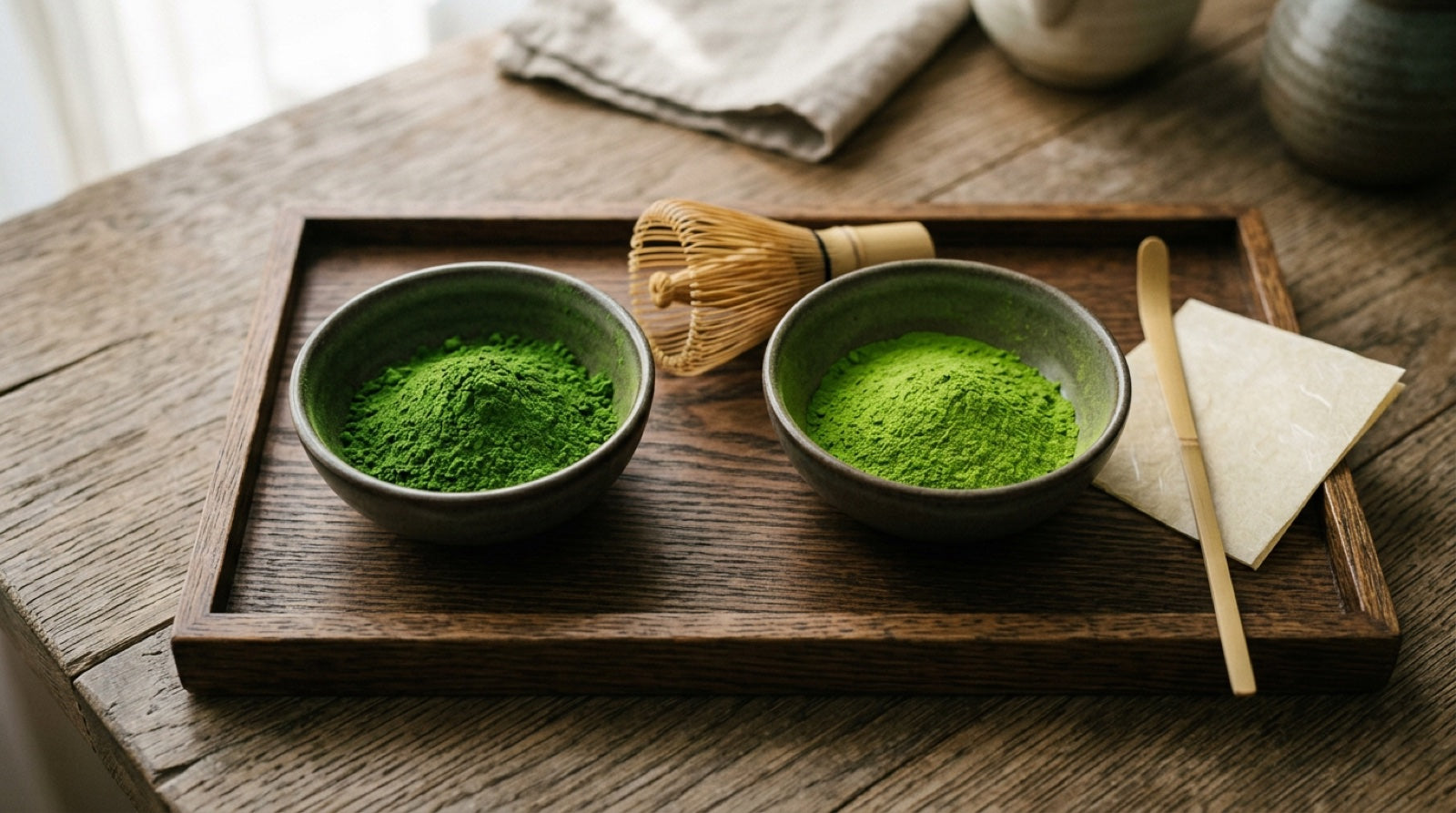

Yes, fake matcha exists. It tends to be a different product sold under the matcha name: green tea powder that was never shade-grown tencha or stone-milled, leaf from outside Japan, or low-grade powder stretched with fillers such as sugar or starch. Four quick checks at home (color, texture, foam, taste) plus a label that names a Japanese prefecture and a harvest year catch most of it. A lot-specific lab report covers what your eyes and tongue cannot.
If you are sourcing matcha for a cafe, boba shop, or small retail program in 2026, this is also a supply-chain risk, not a theoretical one. A 2024 Food Chemistry study found lead, arsenic, or cadmium in 12 percent of low-grade matcha samples at levels exceeding U.S. safety limits (Food Safety News, April 2025), and the same report describes fillers like sugar or starch in bargain products. Here is how to tell the real thing from the fake, what is driving the spike, and how home and cafe buyers can protect themselves.
Key Takeaways
- Fake matcha is usually a different product under the matcha name, not a forged box: non-matcha green tea powder, non-Japanese leaf, or powder stretched with fillers like sugar or starch (Food Safety News). No published study measures what share of matcha on sale is fake, so be wary of anyone quoting one.
- The 2026 matcha boom is a supply-side problem first. Japan exported 13,125 tons of green tea in FY2025, up 42 percent year over year and worth 84.7 billion yen (Japan Times). Demand still outruns supply, which is the economic condition that breeds fraud.
- "Ceremonial grade" is not a Japanese government standard, so the label alone proves nothing (see What Is Ceremonial Grade Matcha?). The Global Japanese Tea Association separates the two ways matcha is made: ceremonial matcha is stone-milled, culinary matcha is factory-ground (GJTA).
- A 2024 Food Chemistry study found lead, arsenic, or cadmium exceeding U.S. safety limits in 12 percent of low-grade matcha samples, and a 2023 FDA alert flagged undeclared allergens and microbial contaminants such as E. coli in bargain matcha (Food Safety News).
- Importers need FDA-registered facilities and prior notice for every shipment, but that is paperwork, not a purity test (FDA). The checks that matter are the 7-point checklist below and a lot-specific lab report.
Is there fake matcha, and what is it made of?
Yes. "Fake matcha" covers three different things, and only one of them involves a forged label.
- Not matcha at all. Powdered green tea sold as "matcha" that was never shade-grown tencha ground on a stone mill. The Global Japanese Tea Association describes ceremonial matcha as stone-milled and culinary matcha as factory-ground (GJTA). Green tea powder that is neither is simply green tea powder.
- Matcha stretched with filler. Food Safety News reports fillers like sugar or starch in bargain matcha, which dilute flavor, and notes that products from unverified suppliers in China or non-Japanese regions are prone to adulteration. It also says not all lower-cost matcha is hazardous, so price alone is a prompt to check, not a verdict.
- Matcha in name only. Drinks and mixes that borrow the word without any tencha. Blue "matcha," for example, is butterfly pea flower (Blue Matcha Is Not Matcha). If you want the real baseline first, start with what matcha is made of.
Is most matcha fake? We could not find a published study that measures what share of matcha on sale is fake, so any "most matcha is fake" figure is a guess. What is documented is where the risk concentrates: bargain powder from unverified suppliers with no named farm, region, or lab report. A seller who names the prefecture, the harvest year, and shows a current lot report is a different bet from an unnamed bargain tin.
What actually counts as counterfeit matcha (it is wider than fakes)
Counterfeit does not only mean a stolen label or a product made in a shed somewhere. In 2026 it covers a wider set of practices, and some of them are technically legal in certain configurations. The tin you bought might fit one of these patterns without ever crossing a fraud line, and that is exactly why this is hard for honest drinkers to sort through.
Mislabeled origin. Real matcha is tencha. Tencha is a specific Japanese cultivation method involving shaded plants, specific cultivars, deveined leaves, and stone-ground processing. Powdered green tea grown anywhere else, processed any other way, is not matcha. It can be a fine powder. It is not matcha. The label "Japanese matcha" without a named prefecture (Uji, Nishio, Kagoshima, Shizuoka) leaves room for blending or repacking.
For where this sits on the map, see where Japan's tea is really grown.
Blended later-flush leaves into a "ceremonial" tin. Ceremonial-grade tencha is first-flush, hand-picked or carefully machine-picked, with a specific color and amino acid profile. Later flushes are bitter, browner, and cheaper. Blending them into a tin sold as ceremonial would be a margin tactic that is nearly impossible to detect without lab work, which is why a named producer and a harvest year on the tin matter so much.
Foreign leaf in the Japanese supply. Japan imported 5,801 tons of green tea from China and other countries in fiscal 2025, an 82 percent increase, and the Japan Times reports that an influx of inexpensive foreign tea has put domestically produced tea at a crossroads. Origin wording matters for that reason: "packed in Japan" is not the same as "grown in Japan."
Culinary powder sold as ceremonial. Factory-ground culinary matcha is a legitimate product when it is sold as what it is. The problem starts when it is priced and labeled as ceremonial. Color alone will not tell you, since a bright green can come from good shading, so judge it together with foam, texture, and origin.
Outright counterfeit packaging. A risk on grey-market e-commerce listings: brand names lifted, labels copied, contents unknown. Lot numbers do not match. No lab reports. If the seller cannot tell you which farm in which prefecture in which season, that is the signal.
Why counterfeit matcha is rising in 2026
Counterfeit matcha is not a new problem, but the 2026 surge has a specific economic cause. Japanese green tea exports hit a record 13,125 tons in FY2025, up 42 percent year over year and worth 84.7 billion yen (Japan Times). The Kyoto May 2025 tencha auction average reached 8,235 yen per kilo, 1.7 times the previous year's average and well past the previous 2016 record of 4,862 yen per kilo (Global Japanese Tea Association). When the wholesale price of the input climbs about 70 percent in a year and demand keeps rising, the gap between what buyers want to pay and what authentic supply costs gets filled by something. Sometimes, that something is adulterated.
The raw cost is public, and we keep it current: the customs record behind matcha pricing.
The 2026 matcha shortage sharpens this: as authentic Japanese matcha grows scarcer and more expensive, the incentive rises to sell cheaper or non-Japanese powder under premium “Uji” labels. That is why verifying origin, not just grade, matters more than ever in 2026. For current tencha pricing, see our breakdown of the 2026 Kyoto opening auction, and for the export numbers behind the boom, Japan green tea exports in FY2025.
The U.S. side of the equation makes it worse. The American Herbal Products Association urged tighter import screening on April 8, 2025, citing rising fraud (Food Safety News). Toxicologist Emily Tran warned in a CBS News report that "bargain matcha often skips rigorous testing." FDA tea safety rules target pesticides and heavy metals but do not specifically address adulteration with cheaper substitutes. The gap is real.
I have seen this firsthand on the importer side. When I started One with Tea, I tested samples from a dozen suppliers offering "ceremonial grade" Japanese matcha at prices that ranged from $8 per 30 grams to $60 per 30 grams. Some of the bargain samples were obviously not stone-milled tencha. Some had a uniform unnaturally bright green color that did not change tone when wet (a tell for added chlorophyll or dye). One sample tasted distinctly sweet, which authentic matcha never does, suggesting added sugar or sweet rice flour. The cheap samples did not just have less flavor. They were fundamentally different products being sold under the same label.
The 7-point authentication checklist (for a single tin or a wholesale order)
Real matcha has physical and sensory properties that are hard to imitate cheaply. Here are seven checks to run on a sample, whether it is one tin on your counter or a wholesale sample before a first order.
| Check | Authentic signal | Counterfeit red flag |
|---|---|---|
| 1. Color (dry) | Vibrant emerald with subtle yellow undertone; varies slightly batch to batch | Uniform electric or neon green that looks identical across lots (possible added colorant, or a powder that is not matcha) |
| 2. Color (wet) | Color softens slightly when whisked with water, still vivid | Color stays exactly the same or becomes more intense (possible added colorant) |
| 3. Taste | Umami forward, slight pleasant bitterness, lingering sweet finish from L-theanine | Distinctly sweet (added sugar or flour), grassy and one-note, or flat with no umami |
| 4. Texture | Ultra-fine, talc-like; dissolves cleanly when whisked | Gritty between fingers; leaves sediment in the bowl (factory-ground or cut with green tea powder) |
| 5. Foam | Builds a thick, stable, creamy foam layer that holds for a minute or more | Foam dissolves within seconds, or never forms at all |
| 6. Origin labeling | Names the prefecture (Uji, Nishio, Kagoshima, Yame, Shizuoka), harvest year, and ideally the producer | "Premium Japanese matcha" or "ceremonial grade" with no prefecture, no year, no farm |
| 7. Price floor | Priced in line with what the leaf costs. Tencha averaged 8,235 yen per kilo at the 2025 Kyoto auction (GJTA), before milling, packing, and shipping. Honest sellers run promotions, so a low price is a prompt to verify origin, not proof of fraud | A "ceremonial" price that looks too low to cover the leaf itself, with no named farm, region, or harvest year to explain it |
Run all seven. No single check is conclusive on its own, but the pattern is: a product that fails several at once is the one to walk away from. Authentic matcha should pass all seven, including small-producer single-estate matcha in plain packaging. These are home checks, not lab tests. They catch the obvious cases, not heavy metals or pesticide residue.
Why current lab reports matter more than ever
Sensory tests catch a lot, but they do not catch heavy metal contamination, pesticide residue, or radioactivity. Those are the questions that matter most for daily drinkers who whisk a bowl every morning.
Heavy metal load is the one most buyers underestimate. Tea plants are bioaccumulators, meaning they pull lead, arsenic, cadmium, and other metals up from the soil into the leaf, and matcha is the whole ground leaf. Whether matcha from Japan is contaminated depends on the lot, not the flag on the tin, and the only way to verify a lot is a recent third-party panel. We publish ours by lot on our Lab Results page. For what recent reports show, see Matcha Tested for Heavy Metals, and for the numbers that matter in a report, How to Read a Matcha Lab Report.
The two cleanest origin signals on a tin in 2026 are the JAS organic seal and the USDA Organic seal. Both require third-party audits of soil, inputs, and processing. Neither is perfect, but a tin carrying both is materially harder to fake than one carrying neither. Beyond the seal, ask for a recent lot-specific lab report. Real producers will have one. They will either link it on the product page or send it on request. If a brand cannot or will not share a current heavy-metal panel, that is an answer.
What to look for on the label (the 30-second scan)
If you have 30 seconds in a store or on a product page, this is the short list that catches most fakes.
- Named region. Uji, Nishio, Kagoshima, Yame, Shizuoka. Not "Japan" alone.
- Cultivar named or first-flush specified. Yabukita, Samidori, Asahi, or simply "first-flush ceremonial tencha." Generic "ceremonial" without harvest detail leaves room for blending.
- Organic certification seal. JAS, USDA Organic, or both. Look for the actual seal, not the word "organic" in marketing copy.
- Harvest year on the tin. Matcha freshness matters. A 2024 tin sold in 2026 is past its useful window. A respectable producer dates the lot.
- A lab results link or QR code. Heavy-metal panel and pesticide screen, dated within the last 18 months. We publish ours by lot at onewithtea.com/pages/lab-results.
- A real address or named producer relationship. If the only contact is a generic email and a Shopify storefront with no farm story, no people, no photos of source, that is a flag.
Pricing is also a label-adjacent signal. A USDA Organic ceremonial-grade tin priced far below its peers deserves a question: the honest landed cost of organic, stone-milled tencha leaves a narrow margin at the bottom of the range. Some retailers run promotions and some brands subsidize loss leaders, so read the price as data, then check origin and the lab report. The same scan works when you are wondering whether a particular brand is legit: named region, harvest year, seals, a lab report, and a real address.
What actually goes wrong when you serve counterfeit matcha
The risk is not just an angry customer who can taste the difference. A 2024 Food Chemistry study found lead, arsenic, or cadmium in 12 percent of low-grade matcha samples at levels exceeding U.S. safety limits, and a 2023 FDA alert flagged microbial contaminants such as E. coli and undeclared allergens (soy, wheat, or milk) in bargain matcha (Food Safety News). For a cafe serving 30 to 80 matcha drinks a day, that is not a hypothetical liability. One foodborne complaint traced to your supply chain becomes a public health filing, a Yelp review, and an insurance conversation in the same week.
The economic loss is real too. If you pay ceremonial-grade prices for what is actually culinary powder stretched with filler, you are paying for leaf you did not get, and the cost compounds with your monthly volume. You are also serving an inferior drink to customers who may know the difference.
Why sourcing direct from Japan-side or founder-led suppliers matters
The structural fix is to compress the supply chain. Every additional hop between the Japanese tea cooperative and your cafe is another opportunity for the product to get blended, repackaged, or relabeled. Sourcing closer to the producer, from a supplier who can name the farm and the lot, is the most reliable way to shorten that list of opportunities.
This is also where the supplier landscape matters. Some heritage names that small cafes used to rely on were not accepting new accounts when we researched this guide in May 2026. Ippodo Tea had paused U.S. and Canada wholesale applications. Marukyu Koyamaen did not run a direct U.S. foodservice channel and routed through resellers. Mizuba Tea Co. was waitlisted. The accessible-today set is smaller than the SEO listicles suggest, which is itself a piece of the counterfeit equation: when established channels are closed, buyers default to whoever shows up in their search results, and that is exactly the surface where fraudulent operators concentrate. For a deeper look at how the available supplier models differ on cost transparency and supply chain trust, see our piece on founder-led vs aggregator matcha wholesale. For a fuller comparison framework across all five supplier archetypes, see our guide to the best Japanese matcha supplier for small business.
Importing matcha into the U.S.: FDA registration and prior notice
If you buy from an exporter in Japan, or plan to import matcha yourself, two FDA requirements apply. The facilities that produce, store, or otherwise handle the food must be registered with FDA, and FDA must receive prior notice of every incoming shipment (FDA). Prior notice has to be submitted and confirmed by FDA no less than 2 hours before arrival by road, 4 hours by rail or air, and 8 hours by water (FDA prior notice guidance, citing 21 CFR 1.279).
Neither is a purity test. Registration and prior notice tell FDA who is shipping what and when, not that a tin is real tencha. FDA says imported food is subject to inspection at the port and non-compliant shipments can be detained (FDA), but Food Safety News reports that FDA inspects less than 5 percent of food imports a year, citing a 2023 report. So ask any supplier whether their facilities are FDA-registered and how prior notice is handled, then ask for the lot-specific lab report, which is the document that actually tests the powder.
The 5 questions to ask any supplier before your first order
If a supplier cannot answer these five questions clearly and specifically, walk away. None of them require sensitive business information. All five are basic operational facts a legitimate Japan-side or direct importer can answer in one email.
- "Can you name the prefecture and the cooperative or farm?" The right answer mentions a specific Japanese prefecture (Uji, Nishio, Kagoshima, Yame, Shizuoka) and ideally a specific cooperative or producer. "Premium Japan" is not an answer.
- "What is the harvest year on this lot?" Tencha is harvested in late spring (April through May for first flush). A specific harvest year and season tells you the supplier knows what they sourced. A vague "fresh" or "current season" is a tell.
- "Is this stone-milled tencha or factory-ground?" The GJTA distinguishes real matcha by mill type, not by grade label (GJTA). Stone-milled tencha is real matcha. Factory-ground product is something else, even if labeled "matcha."
- "Do you have lab test results for heavy metals and radioactivity?" Reputable suppliers test against Japanese and U.S. food safety standards and can share the results. The radioactivity tests in particular reference the post-2011 inspection regime and are standard practice for legitimate Japanese tea exporters.
- "Can you describe or show me the processing facility?" A real supplier knows where their tencha is milled and can describe the operation, even if the answer is "we work with a specific co-op in Kyoto Prefecture and visit twice a year." Suppliers who cannot answer this are almost certainly intermediaries who do not have direct producer relationships.
What we recommend
The honest framing is that there is no single "safest" supplier, only suppliers that match your business size, your use case, and your tolerance for supply chain opacity. We run One with Tea, which means we ship founder-led D2C and wholesale matcha sourced directly from Japan, and we have an obvious bias. We try to disclose it clearly: for small cafes and boba shops under roughly $5,000 per month matcha spend who want a real relationship with a U.S.-based founder who can answer all five sourcing questions on a phone call, we are built for that buyer profile. We are not the right fit for high-volume buyers above $10,000 per month, who should look at established importers like Naoki or Encha that have application-gated wholesale and explicit foodservice programs. For one-off retail or ceremonial single-bowl programs, Ippodo (when wholesale reopens) and Marukyu Koyamaen via Luna Matcha remain the classic heritage answers.
What we will say without hedging: any supplier that fails the 7-point authentication checklist or cannot answer the 5 sourcing questions is not worth the risk, even at half the price. The cost of one foodborne complaint or one batch of dyed product reaching a customer is higher than the savings on a year of bargain wholesale.
Frequently Asked Questions
Is there fake matcha powder?
Yes. Fake matcha is usually a different product sold under the matcha name: green tea powder that was not shade-grown tencha ground on a stone mill, leaf from outside Japan, or low-grade powder stretched with fillers like sugar or starch (Food Safety News). A bright color, a clean foam, a named Japanese prefecture, a harvest year, and a lot-specific lab report are the fastest ways to tell the difference.
Is most matcha fake?
No one has published a measured share, so any "most matcha is fake" figure is a guess. What is documented is that the risk concentrates in bargain powder from unverified suppliers with no named farm, region, or lab report. Matcha from a seller who names the prefecture and harvest year and shares a current lot report is a very different purchase.
How can I quickly test a matcha sample for authenticity?
Whisk one gram of the sample in 60 ml of hot water (175 degrees Fahrenheit). Authentic matcha builds a thick stable foam in 15 seconds and has a vivid color that softens slightly in water, with an umami-forward taste and subtle bitterness. Counterfeit product typically fails on foam, has an unnaturally uniform color that does not change in water, or tastes flat or sweet.
Is "ceremonial grade" a legal designation in Japan?
No. There is no Japanese government standard for the term, so any seller can print it. The Global Japanese Tea Association separates matcha by how it is milled: ceremonial matcha is stone-milled, culinary matcha is factory-ground (GJTA). Our guide to ceremonial grade matcha covers the industry's working definition.
Why does counterfeit matcha cost less if real matcha is in short supply?
Because the input is different. Real ceremonial matcha is stone-milled tencha from shaded plants harvested in spring, and the Kyoto tencha auction average reached 8,235 yen per kilo in May 2025, 1.7 times the year before (GJTA). Counterfeit product substitutes cheaper green tea powder or stretches the real thing with filler. The price gap is the entire business model.
Does FDA testing catch counterfeit matcha?
Not directly. FDA tea safety rules target pesticides and heavy metals, not adulteration with cheaper substitutes, and FDA inspects less than 5 percent of food imports a year, according to a 2023 report cited by Food Safety News. The American Herbal Products Association urged tighter import screening on April 8, 2025. Buyer-side authentication is currently the strongest defense.
What does FDA require to import matcha from Japan?
The facilities that produce, store, or otherwise handle the food must be registered with FDA, and FDA must receive prior notice of every shipment (FDA). Prior notice must be confirmed no less than 2 hours before arrival by road, 4 hours by rail or air, and 8 hours by water (FDA guidance). These are paperwork requirements, not purity tests, so you still need a lot-specific lab report.
What is the most common adulterant in fake matcha?
The best-documented one is filler: Food Safety News describes sugar or starch added to bargain matcha, and products from unverified suppliers in non-Japanese regions being prone to adulteration. Sweetness is the tell, because authentic matcha is not sweet on its own. Some products marketed as "premium Japanese matcha" contain tea from outside Japan, with origin information left vague on the packaging.
Where this leaves you
The 2026 matcha boom created the economic conditions for counterfeit and adulterated product to scale, and the U.S. regulatory framework has not caught up. The defense is buyer-side: run the 7-point authentication checklist on every sample, ask the 5 sourcing questions before any wholesale order, and prefer suppliers who can compress the chain between the Japanese producer and your cafe. If you want help thinking through which supplier archetype fits your specific business, our pillar guide on choosing a Japanese matcha supplier for small business walks through the five real options in the 2026 market. Buying a tin for your own kitchen? Browse the organic Japanese matcha collection, with lab results published by lot.
If you are considering wholesale matcha for your cafe, boba shop, or retail program and want to talk through any of this with a real human, our wholesale inquiry page is the right place to start. We answer every email personally.
Christian Mauerer is the founder of One with Tea. He sources ceremonial-grade matcha directly from producer cooperatives in Uji, Nishio, and Kagoshima, and works with U.S. cafes, boba shops, and small-batch retail brands. He has personally tested over a hundred matcha samples and built One with Tea's supplier verification process around the authentication framework described in this article.

From our tea room
Organic Ceremonial Matcha Powder - USDA Certified (30g)
Stone-milled ceremonial grade, USDA Organic, third-party lab tested.
View Ceremonial Matcha
Share:
Best Japanese Matcha Supplier for Small Business (2026)
Matcha Supply Security: How US Cafes Lock In Authentic Japanese Supply in 2026