



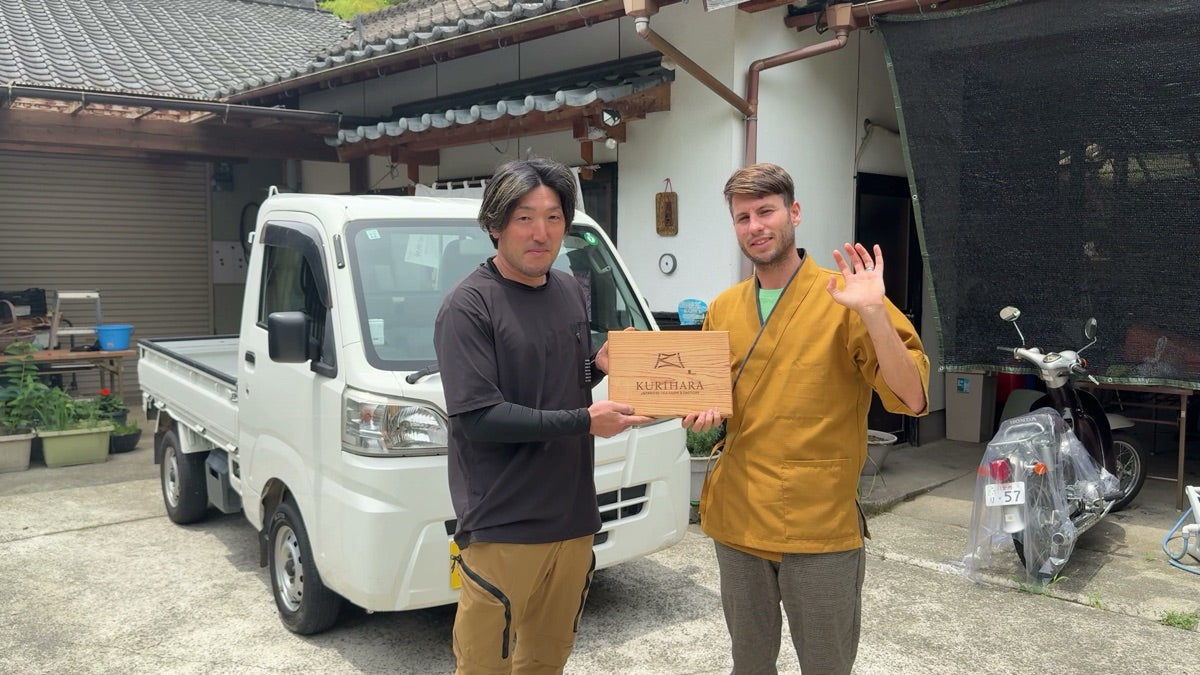
by Christian, founder of One with Tea, May 15, 2026
By the time we crossed into Yame, the air had changed. Fukuoka is further south than the Shizuoka rolls I had been moving through earlier in the trip, and the valleys here are narrower, the slopes shadier, the rivers louder. Yame is a quiet name in the West, but in Japan it is one of the most respected prefectures in tea. The country's most expensive lots, the ones that clear tens of thousands of yen per kilogram at the All Japan Tea Fair, tend to come from this valley. So when our schedule put us at Kurihara Seicha for the day, I knew we were sitting down with people who do not need to talk about their work for the work to speak.
What I did not expect was how warm they were. The Kurihara family is into its fourth generation of tea, and the Yame lineage they sit inside is older than that by a long way. They greeted us in their factory, gave us white coats and hairnets, and walked us through the room where their gyokuro and matcha actually get made. Then we sat down for a tasting that I am still thinking about. This is what that day taught me about Yame, about craft at the high end, and about why the maker keeps mattering.
Key Takeaways
- Kurihara Seicha is a fourth-generation tea producer in Yame, Fukuoka, specializing in shaded teas including gyokuro and matcha. The family began in 1922 as a wholesaler and moved to Yame in 1942 to grow tea themselves.
- Yame is a small region inside Fukuoka Prefecture that produces a disproportionate share of Japan's award-winning tea, with top lots regularly clearing five-figure-yen prices per kilogram.
- Yame's edge sits in microclimate (forest shade, mist, narrow valleys) plus a centuries-old craft lineage that traces back roughly six hundred years.
- Shading the tea plant a few weeks before harvest stops photosynthesis and concentrates chlorophyll and amino acids, producing the deep green color and umami flavor that gyokuro and matcha are known for.
- Akio Kurihara is a four-time winner of the Southern Japan hand-rolling competitions and took the Minister's Prize at the 2019 Fukuoka Tea Competition in the gyokuro category.
- Kurihara does not appear on One with Tea's shelves today. The visit shaped how we judge any producer we consider working with in this tier.
The Yame postcode: where Japan's most respected tea is made
To understand Kurihara, you first have to understand Yame. The valley sits in southern Fukuoka, on the western side of Kyushu, and it has been a tea region for roughly six centuries. The traditional story is that a monk named Shuzui brought tea seeds back from Ming China in the 1420s and planted them at a temple here. The cultivation never really stopped after that. Today Yame produces only a small slice of Japan's total tea volume, but at the top of the market its share is enormous. The annual All Japan Tea Fair, which is the closest thing the country has to a Bordeaux-style auction, sees Yame gyokuro repeatedly take the highest honors. Premium lots in the gyokuro category have cleared price points that would shock anyone outside the trade.
That context matters because it sets the room temperature for a visit like this. You are not stopping in at a hobby farm. You are sitting down with people whose work is judged each year by the most discerning tasting panels in Japan. Kurihara Seicha is one of the houses that show up on those leaderboards. They do not chase the headline. They make the tea, year after year, and the tea earns the headline.

Meeting Kurihara: four generations, six centuries
The factory door opened into a working space. Stainless trays, woven baskets, a quiet hum from sorting equipment in the back. Kurihara-san greeted us with that very Japanese mix of formality and warmth that takes a few minutes to read. He told us he is the fourth generation in the family business, and when we asked how far back tea goes around here, he laughed and said, very long time. Over ten generations of families in Yame have lived inside this same craft. The man across from us was Akio Kurihara, who farms the rows; his brother Yuji runs the business side and serves in the Fukuoka prefectural legislature. Their father, Kippei Kurihara, is a Yame city councilman who handed the operation down after the family began in 1922 as a wholesaler and moved to Yame in 1942 to grow tea themselves (Tokyo Matcha Selection). Akio is a four-time winner of the Southern Japan hand-rolling competitions and took the Minister's Prize at the 2019 Fukuoka Tea Competition in the gyokuro category, the top award, granted only when at least 100 entries compete (Japan Wellness Travel).
That length is hard to feel from the outside. Six hundred years of continuous cultivation in one valley means that the soil has been read, the slopes have been planted, the cultivars have been chosen, and the methods have been refined by an unbroken chain of practitioners. When Kurihara-san trims a row or sets a shade cloth, he is not improvising. He is repeating a movement that his grandfather's grandfather worked out a long time ago, then adjusting one variable for this season's weather. That is what generational craft actually looks like.
The other thing that struck me was the humility. Kurihara Seicha has awards. They do not lead with them. Nobody in the family pulled out a trophy or a magazine clipping. They walked us to the next bin of leaves, asked us to smell it, asked what we thought. The conversation was always pointed at the tea, never at themselves.
Shade, chlorophyll, and the umami that built Yame's reputation

Yame's flagship category is shaded tea. Gyokuro and tencha, the leaf base for matcha, are both made by covering the plants for roughly twenty days before harvest. The shade does something specific to the plant: it stops photosynthesis from running at full speed, which forces the plant to keep its amino acids instead of converting them. The leaves stay deeper green because chlorophyll concentrates, and the cup ends up with the savory, almost broth-like umami that defines gyokuro at its best.
What I had not appreciated until I walked Kurihara's fields was how much the natural landscape does the same job. The Yame valleys are narrow. Mist sits between the slopes for hours in the morning. Forest edges throw cool shade across the rows for parts of the day. The cultivated shade cloth used in the final stretch before harvest is layered on top of a microclimate that is already doing some of the work. That stacking, natural and engineered, is part of why Yame's shaded teas read with such depth.
Kurihara-san walked us into one plot that sits inside a pocket of forest. The owner of that land specializes entirely in shaded styles, and the way he described the leaf there was simple: a leaf that grows in this terroir does not taste like a leaf grown in a sunny plain. The land speaks, the maker listens, the cup tells you both.
Inside the factory: where leaves become aracha

After the fields we moved into the processing facility. Hairnets, coats, the works. The room runs the early stages of conversion from freshly steamed leaf into aracha, which is the half-finished form that gets refined again before it ships as gyokuro, sencha, or tencha bound for the matcha mills. The smell in the room was beautiful. Cooked grass, sea air, and that specific cool sweetness that means the steam timing is on.
What stayed with me about the factory tour was the obsession with detail. Kurihara-san stopped at one machine and showed us his Sencha Saimidori, a cultivar he has been working on for years. He has been pushing the steaming to produce a thinner leaf than is standard. The aroma changes when the leaf is thinner. The lighter, brighter top notes come forward, and the cup feels more aromatic. He showed us a side-by-side: a thicker, more conventional leaf and his thinner version. Both were beautiful. His was singing.

From our tea room
Superior Sencha Green Tea - USDA Organic Japanese First Flush
First-flush loose leaf, USDA Organic, direct from Japanese family farms.
View Superior SenchaThis is the part of Japanese tea that does not survive translation in most Western coverage. Aracha is not a place to cut corners. The choices made at this stage, how long to steam, how to shape, how to dry, how thin to roll, lock in the personality of the finished tea. A maker who does this work with intention every season is the difference between a cup that is technically correct and a cup that has something to say.
Tasting at the table: what 'wizard with tea' actually means

We finished the day in a small tasting room. Porcelain cups with painted florals, an iron kettle on the table, a calligraphic fan on the wall, the kind of quiet that makes you sit up a little straighter. Kurihara-san poured us through a flight that moved from a brighter sencha to deeper shaded styles, finishing in their gyokuro and a bowl of matcha that he had milled himself.
I wrote one line in my notebook that I keep coming back to: wizard with tea. He is not a showman. He does not narrate the cup. He pours, watches you taste, asks one question, pours again. The gyokuro was the part that broke me a little. The cup was tiny, almost a spoonful, and it carried a length of flavor that felt physically impossible from that much liquid. Sweet seaweed, soft umami, a finish that kept widening for a long minute after the sip. That is what people in Japan mean when they talk about Yame gyokuro at the top of the market.
When I asked him what makes the difference between an ordinary cup and a great one, he was quiet for a moment. Then he said something close to: time, and care, and not cutting the leaf any earlier than it asks to be cut. That is also Houkouen's answer. It is also Mohei Honda's answer. The very best Japanese tea producers, when pushed on the question, all say a version of the same sentence. The technique is the floor. The intention is the ceiling.
What the visit set as our standard

Kurihara Seicha is not currently on One with Tea's shelves. The house operates inside a network of long-running relationships in Japan, and we did not visit to negotiate a deal. We visited to learn what the top of this craft actually looks like, so that we know what we are looking at the rest of the time.
The standard the day set for us is concrete. When we taste a new Japanese green tea at a sample table now, the questions in my head are Kurihara questions. Is the maker pushing one variable on purpose? Does the cup carry length, not just brightness? Is the producer answering the question of "why" with something more than a spec sheet? Does the work feel like the next entry in a long lineage, or does it feel like marketing? Those questions came home in our luggage from Yame.
If you are starting out with Japanese tea, you do not need to drink at the Kurihara tier yet. Most people, including me when I started, get there slowly. But it helps to know that this level of craft exists. It is the reason a good ceremonial matcha costs what it does, and the reason it is worth it.
If you want to start on the more accessible end of that ladder, our organic ceremonial matcha is the bowl we built around the same principles we saw at Kurihara. And if you run a cafe, a yoga studio, or a wellness brand and want to source matcha at the standard that took us five weeks in Japan to define, our wholesale program is the easiest way to start a conversation.

Where is Kurihara Seicha located?
Kurihara Seicha is based in Yabe Village, Yame, in southern Fukuoka Prefecture on Japan's island of Kyushu. Yame is one of the country's most respected tea regions, with a cultivation history that traces back roughly six hundred years.
Who runs Kurihara Seicha?
The fourth-generation Kurihara brothers run the operation today: Akio Kurihara handles farming and Yuji Kurihara handles the business side. Yuji also serves in the Fukuoka prefectural legislature. Their father Kippei Kurihara, a Yame city councilman, handed the operation down after the family began in 1922 as a wholesaler and moved to Yame in 1942 to grow tea themselves.
What awards has Kurihara Seicha won?
Akio Kurihara is a four-time winner of the Southern Japan hand-rolling competitions and took the Minister's Prize at the 2019 Fukuoka Tea Competition in the gyokuro category, the top award, granted only when at least 100 entries compete.
What makes Yame tea different from tea from Shizuoka or Uji?
Yame's signature is shaded tea grown in narrow valleys with high morning mist, dense forest borders, and a centuries-old craft lineage. The combination of microclimate and tradition has made Yame the dominant region in Japan's top-end gyokuro competitions, even though it produces far less total volume than Shizuoka or Kagoshima.
Does One with Tea sell Kurihara Seicha tea?
No. Kurihara Seicha is not part of the One with Tea catalog. We visited the farm and factory on our documentary trip earlier this year to learn what high-end Yame craft looks like up close. The lessons from that visit inform how we evaluate every producer we consider working with.
Why does shading the tea plant matter?
Shading the plant for roughly twenty days before harvest slows photosynthesis. The leaf holds onto more amino acids and concentrates chlorophyll, which produces the deep green color and savory, umami-rich flavor that defines gyokuro and matcha at their best.
Why is Yame gyokuro so expensive?
Yame's top gyokuro lots win the highest honors at Japan's national tea fair almost every year. Auction prices reflect that scarcity. Limited yield, twenty-plus days of shade cultivation, hand-picked harvest, and decades of craft in a single family combine to produce lots that regularly clear five-figure-yen prices per kilogram at the wholesale level.
If you want the number behind the number, we track what Japanese green tea actually costs at origin.
More producer profiles from this Japan trip: Mohei Honda (Shizuoka) · Ichikawa-en (Makinohara, Shizuoka) · Houkouen (Shizuoka mountains).
For where this sits on the map, see prefecture by prefecture production figures.
Christian, founder of One with Tea
Share:
Japanese Tea Producers: 5 Voices Reshaping the Matcha World
Horiguchi Seicha: 300 hectares of Kagoshima tea in one cup