



Looking for ceremonial matcha sourced honestly from named Japanese regions?
USDA Organic and JAS certified, third-party lab tested, direct from family farms.
Shop Matcha CollectionInquire About Wholesale
Traditional stone-ground matcha is produced using granite mills called ishi-usu that grind tencha leaves into particles as fine as 5 to 15 microns, roughly one-fifth the width of a human hair (Soar Organics, 2024). This slow process, producing just 30 grams per hour, preserves the chlorophyll, L-theanine, and catechins that give ceremonial-grade matcha its vivid color, smooth taste, and calm energy. If you've ever wondered why some matcha tastes bitter and dull while others feel alive on your tongue, the grinding method is usually the answer.

From our tea room
Organic Ceremonial Matcha Powder - USDA Certified (30g)
Stone-milled ceremonial grade, USDA Organic, third-party lab tested.
View Ceremonial MatchaKey Takeaways
- Stone mills (ishi-usu) produce only about 30g of matcha per hour, over 300 times slower than industrial mills (Chajin, 2024).
- The slow speed keeps temperatures below 35 to 40°C, preserving chlorophyll and catechins that degrade with heat.
- Only a small number of artisans in Japan still hand-carve ishi-usu grinding stones, a craft passed down through generations (Mizuba Tea, 2023).
- Particle size, color, and flavor all trace back to how the leaf was ground, not just where it was grown.
How Does Stone Grinding Actually Work?
A single ishi-usu mill produces just 30 grams of matcha per hour (Chajin, 2024). That's roughly one tin of ceremonial-grade matcha for every 60 minutes of grinding. The process is deliberately slow, and that slowness is the entire point.
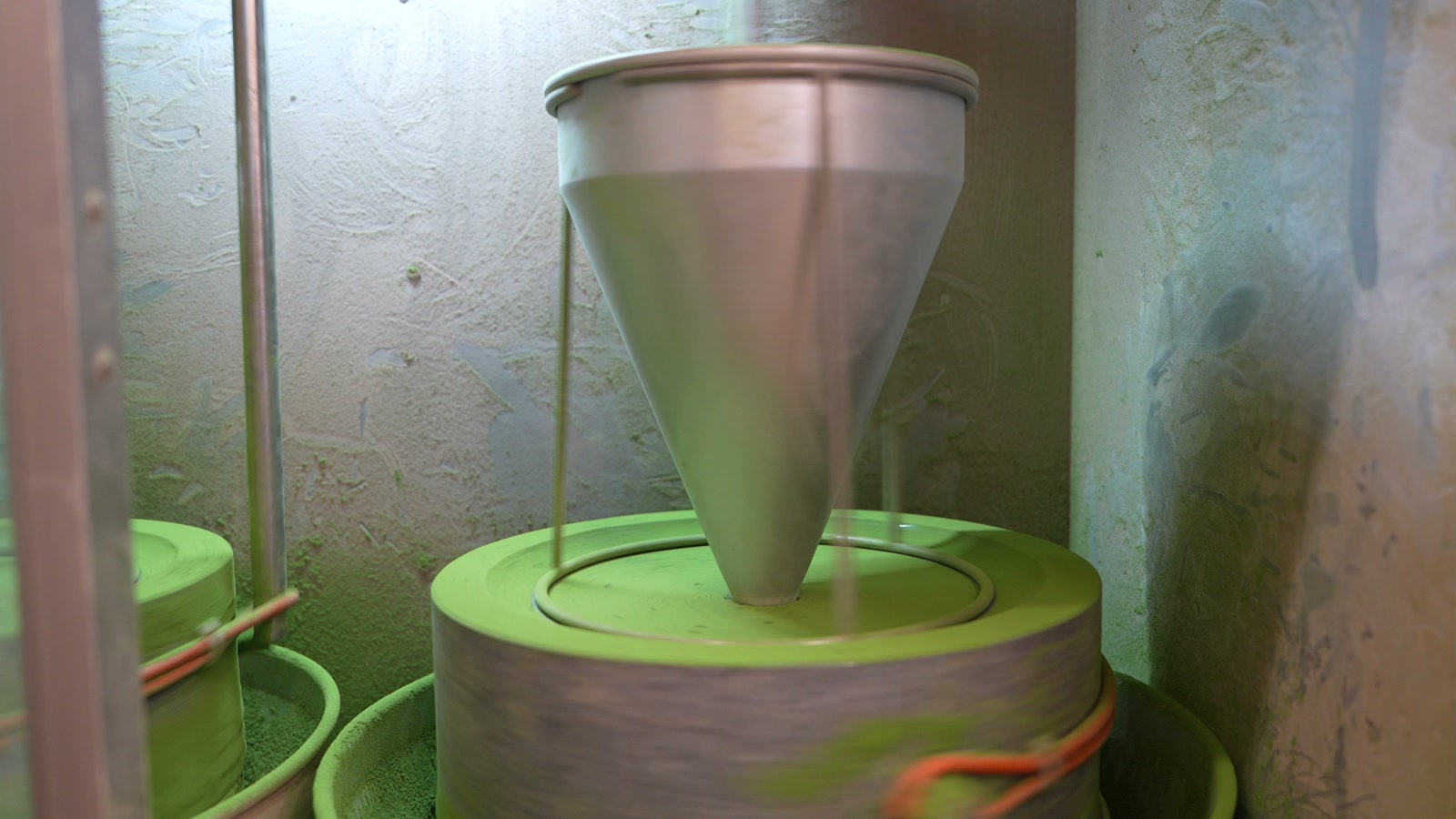
The ishi-usu consists of two granite discs stacked together. The upper stone rotates while the lower one stays fixed. Dried tencha leaves feed into a small hole at the center and work their way outward through hand-carved grooves etched into the stone faces. These grooves do two things: they guide the leaves outward and they create the shearing force that breaks them into ultra-fine particles without generating excessive heat.

Each groove pattern is unique. Fewer than 50 artisans in Japan still possess the skill to carve these stones by hand (Mizuba Tea, 2023). The angle, depth, and spacing of the grooves determine the particle size, the heat generated, and ultimately the flavor of the finished matcha. It's a craft measured in decades of apprenticeship, not engineering specs.
Our experience: When we visited tea farms in Uji, we watched a single ishi-usu run for an entire afternoon and produce barely enough matcha to fill two tins. The sound is quiet, almost meditative. There's no rush in the process, and you can taste that patience in the cup.
Why Is Stone Grinding So Slow Compared to Industrial Methods?
Industrial granite mills can produce 10,000 grams per hour, over 300 times faster than a traditional ishi-usu (Delijx, 2024). Ball mills sit in the middle at around 1,500 grams per hour. Speed and quality trade off directly here, and the reason comes down to heat.
Faster grinding generates more friction, which generates more heat. Ball mills require active cooling systems to keep temperatures between 5 and 15°C in ambient conditions (Delijx, 2024). Traditional stone mills, because they turn so slowly, stay below 35 to 40°C naturally, with no cooling needed. That temperature difference matters enormously for what ends up in your cup.
Think of it this way: the ishi-usu grinds with the patience of the leaf itself. The tea plant spent weeks under shade cloth building up amino acids and chlorophyll. Rushing the final step with high-speed machinery can undo weeks of careful cultivation in minutes.
How Does Heat Affect Matcha's Nutrients and Flavor?
Catechins, the primary antioxidant compounds in matcha, show no significant change when stored at 4°C for up to two months, but continuously decrease at higher temperatures (Food Science and Biotechnology, 2020). At 80°C, caffeine content drops to 60% within just seven days. The grinding process doesn't reach these extreme temperatures, but the principle holds: less heat means more of the good stuff survives.
Chlorophyll is even more sensitive. Ball milling causes "partial chlorophyll destruction," resulting in a duller, more olive-toned powder (Delijx, 2024). Stone-ground matcha, by contrast, retains complete chlorophyll integrity, which is why it stays that striking, electric green. The color isn't just aesthetic. It's a direct indicator of how the leaf was processed and how much of its nutritional profile survived the journey from farm to cup.
Here's what most matcha guides won't tell you: EGCG, the most studied catechin in green tea, degrades through a process called epimerization when subjected to thermal stress (Food Science and Biotechnology, 2020). The cumulative thermal stress from faster mills adds up. A stone mill running at 35°C for an hour exposes the leaf to far less thermal energy than a ball mill requiring active cooling to prevent overheating. The total heat exposure over time, not just peak temperature, determines how much survives.
Does Particle Size Really Matter for Taste?
Stone-ground matcha achieves particle sizes of 5 to 15 microns, while industrial granite mills produce particles averaging around 50 microns (Soar Organics, 2024). That five-fold difference in particle size directly affects how the matcha feels on your palate, how it suspends in water, and how it releases flavor.
Finer particles create a smoother, creamier mouthfeel. They also suspend more evenly in water, which is why properly stone-ground matcha stays blended longer after whisking rather than settling to the bottom of your bowl. Coarser particles from industrial mills tend to feel gritty and separate quickly, producing a thinner, less satisfying drink.
A 2023 study published in Powder Technology found that stirred media milling could reduce matcha particles from 330 microns down to 17 microns while preserving active polyphenols and amino acids (ScienceDirect, 2023). This suggests that modern engineering can approach traditional quality, but the stone mill still produces the finest, most consistent grind at 5 to 15 microns. Can a machine replicate centuries of craft? It's getting closer, but not quite there yet.

The Disappearing Art: Who Still Carves Stone Mills?
Only a handful of stone mill carvers remain active in Japan (Mizuba Tea, 2023). Each ishi-usu takes weeks to carve, and the groove patterns are passed down through families across generations. As demand for matcha surges globally, this bottleneck at the production level explains why authentic stone-ground ceremonial matcha remains expensive and relatively scarce.
Japan harvested a record 5,336 metric tons of tencha (the raw leaf used for matcha) in 2024 (IntTea, 2025). Meanwhile, Kyoto first-flush tencha prices rose about 2.6-fold, from 5,500 JPY per kilogram in 2024 to 14,333 JPY in 2025. Production is up, prices are way up, and the mills doing the finest work can only turn so fast.
Our observation: When we source our ceremonial matcha, we specifically verify that our farms use traditional ishi-usu mills. It's a non-negotiable for us. The difference in color and taste between stone-ground and industrially milled matcha from the same farm, using the same leaves, is striking enough that you'd think they were different teas entirely.
How Can You Tell If Your Matcha Is Stone-Ground?
According to Soar Organics, stone-ground matcha achieves particle sizes of 5 to 15 microns (Soar Organics, 2024), and those microscopic differences show up in ways you can see, feel, and taste without any lab equipment.
True stone-ground matcha will almost always say so on the label, because it's a significant quality indicator and a production cost that brands rightfully want to communicate. But labels aren't always reliable. Here are the sensory cues that don't lie.
Color. Stone-ground matcha is vibrant, almost neon green. If your matcha looks olive, brownish, or dull, it likely went through a process that degraded its chlorophyll. That's usually a sign of excessive heat from faster milling or lower quality starting leaf.
Texture. Rub a small amount between your fingers. Stone-ground matcha feels silky and almost disappears into your skin. Industrial matcha feels slightly grainy or sandy. The difference maps directly to particle size, 10 microns versus 50 microns is a texture you can feel.
Taste. Properly stone-ground ceremonial matcha has a natural sweetness (from L-theanine and amino acids) and a clean, lingering finish. Bitterness and astringency often indicate heat damage during processing or lower-grade leaf, sometimes both. The grinding method alone won't save a bad leaf, but it can certainly ruin a good one.
Suspension. Whisk your matcha in water and wait 60 seconds. Stone-ground matcha stays suspended and frothy. Coarser grinds settle to the bottom quickly, leaving a watery top layer and a sludgy bottom.
Stone-Ground vs Machine-Ground, in Brief
The short version: a stone mill stays cool and slow, which protects the color, umami, and aroma described above, while ball and jet mills run faster but ball-milling adds friction heat. Particle size overlaps across methods, so fineness alone does not decide quality. For the full head-to-head, microns, grinding speed, temperature, and why the method signals quality without proving it, see our dedicated guide: Stone-Ground vs Machine-Ground Matcha.
What Does This Mean for Choosing Your Matcha?
Processing method is one of the three pillars of matcha quality, alongside leaf grade (shade-grown tencha from specific matcha growing regions in Japan) and freshness. You can start with the finest first-flush tencha from Uji and still end up with mediocre matcha if it goes through the wrong mill.
When you're shopping for matcha, here's what to look for:
- Ceremonial grade for drinking straight: Always stone-ground. If the label doesn't mention the grinding method, it's likely not ishi-usu milled.
- Latte grade for mixed drinks: Ball-milled is acceptable here because milk and sweeteners mask the subtler differences. Our latte grade matcha still uses quality tencha, and the flavor holds up beautifully in lattes and smoothies.
- Culinary grade for baking: Industrial milling is fine when the matcha will be baked at 180°C anyway. Particle size matters less when it's bound into batter.
The more directly you're consuming the matcha, the more the processing method matters. A bowl of koicha (thick tea) made from stone-ground ceremonial matcha is about as pure a tea experience as exists. Every micron, every degree of heat, every minute of grinding shows up in the cup.
Frequently Asked Questions
Is stone-ground matcha worth the higher price?
For ceremonial drinking, yes. Stone mills produce just 30 grams per hour (Chajin, 2024), and only a small number of artisans in Japan still carve these mills. The labor-intensive process preserves chlorophyll and amino acids that faster methods degrade. For lattes or baking, the premium matters less.
How fine is stone-ground matcha compared to regular matcha?
Stone-ground matcha achieves 5 to 15 micron particle sizes, about one-fifth the width of a human hair. Industrial granite mills produce approximately 50 micron particles (Soar Organics, 2024). Finer particles create smoother mouthfeel, better water suspension, and more even flavor release.
Does the grinding method affect matcha's antioxidant content?
Yes. Ball milling causes partial chlorophyll destruction and can degrade heat-sensitive catechins (Delijx, 2024). Stone mills operate below 35 to 40°C naturally, preserving the compounds that peer-reviewed research shows degrade at higher temperatures (PMC7406592, 2020).
Can you taste the difference between stone-ground and industrially milled matcha?
Most people can, even without training. Stone-ground matcha tends to be sweeter with more umami depth, while industrially milled matcha often leans bitter and astringent. Color is the easiest visual cue: vibrant green signals preserved chlorophyll from gentle processing, while olive or dull tones suggest heat damage.
What is an ishi-usu?
An ishi-usu is a traditional Japanese granite stone mill made from two interlocking discs with hand-carved grooves. The upper stone rotates while tencha leaves feed through the center, slowly grinding into ultra-fine matcha powder. Each mill is hand-carved by specialized artisans, a tradition spanning centuries in Japanese tea culture.
The Slow Path to Better Matcha
In a world that rewards speed, stone-ground matcha is a quiet rebellion. Thirty grams per hour. Hand-carved granite. A tradition held by a dwindling number of master craftspeople. Every cup of properly stone-ground ceremonial matcha carries that intention, that deliberate slowness, that refusal to cut corners.
We built One with Tea around this philosophy. Our USDA Organic Ceremonial Matcha is stone-ground from first-flush tencha, sourced directly from farms we've visited. Not because it's the easiest path, but because the cup tells the truth about the process behind it.
The next time you prepare your matcha, take a moment to notice the color, the texture, the way it suspends in the water. You're not just drinking tea. You're tasting centuries of craft, one slow revolution of stone at a time.
Share:
Matcha Growing Regions in Japan: A Complete Guide to Uji, Nishio, Kagoshima, Shizuoka, and Miyazaki
Best Time to Drink Matcha for Peak Energy & Focus