



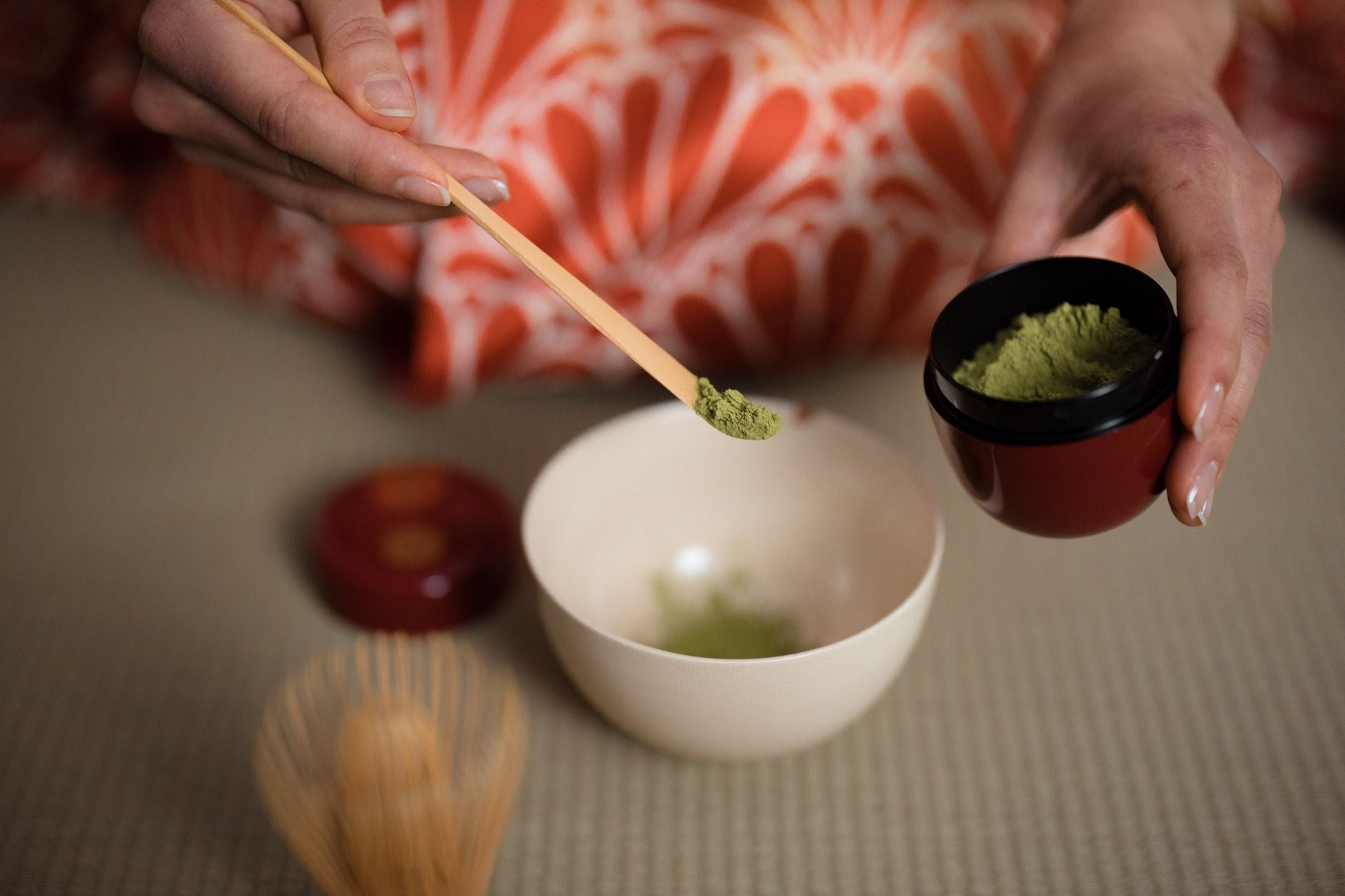
Matcha is a stone-ground powder made from shade-grown Japanese green tea leaves, whisked into hot water and drunk whole, leaf and all. It comes from the same plant as every other green tea, Camellia sinensis, but the leaves are shaded for weeks before harvest, then dried and milled into a fine powder rather than steeped and strained. Because you drink the suspended leaf itself, a bowl of matcha delivers the whole leaf in every sip, which is the single fact that sets it apart from ordinary steeped tea.
That difference shapes everything else about matcha: its bright color, its smooth texture, its calm and steady energy, and its price. This guide defines what matcha actually is, how it is grown and ground, how it differs from a cup of steeped green tea, the grades you will see on a tin, and where the best of it comes from.
Key takeaways
- Matcha is powdered green tea from the Camellia sinensis plant, grown in shade and stone-ground into powder.
- You whisk it into water and drink the whole leaf, so nothing is strained away.
- Steeped green tea is an infusion you discard the leaf from; matcha is a suspension you drink completely.
- The two broad grades are ceremonial and culinary, and they signal use, not a formal certification.
- Most fine matcha is grown in Japan, with Uji in Kyoto, Nishio in Aichi, and Shizuoka as the best-known regions.
What matcha actually is
Matcha is finely ground green tea powder, specially processed from shade-grown tea leaves of the Camellia sinensis plant. Every green tea, black tea, oolong, and white tea begins with this same species. What separates them is how the leaves are grown, oxidized, and finished after picking.
For matcha, the growers shade the tea plants for roughly two to three weeks before harvest, covering them to block most of the sunlight. The plant responds by producing more chlorophyll and more free amino acids, which gives the leaf its deep green color and its mellow, savory character. This shading step is what makes matcha matcha, and it is why sun-grown green tea powder is not the same thing.
After harvest, the shaded leaves are steamed, dried, and separated from their stems and veins. At this stage the leaf is called tencha, the raw material for matcha. Only when tencha is slowly milled into a fine powder does it become the matcha you whisk into a bowl. If you want the full breakdown of the leaf and the plant behind it, our companion guide on what matcha is made of goes deeper on tencha and the shading science.
How matcha is made, step by step
The path from field to powder is short in steps but slow in execution. Each stage protects the color, the aroma, and the smooth texture that define a good bowl.
- Shade the plants. Growers cover the tea rows for about two to three weeks before picking, blocking most sunlight to raise chlorophyll and amino acid levels.
- Harvest the young leaves. The tender top leaves are picked, since they carry the finest texture and the least bitterness.
- Steam quickly. The leaves are steamed for around ten to fifteen seconds to stop oxidation and lock in the green color.
- Dry without rolling. Unlike most green teas, the leaves are dried flat and never rolled, which keeps them fragile and open.
- Devein and destem. The stems and veins are removed, leaving only the soft leaf flesh, now called tencha.
- Stone-grind slowly. Granite mills grind the tencha at low speed in cool rooms, turning it into a talc-fine powder without scorching it.
The final grinding is the quietest and slowest part. Stone mills turn gently so the friction never heats the powder, because heat would dull both the color and the aroma. This patience is part of why real matcha costs more than a bag of green tea.
Matcha vs steeped green tea: the core difference
The clearest way to understand matcha is to compare it to a normal cup of green tea. With steeped tea, you pour hot water over loose leaves or a teabag, let them infuse, then remove the leaves and drink only the liquid. Whatever stays locked inside the discarded leaf never reaches your cup.
Matcha removes that step. The leaf is already ground into powder, so when you whisk it into water you create a suspension, not an infusion. You drink the entire leaf, which is why matcha tastes fuller, looks opaque green rather than translucent, and carries more of the leaf's compounds per serving.
| Attribute | Matcha | Steeped green tea |
|---|---|---|
| Form | Stone-ground powder | Whole or broken loose leaf |
| How you drink it | Whisked and suspended, leaf included | Infused, then leaf discarded |
| Growing | Shade-grown two to three weeks before harvest | Usually sun-grown |
| Appearance in the cup | Opaque, vivid green | Clear, pale to golden green |
| Caffeine | About 19 to 44 mg per gram of powder | About 11 to 25 mg per gram of leaf |
| Preparation | Whisk with a chasen or frother | Steep and strain |
The caffeine figures come from measuring the powder itself, so a single serving depends on how much you use. A common bowl uses around two grams of matcha, which places most servings in the range you would expect from a moderate cup of coffee or a strong green tea, though the experience feels calmer thanks to the amino acid L-theanine that shading concentrates in the leaf.
The main grades of matcha
Matcha grading is a guide to use, not a legal standard. You will mostly see two labels, ceremonial and culinary, and understanding what they signal helps you buy the right tin for what you want to make.
Ceremonial grade
Ceremonial matcha is made from the youngest, most tender shaded leaves and ground the finest. It is meant to be whisked simply with water and enjoyed on its own, where its smooth, naturally sweet character has nowhere to hide. This is the grade you want for a traditional bowl or a clean morning ritual.
Within the ceremonial world, Japanese tea culture also distinguishes two ways of preparing it. Usucha, or thin tea, is whisked to a light froth with more water. Koicha, or thick tea, uses more powder and less water to make a dense, almost painterly bowl, and it calls for the highest grade of all.
Culinary grade
Culinary matcha is still good tea, but it is chosen to hold its flavor against other ingredients. It is the grade for lattes, smoothies, baking, and anything where milk, sweetness, or heat would otherwise flatten a delicate ceremonial bowl. A slightly bolder, more astringent profile is a feature here, not a flaw.
Neither label is regulated, so quality varies between sellers even at the same grade. Color, aroma, and origin tell you far more than the word on the front. For a full walkthrough of grades and how to read a label, see our guide to the types of matcha.
Where matcha comes from
Almost all fine matcha is grown and milled in Japan, where the craft was refined over centuries. A handful of regions are known for it, each shaped by its soil, climate, and local tradition.
- Uji, Kyoto. The historic heart of matcha, often treated as the benchmark for quality and depth of flavor.
- Nishio, Aichi. A major producing area with a long matcha-making history and a large share of Japan's output.
- Shizuoka. Japan's largest tea-growing prefecture overall, and a significant source of matcha and its base leaf.
Origin matters because shading, soil, and cultivar all show up in the cup. A leaf grown for matcha in a cool, misty valley tastes different from one grown for volume. If you want the full map of growing regions and what each brings to the bowl, read where matcha comes from.
At One with Tea, our matcha is USDA-organic and sourced from named Japanese producers we have filmed on their farms, with third-party lab data for lead and cadmium. Knowing the exact origin of a powder you drink whole, leaf and all, is not a marketing detail. It is the whole point.
A short history of drinking the whole leaf
Drinking powdered tea is an old idea that traveled and changed. The practice of grinding tea into powder and whisking it took shape in China and was carried to Japan by Buddhist monks, who valued it as a steady support for long hours of seated meditation.
Over the following centuries Japanese tea culture refined the powder, the tools, and the etiquette into the tea ceremony known as chanoyu. The unhurried gestures of that ceremony, sifting, measuring, whisking, and serving, are the same steps you follow at home, only quieter. When you whisk a bowl today you are repeating a ritual that has been kept alive for many generations.
That lineage is part of why matcha feels different from a convenience drink. It was never designed for speed. It was designed for attention, and the whole-leaf method is a direct expression of that. Nothing is thrown away, and nothing is rushed.
What matcha tastes like
Good matcha tastes green, smooth, and gently sweet, with a savory depth that tea people call umami. That umami is the taste of the amino acids the shading concentrates in the leaf, and it is the flavor a careful bowl is built around.
Alongside the sweetness there is a soft, grassy freshness and a light natural astringency that keeps the cup from feeling flat. In a high grade these notes stay balanced and clean, with no harshness at the finish. In a lower grade, or when the water is too hot, the astringency turns sharp and bitter, which is usually a sign of the preparation rather than the tea.
Texture matters as much as flavor. Because you are drinking suspended powder, a well-sifted, well-whisked bowl feels silky rather than gritty. The fine froth on top of a usucha bowl is not decoration alone. It softens the first sip and carries the aroma up to you.
How to choose good matcha
Because grade labels are not regulated, the tin tells you less than your own senses and a few honest details from the seller. Four signals separate careful matcha from filler.
- Color. Look for a vivid, saturated green. A yellowish or dull olive powder usually means older or sun-grown leaves.
- Aroma. Fresh matcha smells sweet, green, and marine. A flat or hay-like smell points to age or poor storage.
- Origin. A named region and, better still, a named producer means someone stands behind the leaf. Vague sourcing is a quiet warning.
- Testing. Because you drink the whole leaf, contaminants are not filtered out. Third-party lab data for heavy metals like lead and cadmium is the clearest proof of a clean product.
This last point is where whole-leaf tea asks more of a brand than steeped tea does. When you strain a leaf, some of what it carries stays behind in the discarded leaf. When you drink the ground leaf, whatever is in it is in you, which is exactly why transparent sourcing and testing matter here more than in most groceries.
Freshness rounds out the list. Matcha is delicate and fades once it meets air, light, and warmth. Buy it in small, sealed tins, keep it cool and dark, and use it within a few weeks of opening for the brightest color and taste.
Is matcha good for you?
Matcha is a whole-leaf green tea, so it carries the leaf's natural compounds in a concentrated form, including caffeine, the amino acid L-theanine, and antioxidant plant compounds called catechins. Research on green tea often points to these compounds when it looks at the drink, though matcha specifically is still a smaller field of study.
One detail people notice is the quality of the energy. Matcha pairs caffeine with L-theanine, and many drinkers describe the result as alert but calm rather than jittery. We keep this framing modest on purpose, because green tea is a pleasant daily ritual, not a remedy, and the honest answer is that it is a lovely thing to drink, enjoyed in reasonable amounts.
How to make a bowl of matcha
A simple bowl takes about two minutes and needs only powder, water, and a whisk. Here is the traditional method for a light, frothy usucha.
- Sift the powder. Pass about one to two grams, roughly half a teaspoon to a teaspoon, through a small sieve into a bowl to remove clumps.
- Heat the water. Bring water to about 80 degrees Celsius, or 175 degrees Fahrenheit, since boiling water can turn matcha bitter.
- Add a little water. Pour in about 60 to 70 milliliters, a small splash to start, over the sifted powder.
- Whisk briskly. Use a bamboo chasen or an electric frother in a light W or M motion until a fine, even foam forms on top.
- Drink fresh. Enjoy the bowl right away, before the powder settles, and taste it plain before deciding whether you want anything added.
For a latte, whisk the same base with a little water first, then top with steamed or cold milk. Starting with the concentrated bowl keeps the matcha smooth instead of grainy.
Frequently asked questions
Is matcha just green tea?
Matcha is a form of green tea, but not an ordinary one. It comes from the same Camellia sinensis plant, yet the leaves are shade-grown, dried, and ground into powder you drink whole rather than steeped and strained. So all matcha is green tea, but very little green tea is matcha.
Do you drink the whole leaf with matcha?
Yes. Because matcha is a powder whisked into a suspension, you consume the entire ground leaf in every sip. With steeped tea you infuse the leaves and then throw them away, so you only drink what dissolves into the water.
Does matcha have more caffeine than green tea?
Gram for gram, matcha powder tends to hold more caffeine than loose green tea leaf, roughly 19 to 44 milligrams per gram versus about 11 to 25 milligrams per gram. Your actual cup depends on how much powder you whisk in, with a typical bowl using around two grams.
What is the difference between ceremonial and culinary matcha?
Ceremonial matcha is made from the youngest leaves and meant to be whisked with water and enjoyed on its own. Culinary matcha is chosen to hold its flavor in lattes, baking, and smoothies. Neither term is officially regulated, so origin and appearance tell you more than the label.

From our tea room
Organic Ceremonial Matcha Powder - USDA Certified (30g)
Stone-milled ceremonial grade, USDA Organic, third-party lab tested.
View Ceremonial MatchaWhere does the best matcha come from?
Most fine matcha is grown in Japan, with Uji in Kyoto, Nishio in Aichi, and Shizuoka among the best-known regions. Uji is often treated as the benchmark for depth and quality, though excellent matcha comes from several areas.
Why is matcha so green?
The color comes from shading. Covering the plants for two to three weeks before harvest raises the chlorophyll in the leaf, which produces the vivid green you see in the powder and the bowl. A dull or yellowish powder usually points to older leaves or less careful growing.
Sources
- Wikipedia, "Matcha," accessed 2026-08-05. https://en.wikipedia.org/wiki/Matcha
- Healthline, "7 Proven Ways Matcha Tea Improves Your Health," accessed 2026-08-05. https://www.healthline.com/nutrition/7-benefits-of-matcha-tea
Explore our organic Japanese matcha and taste the difference a named origin makes.
Share:
Can You Mix Matcha and Coffee? The Dirty Matcha Guide
What Does Matcha Taste Like? Umami, Sweetness, and Why Quality Matters