



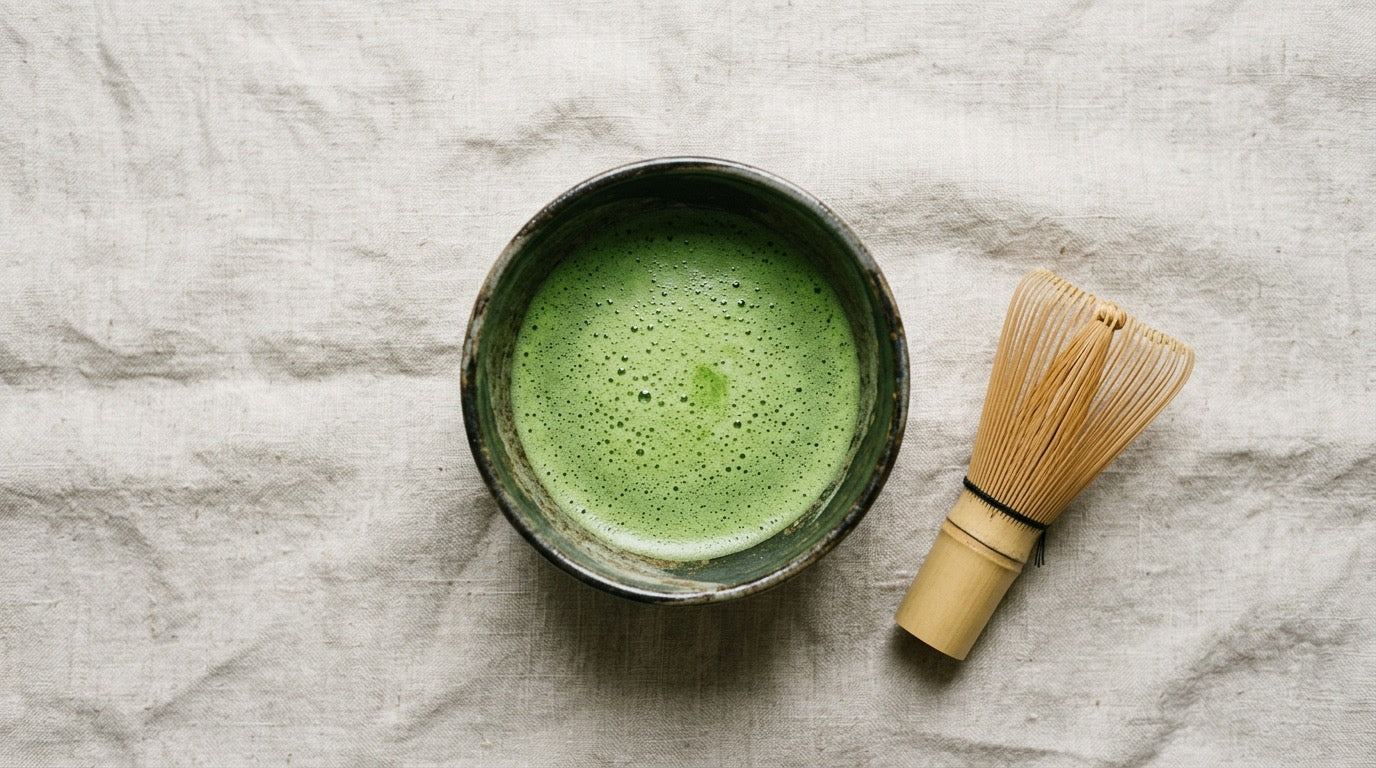
Short answer: no study has shown that matcha lowers cortisol. The closest evidence is about L-theanine, the amino acid matcha is rich in. In one crossover trial, an L-theanine drink reduced the salivary cortisol response to a stressful task three hours after the dose (White 2016, n=34). A four-week trial of 200 mg L-theanine a day found no change in resting cortisol, even though participants reported less stress and better sleep (Hidese 2019, n=30). The one matcha trial measured anxiety, not cortisol, and found less of it only with matcha high enough in theanine (Unno 2018, n=39). So matcha will not "melt your cortisol away." What it may offer is a calmer kind of caffeine and a few quiet minutes of ritual.
Updated September 21, 2026 by Christian Mauerer, founder of One with Tea: added the theanine threshold from the matcha trial, the caffeine-and-cortisol data, and a full source list.
Key Takeaways
- Cortisol is your body's main stress hormone, useful in short bursts, wearing when chronically elevated.
- L-theanine (matcha is unusually rich in it) is the most-studied link to a calmer stress response. The evidence is promising but early and mixed.
- One crossover trial saw a reduced cortisol response to an acute stressor after L-theanine (White 2016, n=34). A 4-week trial found no change in resting cortisol (Hidese 2019, n=30).
- Matcha also contains caffeine, which can raise cortisol. L-theanine appears to soften that edge, which is the real story of matcha's "calm energy."
- Individual response varies. This is a wellness ritual, not medical care. If you manage a health condition, check with your doctor.
What is cortisol, and should you try to lower it?
Cortisol gets talked about like a villain, but it isn't one. It's the hormone that wakes you up in the morning, sharpens focus under pressure, and helps your body meet a real challenge. The problem isn't cortisol itself, it's cortisol that never comes back down, the low-grade hum of modern stress that keeps the system switched on.
So the honest aim isn't to crush cortisol. It's to help the stress response rise when you need it and settle when you don't. That framing matters, because it's the lens the research supports, and the one most matcha marketing ignores.
Why is matcha linked to stress relief?
Matcha is made from shade-grown leaves, a step that concentrates an amino acid called L-theanine. L-theanine makes up roughly 2% of green tea leaf (EFSA 2018), and with matcha you drink the whole stone-ground leaf rather than an infusion. A 2 g bowl of matcha that clears the 17 mg-per-gram bar used in the matcha trial below carries at least 34 mg.
L-theanine is associated with alpha-wave brain activity, the relaxed-but-alert state you might recognize from meditation: in one EEG study, 50 mg raised alpha activity versus placebo (Nobre 2008). That's the plausible mechanism behind matcha's reputation for calm. Whether that translates into measurable changes in cortisol is exactly where the evidence gets interesting, and where honesty matters.
Does it matter which matcha you drink?
Here's the part most matcha marketing leaves out. The calming compounds aren't in every green powder labeled "matcha." L-theanine is concentrated by shade-growing, the weeks of covering the plants before harvest that also give true matcha its sweet, umami depth. Skip the shading (it's cheaper and higher-yield for the producer) and you get a flatter, more bitter powder that's lower in the very amino acid linked to the calming effect.
So the stress benefit is conditional on quality, and price alone won't tell you. The most reliable test is the one you already own: your palate. Genuinely shade-grown matcha tastes sweet and savory; harshly bitter, astringent matcha is often lower grade, stale, or under-shaded. Taste is your signal that the L-theanine, and the calm that may come with it, is actually in the bowl.
The numbers behind that. Combining mouse experiments with a 39-person trial, Unno's team concluded that matcha needs more than 17 mg of theanine per gram, and a (caffeine + EGCG) to (theanine + arginine) molar ratio below two, to be expected to reduce stress. When the team checked store-bought matcha against the theanine bar, 50 of 76 samples sold in Japan cleared it, against 6 of 67 samples sold overseas (Unno 2018). That's one lab's cutoff, not a regulatory standard, but it's the clearest evidence we know of that the word "matcha" on a label doesn't promise the compound the calm is credited to.
What does the research actually show?
Here's the real picture, benefits and limits together.
The encouraging signal. In a double-blind crossover trial, healthy adults who took an L-theanine drink reported a lower subjective stress response to a demanding multitasking challenge, and showed a reduced salivary cortisol response to that stressor a few hours later (White 2016, n=34). That's a real, if small, result: it suggests L-theanine may blunt the cortisol spike from an acute stressor.
The honest caveat. A separate randomized trial gave participants 200 mg of L-theanine daily for four weeks. Their stress-related symptoms (anxiety, low mood, sleep quality) improved, but the researchers found no significant change in cortisol levels in saliva or serum (Hidese 2019, n=30). In other words: people felt better; their measured cortisol didn't necessarily move.
The matcha-specific study. Closest to the cup itself, a double-blind trial gave 39 pharmacy students 3 grams of matcha a day, stirred into 500 mL of water, before and during a stressful off-campus placement. The twist: the placebo was also matcha, just one with low theanine relative to its caffeine and EGCG. The high-theanine group reported significantly less anxiety before the placement (p = 0.03) and had lower morning salivary α-amylase, a fast-moving physiological stress marker (Unno 2018). Worth noting: this measured α-amylase, not cortisol, and the anxiety gap had narrowed by day eight of the placement.
Put together, the evidence leans gently positive for the stress response and for how people feel, while the specific claim "matcha lowers your cortisol" remains unproven and genuinely mixed. More and larger studies are needed. We'd rather tell you that than sell you a number.
| Study | Design | What it measured | Result |
|---|---|---|---|
| White 2016 | n=34, crossover | Cortisol response to an acute stressor | Reduced |
| Hidese 2019 | n=30, 4 weeks | Resting cortisol (saliva + serum) | No change |
| Unno 2018 | n=39, matcha vs low-theanine matcha | Anxiety + salivary stress marker | Reduced |
Does the caffeine in matcha raise cortisol?
There's a wrinkle most "matcha for cortisol" articles skip: matcha contains caffeine, and caffeine on its own can raise cortisol, especially in people who don't drink it regularly. So why does matcha feel calmer than coffee?
The likely answer is the pairing: in a 27-person trial, 50 mg caffeine plus 100 mg L-theanine improved attention-switching more than caffeine alone (Owen 2008). L-theanine appears to moderate caffeine's sharper edges, which is why matcha tends to deliver sustained, even energy rather than a jittery peak and crash. That balance, not a cortisol-crushing trick, is matcha's honest advantage for a stressful day.
If you are comparing, here is caffeine and L-theanine across every tea type.
Caffeine tolerance is also genetic. The liver enzyme CYP1A2 handles about 95% of caffeine breakdown and varies between people, and variants in the brain's adenosine receptor shape sleep sensitivity too (Nehlig 2018). That helps explain why one person can sip matcha at 3pm and sleep fine while another lies awake. There's no universal "right" dose. The practical rule: whatever amount you can drink without disturbing your sleep is the right amount for you.
How big is the caffeine effect? In a controlled trial of 96 adults, 250 mg doses of caffeine raised cortisol across the day after five days without caffeine. In people already taking 300 or 600 mg a day, the response to the morning dose disappeared, but cortisol still rose after a second dose at 1 pm (Lovallo 2005). The authors' summary: cortisol responses to caffeine are reduced, but not eliminated, in daily consumers. For scale, a 2 g bowl of ceremonial matcha holds roughly 50 to 70 mg of caffeine (Meyer 2023), well under the test doses.

From our tea room
Organic Ceremonial Matcha Powder - USDA Certified (30g)
Stone-milled ceremonial grade, USDA Organic, third-party lab tested.
View Ceremonial MatchaHow much matcha, and when should you drink it?
The studies above used roughly 3 grams of matcha or 200 mg of isolated L-theanine per day. One to two servings of quality matcha (about 2 grams each) is a reasonable, food-first range. Timing tips that fit the research and common sense:
- Morning to early afternoon, so the caffeine doesn't reach bedtime.
- With or after food if you're caffeine-sensitive.
- Consistently, the symptom benefits in trials showed up over days and weeks, not from a single cup.
Individual response varies. If you're pregnant, manage a health condition, or are sensitive to caffeine, talk to your doctor before changing your routine.
The part the studies can't measure: the ritual
There's a reason a tea ceremony slows everything down. Whisking matcha is two or three minutes of single-tasking, warm bowl in your hands, one small act of attention before the day pulls you back. Whatever the cortisol data eventually settles on, that pause is a real, repeatable way to signal to your nervous system that it's safe to come down a notch.
That's how we think about matcha at One with Tea: not as a hack to override your body, but as a daily invitation to meet it. May you become one with tea, one with yourself.
New to ceremonial matcha? Our USDA Organic Ceremonial Matcha (30g) is stone-ground, USDA Organic ceremonial matcha.
Frequently asked questions
Does matcha lower cortisol?
The evidence is mixed and early. One crossover trial found L-theanine reduced the cortisol response to an acute stressor (White 2016, n=34), while a four-week trial found no change in resting cortisol despite improved stress symptoms (Hidese 2019, n=30). Matcha may support a calmer stress response, but "lowers your cortisol" is not an established claim.
Is matcha better than coffee for stress?
Possibly, because of L-theanine. Caffeine alone can raise cortisol, but matcha pairs caffeine with L-theanine, which appears to produce steadier, calmer energy rather than a sharp spike and crash. Individual response varies.
Does matcha raise cortisol?
Possibly a little, through its caffeine. In a controlled trial, 250 mg caffeine doses raised cortisol, and the effect was smaller but not gone in daily caffeine drinkers (Lovallo 2005). A 2 g bowl of ceremonial matcha has roughly 50 to 70 mg of caffeine, far below that dose, and comes paired with L-theanine.
Which matcha is best for stress?
One with plenty of theanine. Unno's team, combining mouse experiments with a 39-person trial, set the bar at more than 17 mg of theanine per gram with a low caffeine-to-theanine balance, a bar that 50 of 76 samples sold in Japan cleared against 6 of 67 sold overseas (Unno 2018). Sweet, savory, shade-grown ceremonial matcha is the practical signal.
How much matcha should I drink for stress?
Trials used about 3 grams of matcha or 200 mg of L-theanine daily. One to two servings (around 2 grams each), taken in the morning to early afternoon and consistently over time, fits both the research and good sleep hygiene.
Sources
- White DJ, et al. Anti-stress, behavioural and magnetoencephalography effects of an L-theanine-based nutrient drink. Nutrients. 2016;8(1):53. doi:10.3390/nu8010053
- Hidese S, et al. Effects of L-theanine administration on stress-related symptoms and cognitive functions in healthy adults. Nutrients. 2019;11(10):2362. doi:10.3390/nu11102362
- Unno K, et al. Stress-reducing function of matcha green tea in animal experiments and clinical trials. Nutrients. 2018;10(10):1468. doi:10.3390/nu10101468
- Lovallo WR, et al. Caffeine stimulation of cortisol secretion across the waking hours in relation to caffeine intake levels. Psychosomatic Medicine. 2005;67(5):734-739. doi:10.1097/01.psy.0000181270.20036.06
- Meyer BR, et al. Catechin composition, phenolic content, and antioxidant properties of commercially-available bagged, gunpowder, and matcha green teas. Plant Foods for Human Nutrition. 2023;78(4):662-669. doi:10.1007/s11130-023-01121-2
- EFSA ANS Panel. Scientific opinion on the safety of green tea catechins. EFSA Journal. 2018;16(4):5239. doi:10.2903/j.efsa.2018.5239
More in the matcha science series: What is L-theanine
Share:
Where Is Matcha Grown? A 2026 Global Production Map
Matcha and Cholesterol: What the Research Says About LDL (2026)