



Last updated: June 05, 2026
Short answer: L-theanine is an amino acid found almost nowhere in nature except the tea plant, and it's the reason a bowl of matcha feels calm and focused instead of jittery. But the part almost no one tells you is why the plant makes it in the first place: theanine isn't there for your nervous system, it's the tea plant's own nitrogen battery and stress shield. Understanding that "hidden half" is what makes tea, and especially shade-grown matcha, genuinely unique.
Key Takeaways
- L-theanine is nearly tea-exclusive. It can make up a large share of the free amino acids in a tea leaf, and it's what gives green tea its sweet, umami (savory) taste.
- The plant makes it for itself: theanine is built in the roots as a nitrogen store and stress protectant, then shipped up to the leaves.
- Shade-growing raises theanine. That's the biological reason matcha and gyokuro taste sweeter and feel calmer than sun-grown tea.
- For you: L-theanine is linked to increased alpha brain waves, the relaxed-but-alert state, within ~30-40 minutes (Nobre 2008), and paired with caffeine it's associated with steadier attention than caffeine alone (Kelly 2008).
- Modest, individual effects, not a drug. This is a food, not a treatment.
What L-theanine actually is
Chemically, L-theanine (technically γ-glutamylethylamide) is an amino acid, but an unusual one. Most amino acids are the building blocks of proteins. Theanine isn't, it floats freely in the leaf as what's called a free amino acid, and in tea it can account for a striking share of the entire free-amino-acid pool. That free, abundant form is why it has such an outsized effect on both flavor and physiology.
On the palate, theanine is the source of umami, the savory sweetness that defines high-grade green tea. When you taste a matcha that's smooth and brothy rather than harsh and bitter, you're largely tasting theanine. That single fact, taste tracks theanine, turns out to be a surprisingly reliable quality signal, and we'll come back to it.
The hidden half: why the tea plant makes so much
Here's the part that reframes everything. The tea plant is essentially the only plant on Earth that produces theanine in real quantity. Producing something rare and expensive (in metabolic terms) is not an accident. So the honest question isn't "what does theanine do for us," it's "what does it do for the plant." The answer is two jobs.
Job 1: a nitrogen battery
Tea is a nitrogen-hungry plant, and it prefers its nitrogen in the form of ammonium. Ammonium is energy-rich but also toxic to plant cells in excess. The tea plant's elegant solution is to rapidly lock that nitrogen away as theanine, a safe, stable storage form, built in the roots by an enzyme (theanine synthase) from glutamate and ethylamine, then transported up to the leaves through the plant's vascular system (Frontiers in Plant Science, 2017). Theanine is, in effect, the tea plant's rechargeable nitrogen battery, and it's lightweight and mobile enough to move quickly to wherever the plant needs to build new tissue.
Job 2: a stress shield
Because all that stored nitrogen sits ready as theanine, it doubles as the plant's first responder under stress. When the plant is stressed, it draws on theanine to build defensive compounds. This is where it gets practical for tea drinkers: research shows that shading the plant raises theanine, while heat, UV, and pest stress tend to break it down (J. Agric. Food Chem., 2021; MDPI Plants, 2025). That's why spring's first harvest and shaded leaves are the richest in theanine, and why a brutal summer sun produces flatter, more bitter tea.
Why this makes matcha unique
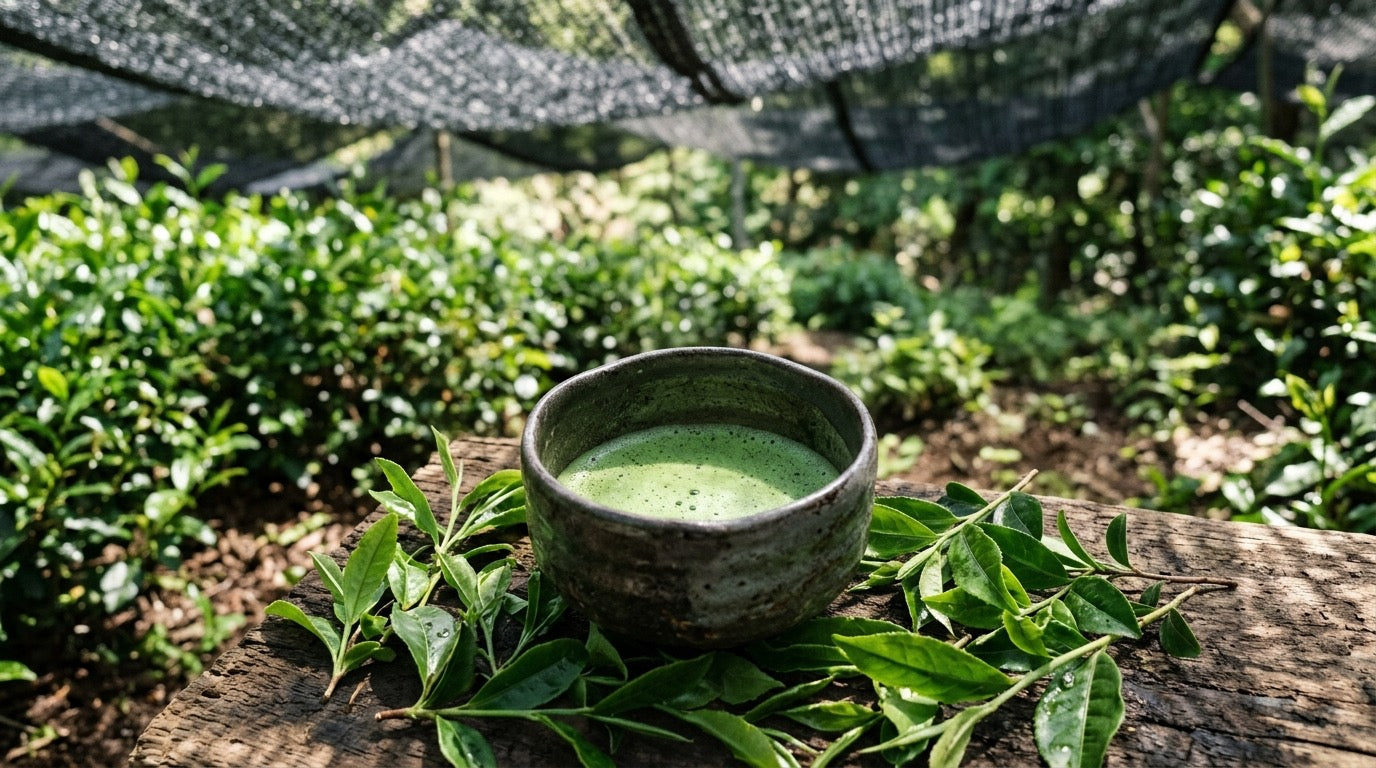
Now the biology pays off as a buying guide. Matcha and gyokuro are shade-grown, covered for weeks before harvest. Per the research above, that shading drives theanine up, which is exactly why true matcha tastes sweet and umami and delivers that signature calm. Skip the shading (cheaper and higher-yield for the producer) and you get a flatter, more bitter powder lower in the very compound people drink matcha for.
So the stress benefit and the flavor are conditional on quality, and price alone won't tell you. The most reliable test is the one you already own: your palate. Sweet and savory means shade-grown and theanine-rich. Harsh and bitter usually means it wasn't.
Which teas actually have the most theanine
Theanine survives some processing better than others, and the ranking is counter-intuitive. Because theanine breaks down during the long enzymatic steps of certain processes, the teas that are "fixed" early (heated to stop oxidation) keep the most. Research on processing transformations finds green and yellow teas retain the most theanine, oolong and black less, and heavily processed dark teas the least (ScienceDirect, 2025). The surprise: lightly processed white tea often has less theanine than oolong or black, because its long withering step gives enzymes more time to break theanine down. "Minimally processed" is not the same as "minimally changed."
| Tea type | Processing | Theanine retention |
|---|---|---|
| Green / yellow (incl. matcha) | Fixed early (heat-stopped) | Most |
| Oolong / black | Withered + oxidized | Moderate |
| White | Long withering | Lower than oolong/black |
| Dark (puer) | Post-fermented | Least |
What L-theanine does for you
Now the human side, hedged honestly. The clearest, most replicated finding is on brain state. Within about 30 to 40 minutes of a typical dose (roughly 50 to 250 mg), L-theanine is associated with a measurable rise in alpha brain-wave activity, the EEG signature of being relaxed yet alert, like the state you might recognize from meditation (Nobre 2008).
The caffeine partnership. On its own, L-theanine is calming. The magic of tea is the pairing: studies of L-theanine plus caffeine show changes in alpha-band activity and steadier attention on demanding tasks compared with caffeine alone (Kelly 2008; Haskell 2008). That's the science behind matcha's reputation for smooth, sustained focus instead of a jittery peak and crash. A 2-gram serving of quality matcha delivers a meaningful dose of both, in roughly the ratio nature intended.
Stress and mood. The evidence here is promising but mixed. One trial found L-theanine reduced the cortisol response to an acute stressor (White 2016), and matcha specifically lowered anxiety and a salivary stress marker in stressed students (Unno 2018). But a four-week trial saw improved stress symptoms with no change in resting cortisol (Hidese 2019). The honest read: L-theanine may soften the stress response and help you feel calmer, but it isn't a guaranteed cortisol switch, and it's a wellness aid, not a treatment for any condition.
How much, and the honest caveats
Studies generally use 50 to 250 mg of L-theanine. A 2-gram serving of good matcha supplies a portion of that range alongside its caffeine, which is why one to two daily servings is a sensible, food-first approach. A few honest notes:
- It comes with caffeine in tea. Pure L-theanine supplements are caffeine-free; matcha is not. Mind the timing if you're caffeine-sensitive.
- Individual response varies, and effects are modest. This is calm support, not sedation or medication.
- Quality decides the dose. Shade-grown, sweet-tasting matcha carries more theanine than harsh, bitter powder, regardless of price.
If you manage a health condition or take medication, check with your doctor before leaning on any food for a specific effect. May you become one with tea, one with yourself.
Want theanine-rich matcha you can taste? Our USDA Organic Ceremonial Matcha (30g) is shade-grown, stone-ground, and first-harvest, sweet and umami by design.
Frequently asked questions
What is L-theanine?
L-theanine is an amino acid found almost exclusively in the tea plant. It gives green tea its sweet, umami flavor and is linked to a calm, focused mental state. In the plant, it serves as a nitrogen store and stress protectant, made in the roots and moved up to the leaves.
Why is L-theanine unique to tea?
The tea plant is essentially the only plant that produces theanine in quantity, because it uses theanine to safely store nitrogen (which it prefers as toxic-in-excess ammonium) and to respond to stress. That dual role is why tea, unlike almost any other plant, is rich in it.
Which tea has the most L-theanine?
Shade-grown green teas like matcha and gyokuro are highest, because shading raises theanine and early "fixing" preserves it. Counter-intuitively, white tea often has less than oolong or black, because its long withering step breaks theanine down. Dark teas like puer have the least.
Does L-theanine make you sleepy?
Not exactly. On its own it promotes calm without strong sedation; in tea it's paired with caffeine, which keeps you alert. The result people describe is relaxed focus, not drowsiness. For sleep specifically, timing your caffeine matters more.
Share:
Matcha and Inflammation: Does It Actually Help? (2026)
Premium Matcha for Cafes and Lattes: A 2026 Sourcing Guide