



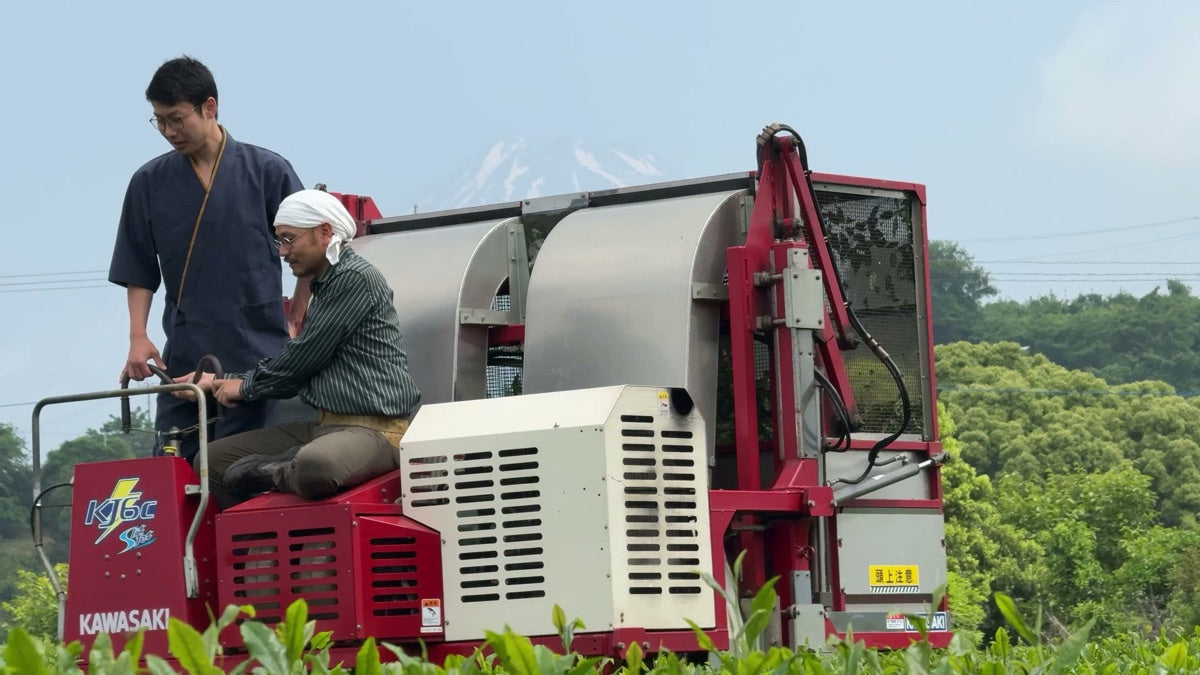
By Christian, Founder, One with Tea
If you have ever had a cup of Japanese green tea, you have almost certainly tasted Yabukita. It is one cultivar, selected by one grower in Shizuoka in 1908, and it still accounts for the largest proportion of Japan's tea cultivation area at 62.2 percent (Breeding Science, 2026). No other tea plant on earth has that kind of reach.
What surprised me when I started sourcing in Shizuoka is how ordinary its origin is. There was no research institute, no breeding programme, no grand plan. There was a man, a patch of ground where a bamboo grove used to be, and a decision about which two seedlings looked worth keeping.
Key Takeaways
- Yabukita was selected in 1908 by Sugiyama Hikosaburo, who cleared his own bamboo grove in what is now Suruga Ward, Shizuoka City, planted a field there, and chose from the seedlings that came up.
- The name is plain description. The sample taken from the north side of the old grove became Yabukita (kita, north). The south sample became Yabuminami (minami, south).
- It was registered in 1953 as tea cultivar number 6, one of exactly 15 registered that year. Its official registered use is sencha.
- Every Yabukita plant is a cutting, so a field is genetically one plant repeated thousands of times, and the whole row flushes together.
- It is the parent of most modern Japanese cultivars, including several the government is now encouraging growers to switch to.

Where the name came from: a bamboo grove in Shizuoka
Yabukita is named after a bamboo grove that no longer exists.
In 1908, a grower named Sugiyama Hikosaburo (杉山彦三郎) cleared a stand of bamboo, takeyabu, on his own land in what is now Suruga Ward, Shizuoka City. He planted a tea field in the cleared ground and then did the patient work that plant selection actually is: watching what came up, and picking the ones worth propagating.
He kept two. The plant from the northern part of the old grove he called Yabukita, from yabu (grove) and kita (north). The one from the southern part became Yabuminami, with minami meaning south. That is the whole story behind the name of the most planted tea cultivar in the world. It is a note about where in the field something was standing.
This is not folklore. Japan's national cultivar registry still lists Yabukita's former line name (旧系統名) literally as 藪北, and Japan's Ministry of Agriculture, Forestry and Fisheries records its lineage as 静岡在来種実生, a seedling selection from the Shizuoka landrace (茶農林登録品種一覧). The Shizuoka Tea Merchants Cooperative tells the same story in Japanese (ocha.or.jp).
Worth being precise about one thing, because English write-ups often get it backwards: he did not stumble on an existing wild field beside a grove. He cleared the grove himself, planted the field, and selected out of his own seedlings.
What Sugiyama selected for, and what the registry recorded

Sugiyama chose Yabukita for reliability, not for prestige.
It took another 45 years for that judgement to become official. After testing by the Shizuoka prefectural tea industry laboratory, Yabukita was registered in 1953 as 茶農林6号, tea cultivar number 6. It was one of exactly 15 cultivars registered that year, the first cohort Japan ever formally registered. Its listed use is sencha.

From our tea room
Superior Sencha Green Tea - USDA Organic Japanese First Flush
First-flush loose leaf, USDA Organic, direct from Japanese family farms.
View Superior SenchaThe registry's own description of it is worth quoting, because it is the most authoritative sensory note that exists for this plant: 「品質は煎茶として極めて良好で、独特の強い香気を持ち、滋味優雅で甘味に富む」. Excellent quality as sencha, with a distinctive strong aroma, an elegant flavour, and rich sweetness. That assessment comes from the cultivar registry, not from a merchant's catalogue.
The trait that really won, though, was hardiness. Yabukita is hardy enough for most Japanese growing regions, which meant a grower in a cold pocket could plant it without losing a crop to a spring freeze every few years. It is worth sitting with how significant that was in 1908, because frost-protection fans did not exist yet.
Those fans are now standard across Japanese tea country, and the mechanism is quietly clever. Research by NARO describes motor-driven fans mounted on poles around 5 metres tall and angled downward. On a clear night with radiative cooling, a layer of warmer air settles roughly 6 to 7 metres above the canopy while cold air pools at leaf level. The fan pulls that warm inversion down and mixes it into the cold layer (NARO). Yabukita earned its place decades before growers had that safety net.
Two honest caveats. Official ratings give Yabukita only moderate cold resistance, so "hardy" is relative, and it is a mid-season (中生) cultivar that still needs active frost protection today. And its registered purpose is sencha. It does turn up in everyday matcha, but shaded Uji cultivars are preferred for ceremonial grades, and I would rather tell you that than oversell the plant. Our guide to Japanese tea cultivars covers how the shaded roster differs.
How one plant became most of Japan's tea

Yabukita spread because it can be cloned, not because it can be bred.
Tea is largely self-incompatible, meaning a plant mostly cannot fertilise itself, so seeds come out genetically scrambled. Plant a Yabukita seed and you do not get Yabukita. You get a lottery ticket. That is exactly what Sugiyama was sorting through in his cleared field in 1908 (Biologia, 2012).
Cuttings solve that. Root a cutting and you get an exact copy. So when propagation by cuttings gradually replaced propagation by seed, roughly from the mid-1960s through the 1970s, a grower could suddenly plant a whole hillside of the same proven plant instead of a field of unpredictable seedlings.
That is why a Yabukita field looks the way it does. It is one plant repeated thousands of times. The rows flush at the same moment, the leaves size up together, and a single machine pass can take the whole block at the right stage. Standing in one of those fields in May, the evenness is the first thing you notice, and it is a little uncanny once you know why.
That uniformity is also the quiet argument for and against monoculture. It gives a predictable harvest and a consistent cup. It also means one plant's weaknesses are the whole region's weaknesses.
Yabukita is the parent of the cultivars now replacing it
The most striking thing about Yabukita is not its share. It is its parentage.
Yabukita appears as a parent in at least nine registered 茶農林 cultivars, including Sayamakaori (31号), Okumidori (32号), Meiryoku (35号), Fukumidori (36号), Saemidori (40号, a Yabukita and Asatsuyu cross) and Sofu (49号). Japan did not just plant Yabukita. Japan bred the next several generations of its tea out of it.
Which produces a genuinely odd situation. Japan's Ministry of Agriculture is actively encouraging growers to convert away from Yabukita toward earlier, high-quality cultivars, naming Saemidori among the targets: 「やぶきた」から早生で高品質な「さえみどり」等への品種転換が図られている (MAFF, November 2024). Saemidori is a Yabukita child. Okumidori, often miscategorised in English as an Uji cultivar, is another one, bred at NARO Kanaya in 1974.
Newer cultivars are moving fast off a small base. Seimei went from 13 hectares in 2019 to 130 hectares in 2023, a tenfold rise in four years (MAFF). Real momentum, and still a rounding error next to Yabukita's footprint.
Why growers are slow to switch

Replanting a tea field is a decades-long financial commitment, and that is the whole reason change is slow.
You pull out producing plants, wait years for the new ones to yield, and carry the gap yourself. MAFF's own framing of the problem is blunter than anything I would write: about 38 percent of Japan's tea garden area is now 30 years old or more, and the ministry warns 「茶園の約4割が樹齢30年以上と老園化しており収量・品質の低下が懸念される」, that roughly four in ten gardens are ageing, with declining yield and quality a concern (MAFF, November 2024).
Meanwhile the sector itself is shrinking. Yabukita's planted area fell from 36,174 hectares to 22,193 hectares, while Japan's total tea area contracted from 48,700 hectares to about 36,000 hectares, a drop of roughly 31 percent (MAFF). Its share has slipped far more slowly than its acreage, because the ground fell away underneath it. Losing hectares while holding share is not the same as staying strong.
Where it grows is concentrated too. Shizuoka accounts for 13,300 hectares, about 37 percent of national tea area, and Kagoshima 8,140 hectares, about 23 percent. For sencha specifically the two are nearly level, at 41 and 40 percent (MAFF). If you drink sencha, you are drinking from those two prefectures far more often than not.
What Yabukita tastes like, and how I brew it

Yabukita's signature is aroma and balance rather than intensity.
I want to be careful here. Almost every specific English tasting note for this cultivar traces back to somebody's product copy for one particular lot, and a single lot is not a cultivar. What I can tell you is what the registry recorded, a distinctive strong aroma with elegant flavour and rich sweetness, and what I notice walking rows and cupping in Shizuoka: a clean grassy top note, sweetness that arrives late rather than up front, and a finish that stays civil instead of turning sharp. It is a balanced tea, which is exactly why it became the default.
Processing shifts it more than most people expect. The same leaf steamed longer, as in fukamushi sencha, gives a deeper colour and a rounder, heavier cup. And if you want to taste how far shading moves things, our sencha and gyokuro comparison is the clearest way in.
For brewing, I use the guidance from JA Shizuoka, the cooperative on Yabukita's home ground.
| Grade | Water | Leaf | Volume | First steep |
|---|---|---|---|---|
| Upper-grade sencha | 70°C / 158°F | 3 g per person (5 g if brewing for one) | 60 mL per person | 2 minutes |
| Standard sencha | 90°C / 194°F | 3 g per person | 90 mL per person | 1 minute |
Source: JA Shizuoka.
For the second infusion, lift the lid after the first pour so the heat escapes, then go about 10 seconds slightly hotter. And pour out every last drop. The liquid left sitting in the pot is what ruins the next cup, a point the Japan Tea Instructor Association makes as well (nihoncha-inst.com).
That last drop is the part I would keep if you forget everything else here. Tea rewards attention at small scales. You are not managing a process, you are just present for a few minutes with something that took a century of somebody else's patience to arrive in your cup.
Frequently asked questions
What does the name Yabukita mean?
It means "north of the grove", from yabu (grove) and kita (north). Sugiyama Hikosaburo selected it from the northern part of a field he had cleared from his own bamboo grove in 1908. The plant he selected from the southern part was named Yabuminami, meaning south of the grove.
Who created Yabukita?
Sugiyama Hikosaburo (杉山彦三郎), a grower in what is now Suruga Ward, Shizuoka City. He selected it in 1908 from seedlings of the local Shizuoka landrace. It was registered as tea cultivar number 6 in 1953, after testing by the Shizuoka prefectural tea industry laboratory.
For where this sits on the map, see where Japan's tea is really grown.
Can you grow Yabukita from seed?
No. Tea is largely self-incompatible, so its seeds do not breed true. A Yabukita seed produces a genetically different plant. Every true Yabukita is propagated from a cutting, which is why a field behaves as a single clone and flushes uniformly.
Why is Yabukita being replaced?
Japan's Ministry of Agriculture is encouraging conversion to earlier, high-quality cultivars such as Saemidori. The change is slow because replanting means years without yield, and MAFF reports that about 38 percent of Japan's tea garden area is already 30 years or older.
Is Yabukita only grown in Shizuoka?
No, it is planted nationwide, though production is concentrated. Shizuoka holds about 37 percent of Japan's tea area and Kagoshima about 23 percent. Shizuoka is where the cultivar was selected, and it remains its home ground.
Tasting Yabukita for yourself
We source organic Japanese tea directly from growers, and Yabukita is the cultivar behind most of the everyday sencha worth drinking. If you want to taste what a century of selection produced, browse our organic Japanese teas and start with a single-origin sencha.
If you run a cafe, shop or tea programme and want to serve it, we supply wholesale directly from our sourcing partners in Japan. Get in touch about wholesale and tell us what you are pouring.
Sources
- Ministry of Agriculture, Forestry and Fisheries, 茶業及びお茶の文化に係る現状と課題 (November 2024). maff.go.jp
- 茶農林登録品種一覧 (Japanese tea cultivar registry). minorien.jp
- Shizuoka Tea Merchants Cooperative. ocha.or.jp
- NARO, frost-protection fan research (2009). naro.go.jp
- Late-acting self-incompatibility in Camellia sinensis, Biologia (2012). link.springer.com
- Advances in tea breeding in Japan, Breeding Science (2026). jstage.jst.go.jp
- JA Shizuoka, brewing guidance. ja-shizuokashi.or.jp
- Japan Tea Instructor Association. nihoncha-inst.com
Share:
Matcha and Blood Pressure: What the Research Says (2026)
Okumidori Cultivar vs Gokou: The Late-Budding Matcha Plants