



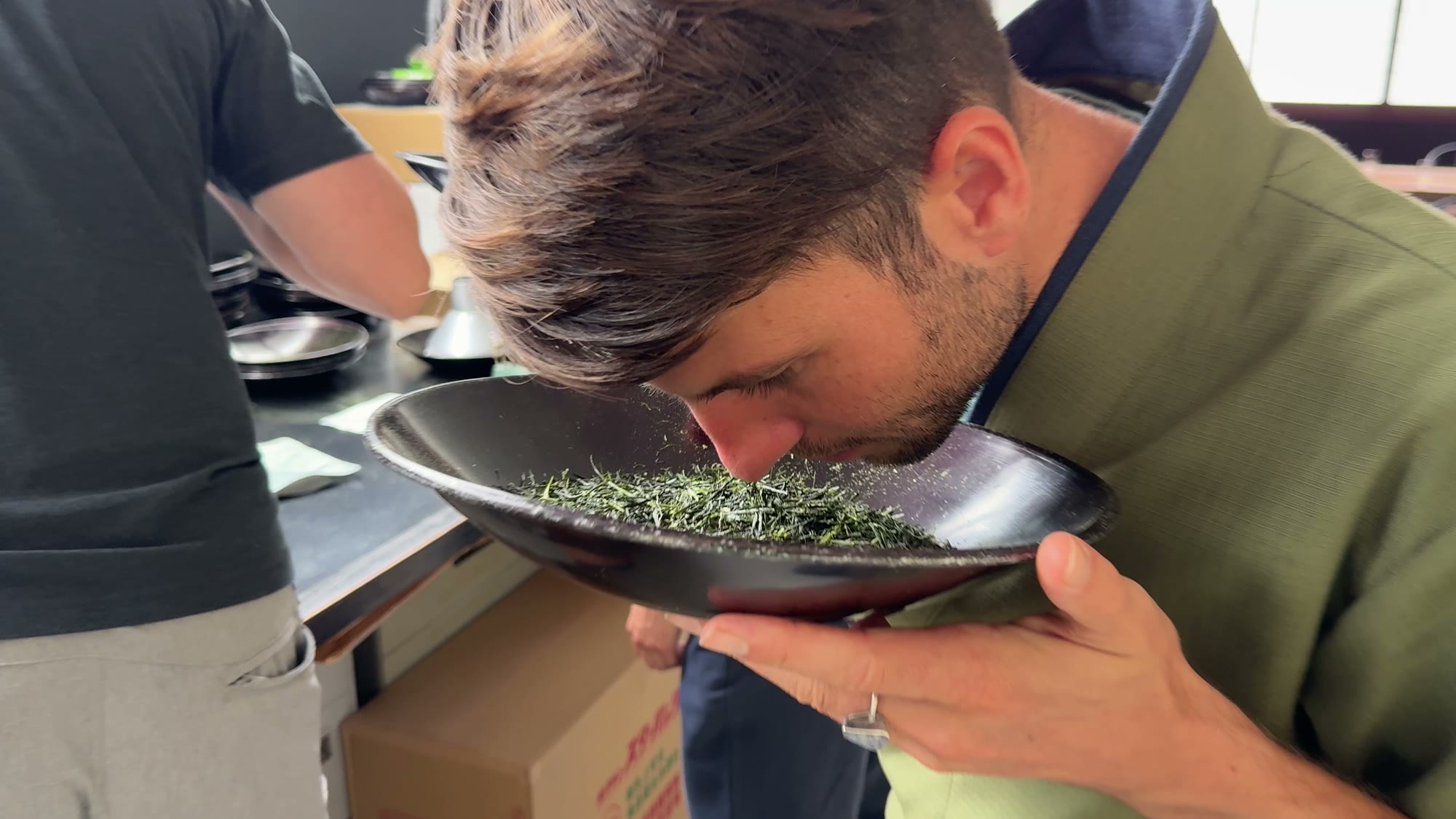
By Christian Mauerer, Founder of One with Tea
Updated July 2026
One with Tea sources premium Japanese green teas directly through relationships in the growing regions of Uji and Yame. We write about what a tea actually is, not the mystique of its name.
Gyokuro is a premium Japanese green tea grown under shade for about 20 days before harvest. That covering changes the leaf's chemistry, raising amino acids like L-theanine and lowering the compounds that make tea taste bitter. The result is a soft, deeply savory cup that many tea drinkers prize above almost any other loose leaf. Its name means "jade dew," a nod to the pale green liquor it pours.
Key Takeaways
- Gyokuro is shaded for roughly 20 days before picking, using reed or straw screens traditionally and synthetic net today (Global Japanese Tea Association, 2019).
- Shading raises theanine and caffeine and lowers catechins, the bitter, astringent compounds (Chen et al., Int. J. Mol. Sci., 2022).
- It's rolled like sencha, so it stays a loose leaf. Matcha comes from tencha, a shaded leaf that's ground instead of rolled.
- Brew it cool, around 50 to 60°C, for a sweet, umami-rich cup with almost no bitterness.
Caffeine at a glance: Gyokuro carries about 30 to 50 mg per 8-oz cup, on the higher end for Japanese green tea, because heavy shading drives caffeine up. See how it compares with every Japanese green tea in our caffeine-by-tea-type comparison.
What is gyokuro?
Gyokuro is a shade-grown Japanese green tea made much like sencha, but from leaves covered from sunlight for about 20 days before the first-flush harvest. The Japan Tea Central Association defines it as tea grown under near-complete shade using reed screens, straw, or netting from the moment new spring shoots appear. That single change in how the plant grows sets everything else apart.

From our tea room
Superior Sencha Green Tea - USDA Organic Japanese First Flush
First-flush loose leaf, USDA Organic, direct from Japanese family farms.
View Superior SenchaThe word gyokuro translates to "jade dew" (Global Japanese Tea Association, 2019). It sits at the top of the Japanese green tea world alongside the finest matcha. If you're mapping out the wider family of Japanese teas, our Japanese green tea guide shows where gyokuro fits among sencha, hojicha, genmaicha, and the rest.

Where does gyokuro come from?
Gyokuro is young by the standards of Japanese tea. It dates to 1835, when Yamamoto Kahei VI, of the Yamamoto tea house, traveled to Uji to study tencha, the shaded leaf behind matcha. A batch handled differently in the drying gave him something new: leaves that curled as they dried and poured a sweeter, rounder cup. Rolling it like sencha, so it stayed a whole loose leaf, came a few years later, credited to Eguchi Shigejuro around 1841. The name stuck: gyokuro, "jade dew," for the pale liquor and the dew-like beads the rolled leaf forms.
How is gyokuro shade-grown? (the matcha connection)
Farmers cover the tea rows for about three weeks before harvest, building an elevated shelf over the field and draping it with reeds, straw, or modern synthetic net. Traditionally this was the honzu or ooishita method with natural materials; today growers often use kanreisha netting. Deprived of full sun, the plant behaves differently, and that's the whole point.
When you shade a tea plant, its chemistry shifts. One 2022 study on shaded green tea found that shading increased theanine and caffeine while decreasing catechins such as epigallocatechin gallate, and it deepened the leaf's chlorophyll and carotenoid content (Chen et al., International Journal of Molecular Sciences, 2022). More theanine and fewer catechins means more sweetness and umami, and far less of the bite you get from sun-grown leaf. It also explains the vivid green color.
Here's the matcha connection. Matcha starts from the same idea of shading, but the leaf takes a different path. Tencha, the base for matcha, is shaded, steamed, then dried and separated from its stems without rolling, and finally stone-ground into powder (Global Japanese Tea Association, 2019). Gyokuro keeps the classic sencha step: the leaves are steamed and then rolled for hours to break the cell walls, so it stays a whole loose leaf you steep rather than a powder you whisk. Shade under 20 days, by the way, and the tea is usually called kabusecha, a lighter cousin, not true gyokuro.
Why is gyokuro so expensive?
Gyokuro costs more because it's labor-heavy at every step. Growers build and manage the shading structures, watch the covered rows closely for roughly 20 days, and hand-pick tender first-flush shoots. Premium production also concentrates in a few celebrated regions, which keeps the best lots scarce. Less supply, more hand work, higher price.
The historic home of gyokuro is Uji, in Kyoto. These days Fukuoka's Yame region is the standout, producing around 40% of Japan's gyokuro and taking the top prize in the gyokuro category at the 2023 National Tea Competition, while Uji led the tencha category (Global Japanese Tea Association, 2023). Shizuoka grows gyokuro too. When we taste and source shaded teas, region tells us a lot about what a lot will taste like before the water even hits the leaf.
The 2026 results echo this. At the 44th Kyoto Prefectural Tea Competition in July 2026, judged over 240 first-flush entries, Kyotanabe City in Kyoto swept the top three places in the gyokuro category, while Uji producers took first through sixth in tencha (Global Japanese Tea Association, 2026).
A quick, honest note from our side of the table. We source premium Japanese green teas directly through relationships in these growing regions, and we've learned that "gyokuro" on a label means little without knowing the harvest, the shading length, and the farm's care. We'd rather tell you what a tea actually is than lean on the mystique of the name. That's the standard we hold ourselves to at One with Tea.
What grades and cultivars of gyokuro are there?
Two things separate one gyokuro from another: the cultivar, meaning the variety of tea plant, and the grade, meaning how it was grown and picked.
Cultivars. A handful of varieties are prized for how they answer to shade. Gokou, selected in 1953 at the Kyoto Prefectural Tea Research Institute, is deeply aromatic and typical of Uji gyokuro. Saemidori, a cross of Asatsuyu and Yabukita registered as its own variety in 1990, pours a bright, pure-green cup with an unusual smoothness. Samidori and Uji-hikari round out the classic Uji set. Asahi, the rarest, is usually held back for the very finest shaded leaf. Yabukita, the workhorse of Japanese tea, shows up in more everyday gyokuro.
Grades. At the top sit competition-grade lots: hand-picked first-flush leaf (ichibancha), shaded the full three weeks, from a named farm. Below them, daily-drinking gyokuro uses machine-picked leaf and shorter shading. Grade is where price and character diverge most, so it pays to know what you are looking at.
How do you choose (and buy) gyokuro?
Good gyokuro tells you about itself on the label. Before you buy, look for these five things, in roughly this order:
- Harvest and flush. First-flush (ichibancha) spring leaf is the standard for real gyokuro. A harvest year tells you it is fresh.
- Shading length. True gyokuro is shaded about 20 days. Shorter than that, and it is usually kabusecha, a lighter cousin, not gyokuro.
- Cultivar. A named cultivar (Gokou, Saemidori, Asahi) signals a producer who knows what they grew.
- Region. Uji in Kyoto and Yame in Fukuoka are the benchmark origins. Region hints at style before the water hits the leaf.
- Grade and picking. Hand-picked, competition-grade leaf sits at the top; machine-picked daily grade is the everyday tier.
The red flag is a bag that says only "gyokuro" and a low price, with no harvest, no shading length, and no origin. At this level, the details are the product. That is the standard we hold ourselves to when we source.
What does gyokuro taste like?
Gyokuro tastes soft, sweet, and intensely savory, with an umami depth people often compare to dashi broth or a marine, seaweed-like note. Bitterness and astringency are very low, thanks to the drop in catechins from shading. The body feels almost thick, and the finish lingers with a gentle sweetness rather than a sharp green snap.
That savory quality traces straight back to L-theanine, the amino acid shading protects in the leaf. It's the same compound that gives the best matcha its rounded, brothy character. If bright and grassy is what sencha does, gyokuro goes the other direction: quiet, dense, and contemplative. It rewards slowing down, which is part of why we love it.
How much caffeine does gyokuro have?
Gyokuro is one of the more caffeinated green teas. At a standard 8 oz (240 ml) cup brewed with a moderate dose of leaf it lands around 50 mg, a touch higher than sencha, even though the two are processed almost identically. The reason is the shade. The same covering that raises L-theanine and umami also concentrates caffeine in the young leaf (Chen et al., Int. J. Mol. Sci., 2022), so a shaded leaf carries more caffeine than a sun-grown one from the same plant. In practice the number swings with how you brew: gyokuro is traditionally steeped with a heavy dose of leaf and very little water, and a full multi-infusion session delivers considerably more than a single light cup.
These figures draw on USDA FoodData Central and, for coffee, the Mayo Clinic; our tea caffeine comparison has the per-source breakdown. So gyokuro sits in the upper-middle of the green tea range: above sencha and hojicha, below whole-leaf matcha (you drink the ground leaf, so you get all of it), and well under a cup of coffee. For the full side-by-side of every tea against coffee, see our tea caffeine comparison, and for the deeper story on how shading and grade move caffeine, our guide to matcha and caffeine.

From our tea room
Organic Hojicha Powder - USDA Certified Roasted Green Tea
Roasted green tea, naturally low in caffeine. USDA Organic.
View Organic HojichaGyokuro, L-theanine, and calm focus
The savory depth of gyokuro and its quiet character trace to the same molecule: L-theanine, an amino acid the shade protects in the leaf. Research on shaded tea links higher theanine to that brothy, umami taste (Chen et al., Int. J. Mol. Sci., 2022). Theanine is also the compound tea drinkers associate with a settled, unhurried kind of alertness, especially alongside the tea's caffeine: a 2008 study found the L-theanine and caffeine combination improved attention versus either alone (Haskell-Ramsay et al., Biological Psychology, 2008), though how strongly you feel it varies from person to person. We keep the claim simple and let the cup speak: gyokuro is a tea to slow down with. For the fuller picture, see our guide to what L-theanine is.
How do you brew gyokuro?
Brew gyokuro cool. The Global Japanese Tea Association recommends dropping the water temperature, especially for the first infusion, sometimes as low as 40 to 50°C, and steeping around 90 seconds (Global Japanese Tea Association, 2019). Cool water pulls out the sweet amino acids while leaving the bitter catechins behind, so the cup stays smooth. Use more leaf and less water than you would for sencha.
Here's a simple starting point you can adjust to taste:
| Infusion | Water temp | Steep time | Notes |
|---|---|---|---|
| First | 50 to 60°C (122 to 140°F) | 90 to 120 sec | Generous leaf, just enough water to cover |
| Second | 60°C (140°F) | 30 to 45 sec | Slightly warmer, shorter |
| Third and on | 70°C (158°F) | 45 to 60 sec | Push a bit warmer as flavor fades |
Follow these steps for your first pot:
- Warm your teapot and small cups, then let a kettle of boiled water cool, or pour it between vessels to shed heat.
- Add a generous measure of leaf, more than you'd use for sencha.
- Pour just enough cool water to cover the leaves and steep about 90 seconds.
- Pour out every last drop, then re-steep two or three more times, warming the water slightly each round.
Can you cold-brew gyokuro? (koridashi)
Yes, and it may be gyokuro at its sweetest. Koridashi, or "ice brew," sets a few grams of leaf under a small mound of ice and lets it melt slowly over an hour or more. The near-freezing water draws out almost pure sweetness and umami and leaves the bitter catechins behind entirely. It is the slowest, quietest way to taste what shading does. A quicker cold brew works too: cover the leaf with cold water, refrigerate for two to four hours, and strain.

How do you store gyokuro?
Gyokuro is delicate and picks up smells fast, so storage matters more than with a sturdier tea. Keep it airtight, cool, dark, and away from anything fragrant, coffee, spices, a scented cupboard. Use an opened bag within a couple of months while the aroma is still bright. For longer keeping, an unopened, sealed pack can go in the freezer; let it come fully back to room temperature before you open it, so no condensation touches the leaf.
Gyokuro brewing troubleshooting
If your cup is not landing, the fix is usually temperature or leaf-to-water ratio:
- Too bitter or astringent? Your water was too hot. Drop it to 50 to 60°C, cooler still for the first steep.
- Thin or watery? Use more leaf and less water. Gyokuro wants a generous dose and just enough water to cover.
- Too intensely savory or "seaweedy"? Shorten the steep and warm the water slightly on later infusions to open up the sweeter notes.
- Flat after one pour? Re-steep. Good gyokuro gives three or four infusions, each a little different.
Gyokuro vs sencha: what's the difference?
Gyokuro and sencha are processed almost identically, both steamed and rolled, so the real difference is shade. Sencha grows in full sun, which keeps it brighter, grassier, and more astringent, while gyokuro's roughly 20 days under cover make it sweeter, softer, and richer in umami.
Tea
Shade before harvest
Processing
Flavor
Form
Gyokuro
~20 days
Steamed, rolled
Sweet, deep umami, very low bitterness
Loose leaf
Kabusecha
~1 to 2 weeks
Steamed, rolled
Between gyokuro and sencha, gently sweet
Loose leaf
Sencha
None (full sun)
Steamed, rolled
Bright, grassy, more astringent
Loose leaf
Matcha
~20+ days (as tencha)
Steamed, dried, stone-ground
Rich, brothy, full-bodied
Powder (whisked)
Frequently asked questions
What is gyokuro?
Gyokuro is a premium Japanese green tea shaded from sunlight for about 20 days before harvest, then steamed and rolled like sencha. The shading raises amino acids and lowers bitterness, giving a sweet, umami-rich cup. Its name means "jade dew" (Global Japanese Tea Association, 2019).
Why is gyokuro so expensive?
Gyokuro is labor-intensive. Farmers build shading structures, tend the covered rows for roughly 20 days, and hand-pick tender first-flush shoots. Premium supply concentrates in a few regions like Yame and Uji, and Yame alone grows around 40% of Japan's gyokuro (Global Japanese Tea Association, 2023).
What temperature should you brew gyokuro at?
Brew gyokuro cool, around 50 to 60°C, and even lower for the first infusion. The Global Japanese Tea Association suggests dropping as low as 40 to 50°C for about 90 seconds (2019). Cool water draws out sweetness and umami while leaving bitterness behind.
Is gyokuro the same as matcha?
No, though both start with shaded leaves. Gyokuro is rolled and steeped as a whole loose leaf. Matcha is made from tencha, a shaded leaf that's dried, de-stemmed, left unrolled, and stone-ground into powder (Global Japanese Tea Association, 2019).
Does gyokuro have caffeine?
Yes. Research on shaded teas found that shading tends to raise both caffeine and theanine in the leaf (Chen et al., Int. J. Mol. Sci., 2022). At roughly 50 mg per cup it sits on the higher side for a green tea, above sencha, below matcha and coffee, though the exact amount depends on the leaf and how you brew it.
Gyokuro is coming to One with Tea
We are bringing a shade-grown gyokuro to the shop. If you would like to be the first to know when it lands, leave your email and we will tell you the moment it is ready.
Ready to taste the shaded difference?
Gyokuro is the pinnacle of shade-grown loose leaf, and its closest everyday cousin is a well-made sencha, the same rolling craft with more sunlight and a brighter cup. Start there and work your way up the shading scale. Explore our organic Japanese sencha and taste where the green tea journey begins.
Sources
- Global Japanese Tea Association, "Gyokuro (玉露)," retrieved 2026-07-24, https://gjtea.org/gyokuro/
- Global Japanese Tea Association, "Japanese Tea Kinds," retrieved 2026-07-24, https://gjtea.org/japanese-tea-information/japanese-tea-kinds/
- Global Japanese Tea Association, "77th National Tea Competition (2023)," retrieved 2026-07-24, https://gjtea.org/77th-national-tea-competition/
- Chen et al., "Effect of Shading on the Morphological, Physiological, and Biochemical Characteristics as Well as the Transcriptome of Matcha Green Tea," International Journal of Molecular Sciences 23(22):14169, 2022, retrieved 2026-07-24, https://pmc.ncbi.nlm.nih.gov/articles/PMC9696345/
- USDA FoodData Central, caffeine values for tea and coffee, retrieved 2026-07-24, https://fdc.nal.usda.gov/
- Mayo Clinic, "Caffeine content for coffee, tea, soda and more," retrieved 2026-07-24, https://www.mayoclinic.org/healthy-lifestyle/nutrition-and-healthy-eating/in-depth/caffeine/art-20049372
- Haskell-Ramsay et al., "The effects of L-theanine, caffeine and their combination on cognition and mood," Biological Psychology 77(2):113-122, 2008, PubMed 18006208, https://pubmed.ncbi.nlm.nih.gov/18006208/
- Global Japanese Tea Association, "Japanese Tea Report – July 2026," retrieved 2026-07-28, https://gjtea.org/japanese-tea-report-july-2026/
Share:
What Is Hojicha? Roasted Green Tea, Caffeine & Hojicha vs Matcha
What Is Bancha? Japan's Everyday Late-Harvest Green Tea