



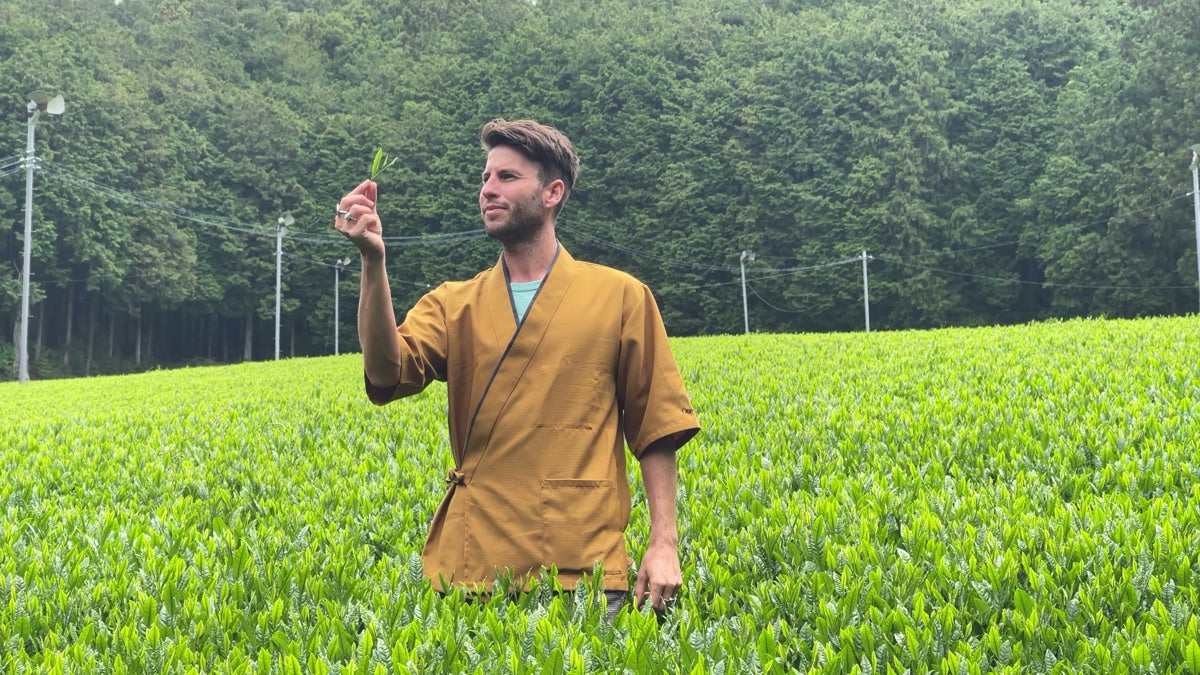
By Christian Mauerer, Founder of One with Tea · Published August 24, 2026
Tencha (碾茶) is shade-grown Japanese tea leaf that has been steamed and dried flat, never rolled, then stripped of its stems and veins. It is the only raw material matcha is legally made from. Japan's Green Tea Labeling Standards define matcha as tencha ground to a fine powder on a stone mill, which means the two words describe the same leaf at two moments in its life. Tencha is the leaf. Matcha is the leaf after the stone.
What surprised me when I read the actual Japanese standard, rather than the English summaries of it, is that shading is not what separates tencha from the other shaded teas. Gyokuro is shaded longer. The line is rolling, and almost nobody writes that clearly.
This page is about tencha as its own thing: a leaf type, a traded commodity, and a tea you can technically drink. If you want the full production walkthrough from bush to bowl, that lives in our guide to what matcha is made of.
Key Takeaways
- Japan's Green Tea Labeling Standards define tencha as leaf from a covered garden, shaded roughly 2 to 3 weeks, steamed, then dried without rolling in a tencha kiln (tencha-ro, 碾茶炉).
- Gyokuro is shaded about 20 days and kabusecha about 7 days, and both are rolled like sencha. Rolling, not shade duration, is what makes tencha tencha.
- Japan produced 5,336 tonnes of tencha in fiscal 2024, roughly 2.7 times its fiscal 2014 volume, at an average 3,278 yen per kilo (MAFF).
- Tencha is bought, priced and auctioned as its own commodity before any of it is milled, so the matcha price is really the tencha price with a grinding cost on top.
- Not all tencha is destined for a tea bowl. Japan's standard carves out a separate category of food-processing tencha.

What is tencha, exactly?
Tencha is defined in writing, not by convention. The Japan Tea Central Public Interest Incorporated Association publishes the Green Tea Labeling Standards (緑茶の表示基準), and its naming annex describes tencha as leaf picked from a covered garden (覆下茶園) that has been shaded for about two to three weeks before harvest using shelf structures hung with reed screens (yoshizu), straw mats (komo) or shade cloth (kanreisha), then steamed and dried without rolling in a tencha kiln or equivalent (Japan Tea Central Public Interest Incorporated Association, Green Tea Labeling Standards naming annex, retrieved 2026-08-24).
The same document defines matcha in one line: tencha, made into a fine powder with a chausu (茶臼) or equivalent. A chausu is the granite tea mill. That is the entire legal definition. Nothing is added, nothing is blended in, and no other leaf qualifies.
The word itself carries the intent. The character 碾 means to grind with a mill, so tencha reads as tea for grinding. Japan named this leaf after what would be done to it.
The kiln deserves a mention because the standard specifies it too. A tencha-ro is a tunnel dryer: steamed leaf is spread flat on conveyors that run through a heated chamber, warmed by radiant heat, conducted heat and hot air, with typically three to five conveyor tiers stacked inside. It exists for one purpose, which is drying leaf without touching it.
Tencha, gyokuro and kabusecha: what actually separates the three shaded teas?

Rolling separates them, not shade. This is the part most English explanations get backwards, and Japan's own standard settles it in three short entries.
| Tea | Shading before harvest | Rolled? | Finished as |
|---|---|---|---|
| Kabusecha | About 7 days | Yes, processed like sencha | Loose leaf to steep |
| Gyokuro | About 20 days, near-total darkness | Yes, processed like sencha | Loose leaf to steep |
| Tencha | About 2 to 3 weeks | No, dried flat in a tencha kiln | Ground into matcha |
Read the shading column again. Gyokuro sits at about 20 days under near-total darkness, which is at or past the top of tencha's two to three week window. So the common claim that tencha is the most heavily shaded Japanese tea does not hold up against the standard that defines them.
What holds up is the rolling. Gyokuro and kabusecha both go through jūnen, the kneading and rolling that twists leaf into needles and breaks down cell walls so flavour releases into hot water. Tencha skips it entirely. The leaf comes out of the kiln flat, open and brittle, which is the only state that shatters cleanly under granite.
If you drink the rolled cousins, our guides to gyokuro and kabusecha go deeper on each, and the matcha lexicon keeps the short definitions in one place.
Why is tencha never rolled?

Because rolled leaf cannot be milled into a smooth powder. Rolling compresses and twists the leaf into a dense, springy needle. Feed that into a stone mill and it grinds unevenly, resisting in some places and powdering in others.
Flat, brittle, unrolled leaf behaves the opposite way. It fractures predictably, which is what lets a slow granite mill shave it into particles fine enough to stay suspended in water rather than sinking. The no-rolling rule is not tradition for its own sake. It is a physical requirement of the last step.
Before milling, the stems and the larger veins come out, and only the soft leaf flesh is kept. Veins carry bitterness and a coarser fibre that would grind badly. What is left after de-stemming and de-veining is thin flakes of shaded green leaf, and that is tencha in its finished, sellable form.
Can you actually drink tencha?
Yes, though almost nobody sells it that way. Tencha is not marketed as a steeping tea in Japan, and the standard treats it as raw material rather than a finished drink. But it brews, and the people who know matcha best brew it on purpose.
The Global Japanese Tea Association notes that some producers now steep tencha for drinking, and that a tencha brew is often used in professional evaluation to judge the quality of the matcha it will become (Global Japanese Tea Association, retrieved 2026-08-24). That detail says something worth sitting with. Before the leaf is ground into the thing everyone wants, the trade tastes it as a tea to find out what it is.
Steeped tencha pours a pale greenish yellow and drinks soft, gently sweet, with a clean herbal aroma. Because the leaf was never rolled, the cell walls stay intact and flavour comes out slowly, so the cup is lighter than gyokuro made from comparable leaf. The flat flakes also float rather than sink (Shizuoka Tea merchant guide to tencha, retrieved 2026-08-24).
I find something quietly moving about it. Tencha is the only Japanese tea grown with the specific intention of being destroyed, ground out of its own shape into something else. Tasting it as leaf is a small act of paying attention to a thing on its way to becoming something else.
How much tencha does Japan make, and what does it cost?

Japan produced 5,336 tonnes of tencha in fiscal 2024, roughly 2.7 times its fiscal 2014 volume, according to the Ministry of Agriculture, Forestry and Fisheries in its March 2026 Ocha wo Meguru Jōsei report. Average tencha traded at 3,278 yen per kilogram, with first-flush tencha at 3,891 yen per kilogram (MAFF, via published MAFF summary, retrieved 2026-08-24).
Those are wholesale prices for a raw material, before milling, packing, export or anyone's margin. They are also the number that actually moves your tin price.
The geography has shifted underneath all of this. In the same reporting, fiscal 2025 aracha production ran to about 30,000 tonnes in Kagoshima against 24,100 tonnes in Shizuoka, out of roughly 75,100 tonnes nationally. Kagoshima ahead of Shizuoka is a reordering of Japan's tea map, and the pull of shaded leaf is a large part of why.
First-flush tencha prices rose about 30 percent in Kagoshima and about 20 percent in Shizuoka in the 2025 crop. If you want the auction-room version of that story, we covered the 2026 Kyoto tencha opening auction the week it happened, and the seasonal picture in what tencha season means for buyers.
We publish the underlying cost data: the customs record behind matcha pricing.
The regional picture is here: our map of Japanese tea production by prefecture.
Not all tencha becomes ceremonial matcha

Japan's standard quietly carves out a second category. Autumn tencha (秋碾茶) and moga-cha, dried unrolled in the same kilns, are understood as food-processing tencha (食品加工用碾茶) and are supplied specifically as raw material for food manufacturing rather than for a tea bowl.
This is the honest answer to why some green powder tastes like a latte flavouring and some tastes like tea. Both can trace back to leaf that met the tencha definition. They did not come from the same harvest, the same season, or the same intent.
Cultivar matters here too, because the plants bred for shade and sweetness are not the same ones bred for volume. Our guide to Japanese tea cultivars covers which plants end up under the shelves.
Why tencha, not matcha, is the real bottleneck

Nobody is short of stone mills. They are short of shaded leaf. Milling capacity can be added in months. Tencha cannot, because it starts with a field that has to be built for shade, planted with the right cultivar, and then grown.
A tencha garden needs overhead shelf structures, covering materials and the labour to manage them across a narrow window each spring. A grower converting a sencha field to tencha is committing capital and years before the first sellable crop, and giving up the sencha income in the meantime. That lag is the shortage. Demand moved faster than fields could be rebuilt.

From our tea room
Superior Sencha Green Tea - USDA Organic Japanese First Flush
First-flush loose leaf, USDA Organic, direct from Japanese family farms.
View Superior SenchaIt is also why the tencha price and the matcha price move together with barely any gap. When first-flush tencha prints 20 or 30 percent higher, every tin downstream inherits it. We wrote about that pass-through in why matcha prices are rising in 2026 and from the sourcing side in the 2026 matcha shortage explained.
I have stood in these fields during first flush, watched the pickers work the shaded rows, and walked the floor where the flakes go into the mill. The thing that stays with me is how narrow the window is. A few weeks a year decide the whole year's supply.
Buying matcha means buying tencha
When you choose a tin, you are choosing a leaf, a harvest and a covering method you will never see. That is the whole reason we film the farms and publish the lab results instead of asking you to trust a label.
If you drink it at home, our organic Japanese matcha is first-flush tencha, stone-milled, with third-party testing published. If you are pouring it for other people, our wholesale programme works on the same sourcing and the same paperwork.
Frequently asked questions
Is tencha the same as matcha?
No, but they are the same leaf at different stages. Tencha is the shade-grown, unrolled, de-veined leaf. Matcha is that leaf ground on a stone mill into fine powder. Japan's Green Tea Labeling Standards define matcha as tencha powdered with a chausu, so no tencha means no matcha.
Can you drink tencha as a loose leaf tea?
Yes. It is rarely sold that way, but it steeps into a pale greenish yellow cup that is soft, faintly sweet and herbal. Professionals brew tencha specifically to judge the quality of the matcha it will become. Because the leaf is never rolled, flavour releases slowly and the flakes tend to float.
How long is tencha shaded before harvest?
About two to three weeks, per Japan's Green Tea Labeling Standards, using shelf structures hung with reed screens, straw mats or shade cloth. Gyokuro is shaded around 20 days and kabusecha around 7 days, so shade duration alone does not distinguish tencha. Not rolling the leaf does.
Why is tencha not rolled?
Rolled leaf mills unevenly. Tencha is dried flat in a tencha kiln so it stays open and brittle, which lets a granite mill fracture it into particles fine enough to stay suspended in water instead of settling.
How much tencha does Japan produce?
5,336 tonnes in fiscal 2024, roughly 2.7 times the fiscal 2014 figure, according to MAFF's March 2026 Ocha wo Meguru Jōsei report. Average tencha traded at 3,278 yen per kilogram and first-flush tencha at 3,891 yen per kilogram.
What is a tencha kiln?
A tencha-ro (碾茶炉) is a tunnel dryer named in Japan's labeling standard. Steamed leaf is spread flat on conveyors that pass through a heated chamber using radiant heat, conducted heat and hot air, usually across three to five stacked conveyor tiers. It dries the leaf without touching or rolling it.
Sources
- Japan Tea Central Public Interest Incorporated Association, Green Tea Labeling Standards (緑茶の表示基準) and naming annex. Naming annex PDF · Standards PDF. Retrieved 2026-08-24.
- Ministry of Agriculture, Forestry and Fisheries (MAFF), Ocha wo Meguru Jōsei, March 2026. MAFF tea statistics, figures via published MAFF summary. Retrieved 2026-08-24.
- Global Japanese Tea Association, Tencha (碾茶). Retrieved 2026-08-24.
- Japan Matcha Association, What is Matcha. Retrieved 2026-08-24.
- Shizuoka Tea, Everything You Need to Know about Tencha (碾茶). Retrieved 2026-08-24.
Share:
What Is Kabusecha? The Shade Tea Between Sencha and Gyokuro
The History of Matcha: From Tang China to Uji