



By Christian Mauerer, Founder, One with Tea
Matcha began as Chinese powdered tea and became Japanese in Uji. The short version: Tang dynasty China compressed tea into bricks, Song dynasty China whisked it into powder, the Zen monk Myoan Eisai carried seeds and the whisking method home in 1191, and roughly three hundred years later farmers in Uji invented a shading technique that turned ordinary green tea into tencha, the leaf that becomes matcha. Everything in your bowl today traces to that sequence.
Most matcha history you will read online collapses eight centuries into one paragraph about monks. I wanted the actual dates and the actual names, because I source this tea for a living and the people who grow it still talk about these events as if they happened to their own families. So here is the timeline, with each step traced to Japan's own records.
Key Takeaways
- The earliest reliable record of tea drinking in Japan is 815, when a Buddhist abbot served tea to Emperor Saga, nearly 400 years before matcha as we know it existed.
- Zen master Eisai (1141 to 1215) brought tea seeds back from China in 1191 and gave some to the monk Myoe Shonin, who planted them at Kozanji Temple in Toganoo and distributed seeds onward to Uji.
- Matcha did not exist until Uji farmers developed oishita shade cultivation around the end of the 1400s. Shading created tencha, and tencha is what a stone mill turns into matcha.
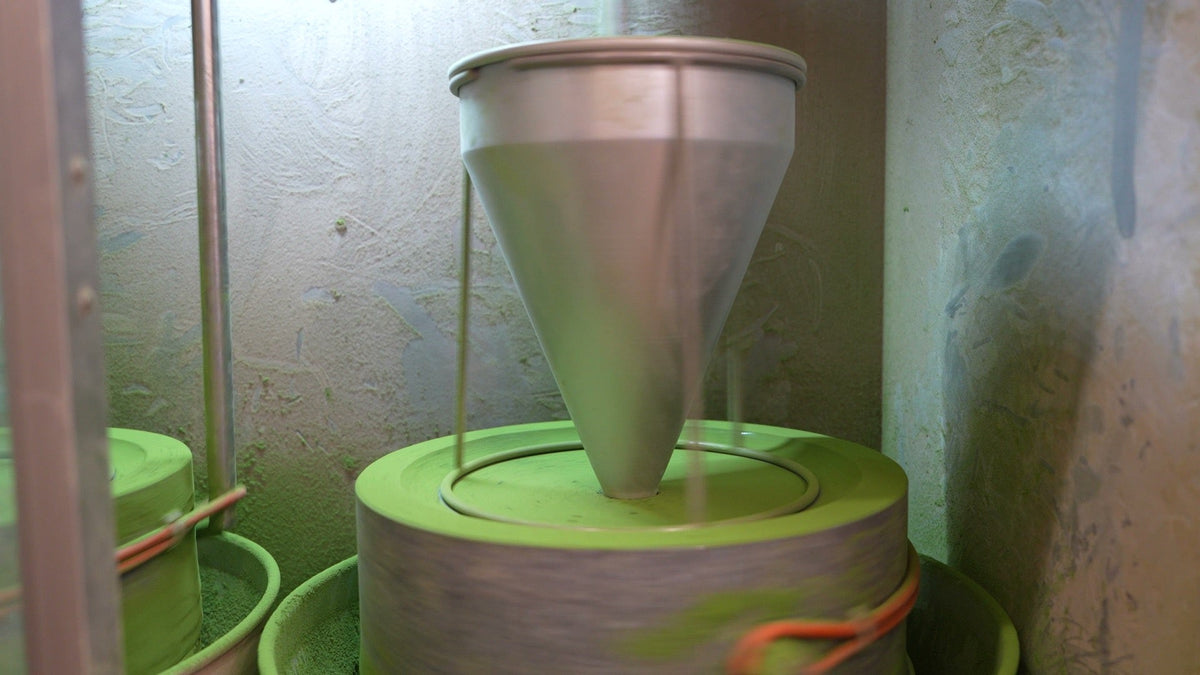
- A traditional matcha mill is about 30 cm across and grinds roughly 40 grams per hour. The slowness is the point, not a limitation.

Matcha history at a glance
| Date | Event | Why it matters |
|---|---|---|
| Tang dynasty | Tea compressed into bricks, ground and boiled | The first powdered-tea practice |
| Song dynasty | Powdered tea whisked in the bowl | Direct ancestor of matcha preparation |
| 815 | A Buddhist abbot serves tea to Emperor Saga | Earliest reliable record of tea in Japan |
| 1191 | Eisai returns from Song China with tea seeds | The arrival that held |
| 1211 | Eisai writes the Kissa Yojoki | Japan's first treatise on tea |
| 1330s to 1400s | Ashikaga Yoshimitsu develops the Uji Shichimeien | Uji overtakes Toganoo as honcha |
| End of the 1400s | Oishita shade cultivation developed in Uji | Creates tencha, and therefore matcha |
| 1522 to 1591 | Sen no Rikyu perfects the tea ceremony | Establishes wabicha, tea of the plain and quiet |
| 1738 | Nagatani Soen invents the Uji processing method | Good green tea reaches ordinary people |
Where did matcha originate?
Matcha originated in China as a preparation method and became a distinct product in Japan. The two halves of that sentence matter equally, and most accounts drop one of them.
During the Tang dynasty, tea was steamed, compressed into bricks, then ground and boiled. The Song dynasty refined this into something much closer to what we would recognize: powdered tea whisked into hot water in the bowl, drunk whole rather than steeped and strained. That whisking practice is the direct ancestor of matcha preparation (History of Tea in Japan, retrieved 2026-08-25).
We keep the full record: our sourced chronology of tea, 486 dated entries.
What China did not develop, and what Japan later did, was the agricultural step that gives matcha its color and its sweetness. The method travelled first. The leaf came centuries after.
If you are asking the related question of which countries grow matcha now rather than where the practice began, we mapped current production separately in our global production map.
How did tea first reach Japan?
Tea reached Japan at least twice, and only the second arrival stuck.
The earliest reliable reference is 815, when a Buddhist abbot served tea to Emperor Saga. Monks returning from Tang China had brought tea knowledge home around 804. But this first wave stayed confined to the court and a handful of temples, and it faded.
The arrival that held was Eisai's. Myoan Eisai (明菴栄西, 1141 to 1215), the Zen master who founded the Rinzai school in Japan, made his second journey to Song China and returned in 1191 carrying tea seeds, which he planted on Hirado and in the mountains of Kyushu. He brought back more than seeds. He brought the Song method of whisking powdered tea, which is the practice that eventually became matcha.
In 1211 he wrote the Kissa Yojoki (喫茶養生記), Japan's first treatise on tea, in two volumes. The upper volume discusses tea's effect on the five vital organs in the framework of Chinese medicine of the period. The lower volume covers cultivation and leaf processing. It is worth being precise about what that book is: a 13th century Zen monk's argument, in the medical vocabulary of his own era, for why tea was worth drinking. I cite it as history, not as a claim about what tea does for anyone today.
How did Uji become the home of matcha?
Uji became the center of Japanese tea because a monk planted Eisai's seeds nearby and a shogun decided the region should win.
Eisai gifted some of his seeds to Myoe Shonin (1173 to 1232), a high-ranking monk of Kozanji Temple in Toganoo, north of Kyoto. Myoe planted them in the temple grounds, made a tea garden, and distributed the harvested seeds onward to Uji and other parts of Japan (Kyoto Prefecture, History and Culture of Uji Green Tea, retrieved 2026-08-25).
We track the production side: which Japanese prefectures actually grow the tea.
For a while, Toganoo held the crown. Tea grown there was called honcha, literally "real tea", and everything grown anywhere else was hicha, meaning tea that was not the real thing. That is a remarkable piece of naming. An entire region's output was defined by not being Toganoo.
Then Ashikaga Yoshimitsu (1358 to 1408), third shogun of the Muromachi shogunate, put his weight behind Uji. He encouraged cultivation there and developed a set of special gardens that became known as the Uji Shichimeien, the seven excellent tea gardens of Uji. A poem later listed them by name: Mori, Iwai, Umonji, Kawashimo, Okunoyama, Asahi and Biwa. Of those seven, only Okunoyama-en still exists today.
Uji's growers were good enough that the hierarchy inverted. Uji tea came to exceed Toganoo tea in both taste and volume, and the word honcha transferred to Uji. The "real tea" title moved because the farming got better. If you want to see what that region looks like now, I walked it and wrote it up in Inside Uji.
The invention that actually created matcha

Matcha as a distinct product begins with shade, not with grinding.
Somewhere around the end of the 1400s, Uji farmers began covering their tea fields before harvest. The method is called oishita, literally "under cover". Fields were shaded from direct sunlight with reeds and straw during the early summer, when the new sprouts appear. Kyoto Prefecture's own account describes the effect plainly: the covering lets the sprouts grow into soft young leaves and protects them from frost damage, and it gives the leaves a distinctive aroma. The Ministry of Agriculture, Forestry and Fisheries adds that oishita was developed as a way of reducing bitterness (MAFF, Uji Tea, retrieved 2026-08-25).
Shaded leaves, steamed and dried without being kneaded, are tencha. Tencha is the raw material for matcha and nothing else. Modern practice covers the plants for about four weeks before harvest (Global Japanese Tea Association, Tencha, retrieved 2026-08-25).
This is the part I find genuinely moving. Nobody set out to invent matcha. They set out to make tea taste less bitter, and in solving that they created a leaf so different that it needed its own name, its own processing, and eventually its own ritual. Gyokuro came out of the same covered gardens, reportedly by accident during the handling of leaves from an oishita chaen.
The same shading logic still governs how we buy. Days under cover is one of the few things about a matcha you can actually ask a producer to state.
Sen no Rikyu and the century that gave matcha its meaning

Matcha became culturally central during the Azuchi-Momoyama period, and one man is largely responsible.
Sen no Rikyu (1522 to 1591) served as tea master to the rulers of his day and perfected the art of the tea ceremony. He is said to have travelled to Uji regularly to taste newly picked tea and hold gatherings there, which pushed the Uji industry further still. After his death the tradition of wabicha, the plain and quiet style of tea, carried on, and Uji green tea settled into its position as the nation's best.
What Rikyu did was decide that the point was not luxury. Wabicha is a deliberate turn toward the simple and the unadorned, and it is why a matcha bowl is a rough ceramic object rather than a gilded cup. The ritual itself, the four principles and the utensils, is a subject of its own and I covered it in our guide to chanoyu.
By the Edo period Uji growers held the exclusive right to produce tea presented to the Imperial Palace and the Tokugawa shogunate. Then in 1738 Nagatani Soen, from what is now Ujitawara Town, invented the Uji processing method that became the national standard for green tea and put good tea within reach of ordinary people rather than only the court.
From the stone mill to your kitchen counter

The grinding step is the last piece, and it is deliberately slow.
A traditional matcha mill is around 30 cm in diameter and grinds about 40 grams of tea per hour. That rate is not a failure of engineering. The speed has to stay constant and low or the tea is spoiled, and at that pace the stone warms to roughly 50°C, just enough heat to finish the flavour (Global Japanese Tea Association, Matcha, retrieved 2026-08-25).
Forty grams an hour. A single 30 g tin of good ceremonial matcha represents roughly forty-five minutes of one stone wheel turning. When people ask me why real matcha costs what it does, I usually just give them that number and let it sit.
Matcha only began wider commercial distribution from Uji in the 20th century, and the global moment it is having now is very recent by the standards of this story. Eight hundred and thirty-odd years of quiet regional craft, then a decade of worldwide demand. The strain that creates is real, and I have written about how Japan's growing regions differ and about why Japan still defines ceremonial grade elsewhere.
Why this history matters when you buy

Knowing the sequence changes what questions you ask.
Once you know matcha exists because of shading, "how many days under cover?" stops being a nerdy question and becomes the central one. Once you know a stone mill does 40 grams an hour, a suspiciously cheap tin explains itself. Once you know that the word honcha moved from Toganoo to Uji because Uji's farmers simply got better, you stop treating a place name on a label as a guarantee and start treating it as a claim to verify.
I have sat in tea rooms in Japan with growers whose families have worked the same fields for generations, and none of them talked about this history as heritage marketing. They talked about it as the reason they do a specific thing a specific way in May. That is the thread I try to keep hold of. The terminology on a tin is downstream of eight centuries of people solving practical problems in a valley in Kyoto.
If you want the vocabulary that goes with all of this, the meaning of the word matcha and the honest version of what ceremonial grade actually means are the two I would read next.
Drink the history. Our organic ceremonial matcha comes from the same shaded-leaf tradition this article describes. Shop our matcha, or if you are a café, retailer or studio looking to serve it, talk to us about wholesale.

From our tea room
Organic Ceremonial Matcha Powder - USDA Certified (30g)
Stone-milled ceremonial grade, USDA Organic, third-party lab tested.
View Ceremonial MatchaFrequently asked questions
Who invented matcha?
No single person invented matcha. The whisked powdered-tea method came from Song dynasty China and was brought to Japan by the Zen master Eisai in 1191. The leaf itself, tencha, was created by Uji farmers who developed oishita shade cultivation around the end of the 1400s. Matcha is the result of a Chinese method meeting a Japanese agricultural invention roughly three centuries apart.
How old is matcha?
Powdered tea reached Japan at the end of the 12th century, so the preparation is roughly 830 years old there. Matcha in its recognisable form, made from shaded tencha, dates to around the end of the 1400s, making it approximately 500 years old.
Where did matcha originate, China or Japan?
Both, at different stages. The practice of whisking powdered tea originated in China. The shaded leaf that makes matcha what it is originated in Uji, Japan. Calling matcha simply Chinese or simply Japanese misses half the story.
Who was Eisai?
Myoan Eisai (1141 to 1215) was the Zen master who founded the Rinzai school in Japan. He returned from Song China in 1191 with tea seeds and the powdered tea method, and in 1211 wrote the Kissa Yojoki, Japan's first treatise on tea.
What were the Uji Seven Gardens?
The Uji Shichimeien were seven tea gardens developed under Ashikaga Yoshimitsu (1358 to 1408), the third Muromachi shogun. A poem records their names as Mori, Iwai, Umonji, Kawashimo, Okunoyama, Asahi and Biwa. Only Okunoyama-en survives today.
Why is matcha ground on a stone mill instead of a machine?
Speed generates heat, and heat damages the powder. A granite mill turning slowly produces roughly 40 grams an hour and warms to about 50°C, which is enough to finish the flavour without spoiling it. Faster industrial grinding is possible and is used for lower grades, but it changes the result.
Sources
- Kyoto Prefecture, History and Culture of Uji Green Tea (retrieved 2026-08-25)
- Ministry of Agriculture, Forestry and Fisheries of Japan, Uji Tea, Traditional Foods in Japan (retrieved 2026-08-25)
- Global Japanese Tea Association, Matcha (抹茶) (retrieved 2026-08-25)
- Global Japanese Tea Association, Tencha (碾茶) (retrieved 2026-08-25)
- History of Tea in Japan (retrieved 2026-08-25)
- Uji Tea (retrieved 2026-08-25)
Share:
What Is Tencha? The Leaf Japan Grows to Be Ground
Matcha vs Sencha: What Actually Separates Them (2026)