



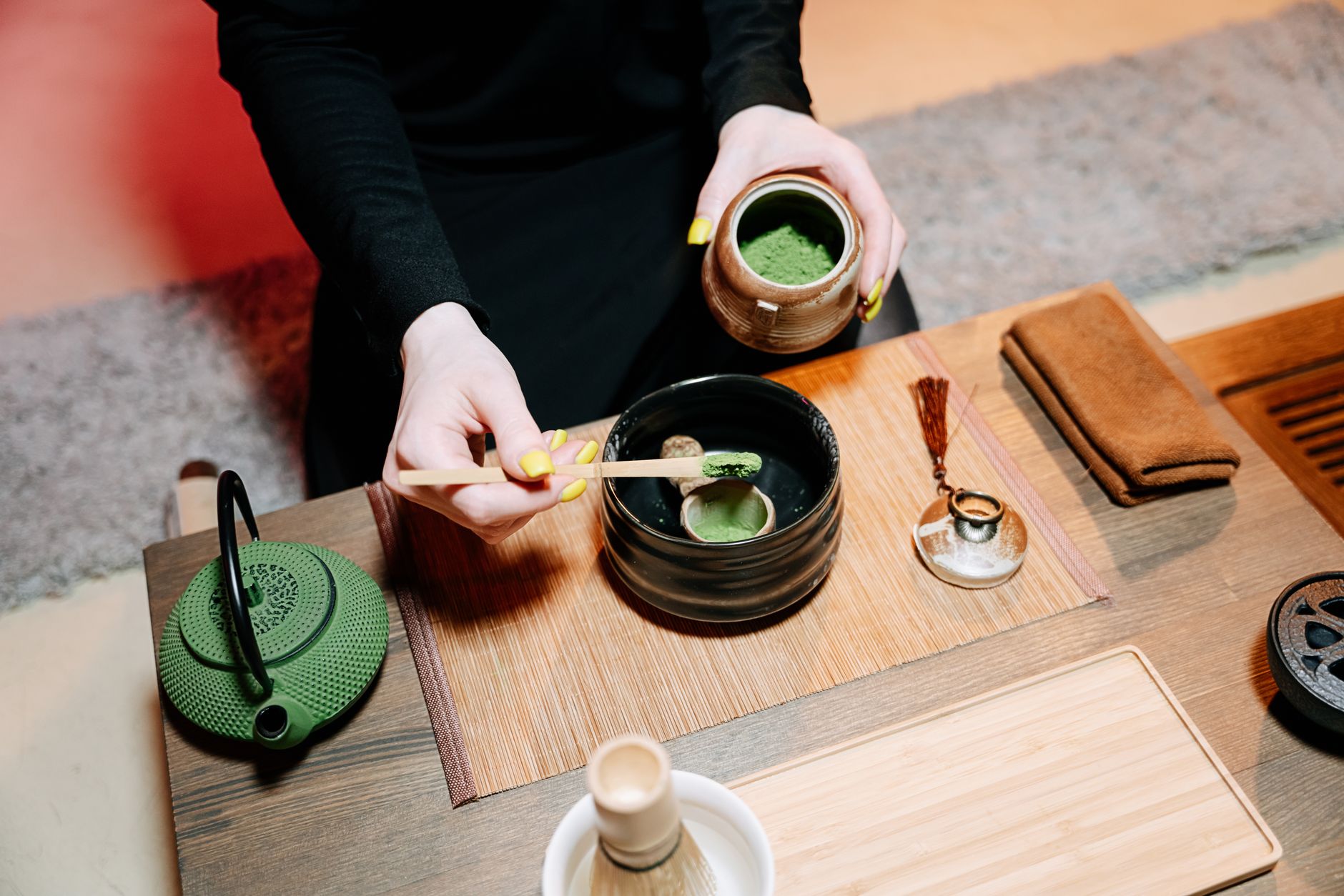
Matcha (抹茶) literally means "ground tea." The word joins two characters: 抹 (matsu), meaning to grind, rub, or crush, and 茶 (cha), meaning tea. So the name is not poetic invention. It describes exactly what matcha is, a green tea whose shade-grown leaves are stone-milled into a fine powder rather than steeped and strained. That powder comes from the same plant as all true tea, Camellia sinensis.
Most pages tell you what matcha is. This one looks at what the word carries: its roots in language, its arrival in Japan, and the quiet philosophy folded into a single cup.
What does matcha mean, character by character
Read the two characters slowly and the meaning opens on its own. 抹 is a verb of the hand. It means to rub, to smear, to grind something down until it turns to powder. 茶 is simply tea, the character shared across the tea-drinking cultures of East Asia. Set side by side, 抹茶 becomes "rubbed tea" or "ground tea," a plain description of method rather than marketing.
That grinding is the whole difference. With most green tea, you pour hot water over leaves, let them release their color, then lift the leaves away. With matcha, nothing is removed. The leaf itself dissolves into the water as powder, so you drink the whole thing. The word remembers this. It names the act of grinding because the grinding is what makes matcha matcha.
It helps to notice that 抹 is not a gentle word. The same character appears in ordinary verbs for wiping, smearing, and applying by hand. There is friction in it, the sense of pressing something against a surface until it changes form. When the character was chosen for tea, it kept that physical weight. The name asks you to picture the stone mill turning slowly, hour after hour, reducing a leaf to something as fine as talc.
The roots of the word
The name traveled before it settled. The technique of whisking powdered tea began in China during the Song dynasty, where the drink was known by characters read as mo cha, again "powdered tea." Japanese monk Myoan Eisai encountered this Song style of preparation at Buddhist temples and brought the method home in the late 1180s. He later set his notes on tea into a treatise in the early 1200s.
So the word and the practice arrived together, carried by monks who drank powdered tea to stay awake and clear through long hours of meditation. In China the whisked-tea fashion eventually faded. In Japan it deepened, folded into temple life and, centuries later, into the formal tea gathering. The language stayed faithful to the origin. Even now, 抹茶 points back to that first act of grinding a leaf to dust.
There is a small lesson in that survival. A word can outlast the culture that coined it and find a truer home elsewhere. Matcha did exactly this. What began as a Song-dynasty fashion became, in Japan, a discipline passed hand to hand across eight centuries. The characters never changed to flatter the new setting. They stayed plain, and their plainness is part of why the tradition feels grounded rather than ornamental.
Matcha meaning versus the poetry people expect
People often hope matcha means something lyrical, like "essence of green" or "spirit of the leaf." The truth is quieter and, in a way, more beautiful. The word is honest labor. It describes a hand, a stone, and a leaf turned to powder. The meaning lives in the making.
| Element | Character | Meaning |
|---|---|---|
| First character | 抹 (matsu) | To grind, rub, or crush |
| Second character | 茶 (cha) | Tea |
| Together | 抹茶 (matcha) | Ground tea, rubbed tea |
This is why matcha feels different to drink. You are not tasting an extract of the leaf. You are taking in the leaf entire, its color, its texture, its full weight of flavor. The name told you that all along.
The quiet philosophy behind the cup
Because matcha came to Japan through temple gates, it never lost its link to attention. Grinding leaf into powder is slow. Whisking that powder into water asks for a steady hand and a settled mind. The drink resists rushing. In this sense the word carries a small teaching: presence is made, not found, and it is made by doing one simple thing with care.
The tea gathering built a whole aesthetic around this idea. Its guiding spirit is often summed up in four qualities, harmony, respect, purity, and tranquility. None of them are grand. They are the ordinary virtues of paying attention. When you whisk a bowl of matcha, you are practicing them whether you name them or not.
At One with Tea we hold to that lineage. The tea is a doorway, not a task. Grind, whisk, breathe, drink. The ritual is short, and the word at its center still means exactly what the old monks meant: tea, ground by hand, taken whole.
How to hold the meaning while you make a bowl
You do not need a ceremony to feel what the word points to. A few unhurried minutes are enough.
- Warm the bowl. Pour a little hot water into your bowl, swirl it, and pour it out. A warm bowl keeps the tea even and gives you a moment to slow down.
- Sift the powder. Add roughly one to two grams of matcha through a small sieve into the bowl. Sifting breaks up clumps so the powder dissolves smoothly.
- Add water off the boil. Pour about 60 to 70 millilitres of hot water, cooled slightly from boiling, over the powder. Water that is too hot turns the taste sharp.
- Whisk with intention. Move a bamboo whisk briskly in a light W or M motion until a fine foam rises. This is the moment the word describes, leaf and water becoming one.
- Drink slowly. Lift the bowl with both hands and drink in a few unhurried sips. Notice the color, the warmth, the settling of your own attention.
Frequently asked questions
What does matcha literally mean?
Matcha (抹茶) literally means "ground tea." It combines 抹, meaning to grind or rub, with 茶, meaning tea. The name describes how the leaf is stone-milled into powder rather than steeped.
What does the word matcha come from?
The word comes from the Chinese characters read as mo cha, "powdered tea," used during the Song dynasty. The whisked-tea method reached Japan through Buddhist monks in the late 1180s, and the name traveled with it.
Is matcha a Japanese or Chinese word?
The characters 抹茶 originate in China, where powdered whisked tea began. The reading "matcha" is Japanese. The practice faded in China but deepened in Japan, which is why the word is most associated with Japanese tea today.
Why is matcha ground into powder instead of steeped?
Grinding lets you drink the whole leaf rather than an infusion of it. The powder dissolves into the water, so the color, texture, and full flavor stay in the cup. The word 抹 records this grinding directly.
What plant is matcha made from?
Matcha is made from Camellia sinensis, the same plant as all true tea. For matcha the leaves are shade-grown before harvest, then steamed, dried, and stone-milled into fine powder.
Does the meaning of matcha relate to how it is used in tea ceremony?
Yes. Because the name centers on grinding and whisking by hand, it reflects the slow, attentive preparation at the heart of the Japanese tea gathering, where care and presence matter as much as the drink.
A word worth keeping close
The next time you lift a bowl of matcha, remember that its name is a small instruction. Ground tea. Rubbed tea. Leaf turned to powder by a patient hand and taken whole into the body. Learn more in our guide to what matcha is, see the slow steps in how to make matcha, or explore our organic Japanese matcha and find the bowl that becomes your own quiet ritual.
Sources
- Wiktionary, "抹茶" (Japanese etymology), accessed 2026-08-05. https://en.wiktionary.org/wiki/%E6%8A%B9%E8%8C%B6
- Wikipedia, "Matcha," accessed 2026-08-05. https://en.wikipedia.org/wiki/Matcha
Share:
Why matcha energy feels steady, not spiky
Is Matcha Bad for You? An Honest, Lab-Data Answer