



By Christian Mauerer, Founder of One with Tea · Published August 26, 2026

From our tea room
Superior Sencha Green Tea - USDA Organic Japanese First Flush
First-flush loose leaf, USDA Organic, direct from Japanese family farms.
View Superior SenchaMatcha and sencha are both made from Camellia sinensis, the same tea plant, and split at one decision: shade. Sencha grows in open sun, gets steamed and rolled into needles, and you steep it and discard the leaf. Matcha grows under cover for at least twenty days, gets steamed and dried flat without rolling into a leaf called tencha, then stone-milled into powder you drink whole. Everything else, the colour, the sweetness, the caffeine, the price, follows from those two choices.
I buy both teas from the same farms in Shizuoka, Fukuoka and Kagoshima, usually on the same visit. What follows is what I have watched happen in the field and on the factory floor, checked against the numbers the Japanese Ministry of Agriculture and the research literature actually publish.
The regional picture is here: which Japanese prefectures actually grow the tea.
Key Takeaways
- The split is shade. Sencha is sun-grown; matcha's leaf is covered for at least 20 days, commonly around four weeks (Global Japanese Tea Association).
- Matcha is not powdered sencha. It is milled from tencha, a leaf dried without rolling, ground to 1 to 20 micrometres (MAFF Japan).
- Caffeine: about 64 mg in a 2 g bowl of matcha against about 20 mg in a typical cup of sencha, which ITO EN measures at 20 mg per 100 mL (ITO EN).
- Shading raises theanine and caffeine and lowers catechins. Per gram of leaf, shaded tea holds fewer catechins, not more (Chen et al., 2022).
- Neither tea is the upgrade. Sencha is built for repetition, matcha is built for attention.

What is the difference between matcha and sencha?
Sencha is a loose leaf you steep. Matcha is a powder you whisk and swallow whole. That is how the matcha vs sencha question usually gets settled, and it is the smaller half of the story. The larger half is that they are not the same leaf processed two ways. They are two different leaves, grown under different light, from the moment a farmer decides which rows to cover.
Sencha is Japan's default cup. It accounts for just over half of the country's tea production (Global Japanese Tea Association), which is why "green tea" in a Japanese home almost always means sencha. Matcha sits at the other end of the scale, roughly six percent of national output (GJTA, January 2025).
| Attribute | Matcha | Sencha |
|---|---|---|
| Cultivation | Shaded at least 20 days, often about 4 weeks | Open sun, uncovered |
| Form | Fine powder, 1 to 20 micrometres | Rolled leaf, needle-shaped |
| Processing | Steamed, dried flat without rolling, de-veined and de-stemmed into tencha, stone-milled | Steamed, then rolled and dried |
| Preparation | Whisked into suspension, leaf consumed | Steeped, leaf strained out |
| Taste | Thick, umami-rich, sweet, low bitterness | Bright, grassy, brisk, clean finish |
| Caffeine | About 64 mg per 2 g bowl | About 20 mg per typical cup |
| Price feel | Premium, shading and milling are slow | Accessible, forgiving to buy |
| Best use | A deliberate bowl, once or twice a day | All day, repeat brewing |
| Plant | Camellia sinensis | Camellia sinensis |
| In the cup | Opaque, frothy, suspended leaf | Clear, light green to pale yellow infusion |
| L-theanine | Higher, shading protects it from light | Lower, full sun converts it toward catechin |
| Keeping | Oxidises quickly once opened, use within weeks, keep cold and sealed | Keeps far better, an opened bag stays good for months |
For the wider category view, including bancha, hojicha and genmaicha, our matcha vs green tea comparison takes the whole family. This page stays on the two teas above.
How are matcha and sencha grown differently?

Roughly three to four weeks before harvest, the rows destined for matcha get covered. Reed screens, straw, or modern black netting, depending on the farm and the tradition. Tencha, the leaf that becomes matcha, is shaded for at least twenty days and often about four weeks (GJTA). Gyokuro, the other shaded tea, is the one commonly given as three weeks, which is where a lot of the confused numbers online come from. Sencha rows stay open the whole season.
The plant reacts. In a twenty-day shading trial published in the International Journal of Molecular Sciences, theanine rose with shade intensity, chlorophyll b reached 1.4 times the unshaded control, and the catechins EC, ECG, EGC and EGCG all fell (Chen et al., 2022). The mechanism is simple enough to hold in your head: theanine breaks down in light and converts toward catechin, so keeping light off the leaf keeps theanine high and bitterness low (ITO EN).
Here is the part most comparisons get backwards. Shading also raises caffeine. Chen's trial measured it, and MAFF says the same thing about gyokuro, that covered tea carries a lot of caffeine precisely because it was covered. Shade is not a gentleness setting. It is a trade: more theanine, more caffeine, less catechin. If you want the amino acid side of this in depth, we wrote about what L-theanine actually is.
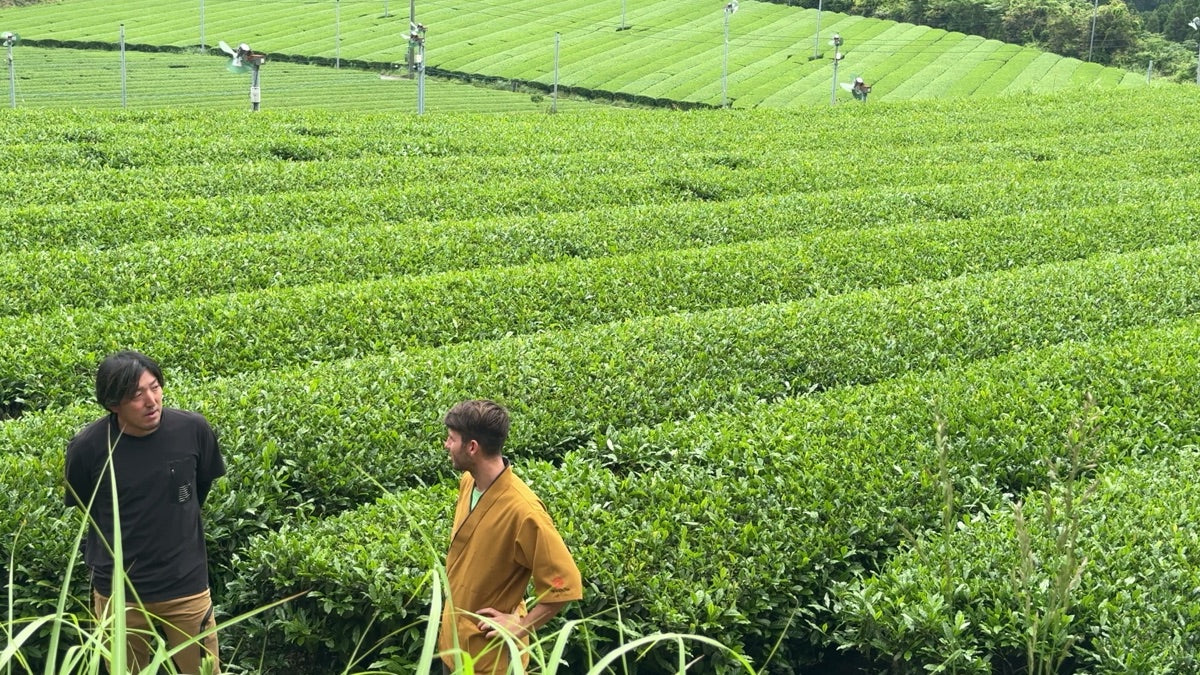
Standing in an uncovered field in May, you can see the difference without instruments. Sun-grown shoots are a harder, brighter green. Shaded shoots go soft and almost blue-black, and the leaf feels thinner between your fingers.
How does processing split one leaf into two teas?

The split is rolling. Sencha is rolled into needles; the leaf that becomes matcha is never rolled at all. Before that, both teas share one step: they are steamed within hours of picking to stop oxidation, which is why both stay green rather than turning into oolong or black tea. Immediately after the steamer, the paths separate and never rejoin.
Sencha gets rolled. Machines knead and shape the steamed leaf through several stages until it dries into the thin dark needles you recognise (ITO EN). Rolling bruises the cell walls, which is what lets a sixty second steep pull so much flavour out.
Tencha gets no rolling at all. The steamed leaf is dried flat in a dedicated dryer, then the stems and veins are stripped away, leaving only leaf flesh. Only that material goes to the stone mill, which grinds it down to between 1 and 20 micrometres (MAFF Japan). The granite mills I have stood next to turn slowly, and a single one fills a tin over the course of an hour. That pace is most of why matcha costs what it costs.
For the market context behind this, see what Japanese green tea actually costs at origin.
So can you make matcha by grinding sencha? No. You would be starting from the wrong leaf, sun-grown and rolled, with stems and veins still in it. You get a dull, bitter powder. The chemistry shows the gap: Horie and colleagues found tea-ceremony-grade matcha above 1.8 g/100 g theanine and above 250 mg/100 g chlorophyll-a, while powdered green teas mostly came in under 60 mg/100 g chlorophyll-a (Horie et al., 2017). The same paper is honest that industrial-grade matcha and powdered green tea are harder to tell apart, which is worth knowing when you see a cheap tin marketed as culinary matcha. Our explainer on what tencha is follows that leaf all the way to the mill.
How do matcha and sencha taste?
Sencha tastes bright, grassy and brisk; matcha tastes thick, sweet and umami-rich. The difference is structural as much as it is flavour: sencha is an infusion that finishes clean, matcha is a suspension that coats the mouth.
Sencha arrives bright. Grass, citrus peel, a clean astringent edge that resets your palate. It is a tea that finishes and gets out of the way, which is exactly why you can drink it all afternoon.
Matcha does not finish. It coats. Because you are drinking suspended leaf rather than an infusion, the texture is thick and slightly creamy, and the sweetness reads as umami, savoury rather than sugary, and it stays with you for a minute after the bowl is empty.
Two things move sencha's flavour more than most people expect. Shincha, the first flush picked from early April to mid May, is the sweetest and most fragrant sencha of the year. It is worth knowing that shincha is a freshness window rather than a grade, applying for one to two months after production, after which the same tea is simply called sencha again (GJTA). And fukamushi, deep-steamed sencha, is steamed two to three times longer, which breaks the leaf structure down into finer particles, gives a thicker colour, and needs a shorter steep than regular sencha (MAFF).
Brewing sencha properly is where most cups go wrong. MAFF's guidance is 2 to 3 g of leaf per 100 mL, 70°C for high quality sencha and up to 90°C for everyday grades, for 90 seconds, in soft water (MAFF Japan). Boiling water scalds it and pulls tannin. Matcha is never steeped at all: you sift, add water around 80°C, and whisk until it suspends.
Does matcha or sencha have more caffeine?

Matcha, per serving, by a wide margin. A 2 g bowl of matcha whisked into 60 to 80 mL of water carries about 64 mg of caffeine. ITO EN puts a typical cup of sencha at about 20 mg, and measures the concentration at 20 mg per 100 mL, so a large 200 mL mug is arithmetically nearer 40 mg (ITO EN). The 20 mg figure is theirs; the scaling is mine.
Two things drive the gap. You consume the entire leaf in matcha rather than an extract of it, and, as above, the shading itself pushed the caffeine up before the leaf was ever picked.
Both numbers move with what you actually do. Grade, leaf age, water temperature and how much powder you scoop all shift the result, and a peer-reviewed survey put matcha's caffeine anywhere from 18.9 to 44.4 mg per gram across samples (Kochman et al., 2020). Treat any single figure as a centre of gravity, not a guarantee. Our tea caffeine comparison sets every Japanese green tea side by side.
Is matcha healthier than sencha?
The honest answer is that they are compositionally different, and "healthier" is not a question tea measurements can settle. Here is what has actually been measured.
Comparing powdered matcha against bagged sencha at the same leaf-to-water ratio, researchers found matcha at 129.02 mg GAE/100 mL total phenolics against sencha's 66.76, and higher antioxidant capacity in an ABTS assay, 78.98 percent inhibition against 72.43 percent. But in the undigested extract, total flavanols showed no significant difference between the two, 53.6 against 51.19 mg CE/100 mL (Rusak et al., 2021).
And the counterintuitive part: per gram of leaf, shaded tea holds fewer catechins than sun-grown tea. ITO EN puts first-flush sencha around 12 to 14 percent catechins and shade-grown gyokuro nearer 10 percent as polyphenols (ITO EN). Matcha's per-serving advantage comes from the fact that you swallow the leaf, not from the leaf being richer.
These are laboratory measurements of what is in a cup. They are not health outcomes, and I am not going to dress them up as any. If you want the amino acid rather than the antioxidant story, sencha and matcha both carry theanine, and shaded tea carries more of it.
Which one should you drink, and when?
Drink both, at different times of day. I keep both open on my shelf, which is the most useful answer I can give to the matcha vs sencha question.
- Choose sencha if you want a tea for the whole day. It is forgiving, it re-brews two or three times from the same leaves, and it costs little enough that you will actually drink it rather than saving it. It is the better first Japanese tea for almost everyone.
- Choose matcha if you want a single deliberate cup with a ritual attached. Sifting, whisking and drinking a bowl takes three minutes that are genuinely yours. It is also the one to buy if you make lattes.
- Choose both, honestly. Sencha in the morning and through the afternoon, matcha when you want to stop and pay attention to something.
If your curiosity is running toward the shaded side of the family, sencha vs gyokuro is the next comparison to read, and our full sencha guide goes deeper on grades and brewing.
How we source matcha and sencha at One with Tea

We buy both from organic Japanese farms, and where we can, we buy them from the same growers. That is deliberate. A farm that grows careful sencha usually understands its own soil well enough to grow careful tencha, and buying across both means I am not a one-season customer to anyone.
What I look for in the field has not changed in years: how evenly the rows have been plucked, how the new shoots feel between my fingers, and what the farmer says when I ask about a harvest that went badly. Our USDA organic ceremonial matcha is stone-milled from shaded tencha, and our organic Japanese sencha comes off the open rows on those same farms.
Serving either at a cafe, studio or shop? Our wholesale program covers both, with the same sourcing and no minimum-order theatre.
Frequently asked questions
Is sencha better than matcha?
Neither is an upgrade on the other. Sencha is built for repeat drinking through a day, matcha for one deliberate bowl. If you are choosing your first Japanese green tea, sencha is more forgiving and cheaper to learn on.
Can you make matcha by grinding sencha?
No. Matcha is milled from tencha, a shade-grown leaf dried flat without rolling and stripped of stems and veins. Sencha is sun-grown and rolled. Grinding it gives you a dull, bitter powder, and measured chlorophyll and theanine levels separate ceremonial matcha from powdered green tea clearly (Horie et al., 2017).
Which has more antioxidants, matcha or sencha?
Matcha measured higher in total phenolics and antioxidant capacity when both were brewed at the same ratio, though total flavanols showed no significant difference (Rusak et al., 2021). Per gram of leaf, shaded tea actually holds fewer catechins. The difference comes from consuming the whole leaf.
Is sencha a good everyday tea?
It is the everyday tea in Japan, making up just over half of national tea production. It re-brews well, sits at a moderate caffeine level near 20 mg for a typical cup, and is forgiving if your water is a little too hot.
Is matcha or sencha better for weight loss?
Neither, and I would not choose between them on that basis. What has actually been measured here is composition, how much theanine, caffeine and catechin sit in a leaf or a cup, and composition is not a weight outcome. Pick the one you will genuinely drink.
How much caffeine is in matcha compared to sencha?
About 64 mg in a 2 g bowl of matcha, against about 20 mg in a typical cup of sencha, measured at 20 mg per 100 mL (ITO EN). Grade, scoop size and water temperature all move the number.
The takeaway
One plant, one decision about light, two teas that ask different things of you. Sencha wants to be part of your day. Matcha wants three minutes of it. Both are worth learning, and neither needs the other to justify itself.
If this was useful, we send one letter a week about what is actually happening on the farms we buy from. No noise, no urgency, just tea.
With love and tea,
Christian
Share:
The History of Matcha: From Tang China to Uji
Gyokuro vs Matcha: Same Shade, Two Different Teas