


Gyokuro and matcha are the same agricultural decision taken to two different endings. Both come from tea plants deliberately starved of sunlight for two to three weeks before harvest. They separate in the factory, not the field: gyokuro is steamed and then rolled into needles you infuse and leave behind, while matcha's raw leaf is steamed and deliberately not rolled, then dried, stripped of stem and vein, and ground into a powder you swallow whole. Every difference people argue about downstream, the price, the caffeine, the texture, the ritual, falls out of that single choice.
Most articles on this comparison get three things wrong, and I want to correct them with Japanese government data rather than repeat them. Gyokuro is not the more expensive tea at wholesale. Gyokuro leaf is not lower in caffeine per gram than matcha. And there is no legal shading percentage for either one.
Key Takeaways
- The dividing line is rolling. Japan's green tea labelling standard defines gyokuro as shaded leaf made "the same way as sencha," meaning steamed, rolled, dried. Tencha, matcha's raw material, is explicitly steamed and dried without rolling.
- Tencha outprices gyokuro at wholesale. In FY2024, average aracha (unfinished tea) prices were 3,278 yen/kg for tencha against 2,637 yen/kg for gyokuro (MAFF).
- Gyokuro leaf carries more caffeine per gram than matcha powder: 3.5 g per 100 g versus 3.2 g per 100 g in Japan's national food composition tables.
- Shading is what both teas are buying. In a Shizuoka trial, shading raised theanine in first-flush tencha leaf from 0.526% to 1.438% of dry weight.
- Neither definition specifies a shading percentage. The official gyokuro entry says roughly 20 days and "almost completely blocking sunlight," nothing more.
| Gyokuro | Matcha | |
|---|---|---|
| Shading before harvest | About 20 days, near-total darkness | Two to three weeks (as tencha) |
| Rolled after steaming? | Yes, sencha-style | No, deliberately never rolled |
| Final form | Whole leaf needles | Stone-milled powder |
| What you consume | The infusion, leaf discarded | The entire leaf |
| Caffeine per 100 g dry | 3.5 g | 3.2 g |
| Aracha price, FY2024 | 2,637 yen/kg | 3,278 yen/kg (as tencha) |
| Share of Japan's aracha crop | 1.0% | 7.3% (as tencha) |
| Preparation | 10 g, 60 mL, 60 °C, 2.5 min | 2 g, 60 to 70 mL off the boil, whisked |
| In the mouth | Viscous liquid, clears | Suspension, body and grain |
| Harvests used | First flush only | First flush and later |
Sources: JTCPIIA Green Tea Labelling Standard, MAFF and MEXT. Full workings below.

What is the difference between gyokuro and matcha?
Gyokuro is a whole-leaf tea you steep and discard. Matcha is a powdered tea you whisk and consume entirely. Both start as shaded leaf, and in Japan both belong to a single family the Ministry of Agriculture, Forestry and Fisheries calls ooicha, covered tea, which groups gyokuro, kabusecha and tencha together (MAFF, Situation Surrounding Tea, May 2026).
That grouping is the part almost nobody outside Japan knows, and it reframes the whole question. Gyokuro is not matcha's opposite. It is matcha's sibling. The tea that actually sits on the other side of the fence is sencha, grown in open sunlight. If you came here wanting the sun-grown comparison instead, we have written it: matcha vs sencha and sencha vs gyokuro.

From our tea room
Organic Ceremonial Matcha Powder - USDA Certified (30g)
Stone-milled ceremonial grade, USDA Organic, third-party lab tested.
View Ceremonial MatchaHow are gyokuro and matcha grown?

Both are shaded for two to three weeks before the first harvest, under structures built over the rows. Japan's green tea labelling standard, published by the Japan Tea Central Public Interest Incorporated Association, defines gyokuro as leaf from a garden covered for about 20 days with reed screens, straw or cheesecloth so that sunlight is almost completely blocked. Tencha, the leaf that becomes matcha, is defined as coming from a covered garden shaded for roughly two to three weeks (JTCPIIA, Green Tea Labelling Standard, last revised July 2026).
Kabusecha, the third member of the covered-tea family, gets about seven days and in practice is usually draped straight over the bushes rather than raised on a trellis, though the standard itself does not specify the structure. It is the honest middle ground, and it is why "shaded" alone tells you very little about a tea.
What shading does is starve the plant of light so it cannot photosynthesise normally. The leaf responds by holding onto amino acids instead of converting them into the catechins that make sun-grown tea brisk. A Shizuoka Prefecture Research Institute trial on first-flush Yabukita tencha measured this directly: theanine rose from 0.526% of dry weight in unshaded leaf to 1.438% under 10 days at 85% shade followed by 10 days at 98%. The total of the seven main free amino acids climbed from 0.844% to 2.364% (Shizuoka Prefectural Research Institute of Agriculture and Forestry, Tea Research Center, FY2016). Nearly a threefold change in the compound most responsible for savoury sweetness.
We track the production side: our map of Japanese tea production by prefecture.
Two things worth flagging, because you will read the opposite elsewhere. Those 85% and 98% numbers are experimental treatments, not legal minimums. No shading percentage appears anywhere in the official definitions; I read the full table. And cultivar swings the result harder than most writers admit. In that same trial, under the same 85% direct cover, Tsuyuhikari reached 3.396% theanine over 24 days where Yabukita reached 1.221% over 20.
Where do gyokuro and matcha actually split?

At the rolling machine. This is the whole answer, and it is written into the definitions.
Gyokuro's entry in the labelling standard ends with the phrase "manufactured in the same way as sencha," and sencha's own entry is steaming, rolling, drying. So gyokuro is shaded leaf run through the ordinary process: steamed to kill the enzymes, then rolled and shaped over heat until it becomes the dark green needle you recognise.
Tencha refuses that step. The same standard defines tencha as shaded leaf that is steamed and then dried in a tencha furnace without being rolled, described as a tunnel dryer with three to five conveyor tiers inside. Because the leaf is never rolled, it dries flat and brittle, like a green cornflake. It is then broken up and the stems and veins are separated out, leaving only leaf flesh. That flesh is what goes to the mill.
Rolling is not decorative. Rolling ruptures the cell walls so hot water can pull flavour out in ninety seconds. An unrolled leaf would be a poor infusion tea, which is precisely why nobody infuses tencha. It is built to be pulverised instead. Matcha, in the same standard, is defined as tencha ground to a fine powder with a tea mill.
One correction here, since it is repeated constantly. "Matcha must be stone-ground by law" is false twice over. The standard says chausu tou, tea mill or equivalent, and explicitly admits equipment that is not a stone mill provided it performs a comparable function. And a labelling standard is an industry rule, not a statute. There is an international technical report, ISO/TR 21380:2022, "Matcha tea, Definition and characteristics," published in April 2022 and covering shaded cultivation, tencha as raw material and stone-mill grinding (NARO press release), but a Technical Report is informative guidance, not a normative standard and not law. Stone grinding is a quality convention we choose, and there are real reasons to choose it, which we cover in stone-ground vs machine-ground matcha.
How do gyokuro and matcha taste?

They share a flavour direction and differ completely in texture. Shading gives both teas the same signature: low astringency, a thick savoury sweetness, a marine or brothy note that people who grew up on sun-grown green tea often find startling the first time.
The texture is where they part, and it is not a subtle gap. Gyokuro is a liquid. A properly made cup is a small amount of viscous, almost syrupy tea that coats the tongue and then clears. Matcha is a suspension. You are drinking ground leaf held in water, so it carries body, a faint grain, and a bitterness at the finish that gyokuro does not have because gyokuro leaves its bitterness in the leaf you throw away.
That single structural fact explains most of the disagreements people have about these two teas. With gyokuro, water does the selecting for you, and cool water is fussy about what it extracts. With matcha, there is no selection at all. Everything in the leaf ends up in the bowl, the sweetness and the astringency together. It is also why matcha concentration is itself a spectrum, which we get into in koicha vs usucha.
Does gyokuro or matcha have more caffeine?
Per gram of dry material, gyokuro leaf is slightly higher. Japan's Standard Tables of Food Composition list gyokuro leaf at 3.5 g of caffeine per 100 g and matcha powder at 3.2 g per 100 g (MEXT, Standard Tables of Food Composition in Japan, Chapter 2, Beverages, 7th revised edition). Sencha leaf sits at 2.3 g per 100 g, which shows you what shading does.
The claim that "matcha has far more caffeine" is really a claim about matcha versus sencha, and there it is correct, because you consume the whole leaf rather than a ninety-second extraction of it. Against gyokuro it does not hold up, for the simple reason that gyokuro is brewed in very little water with a lot of leaf.
Under the composition table's own standardised method, 10 g of gyokuro in 60 mL at 60 degrees Celsius yields an infusion at 160 mg of caffeine per 100 g, which works out to roughly 96 mg in that small serving. A 2 g bowl of matcha, by the same table, carries about 64 mg. Both of those last figures are my arithmetic on the published values, not published figures themselves, and the gyokuro method is a laboratory standardisation rather than a brewing recommendation. Treat them as the shape of the answer, not the decimal.
What I would not tell you is that shading lowers caffeine. That line circulates widely and the research points the other way. A 2022 study in the International Journal of Molecular Sciences found, in a trial on Fuding cultivar plants, that shading increased both theanine and caffeine in the leaf while lowering epicatechin and epigallocatechin (Li et al., IJMS 2022). For the sun-grown comparison, see matcha vs green tea caffeine.
Which is more expensive, gyokuro or matcha?

Tencha, and this surprised me when I first read the crop statistics. Gyokuro carries a reputation as Japan's most precious tea, and at the retail counter for a top-grade single-garden lot that reputation is earned. At the wholesale level, where the whole national crop is priced, it is the other way round.
In FY2024, average aracha prices reported by the National Federation of Tea Producers' Organisations and published by MAFF were 3,278 yen per kilogram for tencha and 2,637 yen per kilogram for gyokuro. On first flush alone the gap widens: 3,891 yen for tencha against gyokuro's 2,637 yen. MAFF states plainly in the same document that tencha trades at roughly 2.7 times the price of sencha.
We publish the underlying cost data: our running index of Japanese tea import prices.
Two structural facts sit behind that chart. Gyokuro is a first-flush-only tea; in MAFF's by-flush table it simply has no entries for second or third harvests. And both are rare. Gyokuro is 1.0% of Japan's aracha production and tencha is 7.3%, against sencha's 49.7%. Tencha's share has been climbing hard, from 1,969 tonnes in 2014 to 5,336 tonnes in 2024, which is the global matcha boom showing up in Japanese crop statistics (MAFF, Situation Surrounding Tea, May 2026).
Finished matcha still costs more than finished gyokuro on a shelf, and now you know why it is not a contradiction. The stone mill is the difference. Milling tencha into ceremonial matcha is slow, low-yield work that happens after the aracha price is set. If you want the harvest-timing layer of that story, we wrote first flush vs second flush matcha.
Labour is the other cost nobody sees. Shading resists mechanisation, and MAFF says so directly: covering work has technical difficulties that make it hard to mechanise, and it accounts for about 18% of field-management labour hours (MAFF, Current Status and Issues in the Tea Industry, November 2024).
It shows in the machinery numbers: riding harvesters are used on 98.4% of tea area in Kagoshima and 83.6% in Shizuoka, but only 20.8% in Kyoto, the covered-tea heartland. And the very top gyokuro is picked by hand as a registered requirement. Yame Traditional Hon-Gyokuro, geographical indication number 5, specifies hand-plucking and natural rice-straw covering on a raised shelf (MAFF GI register). That is a requirement for that designation, not for gyokuro in general.
How do you prepare each one?
Gyokuro wants cold water and patience. Matcha wants hot water and a whisk.
For gyokuro, the composition table's standardised method is 10 g of leaf in 60 mL of water at 60 degrees Celsius for two and a half minutes. That is a laboratory method rather than a recipe, but the shape is right: a lot of leaf, very little water, well below boiling, and a long soak. Cool water leaves the astringent compounds in the leaf and pulls the amino acids out, which is the entire point of having shaded the plant. The labelling standard takes this seriously enough that it lists "boiling-water gyokuro" among prohibited product labels, on the grounds that the phrase is inaccurate or misleading. Full brewing detail lives in our gyokuro guide.
For matcha there is no extraction to control, so temperature is a texture decision rather than a chemistry one. Sift 2 g, add roughly 60 to 70 mL of water off the boil, and whisk until the surface holds a fine foam. Water that is too hot will make it harsher because you are suspending everything regardless. Our full walkthrough is in the matcha guide.
- Gyokuro: warm the vessel, add about 10 g of leaf, pour 60 mL of water cooled to roughly 60 degrees Celsius, wait two and a half minutes, pour out completely, then resteep hotter and shorter.
- Matcha: sift 2 g into a warmed bowl, add 60 to 70 mL of water just off the boil, whisk briskly in a W motion for about fifteen seconds until a fine even foam forms, drink straight away.
Which should you drink, and when?
Choose gyokuro when you want to sit down. Choose matcha when you want to begin.
Gyokuro is not a functional drink. It is a small, slow, attention-demanding cup best made when you have twenty unhurried minutes and can resteep the same leaf three or four times, watching it change. It is bad at being a morning habit and superb at being an occasion.
Matcha is the opposite. It takes ninety seconds, it scales into a latte, it holds up to milk and ice, and it is the one you can genuinely build a daily practice around. It is also the one you can travel with, because a tin of powder needs nothing but water and a whisk.
If you are new to shaded tea altogether, start with matcha. The flavour vocabulary is the same and the barrier to entry is far lower. Gyokuro is the deeper end of the same pool, and it rewards you more once you already know what shading tastes like.
How we think about shade at One with Tea

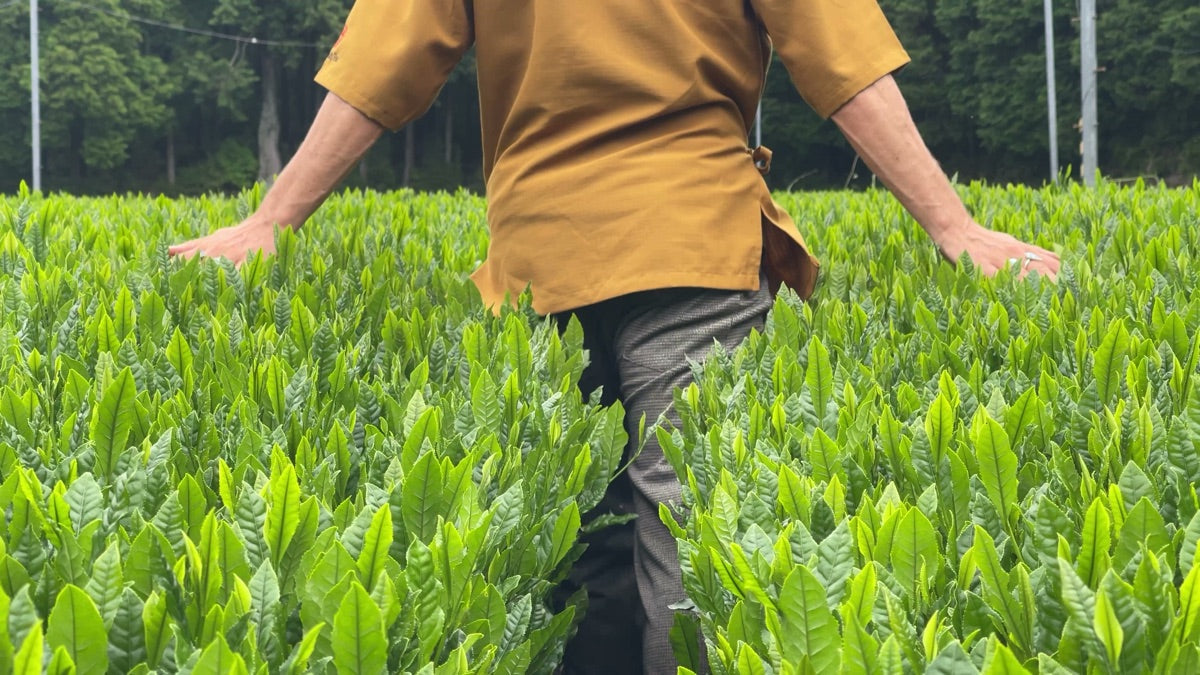
I spent weeks in Japanese tea gardens, in Shizuoka under Mount Fuji, in Fukuoka, in Shibushi, and the thing that changed how I buy was watching how much of a farmer's year the covering consumes. It is scaffolding built by hand over living rows, timed to a window of days, undone again after the harvest. Every yen of the price difference in that chart is somebody's labour in a field in May.
That is why we buy shaded leaf the way we do. Our ceremonial matcha is USDA organic, single-sourced from Japan, and stone-milled, and we would rather carry fewer lots that we have stood in front of than a broad catalogue we have not.
We do not sell gyokuro yet. It is coming, and when it does it will be because we found a garden worth the twenty days rather than because the keyword had volume. In the meantime, if you run a cafe or a shop and want to talk about shaded tea at wholesale, our wholesale page is the fastest way in. Those enquiries come to me, not to a queue.
The takeaway
If you remember one sentence from this, make it the one about rolling. Shading is what gyokuro and matcha have in common, not what separates them. The separation happens when one leaf goes into the rolling machine and the other deliberately does not, and everything else, the price, the caffeine, the texture in your mouth, follows from there.
The internet's version of this comparison is mostly built on repeated claims rather than read documents. Gyokuro is not automatically the pricier tea, its leaf is not lower in caffeine, and no law anywhere specifies a shading percentage or a stone mill. The Japanese sources are public and I have linked every one of them above.
Start where the door is widest. Our organic ceremonial matcha is the same shaded leaf, twenty-odd days in the dark, ground fine enough to drink whole.
Written by Christian Mauerer, founder of One with Tea. Questions about shaded tea, sourcing or wholesale reach me directly.
Frequently asked questions
Is gyokuro the same as matcha?
No. They share the shading step and belong to the same covered-tea family in Japanese classification, but gyokuro is rolled into whole leaf that you infuse and discard, while matcha is unrolled leaf, dried as tencha, de-stemmed and ground into powder that you consume entirely.
Can you grind gyokuro into matcha?
You can grind it, but the result is not matcha. Matcha is defined as ground tencha, and tencha is specifically leaf that was never rolled and had its stems and veins removed. Rolled leaf has been shaped and heat-treated differently, so ground gyokuro gives a coarser, duller powder with a different flavour. Products sold as gyokuro powder are usually exactly that, ground gyokuro, and they are a separate thing rather than a cheaper matcha.
Which has more L-theanine, gyokuro or matcha?
Both are elevated by shading, which is the point of shading. Published comparisons measure theanine in the leaf rather than in the finished cup, so a clean head-to-head on a per-serving basis is not something I can source honestly. What is measurable is the effect of the shading itself: 0.526% to 1.438% of dry weight in the Shizuoka tencha trial.
Is gyokuro powder the same as matcha powder?
No. Gyokuro powder is ground finished gyokuro. Matcha is ground tencha. Different raw material, different processing history, different result in the bowl.
Does gyokuro have more caffeine than matcha?
Per gram of dry material, yes, slightly: 3.5 g per 100 g for gyokuro leaf versus 3.2 g for matcha powder in Japan's national composition tables. Per serving it depends entirely on how much leaf and how much water you use, and gyokuro is conventionally brewed with a high leaf-to-water ratio.
Why is gyokuro so expensive if tencha costs more at wholesale?
Wholesale aracha pricing and retail pricing measure different things. Gyokuro is rare, first-flush only, and the very top lots are hand-picked, which pushes named single-garden gyokuro high at retail. Tencha's higher aracha average reflects strong global matcha demand for the raw material, and finished matcha then adds the cost of stone milling on top.
Share:
Matcha vs Sencha: What Actually Separates Them (2026)
Hojicha vs Matcha: What Actually Separates Them (2026)