



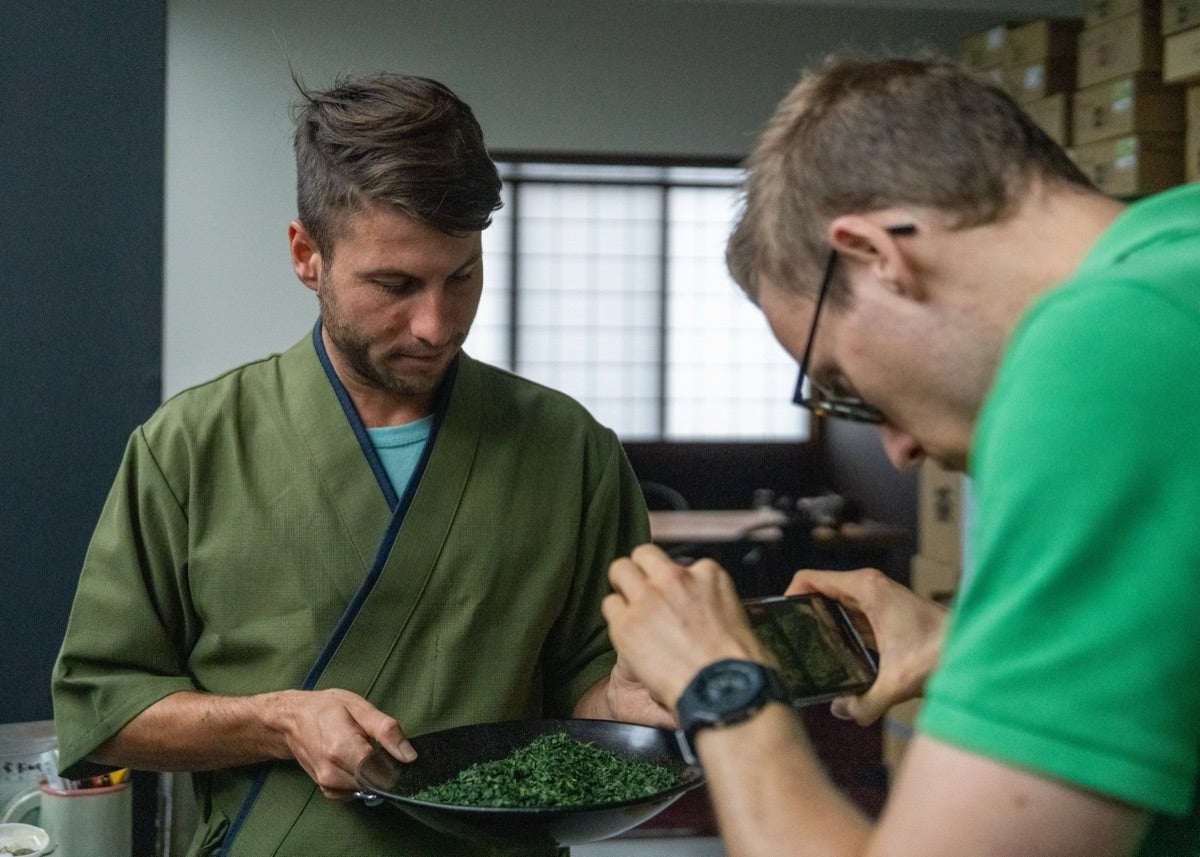
The honest answer: the grinding method changes the powder, but it does not by itself make a matcha good. A slow granite stone mill grinds matcha into particles about 5 to 10 microns wide, smaller than a red blood cell, and it does so gently, rarely warming the tea above 30°C. Machines grind far faster, some over a thousand grams an hour, but ball mills add friction heat and jet mills make a smoother particle that foams a little less. For a ceremonial bowl, that low, slow grind protects color, umami, and aroma.
For a latte or a recipe, a machine grind is usually fine. The leaf matters more than the mill.
At a glance
- How fine is matcha: stone-ground is about 5 to 10 microns; jet-milled is 2 to 5, ball-milled 10 to 20.
- Speed: a stone mill makes only ~30 to 40 grams an hour; machines make 300 to 1,000+.
- Heat: stone mills stay near 30°C; aroma and chlorophyll start to degrade above ~40°C.
- Texture: stone-ground has slightly irregular particles that whisk into a more stable foam.
- The catch: grinding method is one signal, not proof of quality. Good tencha ground by machine still beats poor leaf ground by stone.
How fine is matcha powder, really?
Fineness is the number people fixate on, and it is real. A traditional stone mill, an ishiusu, produces a powder of roughly 5 to 10 microns. That is close to the size of a red blood cell, which is why good matcha feels like silk rather than sand and suspends in water instead of sinking. Air-jet mills can go even finer, down to 2 to 5 microns, while ball mills sit coarser at 10 to 20. So finer is not unique to stone grinding. What stone grinding does differently is how it gets there.
Stone, ball mill, and jet mill, side by side
| Method | Speed | Particle size | Temperature | Character |
|---|---|---|---|---|
| Stone mill (ishiusu) | ~30-40 g / hour | 5-10 microns | Rarely above 30°C | Slightly irregular particles, stable foam; the traditional choice for ceremonial grade |
| Ball mill | 300-500 g / hour | 10-20 microns | Needs active cooling | Fast and cheap; friction heat is the trade-off, so cooling matters |
| Air-jet mill | 1,000+ g / hour | 2-5 microns | Runs cool | Very fine and uniform, but smooth particles suspend and foam a little less |
Figures are typical industry ranges, not fixed specs. Sources: Best Matcha, "Stone Grinding"; Tezumi, "Matcha Myths".
Why the slow grind protects the bowl
A granite mill is about 33 cm across and turns slowly, near 30 to 40 rotations a minute. Spin it faster and friction heats the powder, and heat is the enemy: aromatic compounds and umami begin to fade above roughly 40°C, and the bright jade color dulls as chlorophyll breaks down. Because a stone mill barely warms the tea, it keeps the color, the sweetness, and the marine aroma that a tencha leaf carries into the powder. That is the real case for stone grinding, not that it is finer, but that it is gentler. The growers we source from still grind on granite, and watching one mill fill barely a single tin over a slow morning is the most honest argument for the method.
The honest part: grind is not proof of quality
Here marketing gets ahead of the tea. Three things are worth saying plainly. First, "ceremonial grade" is a marketing term, not a legal standard, so a stone-ground label alone guarantees nothing. Second, greener is not automatically better; over-shading and additives can make a mediocre matcha look vivid. Third, the grinding method is one input among many. The cultivar, the shading, the harvest, and above all the tencha that goes into the mill shape the cup far more than the mill itself. A fine tencha ground by a well-cooled machine will beat a poor leaf ground on stone. Stone grinding is a mark of care, and often of a maker who took the slow path, but it is a signal, not a certificate.
Our ceremonial matcha is stone-ground from single-origin Japanese tencha, chosen for the leaf first and the mill second. For the deeper dive on what the slow grind does to nutrients and flavor, read the benefits of stone-ground matcha.
Frequently asked questions
Is stone-ground matcha better than machine-ground?
For a whisked ceremonial bowl, usually yes, because the low heat of a stone mill protects color, umami, and aroma. For lattes, baking, and smoothies, a good machine-ground matcha is perfectly fine and far more affordable. The leaf quality matters more than the mill.
How fine is matcha powder?
Stone-ground matcha is roughly 5 to 10 microns, smaller than a red blood cell. Jet-milled can reach 2 to 5 microns, and ball-milled sits around 10 to 20. Fineness affects texture and suspension, not automatically quality.
Can you tell if matcha is stone-ground?
Not reliably by looking. Stone-ground powder tends to feel silky and whisk into a lasting foam, but particle size overlaps with machine methods. Trust the maker's transparency about the leaf and origin more than the grinding claim alone.
Is machine-ground matcha bad?
No. Ball and jet milling are legitimate methods; the main risk is friction heat in ball milling, which good producers manage with cooling. Machine-ground matcha is the sensible choice for culinary use.
What does the grinding method not tell you?
Whether the matcha is actually good. Cultivar, shading, harvest timing, and freshness decide most of the flavor. Grinding method is one honest signal among several, not a guarantee.
Sources
Best Matcha, "Stone Grinding" glossary; Tezumi, "Matcha: 7 Myths and Misconceptions". Particle-size, speed, and temperature figures are typical industry ranges and vary by producer and equipment.
Share:
What Is Strawberry Matcha? The Trend, the Blend, and How to Make It
Matcha Tested for Heavy Metals: What 2026 Lab Reports Show