



The honest dose, the arithmetic nobody shows you, and why the number matters less than the marketing suggests.
Two to four grams of matcha per day, which is one to two bowls, is the sensible amount if weight management is your reason for drinking it. That range sits comfortably under the caffeine ceiling and lands in the same territory as the lower-dose human trials. It does not reach the high catechin doses used in the fat oxidation studies, and the honest reading of the research is that the weight effect is small either way.
I want to walk you through the arithmetic, because almost nobody does. Most pages answer this question with "two to three cups" and move on. That skips the only part that matters, which is how many milligrams of EGCG a bowl of matcha actually delivers, and how that compares to what researchers gave people in the studies everyone cites.
Key Takeaways
- 2 to 4 g of matcha per day (roughly 1 to 2 bowls) is a reasonable ceiling-respecting amount. More is not better here.
- The trials people cite used 90 mg to 366 mg of EGCG, delivered as concentrated extract capsules, not as brewed matcha.
- Measured matcha contains around 7.6 to 16.9 mg of EGCG per gram, so a normal habit does not reach the higher trial doses.
- The Cochrane review of 14 studies found green tea preparations produce a weight change that is small and not clinically important.
- Your practical limit is caffeine, not catechins. It arrives first.

How much matcha per day for weight loss?
Two to four grams daily. In practice that is one bowl in the morning and, if you want it, one in the early afternoon. A standard bowl uses about 2 g of powder, which is roughly one heaped chashaku scoop or a slightly rounded half teaspoon. If you want the measuring detail, we covered it in how much matcha powder per cup.
That range is not a magic number. It is what falls out when you hold three things at once: the doses used in the research, the caffeine you can reasonably take in a day, and the amount of matcha a person will actually drink over months rather than for one enthusiastic week.
Here is the part I want to be plain about before we go further. Matcha is not a weight-loss intervention. In the studies where anything measurable happened, the tea or extract sat alongside diet and exercise changes, and it was the smaller of the two levers by a wide margin. Anyone selling you the reverse is selling you something.
What the trials actually dosed

Two human studies do most of the work in this conversation, and they used very different amounts.
The lower one is Dulloo and colleagues, published in the American Journal of Clinical Nutrition in 1999 with 10 healthy men. The green tea extract they used contained 90 mg of EGCG and 50 mg of caffeine per dose. Relative to placebo, it produced a significant increase in 24-hour energy expenditure of 4% (Dulloo et al. 1999, n=10, PMID 10584049). Four percent is real, and it is also modest. On a 2,000 calorie day it is about 80 calories, and the study measured expenditure in a metabolic chamber rather than weight change over time.
The higher one is Venables and colleagues, also in the American Journal of Clinical Nutrition, in 2008. Participants took three capsules containing 890 ± 13 mg of polyphenols and 366 ± 5 mg of EGCG. Average fat oxidation rates during moderate exercise were 17% higher after the extract than after placebo (Venables et al. 2008, n=12, PMID 18326618). The limit worth naming: this measured fuel use during a single exercise session, not fat loss over weeks, and the sample was twelve people.
Notice what both studies have in common. The EGCG arrived as a concentrated capsule with a known milligram count. Neither study asked anyone to drink matcha. That distinction is the whole reason the next section exists.
How much EGCG is in a gram of matcha?

Less than the marketing implies, and the honest answer is a range rather than a number.
One analysis of three commercial matcha products measured EGCG at 7,610 to 16,900 µg/g, which is about 7.6 to 16.9 mg per gram, with caffeine at 14.1 to 16.1 mg/g (Antioxidants, 2022, 3 commercial samples). That is a small sample, and only one of the three was Japanese in origin, so read it as an indication rather than a settled value. A separate review reports matcha caffeine across a wider band of 18.9 to 44.4 mg/g (Kochman et al. 2021, Molecules 26(1):85, PMID 33375458).
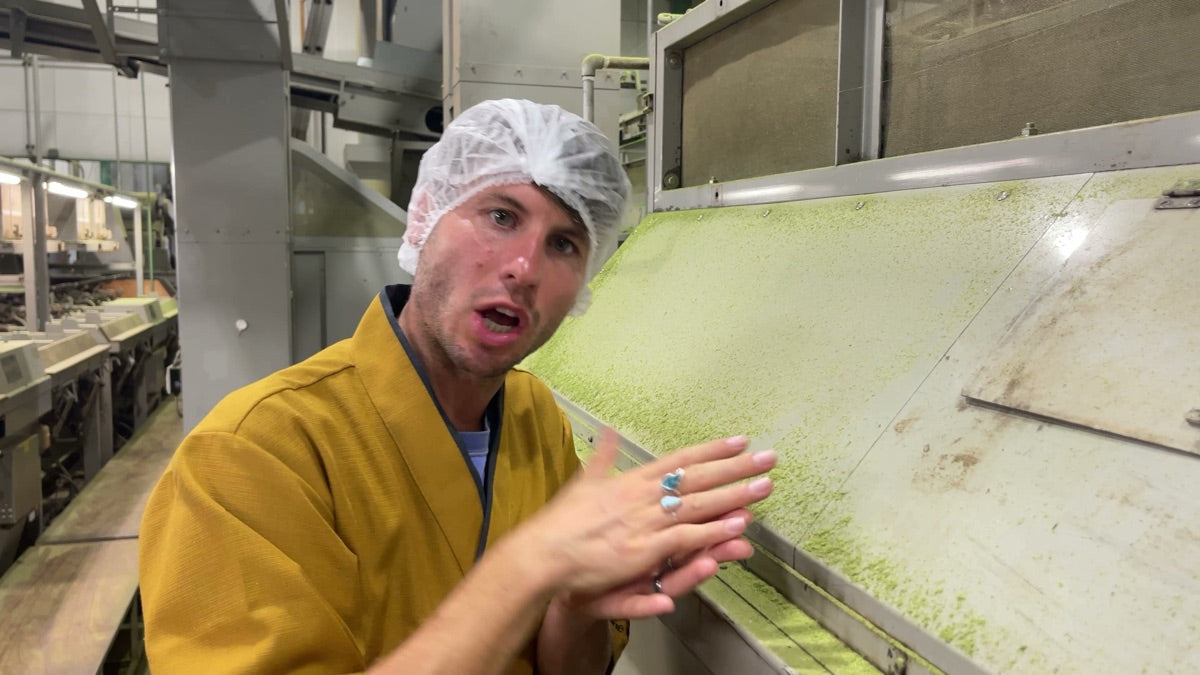
Published figures vary a great deal, and I think that variation is the most useful thing on this page. Shading, harvest, cultivar and grade all move catechin content, which is exactly what you would expect from an agricultural product. When I stood on the mill floor in Shizuoka watching tencha go through the stone mills, the thing that struck me was how much the input leaf differed batch to batch. A single tidy number for "EGCG in matcha" would be a fiction. Treat any brand quoting one to two decimal places with suspicion.
We track the production side: our map of Japanese tea production by prefecture.
Now the arithmetic. Take the Venables dose of 366 mg of EGCG. At 7.6 to 16.9 mg per gram, reaching it would take roughly 22 to 48 grams of matcha in a day. That is eleven to twenty-four bowls. Nobody drinks that, and the caffeine alone would put you far past any sensible limit long before you got there.
| Daily matcha | Bowls (2 g each) | EGCG delivered | Caffeine delivered | Reaches trial dose? |
|---|---|---|---|---|
| 2 g | 1 | 15 to 34 mg | 38 to 89 mg | No |
| 4 g | 2 | 30 to 68 mg | 76 to 178 mg | No |
| 5 to 12 g | 2.5 to 6 | 90 mg | 94 to 533 mg | Matches Dulloo 1999 (90 mg) |
| 22 to 48 g | 11 to 24 | 366 mg | Far above the 400 mg limit | Venables 2008, not realistic |
EGCG calculated at 7.6 to 16.9 mg/g and caffeine at 18.9 to 44.4 mg/g. Ranges are wide because matcha is an agricultural product, not a standardised capsule.
The Dulloo dose of 90 mg of EGCG is a different story. At the same measured range that is about 5 to 12 grams, so the upper end of a normal habit reaches toward it without arriving. This is the realistic picture: a daily matcha habit sits in the neighbourhood of the low-dose study and nowhere near the high-dose one.
While we are here, the "137 times more antioxidants than green tea" figure you see everywhere is not a dose and should not be read as one. It is a comparison of concentrations under particular test conditions, not a statement about how many milligrams land in your cup, and it has been repeated so widely that it now travels without its context. A measured comparison found matcha's total phenolic content about 1.9 times higher than sencha before digestion, and 2.6 times higher after gastric digestion (Journal of Food Science and Technology, 2021). A few times more concentrated is the honest claim, and it is still a good one. If you want the compound itself explained properly, that lives in our guide to EGCG in green tea.
How much weight does this actually move?
Very little, and the best evidence is unambiguous about it.
The Cochrane systematic review pooled 14 studies covering 1,562 participants. Its conclusion is worth quoting exactly: "Green tea preparations appear to induce a small, statistically non-significant weight loss in overweight or obese adults. Because the amount of weight loss is small, it is not likely to be clinically important." In the six studies conducted outside Japan, the mean difference in weight loss was −0.04 kg (95% CI −0.5 to 0.4; P = 0.88), which is indistinguishable from nothing (Jurgens et al. 2012, Cochrane Database of Systematic Reviews, PMID 23235664).
A separate meta-analysis of 11 articles is somewhat more favourable. It found that catechin and EGCG-caffeine mixtures significantly decreased body weight and helped maintain it after a period of weight loss, with a mean difference around −1.31 kg, and described the effect as "a small positive effect" (Hursel et al. 2009, International Journal of Obesity, PMID 19597519). The limit here matters: that figure comes from catechin-caffeine mixtures at study doses, and habitual caffeine consumers appear to respond less.
So the two best syntheses disagree in magnitude and agree in direction. Somewhere between nothing and about 1.3 kg, over months, on top of diet and exercise. That is the truthful range. It is not a reason to skip matcha and it is not a reason to drink it. If your goal is body composition, the tea is the smallest lever on the table.
This is where I part ways with most of the category. Two claims are common and both are wrong. One says matcha drives weight loss. The other says the compounds do nothing at all. The data sits in an unglamorous middle, and the middle is where honest advice lives.
The upper limit: caffeine arrives before catechins

If you are tempted to push the dose, caffeine is what stops you, not EGCG.
EFSA considers caffeine intakes from all sources up to 400 mg per day for healthy adults, and single doses up to 200 mg, as raising no safety concerns (EFSA). Using the reported matcha caffeine range of 18.9 to 44.4 mg/g, 400 mg of caffeine works out to somewhere between 9 and 21 grams of matcha, and that assumes matcha is your only source. Add coffee or tea elsewhere in the day and the number falls fast. At 2 to 4 g of matcha you are using roughly 40 to 180 mg, which leaves sensible room.
We put them side by side: our caffeine comparison across teas.
The EGCG safety question is real but it is aimed somewhere else. EFSA concluded that doses of EGCG at 800 mg per day may be associated with initial signs of liver damage when taken as a food supplement. For brewed tea the finding was different: EFSA reported that for green tea infusions "there is generally no indication of liver damage even after high consumption," and considered catechins from infusions brewed with hot water to be generally safe (EFSA, 2018).
Read that boundary carefully, because it is the most misused finding in this whole topic. The concern attaches to concentrated green tea extract capsules, which is precisely the format the fat oxidation trials used. It does not attach to drinking matcha at normal amounts. This is also a good argument against chasing the trial doses through supplements to "get the research effect." You would be taking on the risk profile that the caution was written about, for a benefit the Cochrane review calls not clinically important. For the broader daily-habit question, we went through it in can you drink matcha every day, and the caffeine detail sits in is matcha caffeinated.
Who should be more careful
Individual response varies. Consult your doctor before changing your routine if you manage a condition or take medication.
A few situations deserve more caution than a blog post can resolve. If you are pregnant, EFSA's figure drops to 200 mg of caffeine per day from all sources, which meaningfully tightens the room for matcha (EFSA). If you take medication, catechins and caffeine can interact with several drug classes, and that is a pharmacist conversation rather than a search-engine one. If you are managing low iron, tea polyphenols are associated with reduced non-heme iron absorption, so timing matcha away from iron-rich meals is a reasonable precaution.
And if caffeine makes you anxious or wrecks your sleep, the honest answer is that no catechin figure is worth that trade. The 4% expenditure difference in Dulloo is not going to outrun a week of bad sleep.
How to make the dose real

The dose that matters is the one you actually take, consistently, for long enough to be irrelevant on any given day.
Measure it rather than eyeballing it. A 2 g scoop is small, and most people underdose or overdose by a wide margin when guessing. If you are drinking it before movement, the Venables study looked at moderate exercise, so if you want to mirror that shape, matcha 30 to 60 minutes before a walk or a session is the sensible interpretation, with the caveat that you are working at a fraction of the dose they used.
Keep it early. Caffeine late in the day costs more than it returns. And keep the powder good: catechin content tracks with shading, harvest and freshness, so a dull, flat, olive-coloured powder is telling you something about how it was grown and how long it has been sitting. If you want the selection criteria rather than the dosing, that is what choosing matcha with weight management in mind is for. Our own organic ceremonial matcha is stone-milled from first-harvest tencha, which is the part of the process I care most about.
One last thought. I came to matcha through the ritual, not the research. The five quiet minutes of whisking are the part that has changed anything in my life, and they are the part no meta-analysis will ever measure. Drink it for that, and let the catechins be a bonus rather than a promise.
Frequently asked questions
How much matcha should I drink per day for weight loss?
Two to four grams, which is one to two bowls. That keeps you well under the 400 mg daily caffeine figure EFSA considers safe for healthy adults, and it is a realistic amount to sustain. Higher intakes do not have better evidence behind them.
How many cups of matcha a day is too much?
Caffeine sets the ceiling before catechins do. Using reported matcha caffeine of 18.9 to 44.4 mg/g, four to five bowls would approach 400 mg on its own, and that leaves no room for coffee or other tea. Most people should stay at one to three bowls.
Does matcha actually help you lose weight?
The effect is small. The Cochrane review of 14 studies and 1,562 participants found green tea preparations produce a weight loss that is small and not likely to be clinically important, with a mean difference of −0.04 kg in studies outside Japan (Jurgens et al. 2012). A separate meta-analysis found around −1.31 kg for catechin-caffeine mixtures (Hursel et al. 2009). Treat matcha as a supporting habit, not a method.
How much EGCG is in a bowl of matcha?
Roughly 15 to 34 mg for a 2 g bowl, based on measured EGCG of 7.6 to 16.9 mg per gram across three commercial matcha products (Antioxidants, 2022). Published figures vary with grade, shading and harvest, so treat any single precise number with caution.
Should I take a green tea extract supplement instead?
That trade is worth understanding before you make it. The higher-dose trials used concentrated extracts, but EFSA concluded that EGCG at 800 mg per day from food supplements may be associated with initial signs of liver damage, while finding generally no indication of liver damage from green tea infusions even at high consumption (EFSA, 2018). Ask your doctor rather than deciding from a product label.
When is the best time to drink matcha for weight management?
Morning or early afternoon, and before movement if you want to mirror the exercise studies. Venables et al. measured fat oxidation during moderate exercise after extract ingestion, so drinking 30 to 60 minutes before activity is a reasonable interpretation. Avoid late-day matcha if it affects your sleep.
Sources
- Jurgens TM, Whelan AM, Killian L, Doucette S, Kirk S, Foy E. Green tea for weight loss and weight maintenance in overweight or obese adults. Cochrane Database of Systematic Reviews, 2012. PMID 23235664
- Hursel R, Viechtbauer W, Westerterp-Plantenga MS. The effects of green tea on weight loss and weight maintenance: a meta-analysis. International Journal of Obesity, 2009. PMID 19597519
- Venables MC, Hulston CJ, Cox HR, Jeukendrup AE. Green tea extract ingestion, fat oxidation, and glucose tolerance in healthy humans. American Journal of Clinical Nutrition, 2008. PMID 18326618
- Dulloo AG, Duret C, Rohrer D, et al. Efficacy of a green tea extract rich in catechin polyphenols and caffeine in increasing 24-h energy expenditure and fat oxidation in humans. American Journal of Clinical Nutrition, 1999. PMID 10584049
- EFSA. Scientific opinion on the safety of green tea catechins, 2018. EFSA summary
- EFSA. Caffeine topic page, safe intake figures. EFSA
- Kochman J, Jakubczyk K, Antoniewicz J, Mruk H, Janda K. Health Benefits and Chemical Composition of Matcha Green Tea: A Review. Molecules, 2021;26(1):85. PMID 33375458
- The Effect of In Vitro Digestion on Matcha Tea (Camellia sinensis) Active Components and Antioxidant Activity. Antioxidants, 2022. PMC9137484
- Matcha and Sencha green tea extracts with regard to their phenolics pattern and antioxidant and antidiabetic activity during in vitro digestion. Journal of Food Science and Technology, 2021. PMC8292538
This article is for general information and is not medical advice. Individual response varies. Consult your doctor before changing your routine if you manage a condition or take medication.
Share:
Stone-Ground vs Machine-Ground Matcha: Does It Really Matter?
EGCG Half-Life: How Long Does EGCG Stay in Your System?