



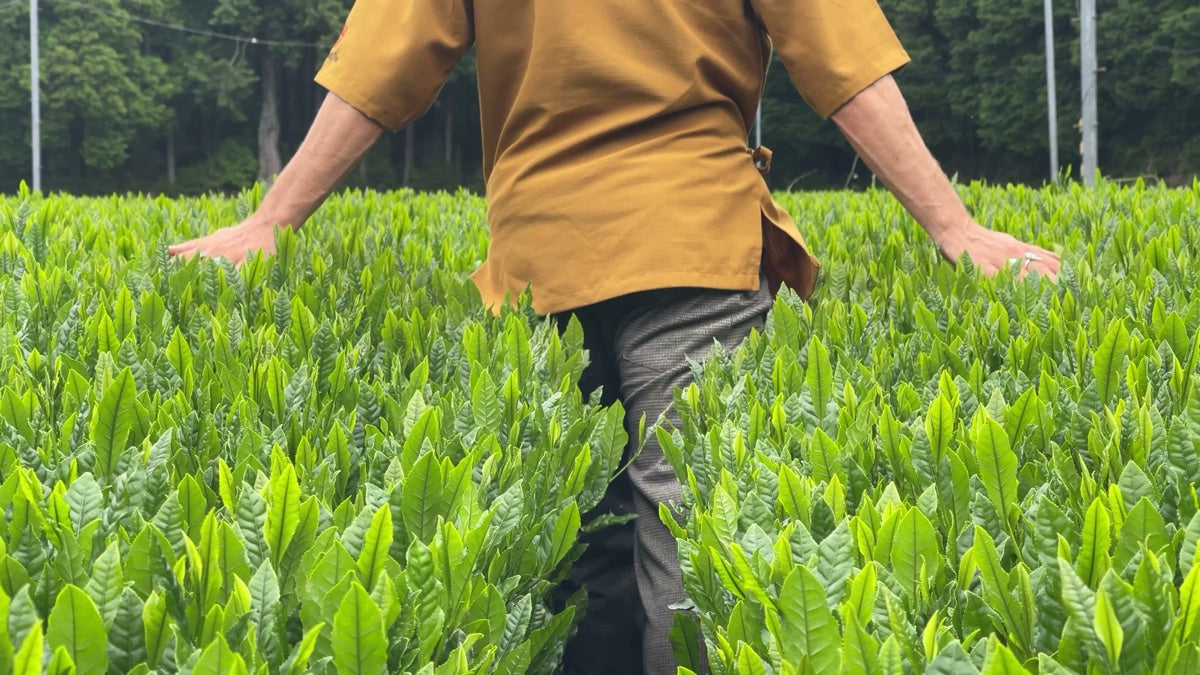
By Christian, Founder of One with Tea. We source organic Japanese matcha directly from growers in Shizuoka, Kagoshima and Uji. Every figure below is linked to the peer-reviewed human study it came from.
For where this sits on the map, see which Japanese prefectures actually grow the tea.
EGCG has a short plasma half-life in humans, measured at roughly 1.9 to 4.6 hours across dose levels in a 60-person study, and 3.4 hours in a smaller green tea trial. Practically, that means most of the EGCG from your morning bowl is out of your bloodstream within about 10 to 24 hours, depending on your body and how you drank it.
That number surprises people. Matcha gets talked about like it builds up in you, like a reservoir you keep topping off. The measured pharmacokinetics say something different, and honestly more interesting. If you want the background on the compound itself first, we wrote a full explainer on what EGCG is in green tea.
Key Takeaways
- Mean terminal half-life of EGCG ranged from 1.9 to 4.6 hours across single oral doses of 50 to 1600 mg in 60 healthy men (Ullmann 2003, J Int Med Res).
- Peak blood levels arrive fast, at 1.3 to 2.2 hours after drinking. This is not a slow-release compound.
- Ring-fission metabolites made by your gut bacteria appear after 3 hours and peak at 8 to 15 hours, long after the parent compound has faded (Lee 2002, n=8).
- Taking catechins on an empty stomach produced a more than 3.5-fold higher peak plasma level of free EGCG than taking them with food (Chow 2005, n=30).
- Commercially measured ceremonial matcha averaged 56.57 mg EGCG per gram, so a standard 2 g bowl carries around 113 mg (Meyer 2023, 15 teas tested).

What a half-life actually means, and what it doesn't
A half-life is the time it takes for the concentration of something in your blood to drop by half. That's the whole definition. It is a measurement of clearance, not of usefulness.
People conflate the two constantly. A short half-life doesn't mean the compound did nothing. It means the molecule itself didn't linger. Three numbers matter here, and they answer different questions:
- Tmax is how long until blood levels peak. For EGCG this is fast, around 1.3 to 2.2 hours.
- Cmax is how high that peak goes. This is the number that dose and timing actually move.
- t½, the half-life, is how quickly the level falls after the peak.
After roughly five half-lives, about 97% of a compound has cleared. So if your personal half-life sits at the 3.4 hour mark, you're looking at somewhere near 17 hours to functionally clear a dose. At the 4.6 hour end, closer to 23 hours. Individual response varies. Consult your doctor before changing your routine if you manage a condition.
How long is EGCG's half-life? The measured human numbers

The best single dataset comes from a randomized, double-blind, placebo-controlled study in 60 healthy male volunteers who took single oral doses of 94% pure crystalline EGCG under fasting conditions, with blood drawn out to 26 hours (Ullmann 2003, J Int Med Res 31(2):88-101). Mean terminal half-life fell between 1.9 and 4.6 hours. Mean Cmax ran from 130 to 3392 ng/ml and arrived at 1.3 to 2.2 hours.
A separate trial using actual brewed green tea rather than isolated EGCG found a tighter number, 3.4 hours plus or minus 0.3, with peak concentration at 1.3 to 1.6 hours (Lee 2002, Cancer Epidemiol Biomarkers Prev 11(10 Pt 1):1025-32). Only eight people, so read it as a signal rather than a settled fact.
| Study | n | Dose | Tmax | Half-life |
|---|---|---|---|---|
| Ullmann 2003 | 60 | 50 to 1600 mg EGCG, fasted | 1.3 to 2.2 h | 1.9 to 4.6 h |
| Lee 2002 | 8 | Green tea, 20 mg solids/kg | 1.3 to 1.6 h | 3.4 ± 0.3 h |
| Chow 2001 | 20 | 200 to 800 mg, single dose | Not reported | Availability rose non-linearly with dose |
| Chow 2003 | 40 | 800 mg daily for 4 weeks | Not reported | AUC rose >60% after 4 weeks |
| Chow 2005 | 30 | 400 to 1200 mg, fasted vs fed | Not reported | Fasted Cmax >3.5x higher |
One caveat worth stating plainly. Every study in that table used capsules of isolated EGCG or a decaffeinated catechin extract, not a whisked bowl of tea. Nobody has run an equivalent study on matcha specifically. So these are the closest reliable numbers we have, not a direct measurement of your morning ritual.
So how long does EGCG stay in your system?
Blood levels climb for about 90 minutes, peak, and then fall steadily. By hour 12 you're down to roughly a tenth of peak. By hour 24, close to nothing.
The same answer applies if you're asking how long matcha stays in your system, since EGCG is the catechin the question is usually really about. Caffeine and L-theanine from the same bowl follow their own separate clearance curves, so "matcha has left your system" isn't a single moment. Different compounds, different timelines.
For the numbers beside every other tea, see how matcha compares with coffee and other teas on caffeine.
Here's the part most articles skip. EGCG doesn't simply vanish. Your gut bacteria break the molecule apart into ring-fission metabolites, and those show up in plasma and urine in meaningful amounts after 3 hours, peaking somewhere between 8 and 15 hours (Lee 2002). So while the parent compound is fading by mid-afternoon, its breakdown products are still rising into the evening. What those metabolites do in the body is not well established, and the same paper flagged considerable differences between individuals and even between repeated tests on the same person. Treat any single number as an average you may not personally match.
Why matcha isn't the same as a brewed cup

With sencha or any steeped leaf, you drink the infusion and throw the leaf away. Whatever catechin content stays locked in the leaf never reaches you. With matcha you're drinking suspended whole leaf, so the delivery is different by design.
That's a real structural difference, and it's also where matcha marketing goes off the rails. You'll see the claim that matcha has 137 times the EGCG of green tea. That figure traces to a single 2003 chromatography paper, and the comparison was against one specific product, China Green Tips (Weiss and Anderton 2003, J Chromatogr A 1011(1-2):173-80). The same paper's broader conclusion was far more modest: at least three times higher than the largest published value for other green teas. Three, not 137.
Later measurements complicate it further. When 15 commercial green teas were analysed side by side, ceremonial matcha averaged 56.57 mg EGCG per gram and culinary matcha 50.53 mg/g, while bagged green teas averaged 46.14 mg/g and the single highest-testing product in the whole set was a bagged tea at 70.22 mg/g (Meyer 2023, Plant Foods Hum Nutr 78(4):662-669). That study also found gunpowder and bagged teas had higher total phenolic content and higher antioxidant capacity than the matcha samples. We sell matcha and we'll still tell you that, because per gram of dry leaf, matcha is not automatically the winner. Its advantage is that you consume the leaf rather than an extract of it.

From our tea room
Organic Ceremonial Matcha Powder - USDA Certified (30g)
Stone-milled ceremonial grade, USDA Organic, third-party lab tested.
View Ceremonial MatchaOn absorption, the news is good. In a simulated digestion study, epigallocatechin and EGCG were among the best-released compounds in matcha, with under 1% remaining in the undigested residue (Koláčková 2022, Antioxidants 11(5):889). Released in the gut is not the same as absorbed into blood, and that study was a lab model rather than people, but it suggests the leaf gives up its catechins readily. If you want the broader picture, see our guide to the benefits of drinking matcha green tea.
What actually changes how much EGCG you absorb
Two things move the needle more than anything else.
An empty stomach. Thirty healthy volunteers took catechins with or without a light breakfast in a crossover design. Fasting produced a more than 3.5-fold increase in average peak plasma concentration of free EGCG compared with taking the same dose with food (Chow 2005, Clin Cancer Res 11(12):4627-33). The catch is tolerance. Mild, transient nausea appeared most often in the fasted condition at the highest dose. If matcha on an empty stomach makes you queasy, that's a real and documented response, not weakness. Our note on the best time to drink matcha goes deeper on timing.
Dose size. In a Phase I study across 200, 400, 600 and 800 mg dose levels in 20 subjects, systemic availability increased disproportionately at higher doses, which the authors attributed to saturable presystemic elimination (Chow 2001, Cancer Epidemiol Biomarkers Prev 10(1):53-8). In plain terms, the clearance machinery has a ceiling. This is a supplement-dose observation, though, and one bowl of matcha sits well below the lowest dose tested.
What this means for a daily bowl

Run the arithmetic. A standard 2 g bowl of ceremonial matcha carries roughly 113 mg of EGCG using the Meyer 2023 average. That lands squarely inside the 90 to 300 mg per day that EFSA reports as typical daily EGCG intake from traditional green tea infusions across the adult EU population (EFSA 2018). One to three bowls a day is an ordinary tea-drinking intake, not an intervention.
Given a half-life of a few hours, spacing bowls does more than stacking them. Two bowls eight hours apart give you two separate peaks. Two bowls thirty minutes apart give you one slightly taller peak and the same clearance curve. Neither is better in any proven sense, but if your goal is presence with the tea rather than a number in your blood, the spaced version is also the nicer day. The same 2 g bowl carries somewhere around 50 to 70 mg of caffeine, based on the 24.95 to 35.01 mg/g measured across the five ceremonial products in that same analysis, which is worth factoring in alongside L-theanine. We cover the stimulant side separately in is matcha caffeinated, and portioning in how much matcha powder per cup.
I've sat with growers in Shizuoka watching the first flush come off the field, and walked the rows in Kagoshima where the shoots come earlier and the air is warmer. Nobody there talks about half-lives. They talk about the water temperature, the whisk, whether the foam is right, whether you're actually present for the three minutes it takes. After years of reading this literature I've landed somewhere in between. The chemistry is genuinely interesting and worth getting right. It is also not why I drink the bowl.
How much is too much?

EFSA reviewed the evidence and concluded that doses of 800 mg EGCG per day or above, taken as a food supplement, produce statistically significant increases in serum transaminases, and that exposure at or above that level for four months or longer is associated with elevations of ALT and AST (EFSA 2018, EFSA Journal 16(4):5239, summary). The panel could not identify a safe supplement dose from the available data.
The same panel reached a different verdict on tea itself. Catechins from green tea infusion prepared in the traditional way were considered generally safe, with the rare reported liver injury cases most probably reflecting idiosyncratic individual reactions. Separately, a four-week trial found it safe for healthy people to take EGCG equivalent to the content of 8 to 16 cups of green tea daily (Chow 2003, Clin Cancer Res 9(9):3312-9).
The honest summary: concentrated extract capsules and whisked tea are not the same exposure, and the safety signal sits with the capsules. Reaching 800 mg from ceremonial matcha alone would take about seven bowls in a day. More on the upper end in can you drink too much matcha.
Frequently asked questions
Does EGCG build up in your body if you drink matcha every day?
Not in the sense of the compound accumulating in tissue. The parent molecule clears within roughly a day. What can shift is how much reaches your bloodstream. After four weeks of 800 mg daily, area under the plasma concentration curve rose by more than 60%, though no such change appeared with 400 mg taken twice daily (Chow 2003, 8 subjects per group). That's a supplement-level dose, so it may not describe tea drinking at all.
How long before matcha's effects fade?
Nobody has measured "effects" as a clean endpoint, so this can only be answered on the pharmacokinetics. Blood EGCG peaks at 1.3 to 2.2 hours and halves every 2 to 5 hours after that. Gut-derived metabolites keep rising until 8 to 15 hours, and what they do is not well characterised. Anything more specific than that would be guesswork.
Does food block EGCG absorption?
It reduces peak blood levels substantially. A light breakfast of one or two muffins cut average peak free EGCG to under a third of the fasted value in a 30-person crossover trial (Chow 2005). Whether that difference matters for a tea drinker is unknown, and fasted dosing came with more nausea.
Is EGCG's half-life the same as caffeine's?
They're in a broadly similar range but they're different molecules cleared by different routes, and caffeine's variability between people is large. A systematic analysis pooling 141 studies and 4,714 individuals found caffeine half-life shifts meaningfully with smoking status, oral contraceptive use and liver function, which is why a single figure is misleading (Grzegorzewski 2022, Front Pharmacol). EGCG's own measured range of 1.9 to 4.6 hours carries the same caution.
The short version
EGCG moves through you quickly. Peak inside two hours, half gone within two to five, functionally cleared inside a day, with gut metabolites trailing into the evening. Food lowers the peak, an empty stomach raises it, and the safety concerns in the literature attach to concentrated capsules rather than to tea. The numbers are smaller and less dramatic than the marketing suggests, and we'd rather you have the real ones.
If you're going to drink matcha daily, what matters most is that it's tea you actually want to drink. We source single-origin organic Japanese matcha directly from growers in Shizuoka, Kagoshima and Uji, stone-milled and shipped fresh, because a bowl worth returning to every morning is the whole point. Come find one that suits your taste.
Share:
How Much Matcha Per Day for Weight Loss?
Matcha and Anxiety: What the L-Theanine Trials Actually Found