



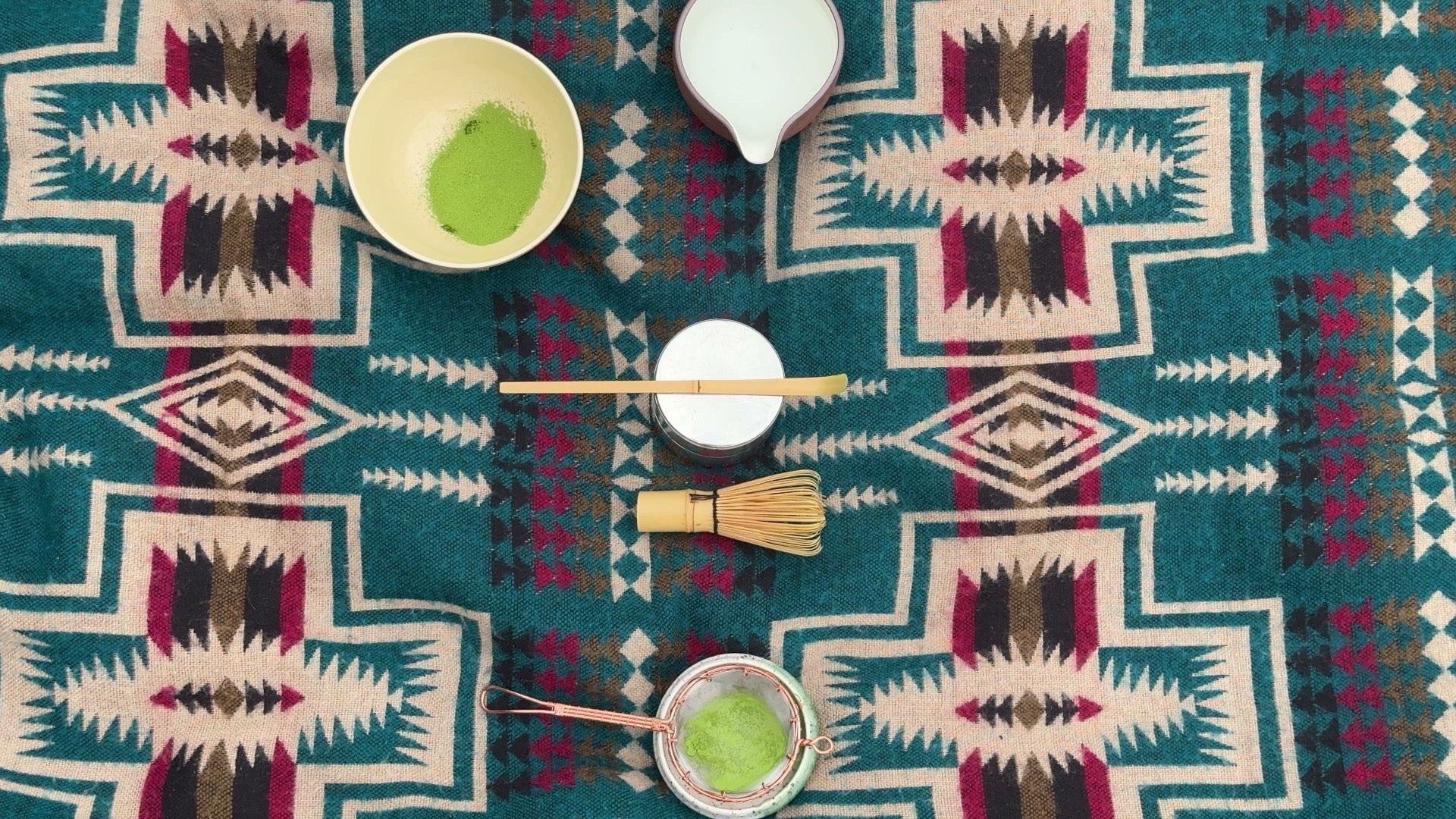
By Christian, Founder of One with Tea
Quick answer: For a standard bowl, use 1 level teaspoon (about 2 g) of matcha per 2 to 3 oz (60 to 80 ml) of hot water. For a matcha latte, use 2 to 4 g (1 to 2 teaspoons) so the flavor carries through the milk. For thick ceremonial koicha, use about 4 g (2 teaspoons) in 30 to 40 ml (1 to 1.4 oz) of water. Sift the powder and keep the water near 175°F (80°C) so the cup stays smooth, not bitter. Need to convert? 4 g of matcha is about 2 teaspoons, and 2 g is about 1 teaspoon.
Getting the matcha-to-water ratio right is less about a single rigid rule and more about tailoring it to the drink you want. While you’ll often hear 2 grams (about 1 teaspoon) as the standard, that’s really just a starting point for one specific style of tea. The real craft lies in adjusting that amount for the perfect daily cup, a creamy latte, or a thick, potent ceremonial brew.
Your Quick Guide to Perfect Matcha Ratios
Mastering your matcha begins with knowing how much powder to use. This single choice dictates the strength, texture, and overall character of your drink. A kitchen scale will always give you the most precision, but a simple teaspoon works just fine when you’re starting out.
Let’s break down the three most common preparations.
-
Usucha (Thin Tea): This is your everyday matcha. Think of it as a smooth, balanced, and refreshing brew with a light froth. For this, you’ll want 2 grams (1 tsp) of matcha whisked into about 2-3 oz (60-80 ml) of hot water. It’s the perfect daily driver.
-
Matcha Latte: When you add milk, you need a stronger matcha flavor to cut through the creaminess. I usually double down here. A good starting point is 2-4 grams (1-2 tsp) of matcha for every 6-8 oz (180-240 ml) of milk.
-
Koicha (Thick Tea): This is a completely different experience. Koicha is a thick, intense, and deeply potent brew with a texture like warm honey. It's reserved for special occasions and requires double the matcha in half the water: 4 grams (2 tsp) of powder to just 1-1.4 oz (30-40 ml) of water.
This quick visual guide helps illustrate how the ratios shift for each drink style.

As you can see, the powder-to-liquid ratio changes dramatically as you move from a light, thin tea to a rich, ceremonial preparation.
Matcha Per Cup At a Glance
For those who just want the numbers, this table provides a quick reference for dialing in your perfect cup.
| Drink Type | Matcha Powder (Grams) | Approx. Teaspoons | Water/Milk Volume | Taste Profile |
|---|---|---|---|---|
| Usucha (Thin Tea) | 2g | 1 tsp | 60-80 ml | Smooth, balanced, refreshing |
| Matcha Latte | 2-4g | 1-2 tsp | 180-240 ml | Creamy, bold, rich |
| Koicha (Thick Tea) | 4g | 2 tsp | 30-40 ml | Intense, potent, syrupy |
Think of these as solid starting points. Don't be afraid to adjust by a half-gram here or there to perfectly suit your own taste.
Matcha Grams to Teaspoons: Quick Conversion
4 grams of matcha is about 2 level teaspoons, 2 grams is about 1 level teaspoon, and 1 tablespoon is about 6 grams. Those are the figures printed on real matcha labels: USDA FoodData Central lists a 1 teaspoon serving of organic matcha powder as 2 g and a 1 tablespoon serving as 6 g (branded records 2408471 and 2398187, retrieved 2026-10-22).
A spoon is still an estimate. Matcha is a light, fluffy powder, so a heaping or tightly packed teaspoon can hold noticeably more than a level one, which is why a 0.1 g kitchen scale gives the most repeatable cup. A bamboo scoop is looser still. The Global Japanese Tea Association counts two chashaku scoops as roughly 1.2 g, so it takes about three scoops to reach 2 g.
| Matcha (grams) | Level teaspoons | Typical use |
|---|---|---|
| 1 g | 1/2 tsp | A very light, gentle bowl |
| 2 g | 1 tsp | Standard usucha |
| 3 g | 1 1/2 tsp | Stronger bowl or a mild latte |
| 4 g | 2 tsp | Bold latte or koicha |
| 6 g | 1 tbsp (3 tsp) | Three bowls of usucha |
In ounces, 2 g is about 0.07 oz and 4 g about 0.14 oz, so matcha is weighed in grams and only the water is measured in ounces. For a longer chart, including tablespoons, see how many grams are in 1 teaspoon of matcha.
The same numbers tell you how far a tin goes. At 2 g a bowl, a 30 g tin of ceremonial matcha makes about 15 bowls. At 4 g a latte, it makes 7 to 8.
The Traditional Standard
That 2-gram measurement for usucha isn’t random, but it isn’t the only traditional answer either. Most modern preparation guides use about 2 grams of matcha to 60-80 ml of water, which is one level teaspoon. The Global Japanese Tea Association’s walkthrough of a ceremony-style bowl uses two scoops from a traditional bamboo chashaku, which it puts at roughly 1.2 grams, in 70-80 ml of water. That is a lighter bowl. Start at 2 g for body and flavor, and step down toward 1 to 1.5 g if you like it gentler.
The longer story is in 486 dated entries on the history of tea.
Key Takeaway: Start with 2 grams (1 tsp) for a standard cup of tea. Use a little more for lattes, and a lot more for the thick, ceremonial Koicha.
Once you get a feel for these foundational ratios, you can start experimenting. For a step-by-step look at the entire brewing process, from sifting to whisking, check out our complete matcha preparation guide.
Crafting Your Daily Cup of Usucha

This is the heart of the daily matcha practice. Usucha, or "thin tea," is the most common way you'll see matcha prepared, and for good reason. It’s smooth, vibrant, and gives you that gentle, focused lift without the jarring buzz of coffee. Getting it right is less about rigid rules and more about a mindful, repeatable process.
For a standard bowl, I’ve found the sweet spot is 2 grams of ceremonial grade matcha. That’s about one level teaspoon, or roughly three traditional bamboo scoops (chashaku). This ratio is key, it creates a balanced brew that has body and flavor without veering into watery or bitter territory. Pouring it into a bigger mug is a different question, covered in the cup-size FAQ below.

From our tea room
Bamboo Chashaku Scoop - Handcrafted Nakabushi
Handcrafted nakabushi bamboo scoop, 18cm.
View Bamboo ChashakuThe Art of Preparation
Before you do anything else, you have to sift. Pushing your matcha through a fine-mesh sieve is the one step I never, ever skip. It breaks up the small clumps that form naturally and is your only defense against a grainy, lumpy cup. Trust me, you can't whisk your way out of unsifted matcha.
Next, get your water right. The ideal temperature is between 70–80°C (160–175°F). If your water is too hot, it will literally scorch the delicate tea, pulling out all the bitter notes and killing the sweet, umami flavors you’re paying for. No temperature-controlled kettle? No problem. Just let boiled water cool for a minute or two before you pour.
The classic pairing of 2 grams of matcha with water at 70–80°C isn't just a preference, it's a time-tested method. Water in that range keeps the astringent notes in check and lets the sweet, savory flavor from amino acids like L-theanine come forward.
Now, add about 2–3 oz (60–80 ml) of your hot water to the sifted powder in your bowl. It's time to whisk. Using a bamboo whisk (chasen), move your hand rapidly in a "W" or "M" shape, scraping the bottom of the bowl lightly. The goal here is aeration, you're trying to whip up a fine, creamy layer of foam.
This brisk, 30-second whisking session does two things: it suspends the powder perfectly in the water and releases the tea’s full aroma. It’s what gives usucha its famously smooth mouthfeel. Once you master this simple ritual, the question of how much matcha powder per cup becomes less of a measurement and more of a moment you look forward to each day.
Making a Cafe-Quality Matcha Latte at Home

The creamy, comforting matcha latte is what gets most people hooked. But if you’ve tried making one at home and it fell flat, the issue is almost always the ratio. To get that rich, cafe-style flavor, you need to use more powder than you would for a traditional bowl of tea.
Why? Milk is a powerful ingredient. It mellows the matcha's complex notes, so a stronger dose is essential to let that signature grassy, umami character punch through.
For a standard 8-10 oz latte, my go-to range is 2 to 4 grams of matcha powder. That’s about 1 to 2 teaspoons. If you like a gentler green tea taste, start on the low end with 2 grams. For those who want a bold, robust flavor that stands up to oat or almond milk, 4 grams is the sweet spot.
Matcha Latte Ratio by Cup Size
For an 8 oz (240 ml) matcha latte, use 3 g of matcha (1 1/2 teaspoons), a 40 ml shot of hot water and about 200 ml of milk. The matcha-to-milk ratio that holds across sizes is roughly 1 g of matcha for every 60 to 70 ml of milk, with the shot's water on top of that. Scale the whole recipe up or down by the gram.
| Latte size | Matcha | Hot water (shot) | Milk |
|---|---|---|---|
| Small, 6 oz (180 ml) | 2 g (1 tsp) | 30-40 ml | about 140 ml |
| Standard, 8 oz (240 ml) | 3 g (1 1/2 tsp) | 40 ml | about 200 ml |
| Large, 10 oz (300 ml) | 4 g (2 tsp) | 60 ml | about 240 ml |
These are my starting points, built on the 2 to 4 gram range above. Go up a gram if your milk is oat or almond and the tea taste fades, or down a gram if you like it mild. For an iced latte, whisk the same shot and pour it over ice before topping with cold milk.
The Secret to a Smooth, Clump-Free Latte
Here’s the single most important trick for a silky-smooth latte: always make a concentrated matcha "shot" first. I’ve seen countless people dump their powder straight into a big cup of milk, and it’s a surefire recipe for lumps and a disappointingly weak flavor.
Instead, take the time to do this one simple step.
Start by sifting your 2-4 grams of matcha into a bowl. Add just a splash of hot water, I use around 40-60 ml (1.5-2 oz), and whisk it like you mean it. You're looking for a smooth, thick paste with no visible clumps. This technique ensures every single particle of matcha dissolves, unlocking its vibrant color and deep flavor potential.
The golden standard for a fantastic matcha latte is 2-4 grams of powder, whisked into a paste with a bit of hot water before adding 140-240ml of milk. For a full breakdown, you can learn how to make the perfect matcha latte right at home.
Once your matcha shot is perfectly smooth, you can pour in your steamed or cold milk. This approach guarantees an even mix, a rich taste, and that beautiful green hue that makes a latte so appealing. Don’t be afraid to experiment with different milks, either. The nuttiness of almond milk or the full-bodied creaminess of oat milk can create entirely new and delicious results.
The powder you choose matters as much as the ratio, so see our guide to the best matcha powder for lattes.
Diving into Koicha: The "Thick Tea" Experience
 Once you've mastered your daily usucha, you might be ready to explore Koicha, or "thick tea." This is an entirely different world, a deeply meditative ritual reserved for moments that call for focus and intention. It’s the heart of the formal Japanese tea ceremony, offering the purest, most intense expression of matcha you can find.
Forget your morning travel mug. Koicha demands a bold approach to the question of how much matcha powder per cup. The ratio is double that of usucha: about 4 grams (or 2 tsp) of powder, but with only a tiny splash of water, just 30–40 ml (about 2 tablespoons).
The result is a brew with a thick, viscous body, often compared to the texture of melted chocolate or warm honey.
A Powerful and Meditative Brew
With such a concentrated ratio, the flavor profile is incredibly powerful. You don't whisk for froth here. Instead, you gently knead the matcha and water together with your bamboo whisk, aiming for a smooth, glossy liquid without any bubbles. The taste is an immersive wave of deep, savory umami, followed by a sweetness that lingers long after the cup is empty.
This intensity is also why you should only use the highest ceremonial grade matcha. Any lesser quality powder would be overwhelmingly bitter and astringent at this concentration. Think of Koicha not as a daily driver, but as a drink for special occasions.

From our tea room
Organic Ceremonial Matcha Powder - USDA Certified (30g)
Stone-milled ceremonial grade, USDA Organic, third-party lab tested.
View Ceremonial MatchaKoicha is usually about 4 grams of powder to just 30-40 ml of water, creating a velvety, paint-like consistency. Schools differ: the Global Japanese Tea Association describes about 2 grams per guest in 30 to 40 ml. Because the dose is doubled, the caffeine in the bowl roughly doubles too.
Want the two side by side? Our koicha vs usucha guide covers how each is mixed, served and graded, and where sources disagree on the exact dose.
Troubleshooting Common Matcha Mistakes
We’ve all been there. You set out to make the perfect bowl of matcha, you measure the powder, heat the water, and whisk with focus, only to be met with a clumpy, bitter, or disappointingly flat cup. It’s a frustrating experience, but these issues almost always trace back to small, correctable details in your technique or tools.
A lumpy cup is the most common complaint I hear, and the problem starts before water even touches the bowl. Matcha powder is incredibly fine, making it susceptible to clumping from static and humidity. No amount of whisking can break down those clumps once they're wet. The only way to guarantee a silky-smooth texture is to push your powder through a small, fine-mesh sieve first. It’s a non-negotiable step.
Why Your Matcha Tastes Bitter
If your matcha consistently has a bitter, astringent bite, two culprits are almost always responsible: water temperature and the quality of your powder.
Water that’s too hot, anything above 80°C (175°F), will scorch the delicate leaves, causing them to release an excess of bitter-tasting tannins. This single misstep can ruin even the most exquisite, high-grade matcha. To get a better handle on this crucial variable, take a look at our guide on the best temperature for matcha.
The grade of your matcha also plays a huge role. Using a lower-grade or culinary matcha for a traditional preparation will nearly always produce a bitter result. Those grades are designed for lattes and baking, where sugar and fats are used to balance their stronger, more assertive flavor. For drinking straight with water, always stick to ceremonial grade.
Achieving the Perfect Froth
Struggling to create that beautiful, thick layer of foam? This usually comes down to your whisking technique and getting the ratio right.
- Vigorous Whisking: Don’t be timid. You need a rapid "M" or "W" motion for a solid 20-30 seconds. Make sure the tines of your whisk are just lightly scraping the bottom of the bowl to aerate the tea properly.
- Fresh Matcha: Old, oxidized matcha loses its vibrancy and won't foam up nearly as well. Freshness is key.
- The Right Ratio: Too much water for the amount of powder creates a thin base that’s difficult to froth. Double-check that your ratio is correct for the drink you're making, whether it's usucha or koicha.
The key to a great cup lies in the details. Sifting your powder, using water at the correct temperature, and employing a brisk whisking motion will fix most common matcha problems and elevate your daily ritual.
If you're measuring these grams for a cafe menu rather than a cup at home, I put together a matcha order calculator for cafes that turns your grams per drink and daily drink count into kilograms per month.
Frequently Asked Questions About Matcha
Getting into matcha always sparks a few questions. I hear them all the time. Let’s tackle the most common ones so you can perfect your daily cup with confidence.
How Much Matcha Powder Should I Use?
Use 1 to 2 teaspoons (2 to 4 grams) of matcha powder per cup. One teaspoon (about 2 grams) makes a smooth, balanced standard bowl, and two teaspoons deepens the flavor for lattes and larger 8 oz mugs.
Sift the powder first, then keep your water below a boil for the sweetest, least bitter result. Our best temperature for matcha guide and full matcha preparation guide walk you through each step.
How Many Teaspoons Is 4 Grams of Matcha?
About 2 level teaspoons. USDA FoodData Central lists 1 teaspoon of matcha powder as 2 g and 1 tablespoon as 6 g, so 2 g is 1 teaspoon, 3 g is 1 1/2 teaspoons and 4 g is 2 teaspoons. A heaping spoon holds more, so weigh it if the exact dose matters.
What Is the Matcha to Milk Ratio for a Latte?
About 1 g of matcha for every 60 to 70 ml of milk. For an 8 oz (240 ml) latte that is 3 g of matcha (1 1/2 teaspoons), a 40 ml shot of hot water and about 200 ml of milk. Use 2 g for a 6 oz cup and 4 g for a 10 oz cup.
Can I Make Matcha Without a Bamboo Whisk?
You absolutely can. While the traditional bamboo whisk, or chasen, is engineered to create that perfect, velvety froth, it’s not a dealbreaker when you're starting out.
A small, battery-powered milk frother is a brilliant substitute. It does an impressive job of breaking up clumps and aerating the tea, giving you a smooth, foamy texture. If you're really in a bind, just shake your matcha and water in a jar with a tight-fitting lid. The goal is vigorous agitation, whatever it takes to get the powder fully suspended.
How Should I Adjust Matcha for Different Cup Sizes?
The traditional 2-gram serving is designed for a small, concentrated preparation of about 60–80 ml (2–3 oz). Keeping that same strength in a larger, American-style mug (around 240 ml or 8 oz) would take roughly 6 to 8 grams, which is why most home mugs use less and taste milder. You have a couple of options.
- For a stronger flavor: Bump the powder up to 3–4 grams. This keeps the taste robust so it doesn't get lost in the larger volume of water.
- For a milder cup: Stick with the standard 2 grams, but prepare it as a concentrated "shot" with 60 ml of water first. Then, top off your mug with more hot water, much like you would an Americano.
My Two Cents: Always make your matcha as a concentrated paste or shot first, no matter what your final drink is. This is the secret to a clump-free cup. It ensures every bit of powder dissolves, unlocking the full, nuanced flavor before you add more liquid.
Is There a Big Caffeine Difference Between Servings?
Yes, because the caffeine scales with the dose. A published review puts matcha at 18.9 to 44.4 mg of caffeine per gram, so a standard 2-gram serving lands at roughly 38 to 89 mg. Double it to 4 grams for a stronger latte or a traditional Koicha (thick tea) and you're at roughly 76 to 178 mg. Our matcha caffeine guide goes deeper.
For the numbers beside every other tea, see how matcha compares with coffee and other teas on caffeine.
That 4-gram serving delivers a much more potent, focused energy. It’s a good fit for the morning, but worth remembering if you’re sensitive to caffeine or enjoying a cup later in the day.
Ready to create your perfect cup? Discover the vibrant flavor and focused calm of One with Tea's superior quality, organic ceremonial matcha. Align your mind, body, and spirit with every sip. Shop our premium Japanese matcha today.
Looking for ceremonial matcha sourced honestly from named Japanese regions?
USDA Organic and JAS certified, third-party lab tested, direct from family farms.
Shop Matcha CollectionInquire About WholesaleRelated reading: Best Matcha Powder for Lattes: Craft Your Perfect Drink, Koicha vs Usucha, How Many Grams Is 1 Teaspoon of Matcha? and Can You Drink Matcha Every Day?
Share:
Is Matcha Good for Pregnancy? A 2026 Wellness Guide
Green Tea vs Matcha A Complete Wellness Guide