



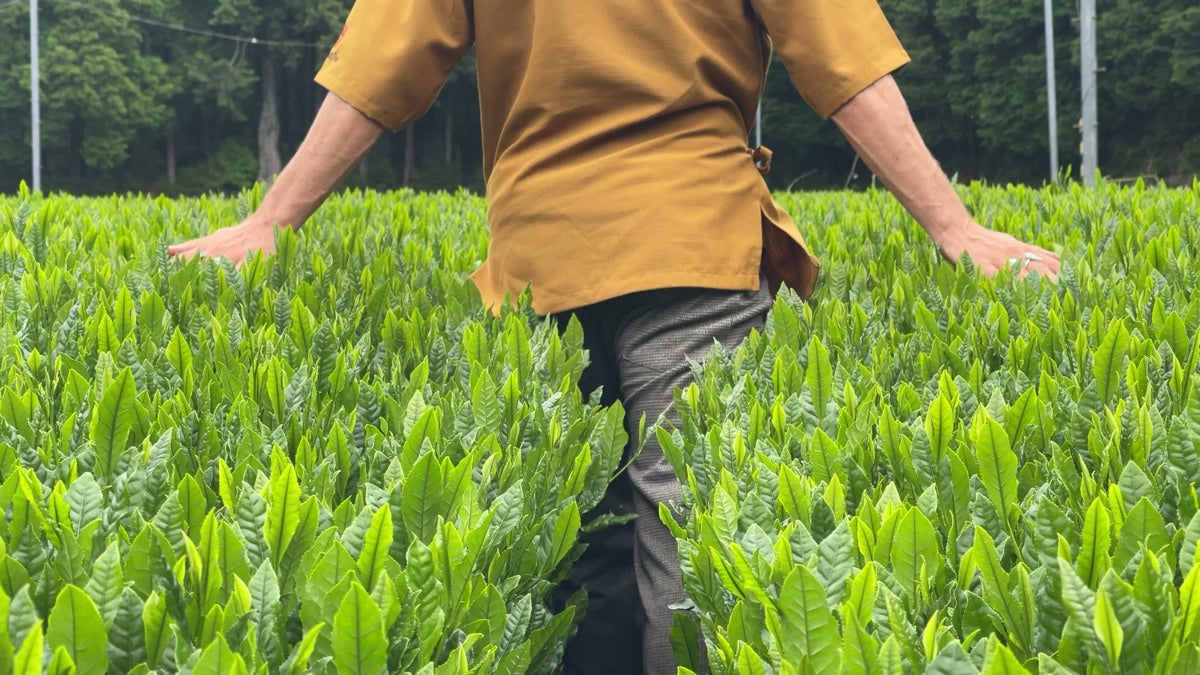
By Christian, Founder of One with Tea. We source organic Japanese matcha directly from growers in Shizuoka, Kagoshima and Fukuoka. Every number below links to the peer-reviewed study it came from, including the trials that found nothing.
We track the production side: our map of Japanese tea production by prefecture.
The most complete look at this question was published in 2026, and its verdict on anxiety is blunt. Pooling 31 randomised controlled trials with 1,168 people, the reviewers reported that L-theanine's "anxiety effects were inconsistent and non-significant" (Gerolymos 2026, Molecular Psychiatry). That is the honest headline, and it sits underneath a great deal of confident internet writing that says otherwise.
There is more to it than that one sentence. A different outcome in the same review did hold up. One small trial using actual matcha, rather than an isolated amino acid, did measure lower anxiety. And there is a dose problem that almost nobody names. So let me walk through what was measured, in how many people, and where the evidence runs out.
Key Takeaways
- Across 31 randomised trials and 1,168 people, L-theanine's effect on anxiety was reported as inconsistent and non-significant (Gerolymos 2026, Mol Psychiatry).
- What did hold up in that review was attention, not calm. A single 200 mg dose improved choice reaction time (SMD 0.51, 95% CI 0.25 to 0.77). That is a focus finding.
- A separate signal appeared for depressive symptoms after a single dose in healthy people, SMD 0.69 (95% CI 0.13 to 1.25) with one outlier excluded. The authors call it a potential effect warranting confirmation.
- The one matcha trial that measured anxiety directly found it lower with test-matcha than placebo-matcha in 39 people, but only when the ratio of caffeine and EGCG to theanine and arginine was below 2 (Unno 2018, Nutrients).
- In people with a diagnosis, it did nothing. Adjunctive L-theanine at 450 to 900 mg daily for 8 weeks did not beat placebo on the anxiety scale in 46 participants with generalized anxiety disorder, p=0.73 (Sarris 2019, J Psychiatr Res).
- The dose gap is the honest core. Trials use 200 to 900 mg of isolated L-theanine. A 2 g bowl of matcha carries roughly 10 to 90 mg, alongside 38 to 88 mg of caffeine.

What researchers actually mean by anxiety, stress, and mood
These three words get used interchangeably in tea writing, and the studies do not use them that way at all. Sorting them out changes what the evidence is allowed to say.
Anxiety is a psychological state, and it is measured by asking people. The two scales that come up most are the State-Trait Anxiety Inventory, which separates how you feel right now from how you tend to feel in general, and the Hamilton Anxiety Rating Scale, a scale a clinician fills in, used in trials of diagnosed conditions. Both are questionnaires. There is no blood test for anxiety.
Stress, in these trials, is usually measured through the body instead. Salivary alpha-amylase and cortisol both rise when the body's stress response fires, so researchers take saliva before and after a stressor. That is a real measurement of a real thing, and it is not the same thing as anxiety. A person can show a flatter amylase curve and still report feeling exactly as anxious. If cortisol specifically is your question, we handled it separately in matcha and cortisol.
Mood is broader again, and depressive symptoms are typically scored on something like the Self-rating Depression Scale. Different construct, different scale, different literature.
Keep the three apart as you read on, because a study that moved one of them is regularly reported as though it moved all three.
What the largest review of L-theanine trials found
In July 2026 a team at Aix-Marseille University published the fullest review we have: 31 randomised placebo-controlled trials, 1,168 people, healthy and clinical populations, in Molecular Psychiatry (Gerolymos 2026).
Three findings matter here, and they point in different directions.
On attention, the evidence was strong. A single 200 mg dose taken 30 to 60 minutes before testing improved choice reaction time with a standardised mean difference of 0.51 (95% CI 0.25 to 0.77). The reviewers call this a robust short-term benefit. Worth being precise about what that is: it is a measure of how quickly you pick the right response, not a measure of how calm you feel. If that is what brought you here, our piece on matcha and brain focus is the better read.
On acute stress, the reduction was modest, SMD 0.31, and the reviewers noted it was largely influenced by studies at high risk of bias. In plain terms, the better the study, the smaller the effect.
On anxiety, the sentence is the one I opened with. Effects were inconsistent and non-significant, with a single exception in one study of psychotic anxiety at 400 mg a day for eight weeks. One exception inside 31 trials is not a foundation.
The surprise was elsewhere. Excluding one outlier, a single dose in healthy people was linked to a drop in depressive symptoms, SMD 0.69 (95% CI 0.13 to 1.25), with low heterogeneity. The authors' own framing is careful: a potential antidepressant effect warranting confirmation in high-quality trials. I am repeating their hedge deliberately, because a single-dose finding in healthy volunteers is a lead, not a conclusion.
One more thing that belongs in any honest summary. The review's own conflict-of-interest statement notes that one of the four authors founded a company selling dietary supplements. That does not invalidate the work, and the review's conclusions on anxiety cut against a supplement seller's interest anyway. It is simply the kind of detail a reader deserves rather than has to dig for.
Two individual trials get quoted constantly, and both deserve a closer look than they usually get. The first gave 30 healthy adults 200 mg of L-theanine daily for four weeks in a crossover design, and reported that trait-anxiety, self-rated depression and sleep-quality scores all decreased after L-theanine (Hidese 2019, Nutrients). Read the wording carefully, though. For the trait-anxiety score the abstract reports a change after L-theanine administration; it is the sleep subscales that are explicitly reported as reduced compared to placebo. That distinction is the difference between a before-and-after change and a drug-versus-placebo effect, and two of the seven authors worked for a company that manufactures theanine.
The second is older and smaller. Twelve people did mental arithmetic as a lab stressor. L-theanine blunted their heart rate and salivary IgA responses, which the authors put down to a calmer stress response (Kimura 2007, Biological Psychology). Twelve people, one lab stressor, physiological markers rather than an anxiety scale. It is a plausible mechanism sketch. It is not evidence that a bowl of tea changes how anxious you feel.
The one matcha trial that measured anxiety directly

Almost everything above tested isolated L-theanine in a capsule. Matcha is not that. It is a whole powdered leaf carrying theanine, arginine, caffeine and catechins together, and the interactions between them turn out to be the whole story.
In 2018, Unno and colleagues published a paper in Nutrients combining animal work with a human trial of 39 participants. The human arm compared a test-matcha against a placebo-matcha, and reported that anxiety, described as a reaction to stress, was significantly lower in the test group (Unno 2018).
The condition attached to that result is what makes the paper interesting. The effect only appeared when the molar ratio of caffeine plus EGCG to theanine plus arginine, which the authors shorten to CE/TA, was below 2. Above that, nothing. Caffeine, in their framing, acts antagonistically against theanine, so the amount of theanine alone does not predict the outcome. The balance does.
We put them side by side: our caffeine comparison across teas.
The group replicated the ratio the following year using matcha baked into cookies. Test-matcha at CE/TA 1.79 versus placebo-matcha at CE/TA 10.64, 4.5 g of matcha daily for 15 days in pharmacy students, and salivary alpha-amylase came out significantly lower in the test group (Unno 2019, Heliyon). Note the outcome there is the stress proxy, not an anxiety scale.
What raises theanine and arginine relative to caffeine and EGCG in a real leaf is shading. Covering the plants for the weeks before harvest slows the conversion of amino acids into catechins, which is also why good matcha tastes sweet and savoury rather than bitter. A 2025 analysis of three matcha grades found a decreasing gradient of amino acids from ceremonial grade 1 down to food grade, with polyphenols moving the other way (Toniolo 2025, Plants).
Which lands somewhere uncomfortable for an industry that sells on price tiers: the composition is doing the work, and the label is not a reliable guide to the composition. Your palate is a better instrument than the packaging. Bitter and flat means the amino acids were not there. We go deeper into the amino acid itself in what L-theanine is.
Where the evidence stops: anxiety as a diagnosis

There is a clean line in this literature, and it is worth drawing it plainly.
In 2019, an Australian team ran a proper test in people who actually had the condition. Forty-six people with a DSM-5 diagnosis of generalized anxiety disorder received either L-theanine at 450 to 900 mg daily or matching placebo alongside their existing antidepressant, double-blind, over an eight-week period (Sarris 2019, J Psychiatr Res).
L-theanine did not outperform placebo on the Hamilton Anxiety Rating Scale, p=0.73. It did not outperform placebo on insomnia severity either, p=0.35. The one place it separated was self-reported sleep satisfaction, p=0.015. The authors concluded that the study did not support efficacy for anxiety symptoms in generalized anxiety disorder.
That is at doses two to nine times higher than the theanine in a bowl of matcha, in the group most motivated to respond, over two months. Matcha is not a treatment for an anxiety disorder, and nothing in the research supports using it as one. If that is what you are dealing with, the right move is a clinician, not a tea shop.
| Study | People | What they got | Outcome measured | Result |
|---|---|---|---|---|
| Gerolymos 2026 (review of 31 trials) | 1,168 | L-theanine, pooled doses | Anxiety scales | Inconsistent, not significant |
| Gerolymos 2026 | 1,168 | 200 mg, single dose | Choice reaction time | Improved, SMD 0.51 |
| Unno 2018 | 39 | Matcha, CE/TA below 2 | Anxiety | Lower than placebo-matcha |
| Unno 2019 | Pharmacy students | 4.5 g matcha daily, 15 days | Salivary amylase | Lower than placebo-matcha |
| Hidese 2019 | 30 | 200 mg daily, 4 weeks | Trait anxiety, mood, sleep | Scores fell after dosing |
| Sarris 2019 | 46, with a diagnosis | 450 to 900 mg daily, 8 weeks | Hamilton Anxiety Scale | No benefit, p=0.73 |
The dose gap between a capsule and a bowl

Here is the quiet arithmetic problem sitting underneath every positive headline.
The trials that found something used 200 mg of isolated L-theanine as a single dose, or 200 mg daily for four weeks, or 450 to 900 mg daily in the anxiety-disorder trial. Those are supplement doses, taken as tablets.
Matcha carries roughly 5 to 46 mg of L-theanine per gram, which puts a standard 2 g bowl at about 10 to 90 mg, as we set out in how much L-theanine matcha actually contains. Even the top of that range, from properly shaded ceremonial leaf, sits below the lowest dose used in nearly every trial above.
Two things follow from that gap. First, most of the positive evidence is on isolated L-theanine in healthy adults, not on matcha, and not in people carrying an anxiety diagnosis. Transferring a capsule result onto a bowl of tea is an assumption, not a finding. Second, the Unno work suggests the transfer may not be linear anyway, because in a whole leaf the caffeine is arriving at the same time.
The caffeine that comes with it
This is the part the calm-in-a-cup writing tends to leave out. Caffeine, on its own, pushes in the opposite direction.
A 2026 systematic review in Stress and Health screened 6,999 studies and analysed 27 of them. It reported a dose-dependent anxiety-raising effect of caffeine in healthy people, and the findings pointed mostly one way: more caffeine, more anxiety symptoms (Nascimento 2026). They also saw the effect vary between light and heavy habitual coffee and tea drinkers, and noted that caffeine-driven poor sleep may itself have fed part of the rise.
A 2 g bowl of matcha delivers roughly 38 to 88 mg of caffeine depending on grade and harvest, as we detailed in is matcha caffeinated. So a bowl is not a delivery vehicle for theanine. It is a delivery vehicle for both, at once, which is exactly why Unno's group ended up measuring a ratio rather than a quantity.
For an upper bound, the European Food Safety Authority's 2015 scientific opinion holds that intakes up to 400 mg a day spread through the day, and single doses up to 200 mg, do not raise safety concerns for healthy adults. Safety is a lower bar than comfort. If caffeine makes you jittery at 150 mg, the ceiling that matters is yours, not theirs.
How I drink matcha, and who should be careful

I sell matcha, so let me be clear about what I think this evidence licenses.
It licenses this: a whisked bowl of well-shaded matcha may support a steadier kind of attention, and the acute-attention finding for 200 mg is the most solid thing in the whole file. It does not license selling tea as an answer to anxiety. The largest review says the anxiety effects are inconsistent and non-significant, the one trial in diagnosed anxiety found nothing, and I would rather write that sentence than a sentence that sells better.
What I actually do is unremarkable. One bowl in the morning, before food rather than after, whisked properly so the powder breaks and the foam comes up. It takes ninety seconds and asks for my attention, which is the part no scale in this article will ever capture. On our growers' farms in Shizuoka and Kagoshima nobody talks about amylase curves. They talk about the shading period, the first flush, the year the weather turned.
Be careful if caffeine already makes you anxious, because a bowl carries a real dose of it. Be careful in the evening, since the sleep question is its own topic and we covered it in matcha and sleep. And if you are taking something for anxiety or mood, the theanine trials were run alongside existing medication under supervision, which is the only sensible way to think about it.
Drink it because you like the taste and because the ritual serves you. That reason survives contact with the evidence. The others mostly do not.
Frequently asked questions
Does matcha help with anxiety?
The strongest available synthesis says the evidence does not support it. Pooling 31 randomised trials with 1,168 people, the reviewers reported that L-theanine's anxiety effects were inconsistent and non-significant (Gerolymos 2026, Mol Psychiatry). One small matcha-specific trial did measure lower anxiety in 39 people, but only under a specific composition condition (Unno 2018). Treat it as a lead, not an established effect.
How much L-theanine is in a bowl of matcha compared with the studies?
Matcha carries roughly 5 to 46 mg of L-theanine per gram, so a 2 g bowl gives about 10 to 90 mg. The trials used 200 mg as a single dose, 200 mg daily for four weeks, or 450 to 900 mg daily in the anxiety-disorder trial. Even well-shaded ceremonial leaf falls short of the lowest tested dose.
Why do some matcha studies find an effect and others do not?
Composition appears to matter more than quantity. Unno's group found the stress-reducing effect only when the molar ratio of caffeine and EGCG to theanine and arginine was below 2, because caffeine acts antagonistically against theanine (Unno 2018). Shading raises amino acids and lowers that ratio, which is why grade and growing method change the result.
Can matcha replace treatment for an anxiety disorder?
No. In 46 participants with a DSM-5 diagnosis of generalized anxiety disorder, adjunctive L-theanine at 450 to 900 mg daily for eight weeks did not beat placebo on the Hamilton Anxiety Rating Scale, p=0.73 (Sarris 2019). That is a far higher dose than any bowl of tea. Anxiety disorders are a matter for a clinician.
Does matcha do anything for mood?
There is an early signal. In the 2026 review, excluding one outlier, a single dose in healthy people was linked to a drop in depressive symptoms, SMD 0.69 (95% CI 0.13 to 1.25). The authors describe it as a potential effect warranting confirmation in high-quality trials, which is where it should stay until those trials exist.
How much caffeine comes with it?
Roughly 38 to 88 mg per 2 g bowl, depending on grade and harvest. A 2026 systematic review of 27 studies reported a dose-dependent anxiety-raising effect of caffeine in healthy people (Nascimento 2026), so if caffeine is what unsettles you, that is the number to watch. EFSA puts the daily ceiling at 400 mg for healthy adults, and single doses at 200 mg.
Sources
- Gerolymos C, Saddier E, Boyer L, Fond G. Cognitive and affective effects of L-Theanine: a systematic review and meta-analysis of 31 randomized trials. Mol Psychiatry. 2026 Jul 6. PMID 42410082
- Unno K et al. Stress-Reducing Function of Matcha Green Tea in Animal Experiments and Clinical Trials. Nutrients. 2018;10(10):1468. PMID 30308973
- Unno K et al. Stress-reducing effect of cookies containing matcha green tea: essential ratio among theanine, arginine, caffeine and epigallocatechin gallate. Heliyon. 2019;5(5):e01653. PMID 31111111
- Sarris J et al. L-theanine in the adjunctive treatment of generalized anxiety disorder: a double-blind, randomised, placebo-controlled trial. J Psychiatr Res. 2019;110:31-37. PMID 30580081
- Hidese S et al. Effects of L-Theanine Administration on Stress-Related Symptoms and Cognitive Functions in Healthy Adults: A Randomized Controlled Trial. Nutrients. 2019;11(10):2362. PMID 31623400
- Kimura K, Ozeki M, Juneja LR, Ohira H. L-Theanine reduces psychological and physiological stress responses. Biol Psychol. 2007;74(1):39-45. PMID 16930802
- Nascimento AOD et al. The Effects of Caffeine on Anxiety Behavior in Healthy Individuals: A Systematic Review of the Literature. Stress Health. 2026;42(1):e70139. PMID 41549915
- Toniolo C et al. A Comparative Multianalytical Approach to the Characterization of Different Grades of Matcha Tea (Camellia sinensis (L.) Kuntze). Plants (Basel). 2025;14(11):1631. PMID 40508306
- European Food Safety Authority. Scientific Opinion on the safety of caffeine, 27 May 2015. efsa.europa.eu
This article is educational and is not medical advice. Individual response varies. Consult your doctor before changing your routine if you manage a condition.
Share:
EGCG Half-Life: How Long Does EGCG Stay in Your System?
Matcha and Blood Pressure: What the Research Says (2026)