



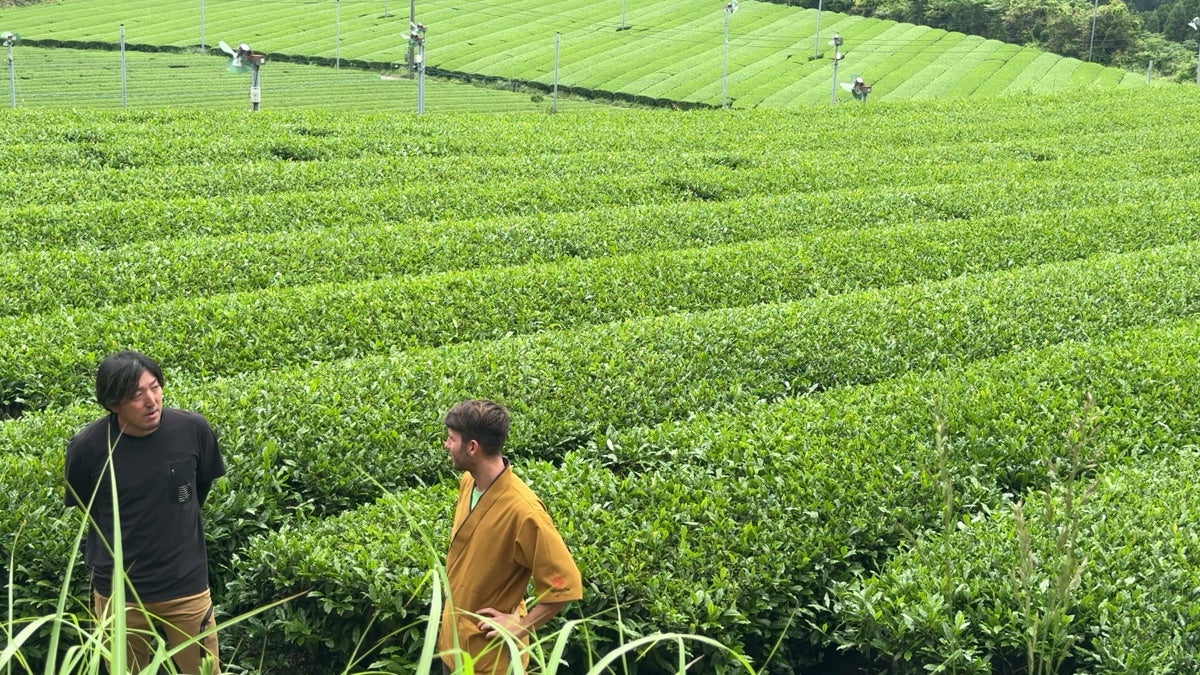
by Christian Mauerer, founder of One with Tea, who filmed with tea growers in Shizuoka and Yame in May 2025
Yamakai tea (やまかい) comes from a Japanese tea cultivar that Shizuoka's prefectural tea station selected from naturally cross-pollinated Yabukita seedlings. Shizuoka named it and made it a recommended cultivar in 1967. It makes a good sencha, but its reputation was built under shade. The Shizuoka Tea Industry Association's cultivar guide rates it for shaded tea, and a 1980 national survey records its nickname in Nara: natural gyokuro.
It is also a tea people argue about. Specialists describe a fruity aroma, raspberry to some and melon to others, and that same aroma gave it a bad name in the wholesale trade. Today Shizuoka estimates it has 54 hectares of Yamakai, against 9,990 of Yabukita. Our guide to Japanese tea cultivars shows where it sits among Japan's other tea plants.
Key Takeaways
- Bred in Shizuoka, not Yame. Yamakai is one of the "7000 series" lines selected from Yabukita seedlings at the Shizuoka prefectural tea station. A 1976 to 1979 survey of 24 tea prefectures found 203 hectares of it, 146 of them in Shizuoka.
- A shade cultivar. Shizuoka's tea industry guide rates it suited to shaded tea. In 1980, reports from five prefectures, including Fukuoka, tied it to gyokuro or covered growing.
- Fruit in the aroma. Tasting notes run to raspberry, melon and red fruit. The same aroma earned it a bad name with wholesalers.
- Hard to farm. It buds early and handles frost badly, is weak to anthracnose, and in Aichi needed more fertilizer than Yabukita. Shizuoka's Yamakai fell from 146 hectares in 1976 to an estimated 54.
- Not a matcha cultivar. I found no source showing Yamakai made into tencha, the shaded leaf that is ground into matcha.

What is Yamakai tea?
Yamakai is a Japanese green tea cultivar from Shizuoka Prefecture, grown for sencha and, above all, for shaded teas such as kabusecha and gyokuro. The cultivar guidebook of the Shizuoka Tea Industry Association (静岡県茶業会議所) calls it a mid-season cultivar, picked at about the same time as Yabukita, with slightly higher yields.
Compared with Yabukita, the same guide says, its finished leaf has a better shape and color. The tea lacks some richness, but it has little bitterness or astringency, carries umami, and suits shaded growing. Its second- and third-flush teas also tend to be very good next to Yabukita's.
| Attribute | Detail |
|---|---|
| Written form | やまかい (山峡) |
| Origin | Natural-cross seedlings of Yabukita, Shizuoka prefectural tea station ("7000 series") |
| Named | 1967, and adopted as a Shizuoka recommended cultivar |
| Line number | Shizu-7166, per one specialist source |
| Plant variety registration | None; anyone may propagate it |
| Harvest timing | Mid-season, about with Yabukita, but buds early |
| Best known as | Kabusecha and gyokuro; also sencha and black tea |
| Area today | 54 hectares in Shizuoka (prefectural estimate, 2018 to 2025) |
Where Yamakai came from

Yamakai started as one seedling among many. In 1935 a national foundation nursery, designated by Japan's agriculture ministry, was set up at the tea division of the Shizuoka Prefectural Agricultural Experiment Station. From naturally cross-pollinated Yabukita seedlings growing on the station grounds, the station selected a group of lines known as the 7000 series. Yamakai is one of them. Florent, a French Japanese tea instructor who writes the Japanese Tea Sommelier blog and sells Yamakai through his own shop, gives its number as Shizu-7166.
In 1967 Shizuoka named it and adopted it as a recommended cultivar for the prefecture. The association's guidebook explains the name: the new shoots and the finished tea look like tea from the mountains. So it was called 山峡, yamakai, which reads roughly as "mountain gorge." Its cousin Fujimidori, another Shizuoka line with a Yabukita mother, was named five years earlier.
One point confuses almost everyone. Japanese sources say Yamakai was registered in 1967, while My Japanese Green Tea calls it an unregistered cultivar. Both are right. The 1967 step was Shizuoka's own naming and adoption. The guidebook's data table records no plant variety registration, Yamakai is absent from the national Cha Norin register of cultivars, and the guidebook says anyone may propagate and sell the plants.
Specialist sources date the start of its trials to 1949. The guidebook ties the 7000-series selection only to the 1935 nursery and gives no year for Yamakai's own trials, so I would read 1949 as likely rather than settled.
Why Yamakai is a shade tea

Yamakai makes good shaded tea: its tea is gentle, with little bitterness, and its finished leaf keeps a fine shape and color. Gyokuro and kabusecha are made by shading tea bushes for a period before the harvest. The Shizuoka Tea Industry Association's guidebook rates Yamakai as suited to shaded tea. It adds that Yamakai has a loyal following in kabusecha districts, because its summer tea is good and it pairs well with covered growing.
The record goes back further. In 1980 the national tea breeding committee published a survey of cultivars across Japan's main tea prefectures in the Tea Research Journal, compiled from reports dated 1976 to 1979. Five prefectures described Yamakai in shade terms:
- Shizuoka: good for early shipping, an especially fine appearance, good summer tea, and also suited to gyokuro.
- Aichi: many branches and easy to train, finished leaf with excellent shape and color, and suited to covered growing on flat and mid-hill land.
- Kyoto: listed among the gyokuro cultivars drawing farmers' interest, with Samidori, Kokou, Komakage and Ujihikari.
- Nara: good quality, especially vivid green, "with the nickname natural gyokuro" (天然玉露の異名がある).
- Fukuoka: earlier than Yabukita, good quality, and good as gyokuro too.
The Nara line is the oldest printed source I found for the natural gyokuro name. A Shizuoka tea maker still sells its Yamakai under the same name today. It fits what the other four prefectures reported: a plant whose color and gentleness suit shaded tea.
Is Yamakai a Yame tea?

Yamakai is not a Yame tea by origin, though some admired Yamakai has come from Yame. It was bred in Shizuoka, and Shizuoka held most of it in the only national count I found. In the 1980 survey, which covered 24 tea prefectures, 146.0 of the 203.1 hectares of Yamakai recorded were in Shizuoka. Fukuoka Prefecture, home of the Yame tea district, had 8.7 hectares. Miyazaki, with 11.4, had more.
Yame's link is quality, not quantity. In 2014 Florent reviewed a traditional hon-gyokuro of Yamakai. It came from Hoshino village, in the mountains of Yame, and was grown by a Mr. Takaki. In 2019 he found a Yamakai sencha in Yabe village, also in Yame. Yame's long record with shaded tea is the subject of our Yame tea region guide and our profile of Kurihara Seicha, a Yame family that makes gyokuro and matcha.

From our tea room
Superior Sencha Green Tea - USDA Organic Japanese First Flush
First-flush loose leaf, USDA Organic, direct from Japanese family farms.
View Superior SenchaIs Yamakai used for matcha?
I found no evidence that Yamakai is used for matcha. Matcha is ground from tencha, a shaded leaf that is steamed and dried flat rather than rolled. Yamakai shares the shading, and that shared method is the only real link to matcha I could find. No source, in Japanese or English, shows Yamakai made into tencha.
The 1980 Kyoto report shows the split. It lists Yamakai among gyokuro cultivars. For tencha it names Asahi and Samidori as the cultivars at the center of planting.
So the honest connection is the method, not the product. The weeks of shade that give Yamakai its gyokuro character are the same practice that gives tencha its deep green. Our comparison of gyokuro and matcha covers where the two part ways. If that shaded taste is what draws you, our organic ceremonial matcha is where we work with it.
What does Yamakai taste like?
Yamakai tastes fruity to the specialists who love it, with raspberry and melon named most often. In his 2014 notes on the Hoshino gyokuro, Florent found a perfume that reminded him of raspberry, strong enough to dominate the umami. He thinks it comes with maturation, writing that the raspberry "is little or not present at the time of shincha in spring." His 2019 Yabe sencha opened milky and sweet, "with raspberry and wafer aromas."
His shop and two Japanese sellers land in the same fruit bowl, with different fruit:
- Florent's shop describes a Shiga sencha, from the only Yamakai garden left in Asamiya, as raspberry and melon, with "raspberry jam" on the nose.
- A Shizuoka tea maker writes that many people compare its umami to dashi and its aroma to melon.
- A Japanese single-cultivar shop describes its Yamakai black tea as tasting like prosciutto and melon.
Not everyone agrees it is a virtue. Florent wrote in 2019 that its "too special perfume gave it a bad reputation among wholesalers." The Shizuoka tea maker is blunter, calling Yamakai the trade's firmly established "disliked one" (嫌われ者). Even the Shizuoka Tea Industry Association's guidebook rates its aroma only middling, below its color and taste. That split is, for me, the most interesting thing about the plant.
Why Yamakai became rare

Yamakai became rare because it is a harder plant than Yabukita, and its aroma did not help sell it. The association's guidebook says Yamakai is picked mid-season but buds early, so spring frost catches it, and it recovers poorly. Young plants are also weak to bark-splitting frost, and it is weak to anthracnose, a leaf disease.
The 1980 prefectural reports add their own complaints. Aichi said it needed more fertilizer than Yabukita, had a short picking window, and regrew poorly after weather damage. Nara found it sensitive to soil, with weak vigor. Fukuoka reported poor recovery after late frost, leaves dropping in strong wind, and weakness to bacterial shoot blight.
| Cultivar | 1976 survey | 2025 estimate |
|---|---|---|
| Yamakai | 146.0 | 54 |
| Yabukita | 7,735.0 | 9,990 |
| All tea in Shizuoka | 21,300.0 | 11,600 |
The figures tell the rest. Shizuoka had 146 hectares of Yamakai in the 1976 survey. The prefecture's current estimate is 54, a figure it has carried unchanged every year from 2018 to 2025, so I read it as approximate. Over those same eight years, Shizuoka's total tea area fell from 16,500 to 11,600 hectares, and Yamakai is no longer on the prefecture's list of recommended cultivars. Yabukita, meanwhile, went from about 36% of Shizuoka's tea in 1976 to about 86% in 2025.
It survives in pockets. One Shizuoka City farm grows it at 450 meters in Ushizuma. Florent has found Yamakai sencha in Wazuka, Kyoto, and in Yabe, Yame, and the Asamiya garden in Shiga is described as the last one in that district.
How to brew Yamakai
Brew Yamakai like gyokuro if it was shaded, and like sencha if not. For the Hoshino gyokuro, Florent used a cool, concentrated method:
- Use 5 g of leaf with 40 ml of water at 50°C (122°F).
- Steep for 1 minute 30 seconds, with the lid off.
- For the second steep, use slightly warmer water for 40 seconds.
For an unshaded Yamakai sencha, start from our guide to brewing green tea, and taste as you go. If Florent is right that the raspberry comes with maturation, a fresh spring shincha may show less of it than a tea that has rested for a few months.
A note from me
Going in, we had Yamakai filed as "the raspberry-scented Yame gyokuro/shade cultivar," close to matcha. Two of those hold. It is a shade cultivar, and the raspberry is real, at least to the specialist who put it in print. But Yamakai was born in Shizuoka, and Yame is where some of its best-loved tea comes from, not where it began. The matcha link is a shared method, not a shared product.
What stays with me is how it survived. The trade called it difficult and disliked its perfume. Its area shrank. And yet the few growers and drinkers who still seek it out love it for exactly the thing the wholesalers rejected. It reminds me of the small makers we met in Japan: particular, stubborn, and kept going by people who care.
We don't sell a Yamakai tea. The photos in this article are from Yame and Shizuoka in May 2025, and none of them shows Yamakai. If you grow it, or have tasted a Yamakai tencha, I would love to hear from you.
Buying tea for a shop, cafe or studio? We supply organic Japanese tea at wholesale, with the same attention to where each lot comes from. See our wholesale program, or get in touch and tell us what you're pouring.
Frequently asked questions
Is Yamakai a registered tea cultivar?
Not nationally. Shizuoka named Yamakai and adopted it as a prefectural recommended cultivar in 1967, which Japanese sources call registration. It has no plant variety registration and is not in the national Cha Norin register, and the Shizuoka Tea Industry Association's cultivar guide says anyone may propagate and sell it.
Is Yamakai good for gyokuro?
Yes. The Shizuoka Tea Industry Association's cultivar guide rates Yamakai as suited to shaded tea, and it has a loyal following in kabusecha districts. In a 1980 national survey, Shizuoka, Kyoto and Fukuoka linked it to gyokuro, Aichi to covered growing, and Nara reported the nickname natural gyokuro.
Does Yamakai taste like raspberry?
To some tasters. A French Japanese tea instructor described raspberry in a Yame Yamakai gyokuro in 2014, and thought it develops with maturation after spring. He also notes red fruit, and Japanese sellers more often describe melon. Its distinctive aroma once gave it a bad reputation among wholesalers.
Is Yamakai grown for matcha?
No evidence says so. Yamakai is grown for gyokuro, kabusecha and sencha. A 1980 Kyoto report lists it among gyokuro cultivars and names Asahi and Samidori as the tencha cultivars. The link to matcha is the shading method, not the leaf.
Where is Yamakai grown?
Mostly in Shizuoka, where it was bred. A 1976 to 1979 survey of 24 tea prefectures found 146 of its 203 hectares in Shizuoka, and Shizuoka estimates 54 hectares today. Smaller plantings have been reported in Miyazaki, Fukuoka (including Yame), Aichi, Kyoto and Shiga.
What is the difference between Yamakai and Yabukita?
Yamakai was selected from Yabukita seedlings, so Yabukita is its parent. The Shizuoka Tea Industry Association's guide says Yamakai has better leaf shape and color and better summer tea, with little bitterness, but it buds early, handles frost badly, and, like Yabukita, is weak to anthracnose. In 2025 Shizuoka estimated 9,990 hectares of Yabukita against 54 of Yamakai.
Sources
- Shizuoka Tea Industry Association (静岡県茶業会議所), cultivar guidebook (茶品種ガイドブック), Yamakai page: PDF, in Japanese. Origin in the 7000 series, 1967 naming and recommendation, no plant variety registration, free propagation, name, timing, yield, disease and cold ratings, quality, shaded-tea suitability.
- Shizuoka Prefecture, 静岡県茶業の現状 (The State of Shizuoka's Tea Industry), March 2026: PDF, in Japanese. Cultivar area by year 2018 to 2025 (Yamakai 54 ha; Yabukita 9,990 ha and total 11,600 ha in 2025) and the current recommended list.
- Tea breeding committee (茶関係専門別総括検討会議育種部会), "The Spreading State and Problems of Clonal Tea Varieties in Main Tea Producing Prefectures of Japan," Tea Research Journal 51 (1980): 38 to 68, DOI 10.5979/cha.1980.38: J-STAGE. Prefecture reports on Yamakai (Shizuoka, Aichi, Kyoto, Nara, Fukuoka) and Table 1, cultivar area by prefecture.
- Florent, "Traditional Gyokuro From Yame, Yamakai Cultivar," Japanese Tea Sommelier, 14 November 2014: blog post. Hoshino gyokuro, raspberry note, maturation, brewing method.
- Florent, "Yamakai cultivar sencha from Wazuka," Japanese Tea Sommelier, 6 June 2019: blog post. Shizu-7166, trade reputation, Wazuka sencha.
- Florent, "Yamakai cultivar sencha from Yabe village in Yame," Japanese Tea Sommelier, 17 July 2019: blog post. Yabe sencha, raspberry and wafer aromas.
- Cha Norin registered cultivar list (茶農林登録品種一覧): minorien.jp. The national Cha Norin register, No. 1 onward; Yamakai does not appear.
- Ricardo Caicedo, "Yamakai," My Japanese Green Tea. Unregistered status, 1949 trial date.
- Florent's tea shop, Asamiya Yamakai sencha listing: product page. Asamiya garden, tasting notes.
- Shizuoka tea maker, Yamakai pages (in Japanese): cultivar page and Ushizuma farm page. Natural gyokuro name, melon and dashi comparison, trade reputation, 450 m farm.
- Japanese single-cultivar tea shop, Yamakai page (in Japanese): product page. Black tea and deep-steamed versions, tasting notes.
Share:
Sakimidori Tea Cultivar: Miyazaki's Bright-Green Sencha
Koshun Tea: The Shizuoka Cultivar Bred for Aroma