



By Christian Mauerer, founder of One with Tea
Yame makes only about 3 percent of Japan's tea by volume, yet it grows close to half of the country's gyokuro (Yunomi, 2023). That single contrast tells you almost everything about this small valley in Fukuoka. It is not a volume region. It is a craft region, and shade is the craft. I spent three days filming there in 2025, walking the rows and sitting with a family who has made gyokuro for four generations. This is what I learned about why Yame tea reads with such depth.
- Yame sits in southern Fukuoka Prefecture on Kyushu and grows about 90 percent of the prefecture's tea (Global Japanese Tea Association).
- It produces roughly 3 percent of Japan's tea by volume but around half of the nation's gyokuro.
- Yame's specialty is shaded tea: gyokuro and tencha, the leaf that becomes matcha.
- Yame gyokuro swept the top five places in the gyokuro category at the 73rd National Tea Competition in 2019.

Where is Yame, and why does its tea matter?
Yame is a city and tea region in southern Fukuoka Prefecture, on the northern side of Kyushu, Japan's southwestern main island (Japanese Tea Sg). It is home to roughly 1,500 growers and ranks as the sixth largest tea region in the country (Ikkyu Tea). Yame grows about 90 percent of all the tea in Fukuoka, so within the prefecture it is essentially the whole story.
What makes Yame matter is the gap between its size and its standing. The region produces only about 3 percent of Japan's tea, yet it accounts for somewhere around half of the country's gyokuro, depending on the year and the source. So when people talk about the finest Japanese shaded tea, they keep landing on this one small valley. The volume is modest. The reputation is not.
For people in the West, that distinction gets lost. We tend to think bigger means better. Yame is the opposite case, a place that chose depth over scale, and held the line on it for centuries.
A 600-year lineage: how Yame became a gyokuro region

Yame's tea history runs about 600 years. It began in 1423, when a Zen monk named Eirin Shuzui returned from China with tea seeds and planted them in the Yame area, founding Reiganji Temple in the process (Ikkyu Tea). Master Shuzui is the name every Yame grower still points back to. Six centuries later, the families here are working inside a craft that is older than most countries.
That lineage shows up in how Yame talks about itself. The competition record is the clearest proof. Yame gyokuro won the national Best Prize for twelve years running, from 2001 to 2012, until a grower from Uji finally broke the streak (Yunomi, 2023). At the 73rd National Tea Competition in 2019, Yame swept all five top places in the gyokuro category in a single year (Japanese Tea Sg).
You feel that history on the ground. Yame is not trying to become a gyokuro region. It already is one, and has been for longer than anyone alive can remember.
The craft of shade: why Yame leans into gyokuro and tencha

Yame's signature is shaded tea, and shade is what separates gyokuro and tencha from everyday green tea. Before harvest, growers cover the plants for weeks. When you block the sun, the tea plant slows its photosynthesis and builds up L-theanine, the amino acid behind umami, along with chlorophyll, which deepens the color, instead of converting them into the catechins that taste bitter (International Journal of Molecular Sciences, 2022).
That is the whole game. A 2022 peer-reviewed study on shaded matcha cultivation found that shading raises theanine while lowering polyphenols, which softens bitterness and lifts the fresh, savory character of the leaf (International Journal of Molecular Sciences, 2022). Gyokuro takes the longest shading. Tencha, the leaf that gets ground into matcha, follows the same logic. Yame specializes in all of it: kabuse-cha, gyokuro, and tencha (Japanese Tea Sg).
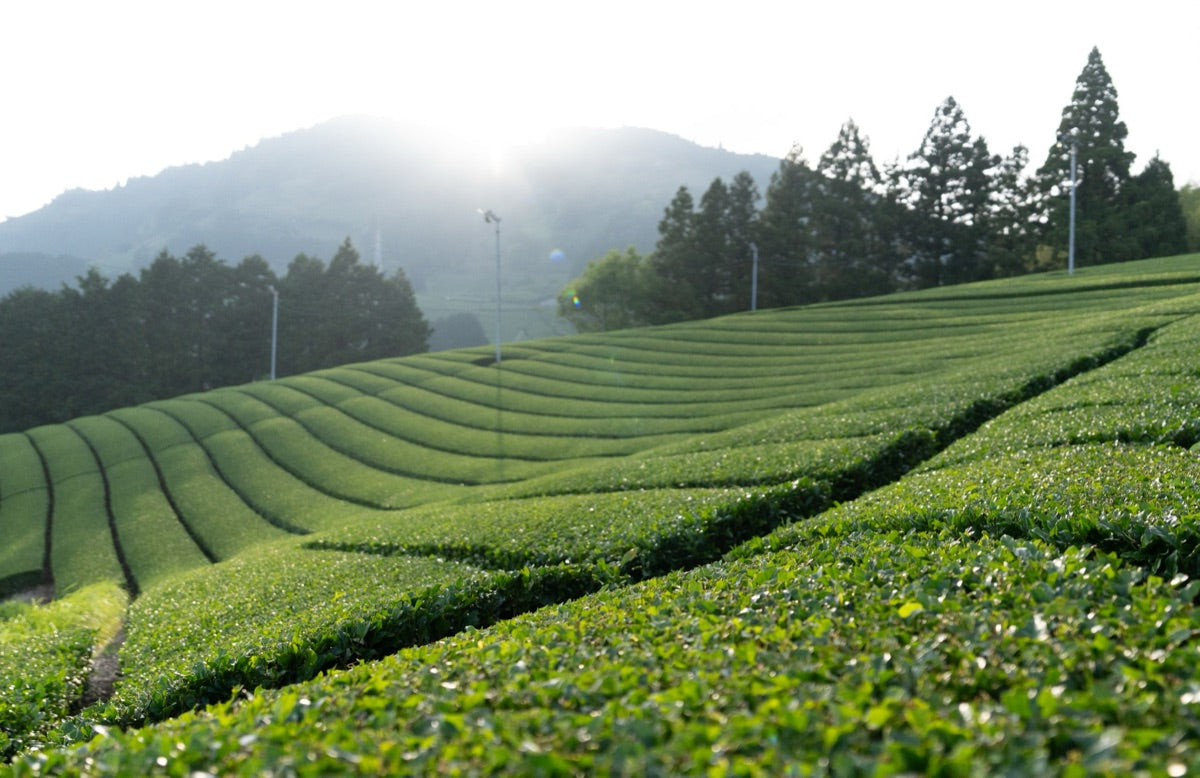
One thing I did not expect was how much of the shading in Yame is geographic, not just artificial. One plot I filmed sits inside the forest, in a narrow pocket where the trees do half the work and the morning mist does the rest. The valleys here are tight, and the mist hangs between the slopes for hours. That natural micro-shading, layered on top of the covers, is a real part of why Yame tea tastes the way it does.
Meeting a Yame family: the Kurihara brothers

To understand Yame craft, I spent a day with the Kurihara family. Akio and Yuji Kurihara are fourth-generation tea farmers who took over from their father, Kippei Kurihara, who is well respected in the Yamecha community and has served as a Yame city councilman (Kurihara Tea). The family business started in 1922 as a wholesaler, and in 1942 it moved into the Yame region, where it has been ever since (Tokyo Matcha Selection).
They are gyokuro specialists. Their farm runs about three hectares at an altitude of 300 to 700 meters, in a small village setting (Tokyo Matcha Selection). Akio is a four-time winner in Southern Japan tea hand-rolling competitions, a discipline that judges a maker's feel for the leaf rather than the size of the operation (Tokyo Matcha Selection).
What struck me most was their humility. They did not lead with awards. Nobody pulled out a trophy. When I asked how far tea went back in the area, the answer was simply that it went back further than anyone could count. If you want the full visit, I wrote about that day in detail in our profile of the Kurihara tea house.
What sets Yame matcha and gyokuro apart in the cup

Yame tea is built for depth, not brightness. Because the region leans into long shading and grows in misty, forested valleys, the cup tends toward a thick, rounded umami with low bitterness and a long, sweet finish. The shading chemistry is the reason, and the terroir reinforces it. This is tea that rewards slowing down.
Cultivar plays a part too. Across Yame, Yabukita is still the dominant plant at about 77 percent, with smaller plantings of cultivars like Saemidori, prized for rich umami and minimal bitterness (Japanese Tea Sg). Saemidori, a Yabukita and Asatsuyu cross registered in 1990, is widely used for gyokuro and tencha because of its sweetness and bright green color (Japanese Tea Sg). At the Kurihara farm I watched them push the steaming on a thin-leaf sencha to draw out the lighter top notes, the kind of small obsession that defines a maker.
If you have tasted matcha from Uji or sencha from Shizuoka, Yame will read differently. It is quieter and deeper, the tea equivalent of a low, warm note held a long time. For more on the amino acid behind that calm, savory character, see our guide to L-theanine.

From our tea room
Superior Sencha Green Tea - USDA Organic Japanese First Flush
First-flush loose leaf, USDA Organic, direct from Japanese family farms.
View Superior Sencha| Yame (Fukuoka) | Uji (Kyoto) | |
|---|---|---|
| Location | Southern Fukuoka, on Kyushu | Southern Kyoto, on Honshu |
| Specialty | Gyokuro and tencha, around half of Japan's gyokuro | Matcha and gyokuro, the historic birthplace of refined matcha |
| Terroir | Narrow, misty, forested valleys with natural shade | River-valley plateaus with a long cultivation history |
| Cup profile | Deep, rounded umami, low bitterness, long sweet finish | Bright, refined umami with classic structure |
How do you choose good Yame tea?
Start with the category and the source. For Yame, gyokuro and tencha-based matcha are where the region truly shines, so those are the styles worth seeking out. Look for tea that names its region and ideally its maker, rather than a generic blend, because traceability is the clearest signal of care. Yame's standing rests on shaded teas grown in a specific place by specific families, and the best sellers will tell you exactly where the leaf came from.
Freshness and storage matter as much as origin. Shaded teas carry delicate aromatics that fade with heat, light, and air, so buy from someone who moves through stock and stores it cold. Global matcha demand has climbed sharply in recent years while Japan's tencha supply stays structurally tight, which means more vague, unsourced product is reaching the market (Tezumi). A named region like Yame is one of the simplest ways to cut through that noise.
At One with Tea, we source named, organic Japanese tea with that same standard in mind. You can explore our organic Japanese matcha, or, if you run a cafe or shop and want to source Japanese tea at volume, see our wholesale page.
Frequently Asked Questions
Where is Yame tea from?
Yame is a tea region in southern Fukuoka Prefecture, on the island of Kyushu in southwestern Japan. It grows about 90 percent of Fukuoka's tea and is home to roughly 1,500 growers, ranking as the sixth largest tea region in the country (Ikkyu Tea).
What is Yame tea known for?
Yame is known for shaded teas, especially gyokuro and the tencha used to make matcha. Though it grows only about 3 percent of Japan's tea by volume, it produces close to half the nation's gyokuro and swept the top five gyokuro places at the 73rd National Tea Competition in 2019 (Japanese Tea Sg).
Why is Yame gyokuro so highly rated?
Yame combines long shading with a terroir of narrow, misty, forested valleys. Shading slows photosynthesis so the plant builds L-theanine and chlorophyll instead of bitter catechins, which deepens umami (International Journal of Molecular Sciences, 2022). That mix gives Yame gyokuro its thick, sweet, low-bitterness character.
How old is the Yame tea tradition?
Yame tea dates back about 600 years. It began in 1423, when the Zen monk Eirin Shuzui returned from China with tea seeds and planted them in the area, founding Reiganji Temple (Ikkyu Tea). The region's families have grown tea inside that lineage ever since.
Is Yame matcha different from Uji matcha?
Both are top shaded-tea regions, but they read differently. Yame leans into long shading in misty, forested valleys, so its teas tend toward deep, rounded umami and low bitterness. Uji, in Kyoto, carries its own centuries-old style. Tasting them side by side is the best way to feel the contrast.
May you become one with tea, one with yourself.
Christian, founder of One with Tea
Sources
- Kurihara Tea (official), homepage, retrieved 2026-06-18, https://kuriharatea.com/
- Tokyo Matcha Selection, Kurihara Family Tea Farm Fukuoka, retrieved 2026-06-18, https://tokyo-matcha-selection.com/kurihara-family-tea-farm-fukuoka/
- Ikkyu Tea, Yame, the Valley of Green Tea, retrieved 2026-06-18, https://ikkyu-tea.com/en/yame-the-valley-of-green-tea
- Global Japanese Tea Association, Japanese Tea Marathon: Fukuoka, retrieved 2026-06-18, https://gjtea.org/japanese-tea-marathon/fukuoka/
- Japanese Tea Sg, Yamecha Guide, retrieved 2026-06-18, https://japanesetea.sg/japanese-tea-pedia/yamecha/
- Japanese Tea Sg, Saemidori cultivar, retrieved 2026-06-18, https://japanesetea.sg/japanese-tea-pedia/cultivars/saemidori/
- Yunomi, Does the Best Gyokuro Come from Yame?, retrieved 2026-06-18, https://yunomi.life/blogs/japanese-tea-guide/does-the-best-gyokuro-come-from-yame
- International Journal of Molecular Sciences, Effect of Shading on Matcha Green Tea, 2022, retrieved 2026-06-18, https://pmc.ncbi.nlm.nih.gov/articles/PMC9696345/
- Tezumi, Matcha Shortage Part 2, retrieved 2026-06-18, https://www.tezumi.com/blogs/tezumi-insights/matcha-shortage-part-2-current-situation-and-the-future
Share:
Shizuoka Tea: Inside Japan's Largest Tea Region
Kagoshima Tea: Inside Japan's New Number One Tea Region