



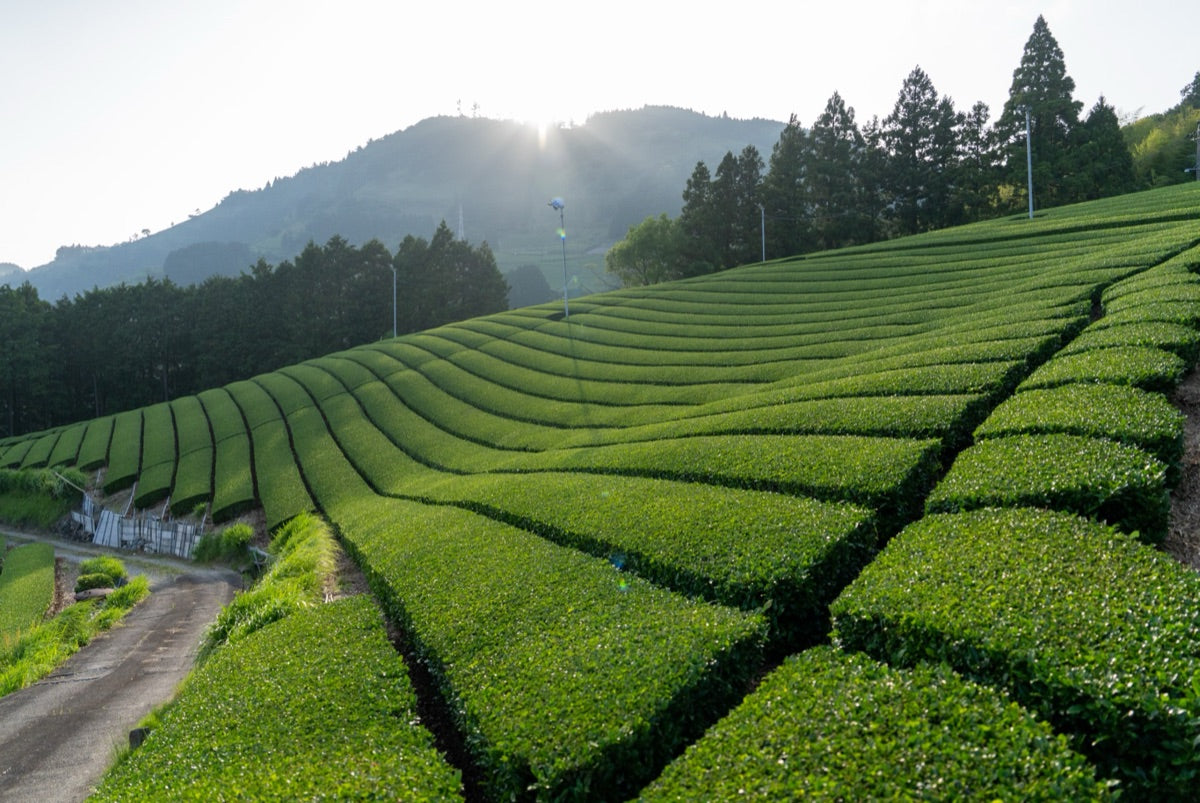
Shizuoka is Japan's historic tea heartland and still its largest growing region by planted area, home to roughly a third of the country's tea across its valleys, plateaus, and river slopes. In 2020 it produced about 25,200 tonnes, some 36% of the national total (Global Japanese Tea Association, 2020), and that share has slipped since: in FY2024 Kagoshima overtook it in crude-tea (aracha) output for the first time since 1959, roughly 27,000 tonnes to Shizuoka's 25,800, so the two now trade the lead: Shizuoka reclaimed the 2026 first harvest and still leads by cultivation area (MAFF, February 2025). I spent part of a five week filming trip here in May, walking the rows and sitting with the families who still tend them.
This is where Japanese tea became an industry, and where much of it still begins. What follows is what I saw, tasted, and learned on the ground, woven together with the history that shaped the place.
- Shizuoka is Japan's largest tea prefecture by cultivation area and its historic heartland; Kagoshima passed it in crude-tea output in FY2024, a first since 1959, leaving Shizuoka around a third of national production and a close second by volume (GJTA; MAFF, 2025).
- Tea reached Shizuoka in 1244, and the Makinohara Plateau was planted by former samurai after the Meiji Restoration.
- The Yabukita cultivar, bred here in 1908, now covers roughly 70% of Japan's tea fields.
- The region holds both volume plateaus and small mountain gardens like Honyama, the oldest tea in Shizuoka.

Where Does the Shizuoka Tea Region Grow?
Shizuoka grows tea across eight named districts, from the flat coastal Makinohara Plateau to the misty mountain valleys of Honyama, spanning cities like Kakegawa, Fujieda, Shimada, Kikugawa, and Fuji (Japan Travel). The range of terroir is the first thing you feel when you drive through it.
The prefecture sits between the Pacific and the southern Japanese Alps. On the coast, the land opens into broad terraces built for machines. Inland, the rows climb steep slopes where the harvest is slower and the fog rolls in off the rivers most mornings.
That spread of altitudes and microclimates is why Shizuoka can be both Japan's volume engine and the home of some of its most delicate mountain teas. One prefecture holds the everyday cup and the rare one at the same time.
For a wider view of how origin shapes flavor, see our guide to what ceremonial grade really means.
| Share of Japan's tea | Around a third of national output; #1 by area, #2 by volume since FY2024 (25,200 t in 2020) |
| First cultivation | 1244, in Ashikubo, Suruga |
| Signature cultivar | Yabukita, bred here in 1908, now ~70% of Japan's fields |
| Signature style | Fukamushicha, deep steamed, popularized from ~1975 |
| Oldest tea | Honyama, over 800 years, upper Abe and Warashina valleys |
How Did Shizuoka Become Japan's Tea Heartland?

Shizuoka's tea story starts in 1244, when the Buddhist monk Shoichi Kokushi carried seeds back from China and planted them in Ashikubo, in the Suruga area (GJTA). Suruga is still regarded as the birthplace of Shizuoka tea, almost eight centuries later.
The scale came much later, and almost by accident. After the Meiji Restoration ended the samurai class, displaced retainers needed new livelihoods. At the end of the 19th century they cleared the vast, unused Makinohara Plateau and planted it with tea (Far East Tea Company).
The land was gentle and flat enough for mechanized cultivation, and warm enough for several harvests a year. When Shimizu port opened in 1899, it quickly became the largest tea exporting port in Japan, and Shizuoka's leaf began moving to the world (GJTA).
Standing on Makinohara today, you can still read that history in the geometry. The rows run for hundreds of meters in clean parallel lines, shaped for the harvesting machines that made this prefecture the heart of an industry.
Who Are the Producers Behind Shizuoka Tea?

The families I met in Shizuoka work at very different scales, from a single tea master near Mt. Fuji to a multi-generation company supplying matcha and sencha across Japan. Each one taught me something the data never could.
In Fuji, I sat with Mohei Honda, a tea master who lets visitors brew their own cup with the mountain filling the window. He talks about water temperature the way other people talk about old friends, slowly and with real affection.
In Shizuoka City, I visited Ichikawa-en, a company that began as a small local tea shop in the Suruga ward more than half a century ago and grew into a house supplying matcha and sencha well beyond the city (Ichikawa-en). They make matcha, sencha, and hojicha, and they keep specialist tea masters, called Chashi, on the bench. Momoko, the owner's daughter, ran the blending table beside her mother while I watched, tasting batch after batch to hold a flavor steady.

From our tea room
Superior Sencha Green Tea - USDA Organic Japanese First Flush
First-flush loose leaf, USDA Organic, direct from Japanese family farms.
View Superior SenchaHigher up, in the fog of the upper Abe River valley, Houkouen tends the kind of mountain garden that gives Honyama its name. The contrast between that misty hillside and the open plateau below is the whole prefecture in a single drive.
If you want to meet these families on film, you can watch the documentary we made across these five weeks.
From Leaf to Aracha: How the Region Makes Its Tea

Most Shizuoka tea is steamed within hours of picking, then rolled and dried into aracha, the rough crude tea that gets refined and blended later. Around 1975 the region popularized fukamushicha, a deep steamed style that has become a Shizuoka signature (GJTA).
Inside the facilities, the smell hits first, green and grassy and almost sweet. Fresh leaf moves through steaming and rolling lines, and what comes out the other end is a dense, deep green crumble that still smells alive.
Deeper steaming breaks the leaf down more, which is why fukamushicha brews a cloudy, full bodied cup with less astringency. It is a practical answer to the lowland coastal leaf, which can grow stronger and needs taming. The technique turned a regional trait into a style people now seek out.
Refining and blending is its own craft. Watching Momoko hold a house flavor across changing batches, I understood that consistency in tea is not the absence of work. It is constant, careful work that the drinker never sees.
What Is the Yabukita Cultivar, and Why Does It Matter?

Yabukita is the single most planted tea cultivar in Japan, covering roughly 70% of the country's tea growing area, and it was bred in Shizuoka in 1908 by Hikosaburo Sugiyama (Far East Tea Company). More than a century later, it is still the plant the rest of the country grew around.
Sugiyama selected it for frost resistance, strong yield, and a clean, balanced flavor. That combination is why it spread so far. A cultivar that survives the cold, fills the basket, and tastes reliably good will always win the field.
So much of what the world tastes as Japanese green tea is, in truth, the taste of one Shizuoka selection from over a century ago. When you understand that, a single old plant in a city ward starts to feel less like trivia and more like a root.
What Does Shizuoka Tea Actually Taste Like?

There is no single Shizuoka flavor, because the prefecture spans deep steamed coastal sencha and delicate high mountain leaf, but the through line is a balanced umami with a clean, grassy finish. Honyama, in the upstream Abe and Warashina valleys, carries over 800 years of history and is the oldest tea in Shizuoka (Japanese Tea).
Those mountain gardens sit high in the upstream valleys, wrapped in river fog, and the tea was prized by Tokugawa Ieyasu at Sumpu Castle from 1605 (Japanese Tea). The cup is gentler and more aromatic than the bold lowland style, with a long, sweet finish.
What stays with me is not one flavor but the range. To stand on the plateau in the morning, then climb into the fog by afternoon, is to taste a whole prefecture in a day. That is why we keep coming back to source here.
For more on choosing a clean, high quality leaf, see our guide to the best organic matcha.
Frequently Asked Questions
Is Shizuoka the largest tea region in Japan?
Shizuoka is Japan's largest tea region by cultivation area and its historic heartland, and it led on output for decades. That changed in FY2024, when Kagoshima produced more crude tea (aracha) for the first time since 1959, about 27,000 tonnes to Shizuoka's 25,800 (MAFF, 2025). Shizuoka still grows around a third of Japan's tea, it reclaimed the 2026 first harvest, and the two now trade the top spot (GJTA).
When did tea cultivation begin in Shizuoka?
Tea reached Shizuoka in 1244, when the monk Shoichi Kokushi planted seeds from China in Ashikubo, in the Suruga area (GJTA). Suruga is regarded as the birthplace of Shizuoka tea.
What is Honyama tea?
Honyama is a high mountain tea from the upper Abe and Warashina river valleys, with over 800 years of history as the oldest tea in Shizuoka (Japanese Tea). Its gardens sit high in the upstream valleys, wrapped in river fog.
Why is the Yabukita cultivar so common?
Yabukita was bred in Shizuoka in 1908 for frost resistance, strong yield, and balanced flavor (Far East Tea Company). Those traits made it the standard, and it now covers about 70% of Japan's tea fields.
Sourcing Shizuoka, the Slow Way
At One with Tea, we travel to the fields and meet the families before we ever sell a tin. It is slower, and it is the only way I know to stand behind what is in the cup.
You can shop our Japanese matcha grown in this tradition, or, if you run a cafe or shop and want to source directly, reach out about wholesale. I read those messages myself.
May you become one with tea, one with yourself.
Christian Mauerer, founder, One with Tea
Sources
- Global Japanese Tea Association, Shizuoka tea region, retrieved 2026-06-18, https://gjtea.org/japanese-tea-marathon/shizuoka/
- Far East Tea Company, Shizuoka: Japan's Largest Tea Region, retrieved 2026-06-18, https://fareastteacompany.com/blogs/fareastteaclub/tea-growing-region-in-japan-shizuoka-prefecture
- Ichikawa-en Co., Ltd., official site, retrieved 2026-06-18, https://www.ichikawaen.com/
- Japanese Tea (japanesetea.sg), Honyama-cha, retrieved 2026-06-18, https://japanesetea.sg/japanese-tea-pedia/honyama-cha/
- Japan Travel, The Eight Tea Regions of Shizuoka, retrieved 2026-06-18, https://en.japantravel.com/shizuoka/the-eight-tea-states/63727
Share:
Inside Wazuka: Kyoto's Hidden Village of Tea
Yame Tea: Inside Fukuoka's Shaded Tea Region