



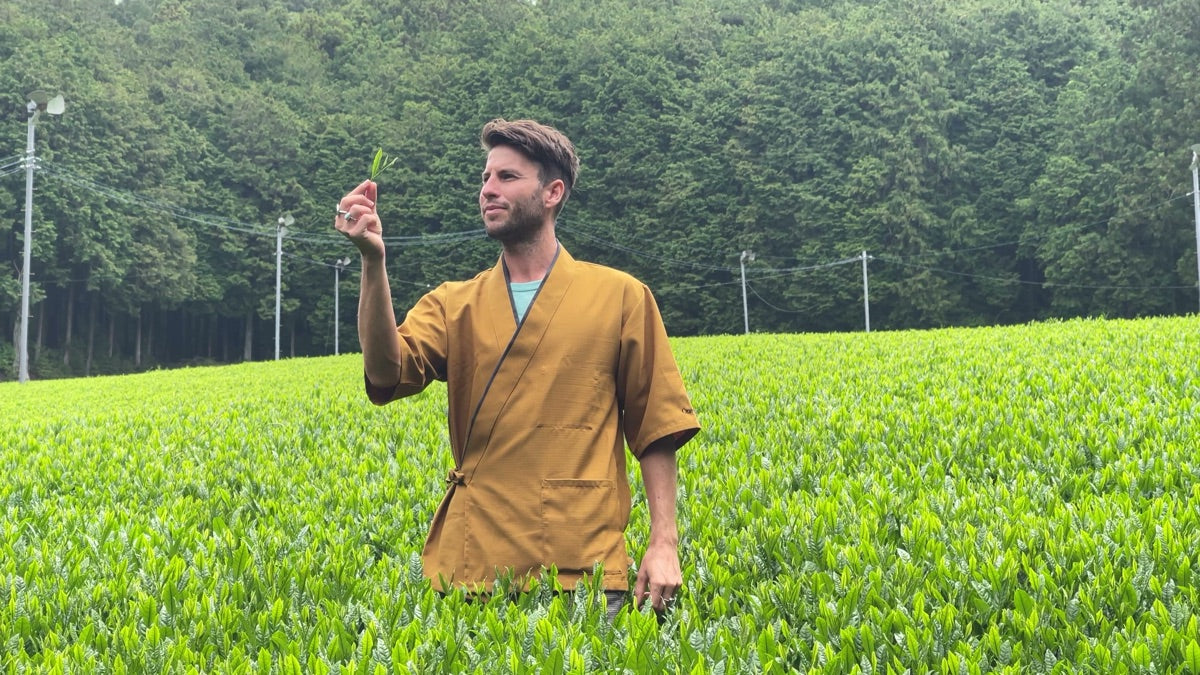
by Christian Mauerer, founder of One with Tea
Koganemidori tea (黄金みどり, "golden green") comes from a Japanese tea plant whose new leaves come up gold instead of green. It began as a single mutated shoot in one family's tea field in Morokozawa, in the mountains of Shizuoka City, and almost all of it still comes from that one garden. It is not a registered variety. Shizuoka University researchers described it under the line name 'Morokozawa', and their 2011 analysis found about 2.4 times the free amino acids of Yabukita, Japan's standard green tea plant.
For a matcha company, the interesting part is that it breaks the rule matcha is built on. Matcha and gyokuro are shaded to raise their amino acids. Koganemidori needs full sun to stay gold, and shade turns it green. Our guide to Japanese tea cultivars covers the registered family it sits beside.
Key Takeaways
- One shoot, one farm. Hiromitsu Sato and his father, Takehisa, found a single gold shoot in their field in the mid-1980s and multiplied it by cuttings for more than 30 years.
- It is unregistered. The registered white-leaf varieties Shizuoka University names are Hoshinomidori (1981) and Kiraka (2006). Koganemidori is neither. The research literature calls it 'Morokozawa'.
- Its parent is disputed. Where English sources name a parent, they say Yabukita. Shizuoka University's researchers say it is "said to be" a bud sport of Sayamakaori.
- Sun makes it gold, shade makes it green. It is a light-sensitive albino, and it keeps its gold from spring to autumn.
- More amino acids, fewer catechins. First-flush shoots measured 73 mg of free amino acids per gram against Yabukita's 30, and 41 mg of theanine against 18.

What is Koganemidori tea?
Koganemidori is an albino, or white-leaf, tea plant. Its newest leaves carry almost no chlorophyll, so they come up yellow-gold while the older leaves below stay green. Japanese growers call this group hakuyoucha (白葉茶, white-leaf tea). A 2021 study in Frontiers in Plant Science, written by a Shizuoka University team and built around this plant, describes it as a "light-sensitive Japanese albino tea cultivar."
White-leaf tea is not white tea. The Shizuoka University lab that studies these plants spells the difference out on its research page: white tea is a processing style, mostly from northern Fujian, named for the white down on its buds. White-leaf tea is a plant whose new shoots are yellow-white. It can be made into more than one style of tea, and Koganemidori's grower makes several.
Its best-known form is a light-steamed (asamushi) sencha. The same garden also makes it into kamairicha (pan-fired green tea), white tea, hojicha and GABA tea.
| Attribute | Detail |
|---|---|
| Written forms | 黄金みどり, read こがねみどり; also written Kogane Midori |
| Status | Not variety-registered; studied as the line 'Morokozawa' |
| Type | Light-sensitive albino (white-leaf) tea |
| Origin | A single gold shoot found in the Sato family's field in the mid-1980s |
| Parent | Disputed: Yabukita (English accounts that name one) or Sayamakaori (Shizuoka University) |
| Where | Koganemidori Chaen, Morokozawa, Aoi Ward, Shizuoka City, at about 500 m |
| Output | About 70 to 80 kg of finished tea a year |
| Made into | Light-steamed sencha, kamairicha, white tea, hojicha, GABA tea |
One golden shoot in a green field

Koganemidori started with one shoot. In a 2020 interview with PERFECT DAY, Hiromitsu Sato told it like this: one day he and his father walked out into the field, and in all that green there was a single gold bud. It was 34 years earlier, he said, the year he started farming. That puts the find in the mid-1980s. A local community site for the upper Warashina valley, Okuwarashina Web, names the father as Takehisa and credits the two of them together.
Nobody set out to make a new tea. The City of Shizuoka's tea site says the first ideas were a bonsai, then a garden hedge, simply because the color was beautiful. The family field was planted with local Yabukita at the time, the standard sencha plant of the region. Only years later, once there were enough plants, did the Satos process the leaf and drink it. Sato's word for the reaction was surprise: a dense, full-bodied tea with an umami that, in his words, exploded in the mouth.
There was no seed to sow and no nursery to buy from, so every plant came from a cutting. Sato and his father built the golden field one cutting at a time over more than 30 years. His summary of the division of labor is my favorite line in anything written about this tea: "My father struggled to grow the saplings, and I struggled to sell them." He only started selling in earnest around 2015, taking the tea to events where nobody had heard of it.
Where it grows: Morokozawa, in the Honyama hills

Koganemidori grows at Koganemidori Chaen, 219 Morokozawa, in the Ōkawa district of Aoi Ward, Shizuoka City. Morokozawa sits in the upper valley of the Warashina River. Shizuoka Prefecture defines Shizuoka Honyama tea as tea grown along the Abe River and its tributary, the Warashina, which places the farm inside Honyama, the area where, by tradition, Shizuoka tea began about 800 years ago. Our Shizuoka tea region guide covers the wider prefecture.
The field sits at about 500 m. The family's tea terrace above it, built for visitors, is at 550 m, according to the regional tea project HONYAMA88. The city describes the access road as barely wide enough for one small car, and a tea specialist who visited told FOODIE the field is steep enough to ski down. Sato told PERFECT DAY in 2020 that the garden yields only about 80 kg of tea a year; the FOODIE piece puts it at about 70 kg. The leaf is fired in an old machine 5 kg at a time, and the final sorting of stems and broken leaf is done by hand because the leaf cannot go through an electric sorter.
Sato also says the plant does not travel. Cuttings planted elsewhere died, he told the city, and PERFECT DAY reported that saplings taken to Shizuoka University for research all died too. That is worth holding next to one detail from the 2021 study: its Koganemidori came from a mature row at the Shizuoka Prefectural Tea Research Center in Kikugawa, and the authors thank Sato for providing rooted cuttings. Koganemidori was already growing at the Tea Research Center by 2010, when the 2011 paper's leaf-color readings were taken there. So the plant can survive a lowland research station. Whether it thrives anywhere the way it does at Morokozawa is a question nobody has published an answer to.
Is Koganemidori a registered cultivar?
No. Koganemidori has no Cha Norin number and no plant variety registration. Shizuoka University's 2011 paper in the Tea Research Journal lists what Japan had registered at the time: two white-leaf varieties, Hoshinomidori in 1981 and Kiraka in 2006. The university lab's research page adds where they came from. Hoshinomidori was found among native seedlings in Hoshino village, in Fukuoka's Yame district. Kiraka was found in Fukuroi, Shizuoka, as a bud sport of Yabukita.
The same paper then names two unregistered white-leaf lines being grown on a small scale in Shizuoka: 'Morokozawa', which is Koganemidori under the name of its village, and 'Yamabuki', said to come from a Yabukita seedling. The lab's current research page still describes Koganemidori as not variety-registered. One Japanese tea guide, CHAMART, goes further and labels Koganemidori a product name.
In practice, "Koganemidori" on a package points to one farm, not to a registry entry. That is unusual in a series where most of the plants I write about come from a breeding station, with a line number and a registration date.
Yabukita or Sayamakaori? The parent question
Where English sources name a parent at all, they say Yabukita. The blog The Floating Tea Stem says so directly. Most Japanese retail copy just calls it a sudden mutation (突然変異) without naming one, and the City of Shizuoka lists it as a grower-selected variety. PERFECT DAY's writer does too, with a telling hedge: a Yabukita mutation, "apparently."
Shizuoka University's 2011 paper, written with the prefecture's own Tea Research Center, says something different. It describes 'Morokozawa' as "said to be a bud sport of Sayamakaori" (「さやまかおり」の枝変わりとされる). The lab page repeats it. And a tea specialist from the company that retails it, interviewed by the Mitsukoshi Isetan food magazine FOODIE, called the variety simply unknown.
Sayamakaori's own pedigree narrows the gap. Sayamakaori is itself a Yabukita seedling, Cha Norin No. 31, registered by Saitama in 1971. So Koganemidori is either a sport of Yabukita or a sport of a Yabukita child. Yabukita is in the family either way. What I could not find is a published genetic test that settles which, and the university's own wording, "said to be," is a hedge too. I am leaving it open rather than picking a side.
Why the leaves turn gold in the sun

Koganemidori turns gold because its new leaves barely build chloroplasts, and sunlight is what keeps them that way. The 2021 Frontiers in Plant Science study tracked four Japanese white-leaf teas from the first spring harvest to the autumn one. Kiraka, Hoshinomidori and Yamabuki are temperature-sensitive: their pale leaves turned green from early summer. Koganemidori is light-sensitive, and its new leaves stayed gold from spring right through autumn.
Only the new growth is gold. The mature leaves underneath are green, and the study measured what Sato had described from the field: the gold leaves photosynthesize poorly, while the green leaves below work hard. As Sato put it to PERFECT DAY, the green leaves do the photosynthesis and send nutrients up to the gold ones.
Shade reverses the whole thing. When the researchers covered Koganemidori rows with an 85% black shade cloth for 14 days in spring, the new leaves turned green. They also found a natural reversion inside a Koganemidori row, a bud sport whose leaves came up green, and used it as a genetically identical control. In the gold leaves, genes that drive chloroplast development, including two versions of a regulator called GLK1, were sharply switched down.
The 2011 paper puts a number on how pale the leaf is. On a handheld chlorophyll meter, first-flush Yabukita read 32.7. Koganemidori read 0.6, the lowest of the four white-leaf teas tested, whose readings ran from 0.6 to 8.1.
The matcha rule, reversed
Matcha and gyokuro are shaded before harvest to raise amino acids and umami. Koganemidori gets there by the opposite route, and shade takes its advantage away. PERFECT DAY's 2020 interview put Sato's point plainly: gyokuro is shaded to increase amino acids, but shade Koganemidori and its amino acid values fall. Our guides to gyokuro and kabusecha cover how shading works on an ordinary green leaf.
The 2021 Shizuoka University study supports Sato's point with a clean comparison. Gold leaves carried more free amino acids than green leaves from the same plant, whether the green came from the bud-sport reversion or from shading. The bud-sport result held in both years studied. The shaded comparison was less consistent between 2015 and 2017, which the authors put down to field conditions and a change of method, so the bud-sport contrast is the stronger evidence.
The gold leaf is not building more amino acids. The authors concluded the high levels come from breaking down proteins, especially chloroplast proteins, and from spending less nitrogen on chlorophyll, possibly helped by a stalled urea cycle, rather than from extra amino-acid synthesis. Genes for making theanine, the amino acid most tied to tea's savory taste, were not switched up at all. The leaf accumulates amino acids because it stops spending them.
Inside the leaf: the 2011 numbers
Koganemidori's first-flush shoots held 73 mg of free amino acids per gram of dry leaf, against 30 mg for Yabukita, or about 2.4 times as much. Morita and colleagues at Shizuoka University and the Shizuoka Tea Research Center measured shoots from the 2009 first harvest, and published the figures in the Tea Research Journal (No. 111, pages 63 to 72). The figures below are per gram of dry shoot, not per cup.
| Measure | Koganemidori ('Morokozawa') | Yabukita |
|---|---|---|
| Chlorophyll meter reading (2010) | 0.6 | 32.7 |
| Total free amino acids | 73 | 30 |
| Theanine | 41 | 18 |
| Arginine | 12 | 3.1 |
| Total catechins | 105.9 | 145.4 |
| EGCG | 51.0 | 75.2 |
| Caffeine | 40.1 | 33.4 |
Theanine was 41 mg against 18, a little over twice Yabukita's level. Arginine was almost four times higher, at 12 mg against 3.1, and the paper notes that arginine takes a much bigger share of the amino acids in all four white-leaf teas. Theanine was still the single largest amino acid in Koganemidori, just a smaller slice of a much bigger pie.
Catechins went the other way. Koganemidori held 105.9 mg per gram against Yabukita's 145.4, roughly three quarters, with EGCG at 51.0 against 75.2. Caffeine was slightly higher, not lower, at 40.1 mg against 33.4. Anyone reaching for this tea as a low-caffeine option should know that.
These are one season's figures from a single harvest year, measured on shoots rather than on brewed tea. They line up with the 2021 study's direction, though, and with what My Japanese Green Tea reports for white-leaf teas generally: about twice the amino acids of a Yabukita sencha, and often lower catechins.

From our tea room
Superior Sencha Green Tea - USDA Organic Japanese First Flush
First-flush loose leaf, USDA Organic, direct from Japanese family farms.
View Superior SenchaWhat does Koganemidori taste like?

Koganemidori tastes savory and sweet with very little bitterness, which is what its chemistry predicts. The 2021 paper frames tea quality as a balance between umami compounds, the free amino acids including theanine, and bitter ones, the catechins and caffeine. Koganemidori tips that balance hard toward umami. Our explainer on umami covers why that registers as depth rather than sweetness alone.
The people who have tasted it reach for food words. Sato described a dense, full umami. FOODIE's write-up compares its umami to dashi, the Japanese savory stock, and the tea specialist it interviewed said they had never tasted a tea like it. CHAMART found that brewed cool or cold it had almost no bitterness, a moderate umami, and a mango-like aroma and sweetness. HONYAMA88's tasting of the light-steamed sencha called it a ripe, tomato-like umami.
The color carries into the cup. In 2019, The Floating Tea Stem found the liquor came out golden-yellow whatever the water temperature, and pushed one session to six infusions. A 2022 revisit found it very rich in umami and very sweet. The Satos' hojicha is sweet and fragrant in Sato's telling, chestnut-like in CHAMART's. Our guide to hojicha explains what roasting does to a leaf.

From our tea room
Organic Hojicha Powder - USDA Certified Roasted Green Tea
Roasted green tea, naturally low in caffeine. USDA Organic.
View Organic HojichaHow the farmer brews it
Brew it cold or cool first. At the tea terrace, Sato covers about 1 g of leaf with water and waits five minutes, according to HONYAMA88. The City of Shizuoka recommends cold brewing outright. The FOODIE piece gives the fullest method:
- Put about 3 g of leaf and water in a teapot and wait five minutes.
- Keep to cold water for the first three or four infusions, which keeps bitterness and astringency down.
- Then switch to water below 50°C for about 30 seconds, and raise the temperature a little with each infusion.
- Expect close to ten infusions from one serving.
Frequently asked questions
Is Koganemidori a white tea?
No. Koganemidori is a white-leaf tea, hakuyoucha, meaning the plant's new shoots are yellow-white because they lack chlorophyll. White tea is a processing style, named for the white down on its buds. The Satos do make a white tea from Koganemidori, but its best-known form is a light-steamed sencha.
Is Koganemidori a registered cultivar?
No. It has no Cha Norin number and no plant variety registration. Shizuoka University's researchers list it as an unregistered line called 'Morokozawa'. The registered white-leaf varieties they name are Hoshinomidori (1981) and Kiraka (2006).
Is Koganemidori a mutation of Yabukita?
Possibly. English sources that name a parent say so. Shizuoka University's 2011 paper says it is said to be a bud sport of Sayamakaori instead. Sayamakaori is itself a Yabukita seedling, so Yabukita is in its ancestry either way. I found no published genetic test that settles it.
Why isn't Koganemidori shaded like gyokuro?
Because shade turns it green. It is a light-sensitive albino: its new leaves stay gold only in sunlight. In a 2021 Shizuoka University study in Frontiers in Plant Science, shading for 14 days turned the leaves green, and green leaves from the same plant carried fewer free amino acids than the gold ones.
How do you brew Koganemidori?
Start cold. Steep about 3 g in cold water for five minutes and keep to cold water for the first three or four infusions. Then move to water below 50°C for about 30 seconds and raise the temperature gradually. It can give close to ten infusions.
Where does Koganemidori grow?
Almost entirely at one farm, Koganemidori Chaen in Morokozawa, Aoi Ward, Shizuoka City, at about 500 m in the Warashina valley, part of the Honyama tea area. The grower says cuttings planted elsewhere died, though a research row has been kept at the Shizuoka Prefectural Tea Research Center in Kikugawa.
A note from me
Koganemidori tea comes without the usual paperwork: no breeding station, no registration date. What it has instead is a farmer and his father who kept one odd shoot going for thirty years, first because it was pretty and then because it tasted like nothing else, and a university lab curious enough to find out why it tastes the way it does.
It also changed how I think about what makes matcha taste the way it does. Matcha is shaded because shade makes a green leaf sweeter and more savory. Koganemidori reaches a similar place by giving up its green altogether. Two opposite roads to the same cup is not something I expected to find in a single mutated bush.
We don't sell Koganemidori. I wrote this because the English story of this tea usually stops at "a golden mutation," and the real one has a disputed parent, a lab's worth of chemistry and a family that never gave up on it. If you have been up to the terrace at Morokozawa, I would love to hear what it's like.
Buying tea for a shop, cafe or studio? We supply organic Japanese tea at wholesale, with the same sourcing detail you have just read applied to every lot. See our wholesale program, or get in touch and tell us what you're pouring.
Sources
- Yamashita, Kambe, Ohshio, Kunihiro, Tanaka, Suzuki, Nakamura, Morita and Ikka, "Integrated Metabolome and Transcriptome Analyses Reveal Etiolation-Induced Metabolic Changes Leading to High Amino Acid Contents in a Light-Sensitive Japanese Albino Tea Cultivar," Frontiers in Plant Science 11: 611140, published January 2021: Frontiers, full text also on PubMed Central. Light sensitivity, seasonal color, shading and bud-sport comparisons, mechanism, source of research plants.
- Morita, Ikka, Kunihiro, Suzuki, Ooishi, Kobayashi and Nakamura, "Chemical Composition of New Shoots in the First Crop Season of White Leaf Tea Cultivated in Japan," Tea Research Journal 111: 63 to 72, 2011: J-STAGE. Registered and unregistered white-leaf teas, the Sayamakaori attribution, chlorophyll meter readings, amino acid, catechin and caffeine tables.
- Shizuoka University, Laboratory of Plant Functional Physiology, research page on tea genetic resources and white-leaf tea: shizuoka.ac.jp. Registration status, parentage attribution, white-leaf versus white tea.
- Appendix 1, List of Cha Norin Registered Cultivars: hinshu.pdf. Sayamakaori, Cha Norin No. 31, Yabukita seedling, 1971, Saitama.
- Shizuoka Prefecture food information center, "Shizuoka Honyama tea": pref.shizuoka.jp. Honyama defined as the Abe and Warashina river basins.
- City of Shizuoka, "Ocha no Machi" tea site, garden page and grower profile: Koganemidori Chaen and Hiromitsu Sato. Discovery, bonsai and hedge, cuttings elsewhere dying, cold-brew recommendation.
- PERFECT DAY, interview with Hiromitsu Sato, June 2020: perfectday.jp. Discovery year, Yabukita field, elevation, amino acids and shade, 80 kg output, processing, product range.
- HONYAMA88, two-part feature on Koganemidori Chaen: part one and part two. Terrace elevation, brewing, light-steamed sencha tasting, hojicha.
- Okuwarashina Web, Koganemidori: okuwarashina-web.net. Father's name, joint discovery, hedge.
- FOODIE (Mitsukoshi Isetan), "A green tea that is golden": mi-journey.jp. Variety described as unknown, access, brewing method, infusions.
- CHAMART, Koganemidori: chamart.jp. Product-name note, cold-brew and hojicha tasting.
- The Floating Tea Stem, tastings of 2019 and 2022: 2019 and 2022. Yabukita attribution, liquor color, infusions.
- Ricardo Caicedo, "Hakuyoucha: White Leaf Tea," My Japanese Green Tea. White-leaf tea overview, amino acid and catechin comparison.
Share:
Minamisayaka Tea Cultivar: Miyazaki's Milk-Tea Aroma, Explained
Best Tea for Coffee Drinkers: Energy Without Jitters