

by Christian, founder of One with Tea
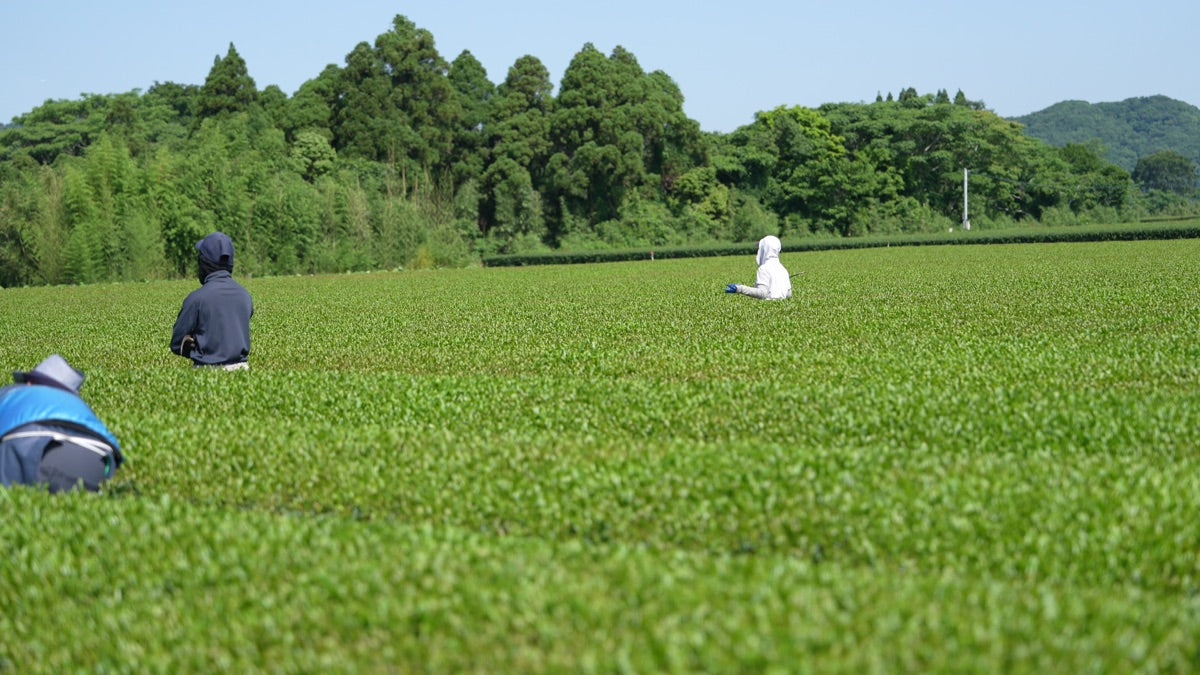
Minamisayaka (みなみさやか, written 南爽) is a Japanese sencha cultivar bred by Miyazaki Prefecture, registered nationally as Cha Norin No. 42 in 1991. Japan's national agriculture institute, NARO, describes its finished tea in one unusually specific phrase: a floral aroma that calls milk tea to mind, over a clean, crisp body. It carries Assam and Caucasus blood on its mother's side and Yabukita on its father's.

From our tea room
Superior Sencha Green Tea - USDA Organic Japanese First Flush
First-flush loose leaf, USDA Organic, direct from Japanese family farms.
View Superior SenchaTwo things you'll read about it in English are wrong, and I want to deal with them up front because I nearly repeated both. It is not a Kagoshima cultivar, and it is not a deep-steaming cultivar. Our guide to Japanese tea cultivars maps the wider family this one belongs to.
Key Takeaways
- Miyazaki, not Kagoshima. It was bred at the Miyazaki Prefectural tea branch station under the line name Miyazaki No. 9. Its registered owner is Miyazaki Prefecture.
- The 1991 and 1994 dates are both real. 1991 is the Cha Norin registration and the year the plant variety application was filed. 1994 is when that registration was granted as No. 3932. English write-ups pick one and never explain the other.
- Its family tree is strange. One grandparent line reaches back to an Assam plant and a tea plant from the Caucasus, which is close to unheard of in a Japanese sencha cultivar.
- Steam it lightly. NARO says the distinctive aroma is emphasized when the steaming is shallower, which is the opposite of the deep-steamed style.
- Professional opinion is split, because it tastes so unlike Yabukita.

What is the Minamisayaka tea cultivar?
Minamisayaka is a fixed sencha cultivar bred in Miyazaki Prefecture in southern Kyushu, from a cross made in 1970. Japan's Ministry of Agriculture, Forestry and Fisheries describes it in its variety registration record as a sencha cultivar suited to the tea-growing districts of the warm southwest. The same record rates it slightly late in budding and plucking, strongly resistant to ring spot, and somewhat high yielding.
The name is a compound the breeders explained themselves. Minami (南) is south, for the warm region it was made for. Sayaka (爽) is crisp or refreshing, for its aroma. NARO's tea cultivar handbook gives the reasoning on page 21: it was named for possessing a refreshing fragrance.
| Attribute | Detail |
|---|---|
| Written forms | みなみさやか, 南爽, Minami-sayaka |
| Meaning | Minami (south) + sayaka (爽), crisp or refreshing |
| Former line name | Miyazaki No. 9 (宮崎9号) |
| Bred by | Miyazaki Prefectural General Agricultural Experiment Station, Tea Branch |
| Cross made | 1970 |
| Parents | Miya A-6 (seed) × Chahon F1NN27, usually written NN27 (pollen) |
| National register | Cha Norin No. 42, 1991, registered use: sencha |
| Variety registration | No. 3932, granted 14 March 1994, lapsed 15 March 2012 |
| Plucking | 1 to 3 days after Yabukita |
| Yield vs Yabukita | 10 to 20 percent more on first flush, 30 to 40 percent more on second |
| Signature | Floral aroma reminiscent of milk tea, clean and crisp on the palate |
Why Minamisayaka has two registration dates
Both 1991 and 1994 are correct, and they refer to two different registers. This is the single most confused fact about the cultivar in English, and it took reading both records side by side to sort out.
1991 is the Cha Norin registration. The national tea cultivar register lists it as Cha Norin No. 42, Minamisayaka, former line name Miyazaki No. 9, bred 1991 at Miyazaki, use: sencha. That is the number Japanese growers use. It sits between Fuushun at No. 41 and Hokumei at No. 43, both also registered in the early 1990s. Fuushun's parent Z1 has its own story in this series.
1994 is the plant variety registration. That is a separate, commercial protection under Japan's Seed and Seedling Act, closer in spirit to a patent. MAFF's record shows application No. 4556 filed on 1 June 1991, granted on 14 March 1994 as registration No. 3932, with an 18 year term of breeder's rights that expired on 15 March 2012. The registrant is Miyazaki Prefecture, and seven breeders are named on the record.
So 1991 is doing double duty. It is the Cha Norin year and the year the protection application went in. 1994 is when that second registration came through. NARO's handbook now marks it a general variety, meaning the protection has lapsed and anyone may propagate it.
Assam, the Caucasus, and Yabukita: an unusual family tree

Most Japanese sencha cultivars are selections from Japanese native seedlings crossed with each other. Minamisayaka is not, and its pedigree is the most interesting thing about it.
NARO's pedigree chart lays out three generations. The seed parent, Miya A-6, was bred in Miyazaki from Takachiho, itself a seedling of a Miyazaki native variety, crossed with a Miyazaki line called F1-9-4-48. Go one more step back and F1-9-4-48 turns out to be MAi23, an Assam plant, crossed with MC3, a tea plant from the Caucasus. The pollen parent, NN27, was bred at the National Tea Experiment Station from Yabukita and a Shizuoka native seedling.
Assam ancestry in a Japanese green tea cultivar is rare. A tea plant from the Caucasus is rarer still, and I couldn't find a published explanation for why the Miyazaki program reached for one. Ricardo Caicedo, who writes the reference site My Japanese Green Tea, hit the same wall and called the choice very odd. I would rather leave that honestly open than invent a reason for it.
What the pedigree does explain is the aroma. Japanese retailers list a Minamisayaka wakoucha, Japanese black tea, from Gokase in the Miyazaki highlands. No official record designates it for black tea, so treat that as a producer's choice, but it is exactly what you'd expect a plant with Assam in its background to take to well.
When is Minamisayaka picked?

Minamisayaka is plucked 1 to 3 days after Yabukita, which makes it slightly late without being a genuinely late cultivar. NARO's own timing diagram places it between Yabukita and Okumidori, nearer the Yabukita end.
For a farm running several cultivars, those few days matter more than they sound. Staggering plucking dates is how a single factory line gets through a harvest without leaf sitting around losing quality. That is the practical reason Kyushu farms keep a spread of cultivars rather than planting one. Next door in the Kagoshima tea region, Horiguchi Seicha runs roughly twenty cultivars across its fields for exactly this reason, with Yabukita down at two to three percent of planted area.
What does Minamisayaka taste like?

NARO puts it plainly: the finished tea is characterized by a floral aroma reminiscent of milk tea, with a clean, refreshing body. The handbook's sensory notes for the cultivar reach for sweet milk and fruit. MAFF's registration record rates the aroma and the taste of the finished product as superior, and the liquor color upper middle.
Caicedo describes the aroma as milky, floral and refreshing, and notes that the sencha leaf takes on a good bright green. He also makes the observation I think is the most useful thing anyone has written about this cultivar: its valuation by Japanese tea professionals is divided, because the flavor is so different from Yabukita.
That's worth sitting with. Japanese tea judging grew up around a Yabukita-shaped idea of what good sencha smells like. A cultivar carrying Assam and Caucasus genes does not land inside that frame, and a scoring system built on one reference point will read difference as deviation. Minamisayaka belongs to a small class that Japanese tea reference works file under aroma cultivars, alongside Fujikaori and Soufuu. If you have tried either of those and liked what the aroma did, this is the same conversation.
Steam it lightly, not deeply

Steam Minamisayaka lightly. NARO's processing notes say the distinctive aroma tends to be emphasized when the steaming is shallower, and this is the part I most want to get right, because the shorthand I started from had it backwards.
Deep steaming, the fukamushi style that dominates much of southern Kyushu, breaks the leaf down further to push body and color forward. On a cultivar whose entire reason for existing is an aroma, that trade runs the wrong way. Nothing in the record ties Minamisayaka to fukamushi, and the Miyazaki station that bred it lists its specialties as sencha and kamairicha, the pan-fired style, not deep steaming.
Two more notes from the same page, both aimed at the factory. Minamisayaka is a heavy-bud type, so picking late costs you. And because its buds stay soft relative to their maturity, a light charge can let leaf settle at the bottom during the coarse rolling stage. Neither is a flaw, exactly. They are the handling terms of a cultivar built around a delicate trait. If you want the contrast in full, our guide to sencha covers how steaming time reshapes a cup.
What it gives the farmer, and what it costs

The yield figures are genuinely good. NARO records 10 to 20 percent more than Yabukita on the first flush and 30 to 40 percent more on the second. The tree is strongly upright, cuttings root well, and it carries strong resistance to anthracnose, ring spot and the white peach scale, with NARO stating outright that control is not needed for those three.
The costs are specific. Blister blight and bacterial shoot blight do occur, and need managing where they are common. Young bushes want low pruning to force branching, and double-row planting to fill out.
Then there is cold, where the sources look like they contradict each other until you read what each one is actually rating. Caicedo calls it fairly cold resistant. NARO warns that cases of sudden wilt have been recorded, so take care in cold regions. MAFF's record settles it: resistance to split-type freeze injury is rated strong, while resistance to bacterial wilt is only medium. Both writers are right about different hazards. The plant handles a hard frost cracking its wood well, and handles the disease pressure that comes with cold ground less well. Nationwide cultivation is possible, with that caveat attached.
One number I will not give you is how much of it is planted. Japan's per-cultivar area tables are not published freely, and I couldn't find a hectare figure for Minamisayaka at any level of source. I would rather say that than print an estimate that then gets quoted back as fact.
Frequently asked questions
Is Minamisayaka a Kagoshima cultivar?
No. It was bred by Miyazaki Prefecture, at the Miyazaki Prefectural General Agricultural Experiment Station's tea branch, under the line name Miyazaki No. 9. Miyazaki and Kagoshima are neighbors in southern Kyushu, which is probably how the mix-up spreads, but every registration record names Miyazaki.
Is Minamisayaka used for deep-steamed tea?
Not by design. NARO's processing note says its distinctive aroma is emphasized with shallower steaming. Its registered use is sencha, and the station that bred it works in sencha and kamairicha rather than fukamushi.
What does the name Minamisayaka mean?
South (南) plus crisp or refreshing (爽). NARO records that it was named for the warm southern region it suits and for its refreshing fragrance.
Why do some sources say 1991 and others 1994?
Because there are two registers. Cha Norin No. 42 was registered in 1991. The separate plant variety registration, No. 3932, was applied for in June 1991 and granted in March 1994. Both dates describe real events.
Can you still plant Minamisayaka freely?
Yes. The breeder's rights ran 18 years and expired on 15 March 2012, and NARO's handbook now lists it as a general variety.
Does Minamisayaka make good black tea?
Japanese retailers list a Minamisayaka wakoucha, Japanese black tea, from Gokase in Miyazaki. Its registered use is sencha, so black tea is a producer choice rather than an official designation, though the Assam ancestry makes it an unsurprising one.
A note from me
I started this one with a note in our own planning file calling Minamisayaka a Kagoshima cultivar from the deep-steaming belt. Both halves were wrong, and I only found out because I went to the Japanese registration records instead of trusting the note.
What I keep taking from these cultivar write-ups is how much gets lost in the hop from a Japanese record to an English summary. A registration number becomes a year. Two registers become one. A processing instruction flips to its opposite. None of it is anyone acting badly. It's just what happens when a fact travels without its paperwork.
We don't currently sell a Minamisayaka tea. I wrote this because the plant is genuinely unusual, and because a cultivar that tastes like something other than Yabukita is worth knowing about whether or not there is anything to sell at the end of it. If you work with this cultivar and can fill in what I could not, particularly the MC3 question or any planted-area figure, I would like to hear from you.
Buying tea for a shop, cafe or studio? We supply organic Japanese tea at wholesale, with the same sourcing detail you have just read applied to every lot. See our wholesale program, or get in touch and tell us what you're pouring.
Sources
- NARO, Tea Cultivar Handbook, 6th edition, 2022, p.21 and pedigree chart: cha_hinshu_handbook06.pdf. Naming, parentage, plucking date, yield, disease resistance, processing notes, flavor description.
- MAFF, plant variety registration record No. 3932: Variety Registration Database. Application No. 4556 filed 1991-06-01, registered 1994-03-14, rights lapsed 2012-03-15, registrant Miyazaki Prefecture, trait ratings.
- Appendix 1: List of Cha Norin Registered Cultivars, MAFF table: hinshu.pdf. Cha Norin No. 42, line name Miyazaki No. 9, bred 1991 at Miyazaki, use sencha.
- Miyazaki Prefectural General Agricultural Experiment Station, tea branch: chagyo.html. Station specialties.
- Furuno Tsurukichi and others, "Breeding of the sencha cultivar Minamisayaka", Bulletin of the Miyazaki Prefectural General Agricultural Experiment Station 31: 40-50, March 1997. Record: CiNii Research, ISSN 0388-8339. Cited as a bibliographic record; the paper itself is not available online.
- Ocha Hyakka tea encyclopaedia, aroma cultivar classification: ocha.tv.
- Ricardo Caicedo, "The Minamisayaka Tea Cultivar", My Japanese Green Tea. Leaf description, divided professional opinion, MC3 note.
Share:
Kuritawase Tea Cultivar: From Shizuoka Seed to Tanegashima
Koganemidori Tea: Japan's Golden-Leaf Green Tea, Explained