



By Christian, founder of One with Tea
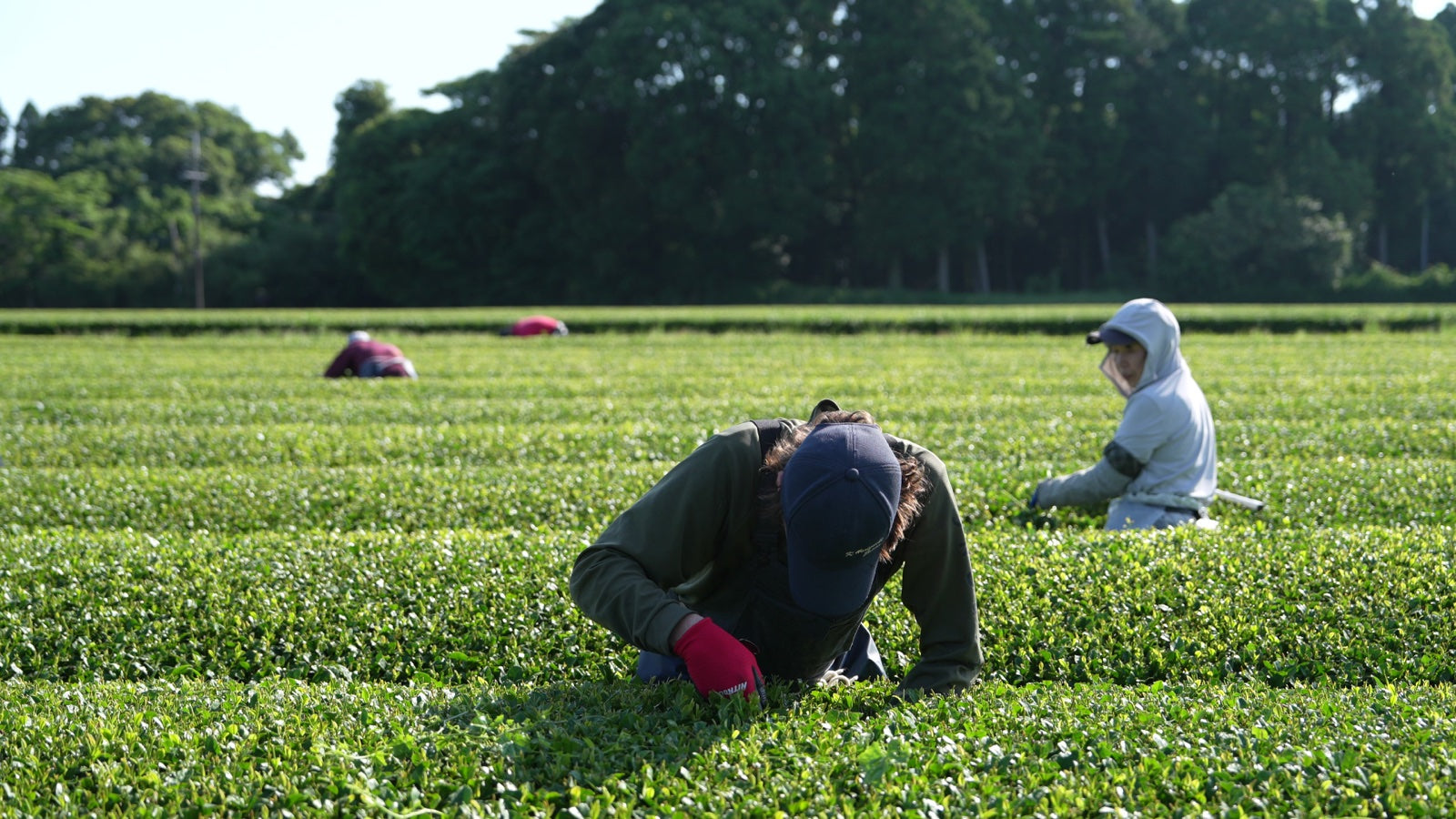
The first time I drove south through Kagoshima, I expected the famous mountain terraces of older tea country. Instead the land opened up. Wide, flat fields of tea ran to the horizon under a huge sky, with the Sakurajima volcano breathing smoke in the distance. This is the southern tip of Japan's main islands, and it has quietly become the most important tea region in the country.
Key Takeaways
- In 2025 Kagoshima out-produced Shizuoka in first-flush tea for the first time since records began in 1991, 8,440 vs 8,120 tons, though Shizuoka reclaimed the first-flush lead in 2026 (about 10,700 vs 9,610 tons); Kagoshima still leads Japan on total tea output (Misty Leaf, 2026).
- Volcanic soil from Sakurajima, flat sun-soaked fields, and a warm southern climate let Kagoshima harvest as early as late March.
- The region leans on cultivars beyond Yabukita, including Yutakamidori, Saemidori, and Asatsuyu.
- Farms like Horiguchi Seicha in Shibushi show what Kagoshima does at scale, 300 hectares of certified tea in one operation.

How Did Kagoshima Become Japan's Top Tea Region?
In 2025 Kagoshima produced 8,440 tons of first-flush tea against Shizuoka's 8,120 tons, the first time the southern prefecture led the first harvest since the survey began in 1991 (Misty Leaf, 2026). Shizuoka's first-harvest volume fell about 19 percent that year, while Kagoshima held nearly level.
Shizuoka reclaimed the first-flush lead in 2026 (about 10,700 tons to Kagoshima's 9,610, per News On Japan), so the first harvest now trades between them. But Kagoshima's total-output lead was not a one-season surprise. In 2024 Kagoshima became Japan's number one producer of aracha, the crude unrefined tea that gets refined into sencha and other styles. It made roughly 27,000 tons against Shizuoka's 25,800, a 36.5 percent national share, ending a Shizuoka run of more than 60 years at the top (Misty Leaf, 2026). As of the April 2026 industry reports, Kagoshima has held first place for two straight years (Global Japanese Tea Association, 2026).
For the global comparison, see the worldwide production picture.
We track the production side: prefecture by prefecture production figures.

Numbers like these tell you where the leaf is grown. They do not tell you why it tastes the way it does. For that, you have to look at the ground itself. For the bigger picture on what is moving prices and supply, I keep our Japanese matcha price tracker updated through the season.
What Gives Kagoshima Tea Its Character?

Kagoshima's character starts in the soil. The Sakurajima volcano blankets the region in volcanic ash that drains well and keeps roots healthy, and the prefecture's wide flat terrain bathes the bushes in long hours of sunlight, unlike the shaded mountain farms further north (Japanese Tea Sommelier SG, 2024).
Then there is the warmth. Kagoshima sits near the southern end of the main islands, so spring arrives early. First-flush picking can begin as early as the end of March, which means Kagoshima tea is often among the very first new-season leaf to reach the Japanese market each year (Japanese Tea Sommelier SG, 2024). When you taste a Kagoshima sencha, you are often tasting the earliest green of the year.

From our tea room
Superior Sencha Green Tea - USDA Organic Japanese First Flush
First-flush loose leaf, USDA Organic, direct from Japanese family farms.
View Superior SenchaStand in a Kagoshima field at dawn and you feel why this matters. The air is soft, the light is already strong, and the rows hold a deep vivid green that the camera never fully catches. There is a stillness here that I think ends up in the cup, a kind of openness the land seems to give freely.
Which Cultivars Define Kagoshima Tea?

Kagoshima is known for cultivar diversity. While Yabukita is the dominant tea variety nationwide, Kagoshima leans heavily on others, including Yutakamidori, Saemidori, Asatsuyu, Okumidori, Kanayamidori, and Yamatomidori (Japanese Tea Sommelier SG, 2024). That range is part of why the region's teas can taste so different from one farm to the next.
Each cultivar brings its own signature. Yutakamidori is prized for a deep color and rich body that suits the deep-steamed fukamushi style. Asatsuyu is sometimes called a natural gyokuro for its sweetness and low astringency. Saemidori brings a bright, clean green flavor that growers love for high-grade sencha. Planting several varieties also spreads the harvest window, so a single farm is not racing to pick everything in one frantic week.
The clearest local expression of all this is Chiran-cha, grown around Minamikyushu. It is Kagoshima's most prominent brand name, recognized for award-winning kabuse-cha and fukamushi sencha, and it pulled several older local names together under one identity in 2017 (Japanese Tea Sommelier SG, 2024). If you want to understand grade and quality more broadly, our guide to ceremonial grade matcha walks through how the same care shows up in powdered tea.
What Does a Kagoshima Tea Farm Actually Look Like?

To make the region concrete, look at one farm I have spent real time with. Kagoshima Horiguchi Seicha sits in Shibushi City on the Osumi Peninsula, and it processes leaf from 300 hectares of tea, 120 hectares the company owns directly plus 180 hectares managed by 42 affiliated farmers (Horiguchi Seicha, 2025; Global Japanese Tea Association, 2024).
The farm's roots reach back roughly 75 years, to post-war black tea cultivation around 1950 (Horiguchi Seicha, 2025). Today it is run by Daisuke Horiguchi, born in Shibushi in 1982 and the second-generation representative director since July 2018. After university he trained four years with a Shizuoka producer, then came home in April 2010 to build on what his father, Yasuhisa, had grown over the previous decade (Global Japanese Tea Association, 2024).

Daisuke is a qualified Japanese tea instructor and serves as an ambassador of the Japanese Ochawari Association. In February 2025 the company earned an Excellence Award at the INACOME Business Contest 2024 for its capsule-tea project (Horiguchi Seicha, 2025). What strikes me most is how lightly he wears all of it. He talks about tea the way some people talk about their kids.
How Does Kagoshima Grow Clean Tea at This Scale?

Scale and care do not have to fight each other here. At Horiguchi Seicha, about 60 hectares, roughly half the fields, are organic-certified this season, and the whole operation carries Rainforest Alliance certification along with FSSC 22000 food-safety certification (Horiguchi Seicha, 2025; Global Japanese Tea Association, 2024). It was among the first tea farms in Japan to earn Rainforest Alliance status.
Some of the cleanest ideas are also the simplest. The Horiguchi family developed a machine they call the Hurricane King, which uses pressurized wind and water to knock pests off the canopy without chemicals (Global Japanese Tea Association, 2024). It is a very Kagoshima answer, practical, low-input, and quietly inventive.
The cultivar mix supports this too. Horiguchi grows only about 2 to 3 percent Yabukita, choosing instead a spread of other varieties that ripen at different times and resist different pressures (Global Japanese Tea Association, 2024). For me, this is what conscious sourcing looks like in practice, not a slogan but a set of careful choices repeated across hundreds of hectares.
Why Should Kagoshima Tea Matter to You?

Because the leaf in your cup increasingly comes from here. With Kagoshima leading Japan on total tea volume, and trading the first-flush lead with Shizuoka year to year, more of the tea sold worldwide as Japanese green tea originates in this one southern prefecture, even when it is blended and labeled elsewhere. Historically about 70 percent of Kagoshima's tea has shipped to other regions as aracha for blending, though the prefecture is building its own name now (Japanese Tea Sommelier SG, 2024).
Knowing the origin changes how you drink. When you choose tea that names its prefecture, its cultivar, and ideally its farm, you are choosing transparency over anonymity. You can taste the difference, and you can trust where it came from. That is the whole reason I source the way I do.
At One with Tea, we work directly with Japanese growers and test what we sell, so you can find that same presence in your own kitchen. Explore our organic Japanese matcha to bring a little of this care home, or if you run a cafe or shop, reach out about wholesale sourcing and we will talk through what fits your menu.
Frequently Asked Questions
Is Kagoshima now the largest tea-producing region in Japan?
Yes. Kagoshima became Japan's number one producer of crude tea in 2024 with about 27,000 tons, a 36.5 percent national share, and in 2025 it also led first-flush production at 8,440 tons against Shizuoka's 8,120, though Shizuoka reclaimed the first-flush lead in 2026 (about 10,700 tons to 9,610); Kagoshima still leads on total volume (Misty Leaf, 2026).
What makes Kagoshima tea different from Shizuoka tea?
Kagoshima's volcanic soil from Sakurajima, flat sun-rich fields, and warm southern climate allow harvesting as early as late March (Japanese Tea Sommelier SG, 2024). The region also favors cultivars beyond Yabukita, giving its teas a distinct depth and sweetness.
Which tea cultivars are grown in Kagoshima?
Kagoshima grows Yabukita, Yutakamidori, Saemidori, Asatsuyu, Okumidori, Kanayamidori, and Yamatomidori (Japanese Tea Sommelier SG, 2024). Yutakamidori suits deep-steamed fukamushi sencha, while Asatsuyu is prized for its natural sweetness.
What is Chiran-cha?
Chiran-cha is Kagoshima's most prominent local tea brand, grown around Minamikyushu and known for award-winning kabuse-cha and deep-steamed sencha. Several historical local names consolidated under the Chiran-cha identity in 2017 (Japanese Tea Sommelier SG, 2024).
Where is Horiguchi Seicha located?
Kagoshima Horiguchi Seicha is in Shibushi City on the Osumi Peninsula. It processes leaf from 300 hectares, 120 company-owned plus 180 managed by 42 affiliated farmers, and its roots reach back roughly 75 years to around 1950 (Horiguchi Seicha, 2025).
A Region Worth Knowing
Kagoshima spent decades as the quiet workhorse of Japanese tea, sending its leaf north to be blended under more famous names. That season is ending. The land, the climate, and a generation of growers like Daisuke Horiguchi have pushed it to the front, and the rest of us are finally paying attention.
Next time you brew a Japanese green, ask where it grew. More and more, the honest answer is Kagoshima. May you become one with tea, one with yourself.
Share:
Yame Tea: Inside Fukuoka's Shaded Tea Region
Matcha and Sencha: Supply Shifts in 2026 and What They Mean for Buyers