



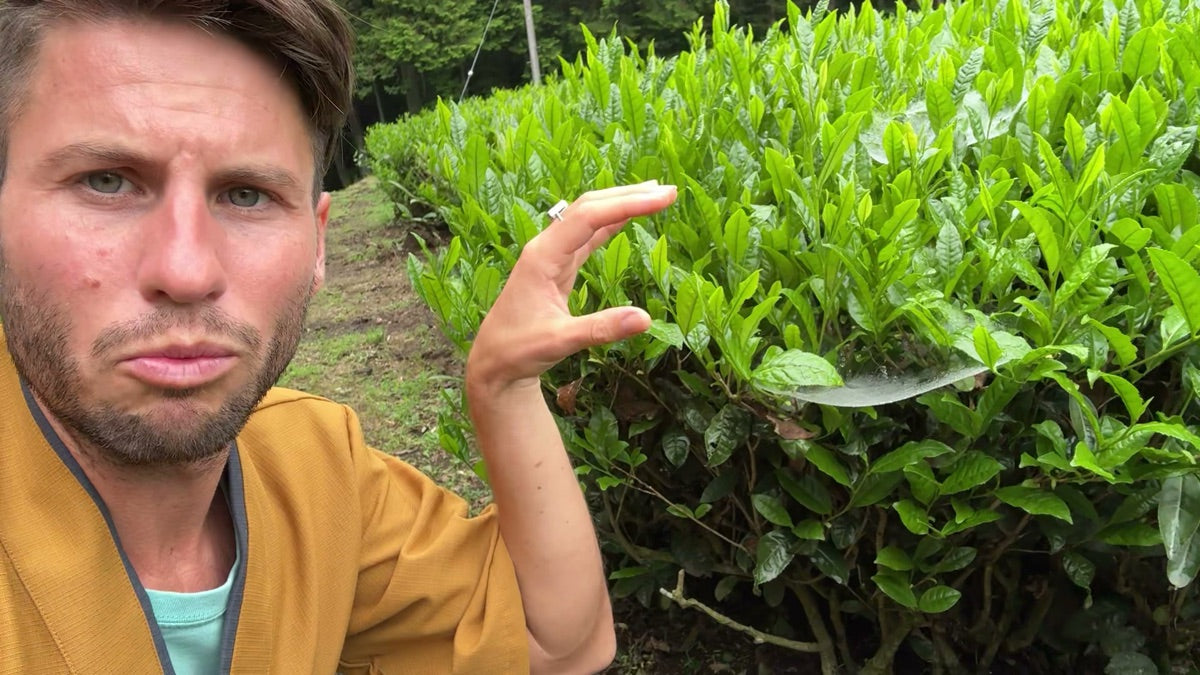
Harumidori is a late-season Japanese sencha cultivar, plucked roughly 3 to 6 days after Yabukita, even though its name translates to "spring green". It was bred at the national tea research station in Makurazaki, Kagoshima, from a Kanayamidori mother and a Yabukita father. It entered the national list as Cha Norin No. 48 in 2000.
I went looking for Harumidori expecting an early cultivar. The name points that way, and so did the note I had written for myself. The records point the other way, and the reason turns out to be more interesting than the mistake.
Key Takeaways
- Harumidori is late, not early. NARO's variety record calls it a late-maturing type, budding and plucked 5 to 6 days after Yabukita; NARO's cultivar handbook puts the plucking gap at 3 to 5 days.
- The name refers to colour, not timing. NARO's handbook says it was named for the vivid green of its spring first-flush shoots.
- It is roughly three-quarters Yabukita by pedigree, because its mother Kanayamidori is itself a Yabukita cross. NARO still rates its finished tea above Yabukita, especially on taste.
- It is weak against three named pests and diseases, and slow to establish. That is the honest reason a cultivar this good in the cup stayed rare.
- We do not sell Harumidori. This is a reference page, not a product page.

What is Harumidori?
Harumidori (はるみどり) is a Japanese green tea cultivar bred for sencha. It carries two separate official numbers: Cha Norin No. 48 in the Ministry of Agriculture, Forestry and Fisheries registered-cultivar table, listed in 2000, and plant variety registration No. 11102, granted on 17 March 2003 with a 25 year term that runs to 17 March 2028. Its old breeding line name was Makurazaki No. 19.

From our tea room
Superior Sencha Green Tea - USDA Organic Japanese First Flush
First-flush loose leaf, USDA Organic, direct from Japanese family farms.
View Superior SenchaThose two numbers come from two different registries and mean two different things. The Cha Norin number is its place in the national list of tea cultivars. The plant variety registration is the breeder's right. Neither one is "the" registration date. That is why you will see both 2000 and 2003 quoted for this cultivar, depending on which document someone was reading.
| Attribute | Harumidori |
|---|---|
| Japanese name | はるみどり ("spring green") |
| Cha Norin number | No. 48, listed 2000 |
| Plant variety registration | No. 11102, granted 17 March 2003 |
| Old line name | Makurazaki No. 19 |
| Parentage | Kanayamidori (seed) x Yabukita (pollen), crossed 1979 |
| Bred at | NARO Makurazaki, Kagoshima |
| Season | Late. Plucked 3 to 6 days after Yabukita |
| Intended use | Sencha |
| Yield | Equal to Yabukita, or 10 to 20 percent higher |
| Cup | Low astringency, strong umami, bright green finely rolled leaf |
| Known weaknesses | Mulberry scale, anthracnose, ring spot. Slow to establish |
One thing to say plainly before anything else. We do not stock Harumidori and I am not building toward a sales pitch here. This page exists because our guide to Japanese tea cultivars maps the wider cultivar field, and Harumidori is a gap in that map worth filling.
Why is a late cultivar named "spring green"?
Because the name describes the colour of the new shoots, not when they arrive. NARO's tea cultivar handbook records the naming reason directly: it was named Harumidori because the colour of the spring first-flush shoot is a distinctively vivid green.
Japanese cultivar names are often read as timing hints by English-speaking buyers, and sometimes that reading works. Okumidori carries oku, meaning late, and it is late. Saemidori is early. So "haru", spring, gets filed the same way, and the assumption slides in that a spring name means a spring-forward harvest.
Harumidori is the case where that shortcut breaks. The shoot is remarkable to look at when it comes, it just does not come first. If you are using cultivar names as a scheduling shorthand, this is a good reminder to check the record instead.
Where did Harumidori come from?
It was crossed in 1979 at the national tea research station in Makurazaki, Kagoshima Prefecture. Kanayamidori was the seed parent, Yabukita the pollen parent. That puts its origin in the far south of Japan's tea country. It is several hundred kilometres from the Shizuoka fields most people picture when they think of sencha.
The southern origin sits oddly against how it was eventually rated. NARO's handbook says Harumidori can be grown across the country and is especially well regarded in cool regions. A cultivar bred in one of Japan's warmest tea areas found its best evaluation in some of the coolest. Breeding programmes select for traits, not postcodes, and cold hardiness was one of the traits this cross carried.
Yabukita shows up in nearly every modern Japanese cross. Our page on Yabukita covers why.
Is Harumidori really three-quarters Yabukita?
By pedigree, close to it. Harumidori's mother, Kanayamidori, is registered as Cha Norin No. 30 and is itself a cross of a Shizuoka native seedling line called S6 with Yabukita. Cross that back to Yabukita and you get a plant whose family tree is roughly three-quarters Yabukita.
This is what plant breeders call a backcross, and it is a deliberate move rather than a shortage of imagination. Yabukita is the reliable, high-yielding, widely adapted benchmark that Japanese tea breeding keeps returning to. Crossing back to it is a way of keeping that reliability while trying to pull one or two traits further.
Here is the part I find genuinely interesting. Despite being mostly Yabukita on paper, NARO's handbook rates Harumidori's finished tea as better than Yabukita, with the taste singled out as superior. A plant that is largely the incumbent by ancestry, and still beats it in the cup, makes a quiet argument. Small genetic differences in tea can carry a lot of sensory weight.
How late is Harumidori, exactly?

Between 3 and 6 days after Yabukita, and the two NARO sources do not fully agree. The variety database record describes it as a late-maturing type whose first-flush budbreak and plucking both fall 5 to 6 days after mid-season Yabukita. The cultivar handbook puts the plucking period 3 to 5 days later.
I am reporting the range rather than picking a number or quietly averaging them. Cultivar timing is measured across trial sites and seasons. A spread of a few days between two publications from the same institute is normal, not a contradiction. Anyone who quotes a single confident figure for this cultivar has chosen one document over the other.
Practically, a few days matters more than it sounds. First flush is a narrow window, and a farm running several cultivars can stagger plucking instead of trying to bring everything in at once. A late cultivar that tastes good is a scheduling asset, not a consolation prize. If first flush timing is new to you, our explainer on shincha and the first flush covers why those days carry so much weight.
What does Harumidori taste like?

Low in astringency with strong umami, and visually it makes a bright green, finely rolled leaf. NARO's variety record describes the appearance as vivid green and well-formed, and the taste as having little astringency with pronounced umami.
The handbook goes further and says the processed tea quality is better than Yabukita, with the taste especially superior. That is a notable thing for a national research institute to write about the benchmark cultivar's own descendant.
There is one processing note worth carrying into a brewing decision. The handbook records that picking early brings out the cultivar's characteristic aroma. So the aroma rewards an early pick on a plant that is otherwise late. Those two facts are not in conflict. They run on different clocks. One is when the bush is ready across the season. The other is where in that window you choose to cut.
Want the general shape of sencha before comparing cultivars within it? Start with our guide to sencha. If shading is what you are curious about, try sencha compared with gyokuro.
Why is Harumidori still rare?

Because it is fragile in the field. This is the part that usually gets left out of cultivar write-ups, and it is the most useful part. NARO's handbook lists Harumidori as weak against all three of the following: mulberry scale insect, anthracnose, and ring spot disease. It has only moderate resistance to blister blight.
The growing notes add more friction. Early growth is slow, so NARO advises planting two-year-old seedlings and managing the young plants carefully. Growth is suppressed in heavy clay soils, so the ground may need improving before planting. Autumn buds stop growing early, so the guidance is to avoid more than three pluckings a year.
Set that against what it offers. Yield equal to or 10 to 20 percent above Yabukita. Strong resistance to fissure-type freeze injury, with cold tolerance on par with its mother Kanayamidori. A cup that NARO rates above the national benchmark. It is a real trade. For a grower whose income depends on a predictable harvest, the pest and disease column is the one that decides it.
I have asked a lot of farmers why they plant what they plant. The answer is always some version of this same arithmetic. Flavour is never the only variable. Risk, labour, soil and the calendar all sit in the equation, and a cultivar can be excellent and still not worth the trouble at scale.
Is Harumidori a matcha cultivar?
No. Both the MAFF registry table and NARO's records list its intended use as sencha. It was not bred for tencha, the shaded leaf that becomes matcha, and it is not used that way.
Cultivar names circulate online without their context. A sencha cultivar can end up quoted in a matcha discussion where it does not belong. If you are trying to place the two categories relative to each other, matcha compared with sencha lays out the difference in growing and processing.
For cultivars that genuinely were bred toward shaded and ground tea, our spokes on Okumidori and Gokou and Samidori and Saemidori are the better starting points.
Where is Harumidori grown?

Potentially nationwide, with the strongest evaluations in cool regions. NARO's handbook says it can be cultivated across Japan and is rated particularly highly in cool areas. The variety record describes it as suited to tea-growing regions from Kanto westward.
I can tell you where you can obtain plants, because NARO publishes that. The listed seedling suppliers sit in two prefectures: Shizuoka, around Shimada, Kanaya and Fuji, and Kagoshima, around Makurazaki. The Shizuoka prefectural economic federation is listed too. That is a supplier list, not a production map, and I want to be careful about the difference. It tells you the cultivar is commercially available in those two prefectures. It does not tell you how many hectares are actually planted, or where the good ones are.
For where this sits on the map, see which Japanese prefectures actually grow the tea.
One more restriction matters if you work in the trade. Taking Harumidori seedlings out of Japan is prohibited. Propagating it yourself requires permission, which is granted free of charge.
Harumidori sits next to Soufuu in the national list, No. 48 and No. 49, registered two years apart at two different stations. Our other recent spokes cover Yutakamidori and Asatsuyu.
Frequently asked questions
Is Harumidori an early or late cultivar?
Late. NARO's variety record classifies it as late-maturing, with budbreak and plucking 5 to 6 days after Yabukita. The cultivar handbook gives 3 to 5 days later for plucking. The name meaning "spring green" refers to shoot colour, not harvest timing.
What does Harumidori mean?
It translates roughly as "spring green". NARO's handbook records that it was named for the distinctively vivid green colour of its spring first-flush shoots.
What are Harumidori's parents?
Kanayamidori is the seed parent and Yabukita is the pollen parent. Because Kanayamidori is itself a cross involving Yabukita, Harumidori is a backcross and is roughly three-quarters Yabukita by pedigree.
When was Harumidori registered?
Two dates are both correct. It appears as Cha Norin No. 48 in the MAFF registered-cultivar table with the year 2000, and it received plant variety registration No. 11102 on 17 March 2003.
Can Harumidori be used for matcha?
It was not bred for it. Both the MAFF registry and NARO's records list its intended use as sencha.
Does One with Tea sell Harumidori?
No. We do not stock it. This page is part of our cultivar reference series.
A note from me
I started this one with a note in my own file that called Harumidori an early cultivar. One afternoon with the actual registry table and NARO's handbook showed it was backwards. The correction turned out to be the most interesting thing on the page.
That happens more than I would like to admit with Japanese tea in English. A name gets translated, the translation gets read as a fact, and the fact travels further than the record it came from. The fix is not clever, it is just slow: go to the source, read the row, and let it change your mind.
If you want the wider map of which cultivar does what, our Japanese tea cultivars guide is where this series starts. And if you are a café or shop sourcing organic Japanese tea directly, our wholesale page is the place to reach me.
With warmth,
Christian
Founder, One with Tea
Sources
- National Agriculture and Food Research Organization (NARO), Harumidori variety record. Plant variety registration No. 11102, registered 17 March 2003; application No. 12602 filed 29 June 2000; late-maturing classification, 5 to 6 days after Yabukita; yield, cold and disease ratings; cup description; Kanto-westward suitability. Retrieved 8 September 2026.
- NARO, Tea Cultivar Handbook, 6th edition (PDF), page 27. Naming reason, parentage, Makurazaki breeding site, 1979 crossing, 3 to 5 day plucking gap, 10 to 20 percent yield advantage, pest and disease weaknesses, cultivation and processing notes, seedling supplier table. Retrieved 8 September 2026.
- Ministry of Agriculture, Forestry and Fisheries, Cha Norin registered cultivar table (PDF). Cha Norin No. 48 Harumidori, old line name Makurazaki No. 19, Kanayamidori by Yabukita, year 2000, Makurazaki, sencha. Also Cha Norin No. 30 Kanayamidori, S6 by Yabukita, which supports the backcross description. Retrieved 8 September 2026.
Share:
Soufuu: The Japanese Tea Cultivar That Smells Like Jasmine
Kanayamidori: The Shizuoka Cultivar That Found Its Home in Kyushu