



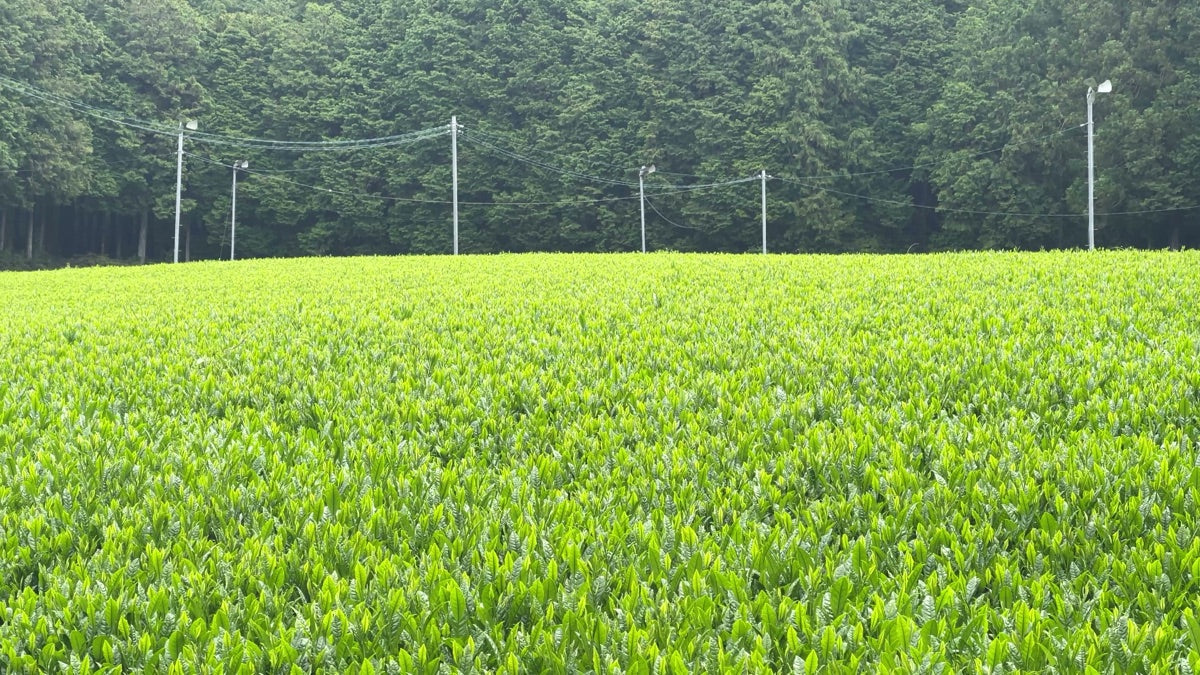
There is a tea plant in Japan that almost nobody drinks on its own, and almost everybody drinks the descendants of. Asatsuyu carries the number two in Japan's national cultivar register, it earned a nickname that promises something sencha plants are not supposed to deliver, and its share of the country's tea fields is now so small that the national statistics name it without ever printing a number for it.
Then you look at what came after it, and the picture inverts. Yutakamidori, the cultivar that ranks second in Japan by planted area, is a seedling of Asatsuyu. So is Saemidori, one of the most prized early cultivars in Kagoshima. So is Tsuyuhikari, a rising name in Shizuoka. Asatsuyu lost the field and won the family tree.
Key Takeaways
- Asatsuyu (あさつゆ) means morning dew. It is Chanorin No. 2, from the batch of fifteen cultivars Japan entered in its register with a breeding year of 1953.
- Yabukita, which went on to take roughly two thirds of Japan's tea fields, is number six in that same batch.
- Asatsuyu was not bred. It was selected out of the old seed-grown tea of Uji, Kyoto, as twelve of those first fifteen were selected rather than crossed.
- Its nickname is natural gyokuro, for a cup that is sweet and full of umami with very little astringency.
- It is genuinely rare. Japan's 2024 cultivar chart names Asatsuyu among its categories but prints no percentage for it.
- Its real legacy is inherited. Yutakamidori, Saemidori and Tsuyuhikari all trace directly back to it.

What is Asatsuyu?
Asatsuyu (あさつゆ) is an early budding Japanese green tea cultivar grown mainly for sencha, known for a sweet, low-astringency cup and carrying the nickname natural gyokuro. The name translates as morning dew.

From our tea room
Superior Sencha Green Tea - USDA Organic Japanese First Flush
First-flush loose leaf, USDA Organic, direct from Japanese family farms.
View Superior SenchaOfficially it is Chanorin No. 2, carrying the earlier line name Kokucha U-14, a breeding year (育成年, the year the selection was completed, whether or not any crossing was involved) of 1953, a raising site of Kanaya and an intended use of sencha (附表1 茶農林登録品種一覧, the register of Chanorin cultivars).
That number two is worth reading carefully, because it is not a chronology. Japan did not register its cultivars one at a time. The first fifteen entries all carry the same breeding year of 1953, numbered together as a single founding batch, and Asatsuyu simply sits second on that list. The plant numbered six in the very same batch is Yabukita (附表1 茶農林登録品種一覧).
Hold those two facts next to each other, because the rest of this article lives in the gap between them. Asatsuyu and Yabukita share a breeding year of 1953 and sit four numbers apart in the same register. Yabukita went on to take roughly two thirds of the country's tea fields. Asatsuyu went on to almost disappear from them. For where the whole system went next, our guide to Japanese tea cultivars and the plants behind matcha and green tea maps the modern landscape.
Where did Asatsuyu come from?

Asatsuyu was not bred by crossing two chosen parents. It was found. The register gives its lineage as 宇治在来種実生, a seedling of Uji native stock, raised at Kanaya in Shizuoka (附表1 茶農林登録品種一覧).
Being found rather than bred was not unusual in 1953. It was the standard route. Of those first fifteen register entries, twelve are seedling selections rather than planned crosses, ten of them from Japanese native stock, and five of those, Asatsuyu included, come specifically from Uji. Yabukita is the same kind of plant, selected from Shizuoka native stock. Japan's cultivar era did not begin with breeding. It began with people walking old seed-grown fields and noticing which bushes were better.
That phrase, Uji native stock, means the old ungrafted seed-grown tea of Kyoto, the zairai populations that predate cultivar agriculture entirely. A selection like this one starts as a single seedling judged worth keeping, and it is carried forward by cuttings rather than by seed. That is why its plantings are clones of that original selection rather than a population of individuals.
You can see the distinction drawn in Japan's own reference work. In the pedigree charts of NARO's Tea Cultivar Handbook, a planned cross has two named parents feeding into it. Asatsuyu's lineage slot holds no parents at all, only the phrase 宇治在来種実生, a seedling of Uji native stock (NARO, 茶品種ハンドブック 第6版, 2022). It is where a family tree starts, not something the tree produced.
Kyoto still treats these Uji-derived plants as a lineage worth naming (京都府, 宇治品種について). Sit with the geography for a second. A plant selected from Kyoto's oldest tea, raised in Shizuoka, went on to reshape tea growing in Kagoshima, several hundred kilometres further south.
The regional picture is here: where Japan's tea is really grown.
Why is Asatsuyu called "natural gyokuro"?

Asatsuyu is called natural gyokuro (天然玉露) because of the cup it gives, not the way it is grown. The name points to the fact that it delivers the sweetness and umami people associate with gyokuro while showing very little of the astringency you would expect from a sencha plant. Chikiriya describes it as an early cultivar with strong sweetness and umami, low bitterness, and high quality (京ちきりや, お茶の品種). Minamikyushu, the Kagoshima city that takes in the Chiran tea district, refers to it directly as the cultivar said to be natural gyokuro (南九州市, 茶の品種 あさつゆ).
Here is the part that usually gets flattened in English write-ups, and I would rather give you the awkward version than the clean one. It is often said that Asatsuyu reaches this profile without shading. That overstates it. The Kagoshima Prefectural Tea Association describes the local practice as covering the plants before harvest and deep steaming them to get the rich colour and umami, and notes in the same breath that it is also called natural gyokuro (鹿児島県茶業会議所, かごしま茶を知る).
So the honest reading is this. The nickname is about what the leaf brings on its own, a naturally sweet and low-tannin character that gets you toward a gyokuro-like cup. It is not a claim that growers never shade it, and it is not a grade. Real gyokuro is defined by an extended spell under cover, conventionally twenty days or more, and this is not that. If you want the underlying chemistry of why shading and sweetness travel together, we cover it in what umami actually is.
Why is Asatsuyu so rare?

Asatsuyu is rare because there is very little of it planted, and Japan's own statistics show that by omission.
In the 2024 cultivar breakdown, which covers 29,879 hectares against roughly 33,400 hectares of tea nationally, the chart lists nine named cultivars plus an other bucket. Asatsuyu is one of the nine. Only three of them get a printed percentage: Yabukita at 64.3%, Yutakamidori at 7.3% and Saemidori at 6.0% (農林中金総合研究所, citing 日本茶業中央会 茶関係資料, 2024). It is named and left blank. It is tracked, and it is too small to print.
For an actual number, Kyoto's Chikiriya gives it 1.0% of cultivated area in its cultivar share list (京ちきりや, お茶の品種). That list carries no survey year, and it is demonstrably from an earlier era: the same list puts Saemidori at 1.8% and Yutakamidori at 5.2%, against 6.0% and 7.3% in the 2024 survey. So read the 1% as an order of magnitude, not a current measurement. Either way the conclusion holds. This is a cultivar you have to go looking for.
The top of that chart is also moving fast. Yabukita held 71.5% of tea garden area in the agriculture ministry's 2019 survey (CHANOYU, citing 農林水産省 figures for 令和元年) and 64.3% in the 2024 cultivar survey. Those two readings come from different bodies measuring slightly different bases, so treat the gap as a direction rather than a precise fall. Its own descendant moved the other way over those years, with Yutakamidori at 6.3% in the 2019 ministry survey and 7.3% in the 2024 one. The plant Asatsuyu produced is gaining exactly the ground Asatsuyu never held. Japan's monoculture is loosening, which is exactly the environment in which a distinctive minority cultivar becomes interesting again.
As for why it never scaled, growers and sellers consistently describe a plant that yields less than Yabukita and handles cold and disease badly (お茶の山麓園, あさつゆとは, a specialist retailer). I want to flag the evidence quality honestly: I could not find that characterisation in a national primary source, only in vendor and specialist descriptions, so treat it as the trade's account rather than a documented figure. What is well supported is where it survives. Cultivation is concentrated in Kagoshima, particularly the Chiran area of Minamikyushu (南九州市, 茶の品種 あさつゆ).
The cultivars Asatsuyu made possible
This one plant is the parent of three of the cultivars that matter most in modern Japanese tea. This is where a minor cultivar turns out to be a major one.
| Cultivar | Register entry | Parentage | 2024 share of surveyed area |
|---|---|---|---|
| Asatsuyu | Chanorin No. 2, breeding year 1953 | Uji native seedling | named in the chart, no percentage printed |
| Yutakamidori | no Chanorin number; Kagoshima recommended cultivar, 1966 | Asatsuyu, open-pollinated | 7.3% |
| Saemidori | Chanorin No. 40, breeding year 1990 | Yabukita x Asatsuyu, crossed 1969 | 6.0% |
| Tsuyuhikari | plant variety registration 11103, March 2003 | Shizu-7132 x Asatsuyu | no published figure |
Register entries from 附表1 茶農林登録品種一覧; shares from 日本茶業中央会 via 農林中金総合研究所, 2024. Asatsuyu has no 2024 figure; an older undated merchant list puts it near 1%. Yabukita, for comparison, is Chanorin No. 6 with the same 1953 breeding year as Asatsuyu, at 64.3%.
Yutakamidori is the big one, and it is second by planted area in Japan. It came from Asatsuyu by open pollination rather than a planned cross: NARO's pedigree charts record Asatsuyu as the seed parent and leave the pollen parent as a question mark, the convention they use whenever a plant is a natural cross (NARO, 茶品種ハンドブック 第6版). There is a neat asymmetry here. Yutakamidori carries no Chanorin number at all, while its parent sits at Chanorin No. 2. It was registered instead by Kagoshima Prefecture, as a recommended cultivar, in 1966 (CHANOYU). Kagoshima made it work by changing the processing rather than the plant, and we tell that story in our profile of Yutakamidori, Japan's second most planted cultivar.
Saemidori is a deliberate cross, and the direction matters. Yabukita was the seed parent and Asatsuyu the pollen parent, crossed in 1969 at the agriculture ministry's tea research station at Makurazaki (南九州市, 茶の品種 さえみどり). Three dates get muddled for this plant, so here they are separated: crossed in 1969, entered in the Chanorin register as No. 40 with a breeding year of 1990, then registered under the seed and seedling law in November 1991 (NARO, 茶品種ハンドブック 第6版; 附表1 茶農林登録品種一覧). Saemidori now outranks its own parent several times over in planted area, and we profile it alongside its Uji cousin in Samidori and Saemidori.
Tsuyuhikari carries Asatsuyu in its name. It came from a cross with the line Shizu-7132 in Shizuoka, with Asatsuyu again as the pollen parent, and was registered under the seed and seedling law in March 2003. The naming is lovely and specific: the tsuyu is taken from Asatsuyu, and the hikari, meaning light, was chosen in the hope that the plant would bring light to the tea industry (CRAFT TEA, お茶の品種ハンドブック つゆひかり).
What does Asatsuyu taste like?

Asatsuyu tastes sweet and rounded, with pronounced umami and very little bite. When it does reach a package it is more often part of a blend than named on the front of it. Minamikyushu's description of the Chiran-grown leaf is precise: excellent vivid green leaf colour, a mellow rich aroma, and a bright deep green liquor with abundant umami (南九州市, 茶の品種 あさつゆ).
An honest note, since this is a section about taste. I have not sat down with a single-cultivar Asatsuyu. We buy tea in Japan every year, we spend that time in growers' factories rather than at trade counters, and it has never once been put in front of me. I am not going to invent a tasting note to fill the gap. That absence is itself the most direct evidence I can give you about how little of this plant leaves Kagoshima, and it is why the description above is Minamikyushu's rather than mine.
If you find some, treat it like the umami-forward tea it is rather than an everyday sencha. Cooler water and a patient first steep will pull the sweetness forward; water that is too hot will push it toward the astringency the plant is specifically prized for not having. Our guide to sencha covers the general brewing frame, and much Kagoshima leaf of this cultivar is finished as a deep steamed sencha, which shortens the steep considerably.
One straight answer, because it matters more than a sales line: we do not currently sell a single-cultivar Asatsuyu. It is scarce, it is concentrated in a handful of Kagoshima growers, and we are not going to put a cultivar name on a tin we cannot consistently source. If that changes, it will be because we found a grower we trust, not because the keyword looked good.
If you buy tea for a shop or a cafe and you are chasing this kind of specificity, our wholesale programme is where those conversations start. If you would rather just drink something excellent today, our organic Japanese teas are all sourced direct from growers.
Frequently asked questions
What is Asatsuyu tea?
Asatsuyu is a Japanese green tea cultivar grown mainly for sencha, entered in Japan's Chanorin register as No. 2 with a breeding year of 1953. It is known for a sweet, umami-rich, low-astringency cup and is nicknamed natural gyokuro. The name means morning dew.
Why is Asatsuyu called natural gyokuro?
Asatsuyu is called natural gyokuro because its leaf gives a cup with the sweetness and umami usually associated with gyokuro, and very little astringency. It is a nickname for a flavour profile, not a grade and not a growing method. In Kagoshima, producers often do shade Asatsuyu before harvest and deep steam it, so it is wrong to say the style never involves covering.
Is Asatsuyu a cross between two cultivars?
No. Asatsuyu was selected as a seedling of native seed-grown tea from Uji in Kyoto, not bred from two chosen parents. Japan's national register lists its origin as a Uji native seedling raised at Kanaya in Shizuoka.
How rare is Asatsuyu?
Asatsuyu is rare. The 2024 cultivar survey covers 29,879 hectares against roughly 33,400 hectares of tea nationally. It names Asatsuyu among its nine named cultivars but prints no percentage for it, while the smallest labelled cultivar, Saemidori, gets 6.0%. Most of what remains grows in Kagoshima, especially around Chiran.
Which cultivars come from Asatsuyu?
The three best known descendants of Asatsuyu are Yutakamidori, second by planted area in Japan, which came from Asatsuyu by open pollination with the pollen parent unrecorded; Saemidori, from a 1969 cross with Yabukita as the seed parent; and Tsuyuhikari, from a cross with Shizu-7132, registered in 2003.
Can you buy single-cultivar Asatsuyu?
Single-cultivar Asatsuyu exists but is uncommon outside Japan, and it is more often blended than sold under its own cultivar name. One with Tea does not currently offer a single-cultivar Asatsuyu.
A note from me
I keep coming back to the shape of this story. Asatsuyu and Yabukita share the same 1953 breeding year and sit four numbers apart in the register. One of them took roughly two thirds of the country's tea fields. The other one took the family tree, and then quietly lost its own place in the ground.
I find that oddly reassuring. It is a reminder that what matters in tea is rarely what is winning by area. We source organic Japanese tea directly from growers and write about what we find, including, as here, the teas we do not sell.
Sources
- 附表1 茶農林登録品種一覧 (official register of Chanorin cultivars). Asatsuyu as 茶農林2号, breeding year 1953, former line name 国茶U14号, origin 宇治在来種実生, raised at 金谷, intended use sencha. Also the source for the 1953 founding batch of fifteen, Yabukita at No. 6, and Saemidori at No. 40. Note this is a mirror hosted by a tea merchant, and it is a 2005 compilation from the National Institute of Vegetable and Tea Science whose last entry is 茶農林52号, so it is current only to 2003.
- NARO, 茶品種ハンドブック 第6版 (Tea Cultivar Handbook, 6th edition, 2022). Pedigree charts showing Asatsuyu as a Uji native seedling with no parents above it, Yutakamidori drawn with Asatsuyu as seed parent (♀) and the pollen parent left as ?♂, and Saemidori's parentage and 1991 registration. Note: the handbook profiles twenty-eight cultivars and does not profile Asatsuyu itself.
- 南九州市, 茶の品種 あさつゆ. The natural gyokuro nickname, the sensory description, and the concentration of cultivation in the Chiran district.
- 南九州市, 茶の品種 さえみどり. Saemidori as a 1969 cross with Yabukita as seed parent and Asatsuyu as pollen parent, at the Makurazaki tea research station.
- 鹿児島県茶業会議所, かごしま茶を知る. Covering before harvest plus deep steaming for rich colour and umami, alongside the natural gyokuro name.
- 京ちきりや, お茶の品種. The 1953 breeding year, the sweetness, umami and low bitterness description, and the undated cultivar share list giving Asatsuyu 1.0%, Yutakamidori 5.2% and Saemidori 1.8%, which is how that list is shown here to predate the 2024 survey.
- 農林中金総合研究所, citing 日本茶業中央会「茶関係資料」. The 2024 cultivar planting breakdown across 29,879 ha, with Yabukita 64.3%, Yutakamidori 7.3% and Saemidori 6.0% labelled, and Asatsuyu named but unlabelled.
- CHANOYU (e-cha), citing 農林水産省 figures for 令和元年. Yabukita at 71.5% of tea garden area in 2019, used here for the change over time.
- CRAFT TEA, お茶の品種ハンドブック つゆひかり. Tsuyuhikari from Shizu-7132 and Asatsuyu, March 2003 varietal registration, and the naming logic.
- 京都府, 宇治品種について. Kyoto's Uji-derived cultivar lineage.
Written by Christian, founder of One with Tea. We source organic Japanese tea directly from growers and write about what we find, including the teas we do not sell.
Share:
Yutakamidori: Japan's Second Cultivar and Kagoshima's Backbone
Soufuu: The Japanese Tea Cultivar That Smells Like Jasmine