



If you have ever drunk a deep steamed sencha from Kagoshima, a cup that pours almost opaque and tastes thick and sweet rather than sharp, there is a good chance you were drinking Yutakamidori. You almost certainly were not told so.
This is the second most planted tea cultivar in Japan, and it is close to invisible to the people who drink it. That gap is worth closing, because the reason it stays hidden is the same reason it exists at all.
Key Takeaways
- Yutakamidori is Japan's second cultivar by planted area. In the agriculture ministry's 2019 survey it covered 6.3% of tea garden area, against 71.5% for Yabukita.
- It was bred at the national tea research station in Kanaya, Shizuoka, under the line name Y-2, as a seedling of Asatsuyu. Kagoshima Prefecture, not the national body, gave it its name in 1966.
- Made as ordinary sencha it is harsh and dull in the cup. Kagoshima did not replace the plant, it changed the processing.
- Deep steaming, usually with shading before the harvest, is what turns that flaw into the thick sweet style the region is known for.
- The name means abundant green. You will rarely see it on a tin, because it is nearly always blended.

What is Yutakamidori?
Yutakamidori (ゆたかみどり) is an early budding Japanese green tea cultivar grown almost entirely in the warm south of the country, and it is the backbone of Kagoshima's deep steamed sencha. The name means abundant green, which is a fair description of both the plant's yield and the colour of the tea it makes when it is processed correctly.

From our tea room
Superior Sencha Green Tea - USDA Organic Japanese First Flush
First-flush loose leaf, USDA Organic, direct from Japanese family farms.
View Superior SenchaIt is also, by a wide margin, the most planted cultivar in Japan that most tea drinkers have never heard of. In the agriculture ministry's cultivar survey for 2019, Yabukita accounted for 71.5% of Japan's tea garden area and Yutakamidori came second at 6.3% (CHANOYU, citing 農林水産省 figures for 令和元年).
Treat that number as a dated reading rather than a fixed fact. Cultivar surveys move. Yabukita's share has been falling steadily for years, a decline we chart in our guide to Japanese tea cultivars and the plants behind matcha and green tea. What has stayed stable across those surveys is the ranking. Yabukita first, by a distance. Yutakamidori second.
Where did Yutakamidori come from?

Here is the part that surprises people who assume a Kagoshima plant is a Kagoshima invention. Yutakamidori was bred in Shizuoka.
It was raised at the agriculture ministry's tea research station at Kanaya, in Shizuoka, where it carried the working line name Y-2. It is a seedling of Asatsuyu, an open pollinated offspring rather than a planned two parent cross. Kagoshima Prefecture carried out the naming registration in 1966 (Chikiriya, お茶の品種).
Follow that lineage back one more step and it gets better. Asatsuyu was itself selected from Uji native stock, the old ungrafted seed populations of Kyoto, and registered in the 1950s. So the plant that carries Kagoshima's tea industry is a Kyoto descendant, raised in Shizuoka, that found its home nine hundred kilometres south of where it was bred.
We track the production side: where Japan's tea is really grown.
That is a very Japanese tea story. Cultivars are clones. Every Yutakamidori bush in Japan is a cutting taken from cuttings taken from that one selected seedling. That is how a single plant chosen in the middle of the last century ends up defining the taste of an entire prefecture. We saw the propagation end of this on a nursery visit in Kagoshima, rows of young rooted cuttings under plastic, each one genetically identical to its neighbour.
Why does Japan's number two cultivar have no registry number?
Japan's nationally registered tea cultivars carry a Chanorin number. Okumidori is No. 32. Saemidori is No. 40. It is a tidy system. We went through it in detail when we wrote about Samidori and Saemidori, the two Uji greens that are constantly confused, where Samidori turns out to be absent from the registry entirely.
Yutakamidori is absent from it too. What makes its case different from Samidori's is not the fact, it is the scale.
Samidori is a boutique tencha plant, treasured in a small corner of Kyoto. Yutakamidori is planted on roughly one hectare in every sixteen of Japanese tea. A plant carrying that much of a national crop sits outside the national registry for a purely administrative reason. Kagoshima named it locally in 1966, and the prefecture, not the ministry, took ownership of it. The registry is a record of a particular kind of administrative decision. It was never a ranking of importance, and Yutakamidori is the clearest proof of that anywhere in Japanese tea.
Why is Yutakamidori almost always deep steamed?

Because on its own terms, it is not a very good sencha.
Processed the ordinary way, Yutakamidori runs strongly bitter and astringent, and the liquor colour disappoints. Japanese tea sellers say this plainly rather than tiptoeing around it. CHANOYU's description is that the bitterness and astringency are strong, which is why it is usually made into fukamushi to draw out umami and sweetness instead (CHANOYU).
Kagoshima's answer was not to abandon the plant. It was to change what happens to the leaf after picking. Steam it far longer than standard sencha, breaking the leaf structure down, and the harshness turns into body. The Kagoshima Prefectural Tea Producers Association describes the regional method directly. Cover the plants before harvest, manufacture by deep steaming, and you get a rich umami with real depth of flavour (鹿児島県茶生産協会, かごしま茶について).
Two interventions, then, doing different jobs. Shading before the harvest raises the sweet, savoury character in the leaf. Deep steaming breaks down the cell structure so the cup pours thick, cloudy and green rather than clear and sharp. Neither is a rescue exactly. Together they are a design decision, and the cultivar and the process arrived at their present form together.
This is why we think it is worth naming the plant when talking about the style. If you want the process itself in full, we wrote a complete guide to fukamushi sencha and how deep steaming changes the leaf. Yutakamidori is the cultivar sitting quietly underneath a great deal of that tea.
What does Yutakamidori taste like?
Made the way Kagoshima makes it, thick and sweet with a broad savoury middle, and very little of the grassy edge people expect from Japanese green tea. The liquor is a deep, slightly cloudy green, because deep steaming leaves fine leaf particles suspended in the cup rather than filtering out clear.
It is a forgiving tea. The same processing that fixed its astringency also makes it hard to ruin with slightly hot water or a slightly long steep. That is a large part of why it works so well in everyday blends and in bottled tea. Delicacy is not what it offers. Depth is.
Drunk unshaded and lightly steamed, it shows the other face, brisk and tannic and rather plain in colour. Both are the same plant. That is the whole point of this cultivar.
Where is Yutakamidori grown?

Overwhelmingly in Kagoshima, with Miyazaki next door taking much of the rest. The concentration is extreme, with the great majority of production sitting in Kagoshima alone (Chikiriya).
The reason is climate, and it cuts both ways. Yutakamidori buds early, roughly five days ahead of Yabukita, which in a warm prefecture means reaching the market at the front of the season when first flush prices are highest. It is also weak against cold. That single weakness rules out most of the country. Our own write up of Saemidori notes the Japanese registry rating Saemidori's cold tolerance as better than Yutakamidori's, and Saemidori is already considered a southern plant.
| Yutakamidori | Yabukita | |
|---|---|---|
| Share of tea garden area, 2019 | 6.3%, second nationally | 71.5%, first nationally |
| Budding | Early, about five days ahead of Yabukita | Mid season, the national benchmark |
| Cold resistance | Weak, limits it to the warm south | Hardy enough for most of Japan |
| Main regions | Kagoshima, Miyazaki | Nationwide, centred on Shizuoka |
| Usual processing | Deep steamed fukamushi, often shaded | Standard sencha and many other styles |
| Registry status | Named by Kagoshima in 1966, no Chanorin number | Nationally registered cultivar |
Sources: MAFF 2019 cultivar area survey for the shares, Chikiriya for the pedigree and regional concentration, and the Kagoshima Prefectural Tea Producers Association for the regional method.
So the cultivar is locked to the warm south, and the warm south built its industry around it. Kagoshima's flat, open fields let growers run riding harvesters straight down the rows, which suits a high yielding early cultivar on a tight harvest window. We spent a day in the fields at Shibushi, and the pairing of terrain, machinery and plant is obvious once you stand in it. We describe that farm in our profile of Horiguchi Seicha and tea at scale in Kagoshima.
Within the region the split varies by district. In Chiran, Kagoshima's best known tea name, Yabukita takes about 40% of the area and Yutakamidori about 30% (CHANOYU). The association also names Yutakamidori as the largest planted early season cultivar in the prefecture. For the wider picture of the region, see our guide to Kagoshima, Japan's number one tea region.
Will you ever see Yutakamidori on a tin?
Rarely, and that is not a scandal. It is what the plant is for.
Yutakamidori is a blending cultivar in daily practice. Its early harvest and reliable volume make it the base that gives a Kagoshima blend its body, with other cultivars layered in for aroma and finish. Single cultivar bottlings exist and are worth trying if you find one, but most of this tea reaches you unnamed, inside a blend or a bottle.
If you want to taste it deliberately, look for a deep steamed sencha from Kagoshima and check whether the seller names the cultivar. Plenty do. If the label only says fukamushi and Kagoshima, Yutakamidori is a reasonable guess at what is doing most of the work in the cup. And if you would rather start from the plant that Yutakamidori is always measured against, we wrote about Yabukita, the cultivar behind most Japanese green tea.
We do not currently sell a single cultivar Yutakamidori. We are writing about it anyway. You cannot understand Kagoshima tea without it, and a cultivar that carries this much of a country's crop deserves to be named out loud.
Frequently asked questions
What is Yutakamidori tea?
Yutakamidori is an early budding Japanese green tea cultivar grown mainly in Kagoshima and Miyazaki. It is Japan's second most planted cultivar and is usually processed as fukamushi, or deep steamed, sencha. The name means abundant green.
Is Yutakamidori the second most common tea cultivar in Japan?
Yes. In the agriculture ministry's 2019 cultivar survey it covered 6.3% of Japan's tea garden area, second to Yabukita at 71.5%. Exact percentages differ between survey years, but the ranking has been stable.
Where does the Yutakamidori cultivar come from?
It was bred at the national tea research station at Kanaya in Shizuoka under the line name Y-2, as a seedling of the Asatsuyu cultivar. Kagoshima Prefecture registered the name Yutakamidori in 1966.
Why is Yutakamidori deep steamed?
Made as ordinary sencha it is markedly bitter and astringent with a disappointing liquor colour. Deep steaming, usually combined with shading the plants before harvest, converts that harshness into a thick, sweet, savoury cup. The processing is what makes the cultivar work.
Is Yutakamidori a matcha cultivar?
No. It is grown for leaf tea, mostly deep steamed sencha. Matcha is made from shaded tencha leaf that is dried without rolling and then milled, which is a different process and generally a different set of cultivars.
Does Yutakamidori have a Chanorin registry number?
No. It was named by Kagoshima Prefecture in 1966 rather than registered nationally, so it carries no Chanorin number despite being Japan's second most planted cultivar.
What does Yutakamidori taste like?
As a Kagoshima fukamushi it is thick, sweet and savoury, with a deep cloudy green liquor and little grassiness. Processed as a light steamed sencha instead, it is brisk and astringent.
Why is Yutakamidori grown mostly in Kagoshima?
It buds early, which is an advantage in a warm prefecture, but it has poor cold resistance, which rules out cooler regions. Kagoshima and Miyazaki suit it, and Kagoshima's flat fields also suit the machine harvesting an early, high yielding cultivar calls for.
A note from me

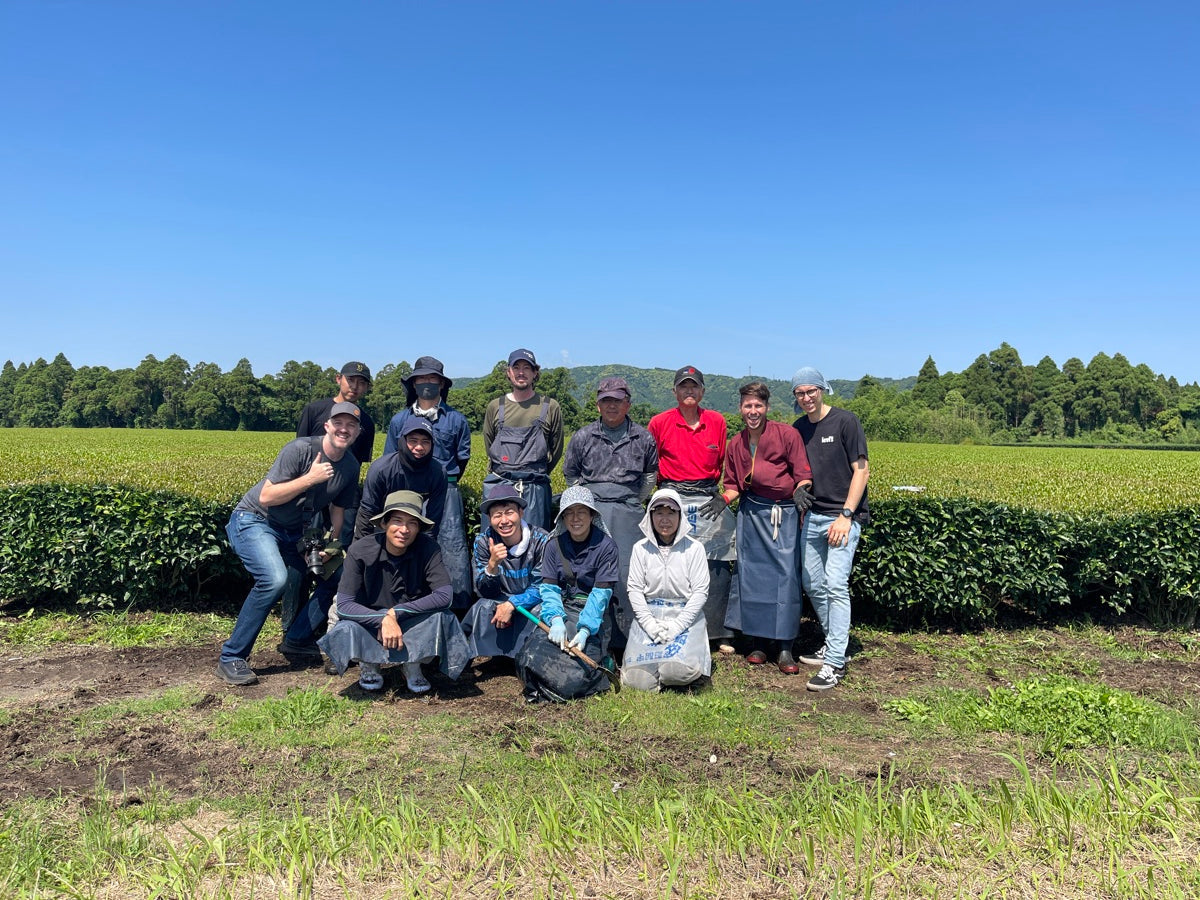
On 31 May 2026 I spent a day in a Yutakamidori field in Shibushi, Kagoshima, hand weeding between the rows with the team there. No machines and no chemistry, just gloves, small sickles and a lot of bending. It is slow work by choice, and after a few hours in a single row you understand what a farm is actually buying when it skips the herbicide.
What stayed with me was how ordinary the plant looked. Row after row of unremarkable green bushes, no name on them anywhere, quietly making up a large share of what Japan grows. Most of that leaf will end up in a blend, and nobody drinking it will know what it is called. I think it is worth knowing.
Sources
- CHANOYU (e-cha), ゆたかみどりとは?. Carries the 農林水産省 (MAFF) 令和元年 cultivar area figures, Yabukita 71.5% and Yutakamidori 6.3%, the 1966 Kagoshima designation, the Chiran area split of roughly 40% Yabukita and 30% Yutakamidori, and the bitterness and astringency rationale for deep steaming.
- 鹿児島県茶生産協会 (Kagoshima Prefectural Tea Producers Association), かごしま茶について. Yutakamidori as the largest planted early season cultivar in Kagoshima and suited to warm districts, and the regional method of covering before harvest plus deep steaming for rich umami and depth.
- Chikiriya, お茶の品種. The pedigree sentence: a seedling of Asatsuyu, raised at the agriculture ministry's tea research station at Kanaya in Shizuoka as Y-2, with Kagoshima carrying out the naming registration in 1966, plus the concentration of production in Kagoshima.
- NARO, 茶品種ハンドブック 第6版 (Tea Cultivar Handbook, 6th edition, 2022). Reference for the national cultivar system and for cultivar comparison baselines, including Yutakamidori's use as a budding time reference point.
Written by Christian, founder of One with Tea. We source organic Japanese tea directly from growers and write about what we find, including the teas we do not sell.
Share:
Rare Japanese Teas: Kamairicha, Tamaryokucha, and Japan's Fermented Banchas
Asatsuyu: Japan's "Natural Gyokuro" Tea Cultivar