



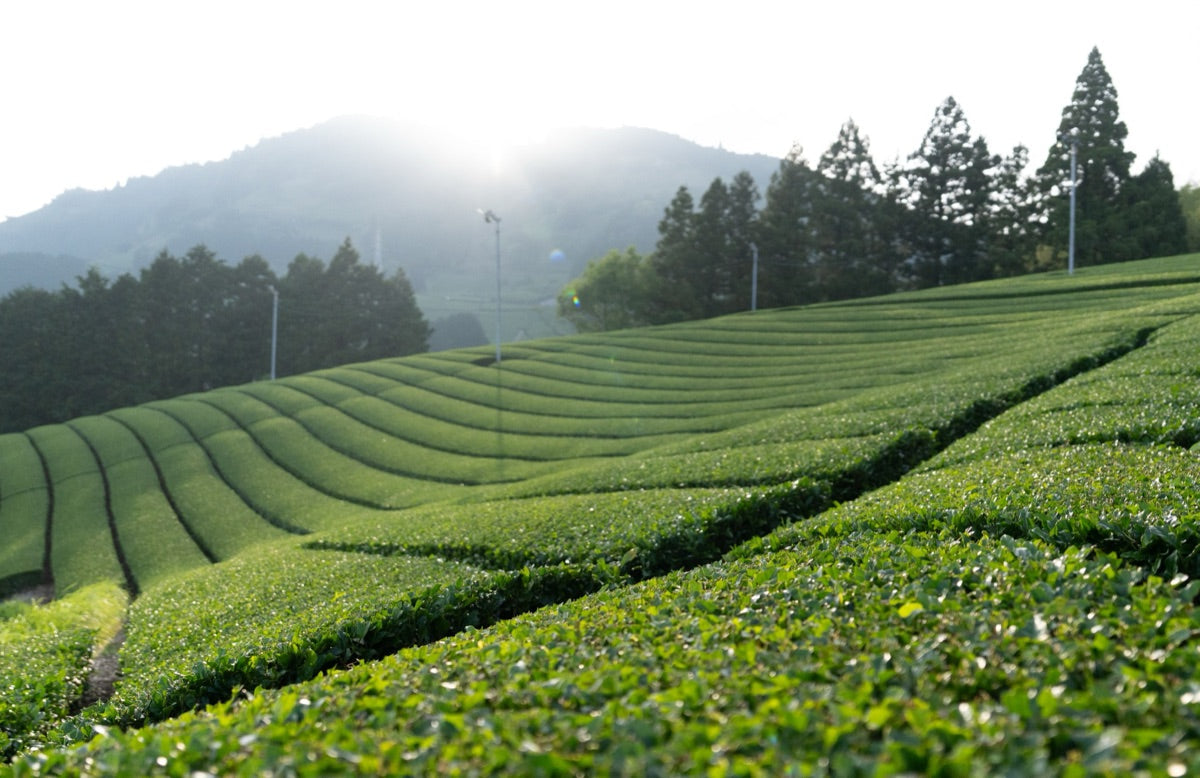
Most Japanese tea cultivars were bred to make something more delicate. Benifuuki was not. It was bred to make black tea. It failed at that job, and then it became one of the most studied tea plants in Japan, for a reason nobody was looking for.
The short version: the compound that makes Benifuuki interesting only survives if you refuse to process it the way it was designed to be processed. That is a strange thing for a plant to be famous for. It is also worth understanding properly, because most writing about this cultivar skips the botany and goes straight to the health headlines.
Key Takeaways
- Benifuuki came from a 1965 cross at Makurazaki, Kagoshima, between Benihomare and Makura Cd86, and received its name registration in 1993.
- It was bred as a black and oolong tea cultivar. Its value as a green tea was a later discovery.
- Processed as green tea it contains EGCG3″Me, a methylated catechin that Yabukita, Japan's dominant cultivar, does not contain at all.
- That same compound is not detected in black tea made from Benifuuki. Fermentation destroys the very thing the plant is now prized for.
- It tastes strong and astringent. This is not a delicate tea, and the astringency and the chemistry come from the same place.

What exactly is Benifuuki?
Benifuuki (べにふうき) is a registered Japanese tea cultivar. The cross was made in 1965 at the tea research station in Makurazaki, Kagoshima prefecture, using Benihomare as the seed parent and Makura Cd86 as the pollen parent. The resulting line was selected over the following decades and given its name registration in 1993, with variety registration following in 1995 (NARO, べにふうき緑茶の研究情報).
Nearly three decades from cross to name is normal for tea. A tea plant is a perennial shrub, and it takes years to reach the age where you can judge it. A cultivar then has to prove itself across many seasons for yield, disease resistance, cold tolerance and cup quality before it earns a name. That slow timeline is part of why the cultivar list changes so rarely, something we cover in our guide to Japanese tea cultivars and the plants behind matcha and green tea.
The parentage is the interesting part, and it is entirely Indian on both sides. Benihomare was selected from seed that Tada Motokichi brought back from India around 1887, during Japan's push to learn black tea manufacture. Makura Cd86 traces to Darjeeling seed given to Kagoshima prefecture. Benifuuki is, in other words, a Japanese plant with a black tea family tree, and the "beni" in its name (紅, crimson) is the same character Japan uses for black tea, 紅茶 (kōcha). The name tells you exactly what it was for.
Why was a black tea cultivar turned into green tea?

Japan did try to build a black tea industry. Benihomare and its descendants were part of that effort, and Benifuuki arrived as a late entry in a programme aimed at producing a domestic black tea that could stand up to imports. By the time it was registered in 1993, that battle was long over commercially.
So the plant existed, it was registered, and it had no obvious job. What happened next is the genuinely unusual part of this cultivar's story.
Researchers analysing Benifuuki processed as an unfermented green tea found it carried an O-methylated catechin, EGCG3″Me, in quantities that other Japanese cultivars did not match. NARO states the point plainly: Benifuuki "is rich in EGCG3″Me, which is not present in 'Yabukita', Japan's leading tea cultivar."
Then comes the twist. NARO also reports that EGCG3″Me is not detected in black tea manufactured from Benifuuki, because the oxidative enzymes at work during black tea manufacture destroy the methylated catechins. Green tea processing steams the leaf early and deactivates those same enzymes, which is precisely why the compound survives. A cultivar bred specifically to be fermented turns out to hide its most distinctive chemistry unless you decline to ferment it.
We find that genuinely humbling as a sourcing story. The plant was not improved. Nobody re-bred it. The only thing that changed was the decision about what to do with the leaf after picking. It is the same lesson that runs through how matcha is made, from tencha leaf to stone ground powder. Processing is not a finishing step applied to a fixed ingredient. Processing decides what the ingredient turns out to be.
What is EGCG3″Me, the methylated catechin?
Green tea catechins are a family. EGCG (epigallocatechin gallate) is the one most people have heard of. EGCG3″Me is a methylated relative, epigallocatechin-3-O-(3-O-methyl)gallate. That small structural difference matters for a practical reason. Methylated catechins appear to be absorbed more readily in the gut, and to stay in the blood longer, than ordinary EGCG.
How much reaches you also depends on physical form. In an absorption study in rats, milling Benifuuki green tea to a finer powder raised plasma levels of ester type catechins substantially. The researchers compared powders at three particle sizes, 2.86 μm, 18.6 μm and 76.1 μm, all dosed at 125 mg per animal. The finest powder produced plasma AUC roughly two to three times higher than the coarsest, with five animals per group (Maeda-Yamamoto et al., Cytotechnology, 2011, PMID 21207145, DOI 10.1007/s10616-010-9331-8).
Two honest caveats on that one. It was a rat study, and the authors say so themselves, noting they were still working on human pharmacokinetics. And five animals per group is small. It tells you that particle size plausibly matters for this compound. It does not tell you what a given cup does in a given person.
One more thing worth stating clearly, because it circulates constantly: the claim that matcha contains 137 times the EGCG of ordinary green tea is not a usable figure. Whole leaf preparations do concentrate catechins relative to a leaf that is brewed and then discarded, but the honest multiple is small, in the range of a few times over, not a hundred.
What does the research actually say, and where is it uncertain?
Benifuuki has been studied mainly in the context of seasonal and perennial allergic symptoms, and the results are genuinely interesting. They are also narrower than the internet suggests, so here is what was measured, at what dose, in how many people.
The most cited trial is a randomised, double blind, placebo controlled study in adults with Japanese cedar pollinosis. 51 adults took part, 26 drinking Benifuuki green tea and 25 drinking Yabukita green tea as the placebo, 700 ml every day from December 2007 through March 2008. During peak pollen season, the area under the curve of symptom scores was significantly smaller in the Benifuuki group. That held for runny nose, itchy eyes, tearing, total nasal symptom score, total ocular symptom score and both symptom-medication scores. No adverse events were reported in either group (Masuda S, Maeda-Yamamoto M, Usui S, Fujisawa T, Allergology International, 2014;63(2):211-217, PMID 24561771, DOI 10.2332/allergolint.13-oa-0620).
The choice of placebo is the elegant part of that design. Yabukita is a green tea, so it matches on taste, caffeine, ritual and expectation, and it contains no EGCG3″Me at all. That isolates the compound rather than the drink, which is more than most tea research manages. If you want the wider story of that cultivar, we wrote about Yabukita, the cultivar behind most Japanese green tea.
NARO separately reports work in perennial allergic rhinitis, and the dose response there is the genuinely useful part. Intake of 34 mg per day of EGCG3″Me was associated with significant improvement in nasal symptom score and symptom-medication score. A 68 mg per day dose was also effective. But 17 mg per day performed no better than the control. NARO also reports that starting at 34 mg per day about 1.5 months before the cedar pollen season was associated with lower symptom scores than starting once the season had already begun.
For the numbers beside every other tea, see how matcha compares with coffee and other teas on caffeine.
Read that dose curve carefully, because it is the most practical thing on this page. There appears to be a floor below which nothing measurable happened, and the amount that did register had to be sustained daily for months and started early. An occasional cup is well under the dose that was studied.
Now the uncertainty, which deserves equal billing:
- The samples are small. Fifty one people and 91 people are respectable for a food trial and modest by clinical standards.
- The evidence base is concentrated. A large share of this work traces back to one research group and the institute that bred the plant. That is common for cultivar specific research, and it is still a reason for caution rather than confidence.
- The cohorts are specific. These were Japanese adults reacting to Japanese cedar pollen. Generalising to other allergens or populations is an assumption, not a finding.
- Dose is not incidental. The effects were tied to 34 mg per day of a specific compound, sustained over months, and started early. A casual cup now and then is not the thing that was tested.
- Absorption data came from rats. Useful for mechanism, not a human result.
Individual response varies. Consult your doctor before changing your routine if you manage a condition.
What does Benifuuki taste like?

Strong, and noticeably astringent. Among Japanese green teas, Benifuuki sits at the bracing end of the range, and drinkers coming from a soft, sweet sencha are usually surprised by it on first contact.
That is not a flaw in the tea, and it is not a processing failure. Catechins are astringent compounds. A cultivar carrying an unusually high catechin load will taste like it. The bitterness and the chemistry are the same fact reported by two different senses, which is a tidy piece of honesty from the plant: you can taste the reason it is studied.
It is worth setting expectations against the teas we spend most of our time with. A shaded gyokuro or a good ceremonial matcha is bred and grown to push the balance toward umami and sweetness, away from exactly this. If you want that end of the spectrum instead, gyokuro and sencha are the better starting points, and sencha versus gyokuro lays out the difference.
How does Benifuuki compare to the matcha cultivars?
Almost every cultivar in the matcha world was selected in the opposite direction to Benifuuki. Shade grown matcha cultivars are chosen for their ability to build amino acids, hold a deep green colour under shade, and keep bitterness low.
| Cultivar | Bred for | Typically grown | Character |
|---|---|---|---|
| Benifuuki | Black and semi-fermented tea | Full sun | Strong, astringent, high catechin. Contains EGCG3″Me. |
| Samidori, Saemidori | Matcha and shaded leaf | Shaded | Smooth, sweet, low astringency. |
| Okumidori, Gokou | Matcha blending, late budding | Shaded | Depth and aroma, used for blend structure. |
| Asahi, Ujihikari | Competition tencha | Shaded, Uji | The top of the quality range, rare. |
| Yabukita | General purpose sencha | Full sun | The national workhorse. Contains no EGCG3″Me. |
Benifuuki belongs to a different project entirely. It is a catechin forward, sun grown, assamica descended plant in a category built around shade and umami. Comparing it to a ceremonial matcha cultivar on taste is a category error. They were bred to solve different problems.

From our tea room
Organic Ceremonial Matcha Powder - USDA Certified (30g)
Stone-milled ceremonial grade, USDA Organic, third-party lab tested.
View Ceremonial MatchaWhere is Benifuuki grown?

Kagoshima, at the southern end of Kyushu, and Shizuoka are the two prefectures most associated with it. Makurazaki, where the original cross was made in 1965, sits on Kagoshima's southwestern coast, and Kakegawa in Shizuoka has been a centre of Benifuuki research and production.
For where this sits on the map, see our map of Japanese tea production by prefecture.
The geography follows the plant. Kagoshima is warmer, flatter in its main tea districts, and more mechanised than the classic Uji hillsides, and it is where Japan does much of its cultivar diversification rather than its tradition keeping. Benifuuki is a good example of what that part of the country is for.
We have not found a reliable current figure for planted hectares of Benifuuki specifically, so we are not going to publish one. Cultivar level acreage in Japan is patchily reported outside Japanese language statistical yearbooks, and a confident number here would be a guess wearing a suit.
Should you drink Benifuuki, and is it matcha?

Benifuuki is not matcha, and this is the single most common confusion about it. Matcha is made from shade grown leaf processed into tencha and then stone milled. Benifuuki is typically grown in full sun and sold as a leaf tea or as a powdered green tea. A powdered green tea is not automatically matcha, a distinction that matters commercially far more than most labels admit.
Who it suits: people who like a bracing, catechin heavy cup, and people specifically interested in this cultivar's chemistry and willing to treat the research as the modest, specific thing it is.
Who it does not suit: anyone looking for the sweet, thick, umami driven experience that draws most people to Japanese tea in the first place. If that is what you are after, you want a shaded cultivar, and you can start with ceremonial grade matcha.
We do not sell Benifuuki. We source shade grown matcha, and we would rather explain a cultivar properly than pretend every tea in Japan leads back to our tin. Benifuuki is a good reminder of why we pay attention to cultivar names at all. The plant, the place, and the processing decision together make the tea, and if a seller cannot tell you all three, they may not know.
If you are sourcing Japanese tea for a shop, cafe or studio and want to talk about what actually grows where, get in touch about wholesale. We would rather have that conversation than sell you the wrong thing.
Frequently asked questions
What is Benifuuki tea?
Benifuuki is a Japanese tea cultivar released in 1993, bred in Makurazaki, Kagoshima from a cross between Benihomare and Makura Cd86. It was developed for black tea, but is now mostly drunk as a green tea because green processing retains a methylated catechin called EGCG3″Me.
Is Benifuuki a matcha?
No. Matcha is shade grown, processed into tencha, then stone milled. Benifuuki is usually sun grown and sold as leaf tea or as a powdered green tea. Powdered green tea and matcha are not the same product.
What is EGCG3″Me?
EGCG3″Me is epigallocatechin-3-O-(3-O-methyl)gallate, a methylated form of the green tea catechin EGCG. NARO reports that Benifuuki is rich in it and that Yabukita, Japan's leading cultivar, does not contain it.
Why does black tea processing remove EGCG3″Me?
NARO reports that EGCG3″Me is not detected in black tea manufactured from Benifuuki. The oxidation involved in making black tea consumes the compound, so the cultivar bred for fermentation only shows this chemistry when it is left unfermented.
How much Benifuuki was used in the research?
In the 2014 cedar pollinosis trial, participants drank 700 ml of Benifuuki green tea daily from December through March. In NARO's perennial allergic rhinitis work, 34 mg and 68 mg of EGCG3″Me per day were associated with improved symptom scores, while 17 mg per day performed no better than the control.
Does Benifuuki help with allergies?
Research has measured reductions in reported symptom scores in specific trials, at specific doses, in Japanese adults with Japanese cedar pollinosis. Those are limited findings from small studies, and they are not a treatment claim. Individual response varies, and you should speak with your doctor about managing a condition.
What does Benifuuki taste like?
Strong and astringent, at the bracing end of Japanese green tea. The astringency comes from its high catechin content, which is the same chemistry the research is interested in.
Where is Benifuuki grown?
Mainly in Kagoshima prefecture, with Shizuoka also producing it. The original 1965 cross was made in Makurazaki, Kagoshima.
Is Benifuuki caffeine free?
No. Benifuuki is a true tea from Camellia sinensis and contains caffeine like other green teas.
Sources
- NARO, Properties of 'Benifuuki' green tea. Registration year, parentage, EGCG3″Me content, absence in Yabukita, absence in black tea, and the perennial allergic rhinitis trial.
- NARO, べにふうき緑茶の研究情報 (Benifuuki green tea research information, Japanese). Breeding history including the 1965 cross at Makurazaki, the Benihomare lineage from seed introduced from India around 1887, name registration in 1993 and variety registration in 1995, the enzymatic loss of methylated catechins in black tea manufacture, and the 17 / 34 / 68 mg per day dose response.
- Masuda S, Maeda-Yamamoto M, Usui S, Fujisawa T. "'Benifuuki' green tea containing O-methylated catechin reduces symptoms of Japanese cedar pollinosis: a randomized, double-blind, placebo-controlled trial." Allergology International, 2014;63(2):211-217. PMID 24561771, DOI 10.2332/allergolint.13-oa-0620.
- Maeda-Yamamoto M, Ema K, Tokuda Y, Monobe M, Tachibana H, Sameshima Y, Kuriyama S. "Effect of green tea powder (Camellia sinensis L. cv. Benifuuki) particle size on O-methylated EGCG absorption in rats; The Kakegawa Study." Cytotechnology, 2011. PMID 21207145, DOI 10.1007/s10616-010-9331-8.
Written by Christian, founder of One with Tea. We source organic Japanese tea directly from growers and write about what we find, including the teas we do not sell.
Share:
Asahi and Ujihikari: Uji's Competition Matcha Cultivars
What Is Aracha? The Unfinished Tea Behind Your Sencha