



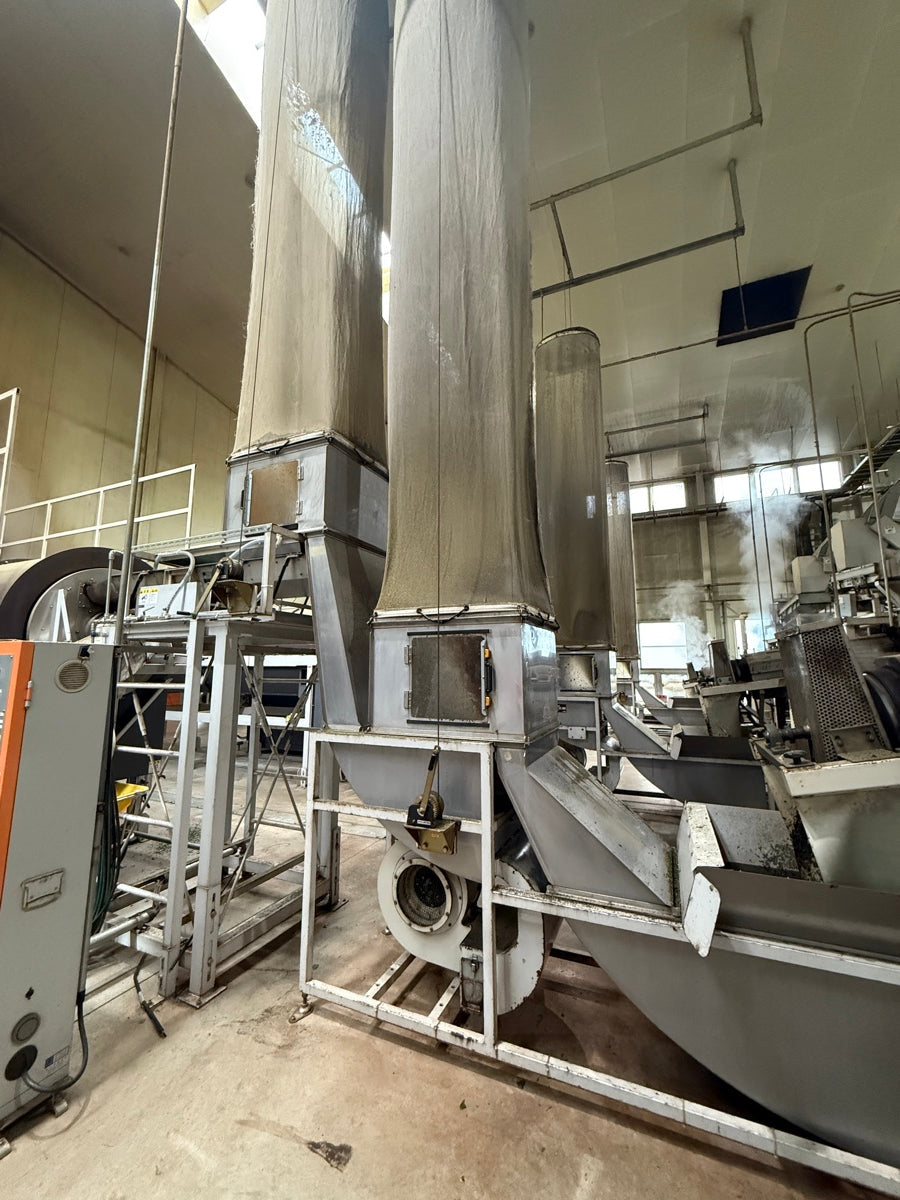
Aracha (荒茶) is Japanese tea that has been steamed, rolled and dried at a farm region factory but not yet finished. Japan's green tea labeling standard defines it as tea made from the leaf prior to finishing manufacture. It leaves the farm at about 5% moisture, uneven in shape, with leaf, stem and dust still mixed together. One more stage, shiage, turns it into something you can buy. Its two decisive steps are the sorting and the final fire, hiire.

From our tea room
Superior Sencha Green Tea - USDA Organic Japanese First Flush
First-flush loose leaf, USDA Organic, direct from Japanese family farms.
View Superior SenchaAlmost every guide to Japanese tea stops at the farm. Leaves get plucked, steamed, rolled, dried, and then somehow a sealed bag appears. There's a whole stage missing in the middle, and it has a name.
That stage is finishing. The tea that goes into it is called aracha, and it isn't something you can buy or brew well. Two more steps stand between aracha and anything worth drinking, and they're where a lot of what you taste actually gets decided.
Key Takeaways
- Aracha (荒茶) means crude or unrefined tea. Japan's green tea labeling standard defines it as tea made from the leaf before finishing manufacture.
- It leaves the farm at about 5% moisture, uneven in shape and size, with leaf, stem and dust all mixed together.
- Shiage (仕上げ) is the finishing stage. Sifting, sorting, cutting and grading separate the batch into fractions by size and by part of the plant.
- Kukicha, konacha and mecha aren't lesser teas invented to use up scraps. Japan's standard defines all three by the finishing step that separates them.
- Hiire (火入れ) is the final fire, and it sits inside shiage rather than after it. A 1974 government study is blunt that its main purpose is aroma, not drying, though it does bring moisture down into the 3% range.
- Hiire is not the roast that makes hojicha. Japan's labeling standard treats firing at 70 to 130°C and roasting at 140°C and above as different operations.

What is aracha?

Aracha is tea that has been made but not finished. The definition isn't loose or regional. Japan's green tea labeling standard puts it plainly. Aracha is "tea manufactured from the leaves of the tea plant, prior to finishing manufacture." Shiage-cha is "the final product manufactured by finishing, using aracha as raw material, into a state fit for eating and drinking" (Japan Tea Central Public Interest Association, Green Tea Labeling Standard, last revised 10 July 2026).
We track the production side: where Japan's tea is really grown.
Getting there is the part most people picture. Japan's Ministry of Agriculture, Forestry and Fisheries describes it in one sentence: leaves plucked in the garden, steamed, rolled, then dried, are called aracha (MAFF, April 2022). That work happens fast, usually within hours of plucking, at a factory in the growing region. The steaming stops oxidation and keeps the leaf green. If you want the fuller picture of how steaming shapes a finished tea, our piece on deep steamed fukamushi sencha covers what happens when you push that step further.
The same MAFF page gives the number that matters most here. That final hot air drying brings the leaf's moisture content down to about 5 percent, and at that point the aracha is complete. Measured values sit right around there. A 1974 study at the Tokyo Metropolitan Agricultural Experiment Station recorded 5.6% moisture at the start of firing across three separate machine trials, and 5.4% in the trial that explicitly used aracha (Shiono, Tea Research Report No. 41, 1974).
So the farmer's work ends with a product that is genuinely tea, and genuinely not ready.
Why aracha isn't sold as it is

Open a sack of aracha and you don't find the tidy needles you'd recognize from a good sencha. You find everything at once. Long leaf, short leaf, broken pieces, bud tips, woody stem, and a fine dust running through all of it. Shape and size are uneven because the plant is uneven.
The World Green Tea Association describes the problem directly: aracha processed at the production area factory is uneven in shape, high in moisture, and can't be stored for long (O-CHA NET). Finishing exists to fix both halves of that, raising the tea's merchantability and improving its aroma and flavor.
The moisture half has a mechanism behind it. Shiono's 1974 work found that tea below 4% moisture shows little deterioration in storage. Aracha sitting at 5 or 6% is above that line. It's stable enough to move and to hold for a while, which is exactly what it's for. It isn't stable enough to sit on a shelf in someone's kitchen for a year.
Who does the finishing is usually a different question from who grew it. Traditionally a tea wholesaler buys aracha and takes it through the remaining stages. You can see that split in the paperwork. Japan's labeling standard provides separate shipping documents for the two stages. The finished tea form carries its own field for the finishing location, filled in when finishing happened somewhere other than where the aracha was made. A standard wouldn't need that field if one operator always did both. That said, growers finishing their own tea is a real and officially supported pattern, so "usually" is the honest word here, not "always."
Shiage: the stage that sorts the leaf
Shiage (仕上げ) is the finishing stage, and it's more mechanical than romantic. The named sub-processes are sifting, firing, sorting and blending (World Green Tea Association).
Kochi Prefecture's Tea Research Station published a full documented line for finishing regular steamed sencha, and it reads like a sequence of decisions about size:
- Appraisal. The batch is assessed first, so the rest of the line can be set to match what this particular aracha actually is.
- Parallel sieves. Mesh numbers 8 through 14 even out thickness.
- Air sorting. A blower lifts out floated leaf and other light material.
- Color sorting. An optical sorter pulls woody stem and anything off color. That removed stem becomes the raw material for stem tea.
- Cutting. Oversized leaf caught on the sieve gets cut to length, then either rejoins the main tea or goes off as raw material for roasted tea.
- Rotary sieves. A number 30 sieve splits the main tea from coarse dust. A number 60 sieve takes out the finest powder.
(Kochi Prefectural Agricultural Technology Center, Tea Research Station, research period FY2018 to FY2020.)
Read that list again and notice what it is. It's not cleaning. It's separation. Every sieve and sorter is splitting one batch into several different products, and only one of them is the sencha you were expecting.
The teas made from what shiage takes out
This is the part I find genuinely satisfying, and it's where a lot of writing about Japanese tea gets it backwards. Kukicha, konacha and mecha are often described as budget teas or leftovers. Japan's own standard describes them as finishing products. It defines each one by the step that separates it:

From our tea room
Superior Kukicha Green Tea - USDA Organic Japanese Twig Tea
Japanese twig tea, gentle and naturally low in caffeine. USDA Organic.
View Superior Kukicha- Kukicha (茎茶), also called bocha. "Tea containing a high proportion of tea stems and leaf stalks, sorted out by a woody stem separator or similar in the finishing process of aracha."
- Konacha (粉茶). "Powdered tea sifted out in the finishing process," explicitly including coarse dust and cut leaf. That last clause matters. Some of konacha is created by the cutting step, not just by leaves breaking in transit.
- Mecha (芽茶). "The bud tips sifted out in the finishing processing of sencha and gyokuro."
(All three from the Green Tea Labeling Standard, implementation rules, Table 1.)
The standard is naming the machine in the definition. These teas aren't a story someone invented to sell the offcuts. They're structural. A finishing line that produces sencha necessarily produces stem and dust and bud at the same time. The plant grows all of those together, and the sieve's whole job is to take them apart. Our guide to kukicha, Japanese twig tea goes deeper into what that stem fraction tastes like and why it brews so differently.
One caution on a word you'll see a lot. Karigane is frequently presented as a defined category meaning gyokuro stem tea. It isn't. It doesn't appear in the national standard at all. Kyoto's own tea industry council relegates it to a footnote saying that some shops use it that way (Kyoto Prefectural Tea Industry Council). It's a trade name for high grade stem tea, and a nice one, but treat it as usage rather than as a grade.
Hiire: the final fire
Hiire (火入れ) is the last heating, and it is one of shiage's own sub-processes rather than a stage that follows it. Ask most people what it's for and they'll say drying, which is half right and the less interesting half.
Shiono's 1974 paper opens by ranking the two purposes explicitly. Firing "also carries the sense of re-drying to reduce moisture in order to prevent deterioration," the paper says, "but the main purpose is the development of the tea's aroma and flavor." The Japanese even has a word for the smell it creates, hiire-ka, the firing aroma. That's the point of the step. Storage stability is the useful side effect.
The moisture target is more precise than the round numbers you usually see. Shiono found that below 4% there's little deterioration in storage, but at 2% the tea's umami thins out, so the 3% range is what you want. His measured run on a shelf type dryer walked a batch from 5.6% down through 4.5, 3.9, 3.6, 3.3 and 3.0% over five hours. Finishing isn't about drying the tea as much as possible. It's about stopping in a narrow window.
How hot does hiire actually get?
Temperature is where I want to be careful, because a single number here is misleading. Sources quote 80 to 120°C, and they're all correct, but they're measuring different things. In Shiono's tests on a ventilated dryer, an in machine air temperature of 80°C left the leaf itself at 59°C, and 120°C air left the leaf at 83°C. On a drum type machine, exhaust temperatures of 130 to 150°C still corresponded to leaf temperatures under 85°C. So the honest version has to name the machine. Kochi writes its guidance in leaf temperature: about 90°C for 30 minutes on a rotary drum for a high grade tea, or 100°C for 20 to 30 minutes for a lighter fire aroma. Their gentler shelf dryer profile runs 60 to 80°C. Any bare figure quoted without saying what was measured can be off by 50 degrees.
Overdoing it is a recognized fault, not just a matter of taste. Kochi's own note is that excessive firing masks the sweet aroma with a scorched smell. Their sensory table shows scorching appearing at 20 minutes and beyond once leaf temperature hits 120°C. At 90 to 100°C it never appeared at any duration they tested (Kochi Tea Research Station).
Hiire is not what makes hojicha
Both steps apply fire to made tea, so they get conflated constantly. They're different operations with different results.
Japan's labeling standard draws an administrative line between them, treating firing at 70 to 130°C and roasting at 140°C and above as separate categories of work. The definition of hojicha in the same document is deliberately qualitative: tea "made by roasting sencha, bancha and the like over a strong fire."
The clearer difference is chemical. Kochi's roasting study found that the roast aroma compounds 2-ethyl-3,5-dimethylpyrazine and tetramethylpyrazine were not detected in aracha, but were detected after roasting in every case but one, tetramethylpyrazine in second flush tea (Kochi Tea Research Station, FY2013 to FY2014). Roasting doesn't amplify something already in the leaf. It builds compounds that weren't there. Firing generates heat reaction aromatics of its own, pyrazines among them, so this is a difference of degree rather than a clean either or. Kochi's comparison was aracha against finished hojicha, not fired tea against roasted. What's not in dispute is that roasting makes a different tea, which is why hojicha tastes nothing like the sencha it started as.
| Hiire (finishing fire) | Roasting (hojicha) | |
|---|---|---|
| Purpose | Develop the tea's own aroma, and drop moisture for storage | Make a different tea |
| Labeling standard band | 70 to 130°C | 140°C and above |
| Standard's definition | Part of finishing manufacture | Roasting sencha or bancha "over a strong fire" |
| Pyrazine aroma compounds | Some heat reaction aromatics form | Built in quantity, not detected in aracha |
| Result | Finished sencha | Hojicha |
Sources: Japan Tea Central Public Interest Association Green Tea Labeling Standard; Kochi Prefectural Tea Research Station.
You'll find "hojicha is roasted at 180 to 200°C" repeated all over the internet. I'm not going to print that number, because I couldn't find a primary source for it, and the experimental record points lower. Kochi's own hojicha trials ran exhaust temperatures of 90°C and 100°C, and varied the depth of roast by changing drum rotation speed rather than heat. Those two numbers aren't measuring the same thing as the standard's 140°C, which is a classification threshold rather than a machine setting, and the same air-versus-leaf gap applies here as everywhere else (Kochi Tea Research Station).
Gogumi: the blend at the end
The last step of finishing is gogumi (合組), blending. The World Green Tea Association defines it as combining teas so as to make the most of the characteristics of the finished teas, to suit consumer preference and price.
Kochi's study treats it as a methodical procedure rather than an art. Vary the formulation in small quantities first, appraise whether appearance and inner quality match the intended grade, settle the ratio, then mix so the whole batch is uniform. Their trial data holds a result worth sitting with. A 50/50 blend of two high grade teas scored 79 points, higher than either component scored alone at 77 and 75. It also cost less: 431 yen per 100g against 563 for the better single tea (Kochi Tea Research Station, Table 6). Their conclusion was that blending a slightly inferior tea into a superior one didn't necessarily drop the quality.
Blending has a reputation as the thing you do to cut costs. Sometimes it is. In that trial it also made a better tea than either of the leaves that went into it. We wrote about how the same logic plays out in the matcha world in single origin versus blended matcha, which covers the buying decision in more depth than I'll go into here.
What this means when you're buying tea
Three practical things fall out of all this.
Harvest date and finishing date aren't the same date. Primary processing and finishing are usually separate jobs, often done by separate businesses in separate places, which is exactly why the labeling standard has a field for the finishing location. So a "2026 harvest" tells you when the leaf was picked. It doesn't tell you when the tea was fired, and firing is what sets the aroma you'll actually taste.
The fire is a house decision. Origin, firing and blending are the three levers a finisher has, and they're the reason two teas from neighboring fields can taste noticeably different in the cup. If you've ever wondered why one seller's sencha is consistently rounder or toastier than another's, hiire is usually a large part of the answer.
Stem and dust teas deserve better than their reputation. Once you know kukicha and konacha and mecha are defined by the sieve rather than by failure, they stop looking like seconds. They're specific parts of the same good leaf, sold separately.
We ask about all of this when we source. Not because it makes for a good story, but because the answers tell you who's actually paying attention to the tea after the harvest photos have been taken. Our guide to sencha covers what to do with the finished leaf once it reaches you, and how matcha is made follows the other branch of the chain, where the leaf becomes tencha and then powder instead of going through shiage at all.
Sourcing for a cafe, studio or shop? We work with wholesale partners directly and can talk through grades, finishing style and volumes. Get in touch and tell us what you're building. If you're buying for yourself, our organic first flush sencha is the finished article this whole piece is about, sourced from farms we've visited and tested.
Thanks for reading this far into the unglamorous middle of tea making. If you'd like more of this kind of thing, we send one letter at a time, slowly, with no urgency about it.
Christian
Founder, One with Tea
Frequently asked questions
What does aracha mean?
Aracha (荒茶) means crude or unrefined tea. Japan's green tea labeling standard defines it as tea manufactured from the tea plant's leaves prior to finishing manufacture. It's a real, complete stage of production, just not the final one.
Can you drink aracha?
You can, and some producers sell it deliberately as a rustic, unrefined style. It's uneven in size, contains stem and dust, and carries more moisture than finished tea, so it brews less predictably and doesn't keep as well.
What's the difference between aracha and sencha?
Aracha is a stage, sencha is a finished product. Sencha aracha becomes sencha once it's been through finishing: sifted, sorted, cut, graded, fired and usually blended.
What is shiage in Japanese tea?
Shiage (仕上げ) is the finishing or refining stage, generally carried out by a wholesaler rather than the grower. It covers sifting, sorting, cutting, size grading, firing and blending, and turns aracha into a saleable finished tea.
What is hiire?
Hiire (火入れ) is the final firing. It brings moisture down into the 3% range for storage stability, but a 1974 Tokyo Metropolitan Agricultural Experiment Station study states that its main purpose is developing the tea's aroma and flavor.
Is hiire the same as making hojicha?
No. Japan's labeling standard treats firing at 70 to 130°C and roasting at 140°C and above as different operations. Roasting also builds pyrazine aroma compounds that aren't detected in aracha. Firing produces heat reaction aromatics too, so the difference is one of degree, but the result is a different tea rather than a more developed version of the same one.
Why are kukicha, konacha and mecha cheaper than sencha?
They come off the same finishing line as by-products of separating the batch by size and leaf part, so they don't carry the cost of the main tea. Japan's standard defines all three by the finishing step that separates them, which makes them specific fractions of good leaf rather than lower quality tea.
Is karigane an official grade?
No. Karigane doesn't appear in Japan's green tea labeling standard, and Kyoto's tea industry council notes only that some shops use it for gyokuro stem tea. Treat it as a trade name for high grade kukicha rather than a defined category.
How much moisture does finished Japanese tea have?
Around 3%. A 1974 Tokyo Metropolitan Agricultural Experiment Station study found little deterioration in storage below 4%, while drying down to 2% thins the tea's umami, so the 3% range is the target window.
Sources
- Japan Tea Central Public Interest Association, Green Tea Labeling Standard and implementation rules, last revised 10 July 2026. Definitions of aracha, shiage-cha, kukicha, konacha, mecha and hojicha; the 70 to 130°C firing versus 140°C and above roasting classification.
- Ministry of Agriculture, Forestry and Fisheries, aff magazine, April 2022. Aracha definition and the approximately 5% moisture figure.
- Shiono T., "Hiire of Tea," Tea Research Report No. 41, Tokyo Metropolitan Agricultural Experiment Station, 1974. Purposes of firing, the 3% target range, measured moisture and temperature data.
- Kochi Prefectural Agricultural Technology Center, Tea Research Station, "Finishing Processing Technology for Locally Produced Aracha," FY2018 to FY2020. Full finishing line, firing guidance by leaf temperature, gogumi method and blend trial data.
- Kochi Prefectural Agricultural Technology Center, Tea Research Station, "Degree of Roasting and Hojicha Quality," FY2013 to FY2014. Pyrazine formation on roasting.
- World Green Tea Association, O-CHA NET, "From Aracha to Finished Tea". Why finishing exists, sub-processes, gogumi definition.
- Kyoto Prefectural Tea Industry Council, "Types of Tea". Classification of finishing fractions and the karigane usage note.
Share:
Benifuuki: The Cultivar Bred for Black Tea That Japan Drinks Green
Tea Documentaries Worth Watching: A Verified 2026 Guide